Removing the carbon dioxide we’ve put into the atmosphere and storing it back on Earth might sound like a fantasy, but the sprouts of an entire industry aiming to do just that are emerging. There’s a problem, though: Who’s buying?
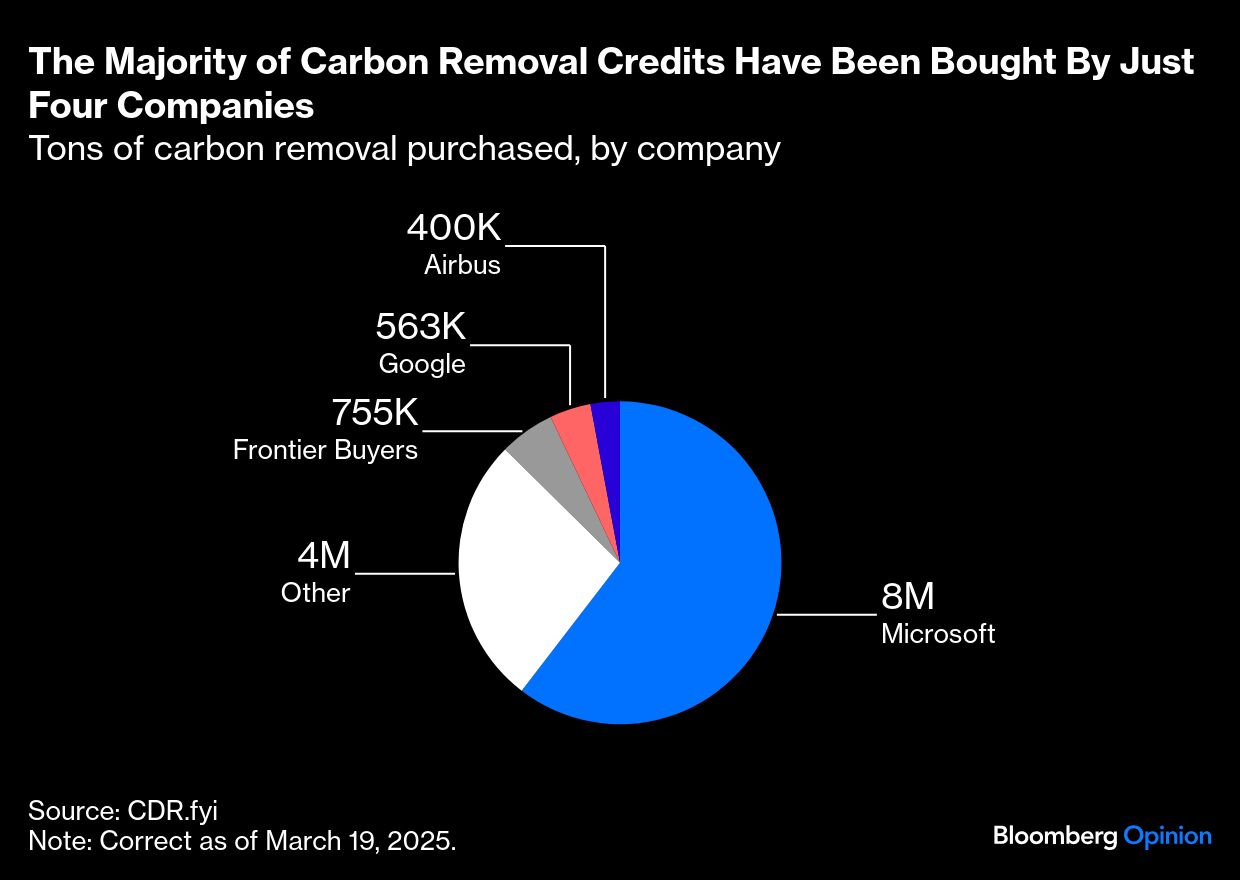
Thus far, upward of 13.5 million metric tons-worth of carbon dioxide removal (CDR) credits have been bought, and just 4.7% of those have been delivered, meaning CO2 has been removed and stored. That’s because most of the CDR technologies being sold — ranging from biochar and direct air capture (DAC) to ocean alkalinity enhancement and marine biomass sinking — are still in development or in the early stages of scaling.
The problem is that there’s not much demand right now. Though hundreds of purchasers are listed on CDR.fyi, an open data platform monitoring the removals market, 73% of the purchases have been made by just four bodies: Microsoft Corp., Alphabet Inc., Airbus SE and Frontier, an advance market commitment from a group of companies including Shopify Inc. and Hennes & Mauritz AB. The number of new purchasers also isn’t growing fast.

Why is that? If you’re a business looking to set a climate target, there’s one organization you need to please: Science Based Targets Initiative, or SBTi. Formed in 2015, more than 10,000 companies globally have now committed to set sustainability goals using the organization’s standards — among them McKinsey & Co., AP Moller-Maersk A/S and Nikon Corp. As such an influential body, SBTi has been blamed for holding back investment in carbon dioxide removal. After all, companies won’t put money into anything that isn’t going to help meet their goals according the SBTi’s standard, quite fairly.
You may wonder if there’s really an issue. As long as we’re emitting about 40 billion metric tons of CO2-equivalent a year, CDR will be trickier and pricier than simply quitting fossil fuels. These removals will really become important when we’re left with residual emissions that are difficult and expensive to get rid of.
But you can’t pluck an apple from a tree you haven’t planted. Many CDR methods require hefty infrastructure, which today barely exists. DAC and bioenergy with carbon capture and storage (BECCS), for instance, require big plants and CO2 pipelines to attain and transport the carbon to where it will be stored deep underground. Others face challenges with monitoring and verification or scaling up supply chains.
To bridge the gap between the present day and the 2040s, when demand is likely to pick up significantly and government regulation is likely to have more of an influence, developers have been banking on a boost from the corporate world.
Science Based Targets Initiative’s current standard stipulates that only once companies have achieved their long-term emissions-reduction target should they neutralize any residual emissions through permanent removal and storage of CO2 from the atmosphere. Such a stance, critics argue, holds back most of the demand for removals until at least 2040 and thus does nothing to help scale the industry to the levels we’ll need then.
SBTi, revamping its flagship Corporate Net-Zero Standard, on March 18 released the first draft for a public consultation. It hasn’t taken a definitive position on carbon removal but instead offers three options: either mandating that companies set separate near- and long-term-removal targets in addition to emissions-reduction goals, recognizing companies that do so or allowing companies the flexibility to address leftovers with additional abatement or removals.
Establishing separate targets for carbon removals and emissions reductions is a positive step. Carbon dioxide removal is often framed as a moral hazard, taking attention and resources away from the most important goal of phasing out fossil fuels — and so these differentiated goals function as a guardrail against that.
CDR insiders aren’t happy that the changes only apply to direct, or Scope 1, emissions. Of the 25 companies with the largest of these emissions, only two have committed to setting a SBTi-validated climate target, meaning near-term demand will be insufficient to help scale up carbon removals.
SBTi has also left open several options for durability thresholds — essentially how long the carbon removed is likely to be stored — suggesting either a gradual ramping-up of durability requirements or the like-for-like principle. Like-for-like is the idea that fossil-fuel emissions, which remain in the atmosphere for thousands of years, should be removed and stored permanently, while other emissions, for example, from land-use change such as conversion of a natural area for agriculture or urbanization, could be offset with nature-based removals such as afforestation. It should be the option that SBTi goes for.
SBTi has also in some ways ignored carbon removal’s ability to address historical emissions. The standard encourages companies to go above and beyond their science-based targets but offers no rationale for why they should. Given that about two-thirds of the fossil-fuel and cement emissions added to the atmosphere since 1750 can be traced back to just 180 companies (169 of which are still active), it only seems right to add a requirement to address past pollution as well as reduce future emissions.
While these questions have been left unanswered for now, the shift is already sending a market signal that carbon removals are going to play a significant but limited role in addressing the climate crisis. Corporations and their sustainability targets won’t make or break the CDR industry — there’s a lot of work to do around trust building and public engagement — but they could give it the boost it needs for now.
A message from Advisor Perspectives and VettaFi: To learn more about this and other topics, check out some of our webcasts.
Bloomberg News provided this article. For more articles like this please visit
bloomberg.com.
Read more articles by Lara Williams