Advisor Perspectives welcomes guest contributions. The views presented here do not necessarily represent those of Advisor Perspectives.
In February 2012, I wrote the following, “Recessions are notoriously difficult to forecast. That, of course, hasn’t stopped many high-profile analysts from predicting recessions in 2010 and 2011 – incorrectly, at least thus far.”
It is now seven years since the publication of that article, in which I reviewed the faulty models pundits John Hussman, David Rosenberg and John Mauldin relied on to falsely warn us of an imminent recession. No recession followed, and their forecasting success turned out to be zero.
Their failure is not stopping them in the same pursuit now; seven years later they are still at it. One can do a Google search with their names and the word “recession” to read their latest recessionary and stock market collapse warnings. Albert Edwards can also be added to the list of hapless forecasters. He stated in 2012 that the U.S. was already in a recession and that the S&P 500 could see its index halved to 666 points.
I demonstrated in the above referenced article that the models used by those three commentators were poor predictors of oncoming recessions, and that better accuracy could be obtained with the freely available Conference Board’s data.
The Conference Board Leading Economic Index (LEI) is also Jeffrey Gundlach’s primary recessionary signals according to this article from Robert Huebscher; Gundlach is the founder and chief investment officer of Los Angeles-based DoubleLine Capital.
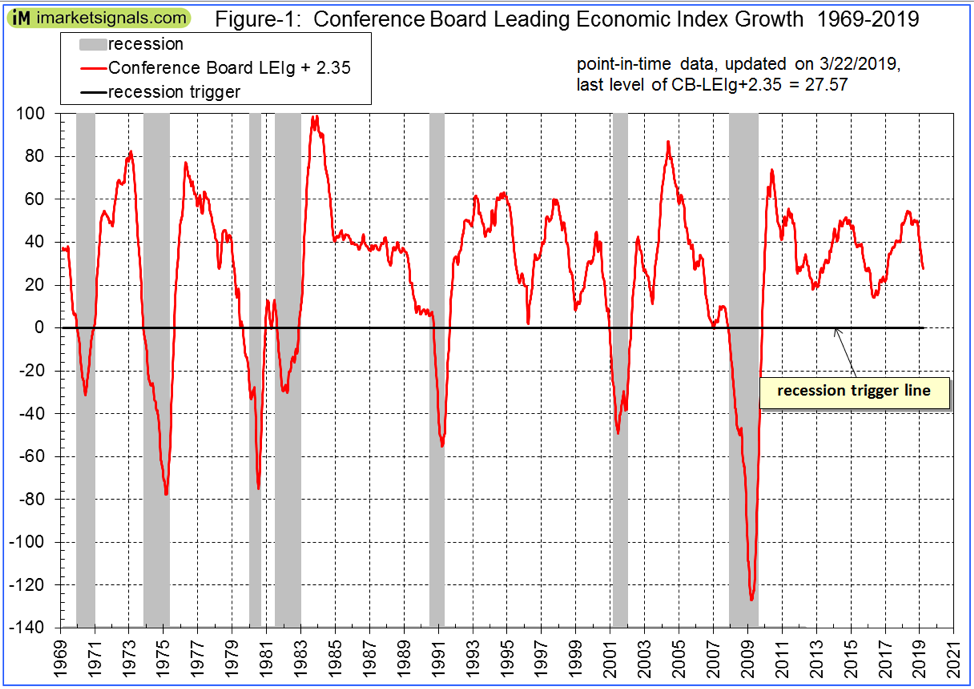
In order to get recession signals from the recently recalibrated LEI series values, I derived the six-month smoothed compound annualized growth rate (CAGR) of the Index. Then I added 2.35% to the growth rate to calibrate the model so that zero is the recession-indicating trigger. The recession indicator is labeled CB-LEIg+2.35 in the graph below. This indicator gets a reasonably high score of 0.501 from my “Scoring System for evaluating Recession Capturing Indicators” (see Appendix-1 of this article). Also, using Likelihood Ratios to measure recession capturing capability, the CB-LEIg+2.35 has a likelihood ratio positive of 13.9 and a likelihood ratio negative of about 0.15.
Likelihood ratios assess the reliability of the result from a test such as one designed to identify recessions. The likelihood ratio is defined as the probability of observing that result when there is a recession divided by the probability of observing that result when there is no recession. (Calculation methods and application to medicine are described here and here.)
In evidence-based medicine, a good test is one that has a likelihood ratio positive of about 10 (or higher) or a likelihood ratio negative of about 0.1 (or lower). A recession test using CB-LEIg+2.35 as the recession indicator would therefore pass as a good test, if the medical standard were applied.

Figure-1 is a real-time plot of the CB-LEIg+2.35 from 1969 to 2019. One can see that this indicator is still far above the recession trigger line, supporting the reported statement from Gundlach that, “There is nothing imminent forecasting a recession… but possibly in 2020.”
At my firm, iMarketSignals, we periodically update several recession indicators. The growth rate of the weekly Business Cycle Index, designated as BCIg with 6% added to it, is one of them. This indicator is also not close to signaling a recession. (The hyperlink is always to the latest update.)
This indicator gets a high score of 0.676 from my scoring system. Also, the BCIg has a likelihood ratio positive of 21.8 and a likelihood ratio negative of about 0.06 when testing for recession capturing capability. The BCIg is a more reliable indicator than the CB-LEIg+2.35 derived from the LEI.
Conclusion
A recession in the U.S. economy is not imminent. The economy is still in the expansion phase of this business cycle, which has lasted already 116 months (as of February 2019), and will probably become the longest on record since 1958 by July this year.
Georg Vrba is a professional engineer who has been a consulting engineer for many years. In his opinion, mathematical models provide better guidance to market direction than financial "experts." He has developed financial models for the stock market, the bond market, yield curve, gold, silver and recession prediction, which are updated weekly or monthly at http://imarketsignals.com/. Georg can be reached at [email protected].
More Fixed Income Topics >