Populism, income inequality and trade wars don’t make it to the top of Robert Shiller's list of his biggest fears. That spot is reserved for the possibility of a nuclear arms race.
Shiller delivered a keynote address titled “The Bubble Discussion” on February 12 at the Inside ETFs conference in Hollywood, Florida.
Shiller teaches at Yale, is the best-selling author of Irrational Exuberance and the winner of the 2013 Nobel Prize in Economic Sciences.
In my last article on Robert Shiller’s debate with Jeremy Siegel about U.S. stock market valuations, Shiller said the market is dominated by short-term conditions that are driving high earnings levels that won’t be sustained.
With the cyclically adjusted price-to-earnings (CAPE) ratio near historic highs and many analysts questioning equity valuations, it is unclear whether market conditions are being driven by short-term earnings spikes.
Let’s review the comments Shiller made this week about a looming downturn. Then I’ll look at what Shiller said about the instability being created by the economic narratives Trump is driving.
Will there be a recession?
Shiller said a U.S. recession is inevitable, but offered only a vague forecast of when it would happen.
Shiller acknowledged that there always a possibility of a recession. Indeed, the likelihood of a recession is never less than a baseline level of approximately 10%.
“There has to be an elevated probability of a recession this year or next year,” according to Shiller.
“This will have been the longest expansion in the history of business cycles that goes back to the era of 1837,” Shiller said. We are also in the midst of the third longest home-price expansion, based on the Case-Shiller index, as well as the longest bull market in U.S. equities – although Shiller said that depends on one’s definition of a bull market.
The record-setting levels of the economy, stocks and housing make it sound like they will eventually crash, and Shiller said that investors tend to adopt a more negative narrative the longer those records are maintained.
“We might set a record on the longest expansion and not get a recession this year, that’s certainly a possibility,” he said. But Shiller’s conviction that this expansion is coming to an end in the next year or two was strong.
CAPE ratio
Shiller said that the CAPE ratio is above 30. (You can track this on his website.) This is well above its historical average of 16.61 and its median of 15.70.
“I don’t want to make too much of it right now,” he said.
“It’s going to come down a little bit,” he said, because of poor earnings data from 10 years ago that will soon “roll off” and no longer be included in the calculation of the denominator. That, he said, will lower the CAPE by about two points.
The CAPE ratio is calculated by dividing the market capitalization of U.S. equities by their earnings, averaged over a 10-year period. Shiller noted that the CAPE ratio explains about 30% of the variability of returns over a 10-year time horizon.
The elevated CAPE ratio doesn’t necessarily forecast negative returns, Shiller said, "because it’s not that strong of a forecast.”
“But it’s strong enough to show that U.S. stock returns are likely to be lower than usual over the next 10 years,” according to Shiller.
“It’s a long-term, not a short-term forecast,” he clarified.
What should investors be worried about?
Shiller said his single biggest worry was a nuclear arms race.
He said that the Davos World Economic Forum surveyed experts and revealed that nuclear war was the top issue of concern, and Shiller said they are “probably right.”
But, he said, likelihood of a nuclear war is extremely small – it’s the devastating consequences that make it so foreboding.
The underlying theme of Shiller’s comments was the common “narrative” or story people use to communicate trends and developments in the economy and the markets. That is also the theme of his forthcoming book, Narrative Economics, due out later this year.
Economics is behind most other social sciences in recognizing the importance of narratives, he said. "The human mind is oriented to stories, more so than numbers. What drives the economy is substantially stories.”
For example, the story of the Great Depression of the 1930s was on everyone’s mind in 2007-2008. It was widely discussed – and that era was called the “Great Recession,” an obvious reference to the 1930s. That narrative drove a belief that a depression could happen again. Shiller said the narrative was very strong, but exaggerated the actual likelihood of a severe economic downturn.
The financial crisis was bad, he said, “but not that many people were actually starving.”
The paradigm of a widespread narrative is not new. “Things used to go viral even before we had social media or computers,” he said. He cited the market panic of 1907, which was very threatening at time, yet little-known today.
Narratives are part of human nature and fundamental to understanding business choices, according to Shiller.
Part of the narrative that’s guiding us is based on President Trump. “Whether or not you like him, you are interested in him and you want to hear the latest story,” he said. The “constellation of narratives” around Trump has captured the public's imagination, according to Shiller.
“It’s actually driving the stock market and the U.S. economy,” he said, “and the rest of the world.”
Part of the narrative is that people are worried about their investing. Shiller said investors want to own something “glamorous. Those narratives don’t go away overnight.”
Economists don’t like to talk about narratives, he said, and consider them plebian and unprofessional.
But narratives are real. One example is the excitement about the bull market, which has been embellished by popularity of the statue of the raging bull in lower Manhattan. It has eclipsed the Statue of Liberty as a tourist attraction, according to Shiller.
“As long as that the market keeps going up, everything will be fine,” he said. “But if it starts going down in a serious way, things will be different.”
Marianne Brunet is an economic analysis manager at Advisor Perspectives.
Read more articles by Marianne Brunet
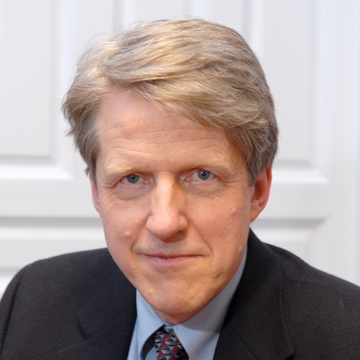 Populism, income inequality and trade wars don’t make it to the top of Robert Shiller's list of his biggest fears. That spot is reserved for the possibility of a nuclear arms race.