
Investors tracking the nuclear renaissance have focused on reactor development, data center power demand, and geopolitical fuel security. Yet one critical link in the nuclear fuel cycle, the conversion stage, has long represented a domestic vulnerability for the United States. This step converts uranium ore concentrate, known as yellowcake or U3O8, into uranium hexafluoride, or UF6, the gaseous form required for enrichment into low enriched uranium (LEU) or high-assay LEU (HALEU).
Today, the Western world relies on just three primary commercial uranium conversion facilities: Cameco’s (CCJ) operations in Canada, Solstice Advanced Materials’ (SOLS) Metropolis Works in the United States, and Orano’s (private) facilities in France. This concentrated capacity has created a clear chokepoint as nuclear energy generation ambitions rise.
Recent announcements from Solstice and two new companies signal accelerating progress toward expanded and diversified domestic UF6 production capacity. These moves directly support U.S. policy goals of energy independence and supply chain resilience, while opening new investment opportunities across the nuclear value chain.
Solstice scales their existing facility
Solstice operates the only commercial uranium conversion plant in the U.S. at Metropolis Works in Illinois. Originally a Honeywell asset before the late 2025 spin off, the facility was idled from 2017 to 2023 amid soft market conditions but restarted in 2023. In February 2026, Solstice announced a significant production ramp. The site is now projected to deliver over 10,000 metric tonnes of UF6 in 2026, a 20% increase over 2024 output.
The expansion is underpinned by a backlog exceeding $2 billion in orders, largely from domestic utilities, plus targeted Department of Energy support. Solstice has also retained an engineering, procurement, and construction firm to evaluate further capacity additions, positioning Metropolis Works to play an even larger role in meeting near term demand.
Uranium Energy Corp pursues vertical integration
Uranium Energy Corp (UEC), one of America’s domestic uranium producers with licensed mines across Wyoming and South Texas, is taking a more ambitious step. In September 2025, UEC launched a wholly owned subsidiary, Uranium Refining and Conversion Corp (UR&C), to develop a new UF6 conversion facility.
Recently, UR&C secured an initial regulatory milestone when the U.S. Nuclear Regulatory Commission issued a docket number for the proposed plant. The facility is designed for approximately 10,000 metric tonnes of uranium per year as UF6, representing a substantial share of current U.S. annual demand of roughly 18,000 metric tonnes. UEC is collaborating with Fluor (FLR) on engineering and design while evaluating multiple potential sites. Once operational, the project would make UEC the only American company with full vertical integration from mining through conversion.
FluxPoint Energy Enters with a Greenfield Project
FluxPoint Energy, a private company only recently emerging from stealth mode, officially launched plans to build what would be the first new U.S. uranium conversion facility in nearly 70 years. Targeting first production in 2030 or 2031, the company is already advancing development with a secured site and front-end engineering studies underway.
Like the UEC project, FluxPoint is designing for substantial scale, initially 2,500 metric tonnes per year, with potential expansion to 10,000 metric tonnes per year as demand materializes. The company explicitly frames the initiative as restoring U.S. fuel sovereignty and eliminating an unacceptable chokepoint in the supply chain.
These expansions and new projects directly address the current U.S. annual UF6 conversion demand. By expanding domestic capacity, they insulate the American fuel cycle from import reliance and geopolitical risks. Significant amounts of federal support also exist in the form of executive orders to reinvigorate the domestic fuel chain and the federal-state partnership program for nuclear lifecycle innovation campuses. Higher conversion capacity will support both the existing reactor fleet and the deployment of advanced reactors that require reliable LEU and HALEU supply.
For investors, the developments translate into tangible opportunities across the nuclear value chain, from uranium producers to engineering and services firms.
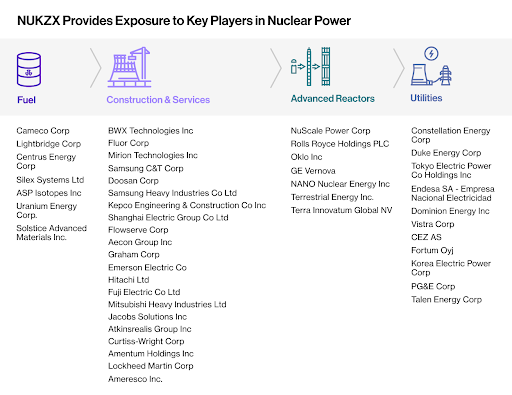
CCJ, SOLS, UEC, and FLR are all constituents of the VettaFi Nuclear Renaissance Index (NUKZX) as shown below. NUKZX includes companies across the nuclear value chain, from fuel to utilities. NUKZX is the underlying index for the Range Nuclear Renaissance Index ETF (NUKZ).
Related Research:
Companies Set to Win as States Vie to Host Nuclear Campuses
Not All Nuclear Exposure Is Created Equally
Iran Conflict Reinforces Nuclear Energy’s Stability
Looking for nuclear insights in your inbox? Subscribe here to keep a pulse on nuclear investing through our weekly research.
For more news, information, and analysis, visit the Nuclear Energy Content Hub.
vettafi.com is owned by VettaFi LLC (“VettaFi”). VettaFi is the index provider for NUKZ, for which it receives an index licensing fee. However, NUKZ is not issued, sponsored, endorsed, or sold by VettaFi. VettaFi has no obligation or liability in connection with the issuance, administration, marketing, or trading of NUKZ.

