Advisor Perspectives welcomes guest contributions. The views presented here do not necessarily represent those of Advisor Perspectives.
“Do you know the only thing that gives me pleasure?
It’s to see my dividends coming in.”
—John D. Rockefeller
Today’s rock bottom interest rates have propelled many investors to pursue high dividend yield stocks. This quest has been made more challenging by the fall in dividend yields over the past six decades. This decline is illustrated in the following graph that depicts the annualized dividend yield on the S&P 500 since 1950. Dividend yields, which topped 7% in the early 1950’s, dropped to their nadir of nearly 1% during the tech boom of the late 1990’s. They have since recovered somewhat but are still at a paltry level of just over 2%.
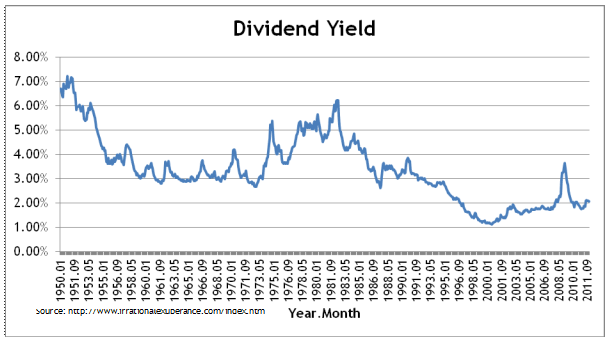
The decrease in dividend yields is attributable to two factors. First, companies have dramatically reduced the proportion of earnings that they pay out in dividends. In the 1950’s, S&P 500 companies routinely paid out well over one-half of their earnings as dividends. This pay-out ratio has now dropped to about one-third of earnings. Second, stock prices relative to both earnings and dividends have increased reducing both earnings and dividend yields.
The decline in yields has sent investors flocking into sectors that offer higher dividend yields including consumer staples, utilities and telecommunications. Wall Street, always eager to capitalize on investor infatuations, has responded with a bevy of high dividend yield products. Not surprisingly, based on both forward and trailing price earnings ratios, these are among the most expensive sectors in the S&P 500.
Investors should step back from their enthrallment with high dividend yields to recognize that dividends are only one component of total return. The second is capital appreciation. Today, earnings per share growth are being accelerated as companies buy back stock in amounts even greater than their dividend payouts. These repurchases lift earnings per share which ultimately should be reflected in capital appreciation.
A common misconception of stock buybacks is that they increase the overall value of a firm. This is not the case. A firm is simply returning cash to its shareholders by reducing corporate cash in exchange for shares. Earnings per individual share are increased but in aggregate this is offset by a reduction in the number of outstanding shares. Whether a company is returning cash to its shareholders by way of dividend or stock repurchases, its aggregate value in both cases remains the same1.
1. Oded, J., and A. Michel, 2008, “Stock repurchases and the EPS enhancement fallacy,” Financial Analysts Journal, 64, 62-75.