Economists love to try to explain why people may act irrationally; such “puzzles” inspire numerous researchers to probe their possible solutions. The annuity puzzle, which ponders why retirees do not buy more annuities, is a classic example. After describing the basic theory behind why this is so puzzling, I will address a variety of potential explanations, and then turn to the practical guidance the puzzle offers for advisors and their clients.
The annuity puzzle
Economists have long been mystified as to why people do not make greater use of single-premium immediate annuities, which provide income for life and protect against longevity risk. Often cited in connection with this bafflement are Menahem Yaari’s research from 1965 about spending for an uncertain lifetime and Franco Modigliani’s Nobel Prize acceptance speech addressing the subject in 1985. In his recent book, The 7 Most Important Equations for Your Retirement, Moshe Milevsky described the mystery in the words of Wharton professor Solomon Huebner, who first defined the basic puzzle in the 1930s:
The prospect, amounting almost to a terror, of living too long makes necessary the keeping of the entire principal intact to the very end, so that, as a final wind-up, the savings of a lifetime, which the owner does not dare to enjoy, will pass as an inheritance to others. In view of these facts, it is surprising that so few have undertaken to enjoy, without fear, the fruits of the limited competency they have succeeded in accumulating. This can be done only through annuities... Why exist on $600, assuming 3% interest on $20,000, and then live in fear, when $1,600 may be obtained annually at age 65, through an annuity for all of life and minus all the fear?
Theory behind the annuity puzzle
Economists describe the annuity puzzle as a problem of maximizing lifetime expected utility. This is similar to maximizing lifetime spending power, except that utility accounts for the diminishing increases in value provided by additional spending in any given time period. This justifies the idea of smoothing spending over one’s lifetime. Higher spending in one year and lower spending in the next will provide less utility than if one evens out one’s spending over time. The gain in utility from spending more in the bad year outweighs the loss in utility from spending less in the good year, making one better off overall.
Other assumptions used to define the annuity puzzle include the notion that retirees do not care about leaving a bequest. They only wish to maximize their lifetime income. What’s more, there is assumed to be no investment risk. Financial markets are simplified to one asset, which always and forever provides the same fixed return to its owners. Of course the assumption of a fixed return is not realistic, but this assumption allows us to focus specifically on the role played by uncertain life spans.
Longevity risk is the key to modeling the annuity puzzle. Individuals do not know in advance their age of death. They can learn about their remaining life expectancy, but that is just an average outcome and there is significant variability around it. These are mostly known unknowns, though, in the sense that actuaries can estimate the probability distribution for mortality and survival rates. Individuals cannot self-insure to protect from this longevity risk, and without annuitization they are obliged to plan for a long lifespan.
The annuity provider, however, can pool longevity risk across a large group of customers, and those who die earlier than average subsidize payments to those who live longer than average. These are mortality credits. Because the annuity provider can pool the longevity risk, they are able to make payments at a rate much closer to what would be possible when planning for remaining life expectancy.

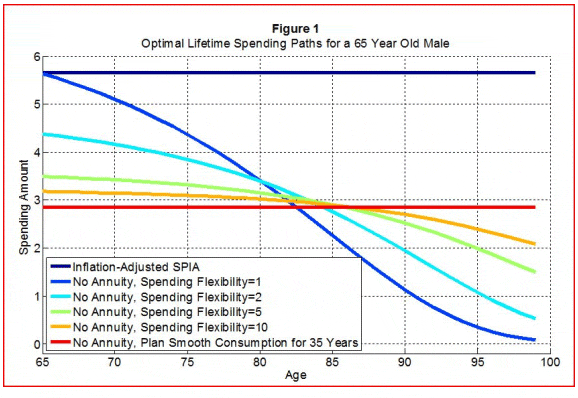
Figure 1 provides the basic idea about the annuity puzzle, showing inflation-adjusted spending amounts as a percentage of retirement-date assets for a male retiring at age 65. With mortality data from the Social Security Administration, an assumption for an inflation-adjusted SPIA with no overhead costs, and an underlying fixed real market return of 0%, I estimate that a 65-year old male could obtain a lifetime real spending stream equal to 5.66% of retirement-date assets.
This spending stream contrasts with the spending from a systematic withdrawal plan. The retiree knows that future returns will be 0%, but he doesn’t know how long he will live. If he plans for 25 years, he could spend 4% each year. For a 30-year horizon, this amount falls to 3.33%, and sustainable spending is 2.86% for a 35-year horizon, or 2.5% for a 40-year horizon.
Besides fixed planning horizons, optimal retirement spending strategies also require accounting for the probabilities of surviving to advanced ages. The retiree does not know how long he will live, but he can decide on how much he will spend each year, should he still be alive. This is easy to do because of the simplifying assumption that future market returns are known in advance. There are now two competing tradeoffs: the retiree wants to spend the same amount every year for as long as he lives to get the most lifetime value from his spending, but he also wants to frontload his spending to early retirement when he has the highest chance to be alive to enjoy it.
To finalize his spending plan, the retiree also must consider his “risk aversion.” In the context of retirement, this describes the flexibility a retiree has to allow his spending to decline with age. The more risk-averse or inflexible a retiree is with respect to spending reductions, the more willing a retiree is to spend less in early retirement to support greater spending in late retirement. Flexible retirees will prefer to frontload their spending when they have a higher chance for survival, and then make cutbacks later if they are still alive. In the figure, small flexibility numbers imply greater flexibility and higher initial spending with more subsequent cutbacks. Larger coefficient numbers guide toward greater consumption smoothing, as retirees really focus on maintaining as high of spending as possible in the low-probability event of living an extremely long life.
But no matter the flexibility, spending plans without annuitization fall dramatically below the sustainable spending level with the annuity. Again, this is because of mortality credits and the ability of the annuity provider to make payouts based on life expectancy rather than maximum lifespan. The figure demonstrates why economists see an annuity puzzle: Why not annuitize, since it invariably provides greater lifetime spending potential?
Taking a further step, economists also like to calculate the “annuity equivalent wealth.” They calculate this as the additional wealth one would need in order to obtain the same expected lifetime value from spending without an annuity as with an annuity. Clearly, the value of spending is higher with the annuity, since it allows greater spending at all ages. With flexibility of 1, the retiree needs 53% more wealth to be just as satisfied as with an annuity. The corresponding numbers increase for less flexible retirees who place greater value on the annuity’s consumption smoothing. With a coefficient of 10, 90% more wealth is needed to be just as happy without an annuity as with an annuity – nearly double!
Resolving the puzzle
One obvious starting point for resolving the puzzle is that many retirees may wish to build a legacy. Maximizing personal spending is not the only goal. The desire to leave a bequest is a strong deterrent from annuitizing.
In the real world, as well, investment returns are volatile. One might expect that this uncertainty would actually motivate greater annuitization as a protection. But there could be another countervailing force at work. Annuities remove downside risks, but they also eliminate upside. There is finality to the decision as one is forever removing the possibility of picking the next winning stock and striking it rich. For hopeful retirees, that loss of potential financial betterment can be a deal breaker.
What’s more, real-world annuities may have overhead charges of 10-20%, as insurance providers must cover expenses, make a profit, and account for adverse selection (annuity purchasers, it has been shown, live longer than the average person). These costs reduce actual payout rates and the potential gains from annuitization.
Another matter is that the economics model does not ascribe importance to the idea that clients may value the ability to maintain control over and flexibility for their financial wealth. Preferences, needs, and circumstances may change, and there is a real value to holding off on making the irreversible decision to annuitize. The extra control may be partly an illusion, since clients face spending needs that must be met and risks of wealth depletion that must be mitigated. Nonetheless, the behavioral need to feel in control is important. Another possible behavioral explanation is the feeling of being poorer after annuitization because of the noticeably lower remaining account balance one observes. This confuses total wealth with the spending power available from that wealth, but it can exert a powerful psychological influence on decisions.
Often, clients may be thinking about annuities framed in terms as a gamble on the possibility of a long life, rather than as a risk reduction measure aimed at improving that possible long life. Retirees can more easily visualize being run over by a bus after signing the contract than they can being old and without income. In this regard, people may underestimate their life expectancies, calibrating it from birth rather than from their current age, and not realizing that they may live significantly longer than average.
Usually one insures against bad outcomes, but annuities are confusing, since they are insurance that supports a generally good outcome: living an unexpectedly long time. Emphasizing a break-even age to which one must survive to make an annuity pay off misses the point about their insurance value. Such viewpoints likely explain reluctance about annuitizing.
Another matter is that Social Security already provides an inflation-adjusted annuity which may fulfill basic needs for many clients. The basic formulation of the annuity puzzle assumes no other outside income sources beyond financial wealth, but Social Security does provide such inflation-adjusted lifetime income support.
As well, clients have a clear need to set aside a certain amount of financial assets to serve as an emergency fund and to also cover uncertain and potentially large future medical and long-term care expenses. With Social Security in place, many clients may not have enough additional financial assets to practically consider further annuities.
Many clients may also worry about the long-term viability of annuity providers and may view the annuity guarantee as anything but a sure bet. Mistrust of the annuity provider could be related both to (a) whether the provider is taking on too much risk and may be unable to fulfill its promises, or (b) whether there is incomprehensible fine print within the annuity contract that is detrimental to client interests. Fear that a systemic crisis could overwhelm annuity providers and state guarantee associations is common.
Finally, issues related to taxes and required minimum distributions may complicate the decision to annuitization.
The bottom line
As each retiree faces unique circumstances, retirement income strategies are an ongoing process to balance goals and protect against risks. The annuity puzzle may oversimplify matters, but it emphasizes a basic truth, that partial annuitization can be an important part of the toolkit for retirees to build an income strategy.
Advisors who believe that annuitization may be the right choice for their clients should frame the discussion in a way that does not make annuitization sound like an investment decision. One recent study found that 70% of respondents would annuitize to obtain $650 of “monthly spending” for life, compared to only 21% who annuitize to obtain a “guaranteed monthly return” of $650 for life. Another helpful technique is to use age-progression software to show the client a picture of their future self, which helps to make longevity risk into a more concrete matter. Finally, do not let the client forget that only some of his or her assets will be annuitized, and funds will be preserved for other goals and needs outside of the planned living expenses to be covered through the annuity.
Wade Pfau, Ph.D., CFA, is an associate professor of economics at the National Graduate Institute for Policy Studies (GRIPS) in Tokyo, Japan, and the curriculum director for the Retirement Management AnalystSM designation program. He maintains a blog about retirement planning research at wpfau.blogspot.com
I want to thank readers of my blog for helping to brainstorm about reasons why the annuity puzzle is less puzzling in reality.
Read more articles by Wade Pfau