Advisor Perspectives welcomes guest contributions. The views presented here do not necessarily represent those of Advisor Perspectives.

His disciples call themselves “Bogleheads” and cling to his “Pillars of Wisdom” as though they were the Ten Commandments. The media adore him and treat his words like gospel. John Bogle is an icon – a God-like figure to thousands of investors.
He is also the founder of the Vanguard Group, and he launched the first index mutual fund in 1975. Since then, he has dedicated his career to encouraging investors to “own the market” by investing in index funds. He stresses the importance of asset allocation and low fees within a passive, buy-and-hold investment approach. No doubt Bogle is sincere and has noble ambitions, but his unwavering faith in the markets is misplaced.
Today, he has taken up what many are calling his final crusade. In February of last year, he appeared before a Congressional committee in Washington, D.C., to tell lawmakers about his vision for “an independent Federal Retirement Board to oversee both the employer-sponsors and the plan providers, assuring that the interests of plan participants are the first priority.”
“Our Federal Retirement Board should not only foster the use of broad-market index funds in the new defined contribution system but approve only private providers who offer their index funds at minimum costs,” he told the committee.
Bogle wants Congress to overhaul our retirement system by “limiting investment choices” for workers’ retirement plans and providing “more understandable options.” Under his plan, “only private providers” (such as Vanguard) would be “approved” investment vehicles.
If you’re not sure which investments are right for you, don’t worry; Bogle knows. If he has his way, a Federal Retirement Board offering only low-cost index funds will impose strict limits your investment options. Doesn’t Bogle realize that shareholders in his index funds saw their retirement plans decimated in 2008? Do you really want him guiding your investment decisions? Nothing personal, Mr. Bogle, but buy-and-hold has failed. It doesn’t work.
On June 19, 2009 IndexUniverse.com asked Bogle, “Do you believe that there are environments that are more favorable to active management than passive management and index investing?” His response was clear. “There is no way that active managers can possibly have an advantage no matter what the circumstances are. It is just statistically, mathematically, tautologically impossible.”
My $100,000 challenge
I hereby challenge John Bogle to a friendly wager. I will bet $100,000 of my own money that my active investment approach can outperform his passive one.
I am challenging Bogle directly because he has the loudest voice in the industry, but my challenge is also open to other passive investors and managers. I have set aside $1,000,000, and I am ready to accept up to ten challengers, hopefully including Bogle.
The Wager: Anyone accepting this wager, including Mr. Bogle, and I will place $100,000 in an escrow account at the bank of his or her choice. At the end of the wager, the winner gets his $100,000 back and the loser will contribute his $100,000 to the winner’s favorite charity in his name.
The Portfolio: Should you accept my challenge, you will be free to construct a portfolio of your choice using the index funds that provide good liquidity. I will create an exact replica of your holdings for my portfolio. During the contest, you must passively hold the assets in your portfolio. In my portfolio, I will limit myself to trading the same assets. As an active manager, I will be able to use cash in my portfolio to help control risk. Of course, you can allocate some of your assets to cash too. If you wish, we can set up a web site to allow the public to follow the portfolios and the results. There will be complete transparency.
The Time Period: You can choose the length of the contest – anywhere from one year to a few years, or as many years as you wish.
Fees and Expenses: Your portfolio will incur no (0%) annual management fees. My portfolio will have the disadvantage of incurring a 2% annual management fee in addition to any transaction costs. We will use a tax-deferred, retirement account structure, so there will be no tax implications for short-term capital gains.
The Results: Risk and return are the most basic and logical measures of investment success. In order to win the contest, a portfolio must have both higher return and lower risk. To calculate risk and return, we will use the statistical measures of total return and daily standard deviation.
There you have it. Since Bogle believes “there is no way that active managers can possibly have an advantage, no matter what the circumstances,” my $100,000 must seem like free money to him. I’m waiting for his call.
I’m not holding my breath though, because I am sure he will find a reason to back down. Of course, if he does, he will help prove my point – that my active investment process is superior to his high-risk “buy-and-hope” approach.
Any passive investor who believes he or she can generate a safer and higher return with a buy-and-hold portfolio than I can with my active portfolio has an opportunity to relieve me of $100,000. I’m giving the passive investor all the choices, except the one they saddle themselves with – the burden of not managing their money.
We have created a web page dedicated to “My $100,000 Challenge to John Bogle” at www.scminvest.com/100k. We will post the names of everyone who takes me up on my challenge (with their permission), and you can sign up to receive an e-mail alert. You can post your comments, ask me a question, and take our “Active vs. Passive Survey.” There is also a link for a free subscription to our Dynamic Investor newsletter.
Talk is cheap
I’ve been writing about the flaws of passive investing for over twenty years, but to what end? Articles, debates and media interviews cannot settle the longstanding dispute between active and passive investors. Talk is cheap.
No mere consumer advocate, Bogle is also a lobbyist promoting the products of the company he founded. Unfortunately for investors, he has the ear of lawmakers in Congress, most of whom do not truly understand investing. Bogle’s philosophy is dangerous to investors’ retirement savings, as the results of the last decade have shown. It is based on old, flawed investment models like Modern Portfolio Theory, the Efficient Market Hypothesis (EMH), and the Random Walk Theory. A proper reading of today’s financial research suggests that these theories are unfounded. To some in our industry, that’s blasphemy, but it’s what I believe to be the truth.
Passive investing is ill-equipped to handle the unpredictable events and market volatility we have experienced over the last ten years. It ignores reality. Professor Robert Shiller of Yale University has shown that the instability of asset prices is much greater than EMH predicts. In other words, where the EMH suggests that passive exposure to investment markets can help control risk, real-life experience (the best kind there is) shows that markets are actually the source of risk! Even Eugene Fama, the father of EMH, recently admitted that “markets are not entirely efficient.” In a recent interview he told David Salisbury that “market efficiency is a simplification of the world, which does a good job on almost everything, but some things it doesn’t do a good job with.”
The problem with building an investment strategy around the Efficient Market Hypothesis (and the other theories EMH supports) is that it only takes one event – one market crash – to wipe out your retirement savings. But every investor’s time horizon is limited – no one has forever to wait for markets to recover.
On August 7th, John Mauldin, an economist and author of Thoughts from the Frontline, shared his opinion on EMH in his weekly e-newsletter. “EMH should be consigned to the dustbin of history. We need to stop teaching it, and brainwashing the innocent,” he said. “Robert Arnott (who oversees $31 billion at Research Affiliates) tells a lovely story of a speech he was giving to some 200 finance professors. First he asked how many of them taught EMH. Pretty much everyone raised a hand high. Then he asked how many of them believed it. Only two hands stayed up!”
Baffle a Boglehead: Use facts and logic
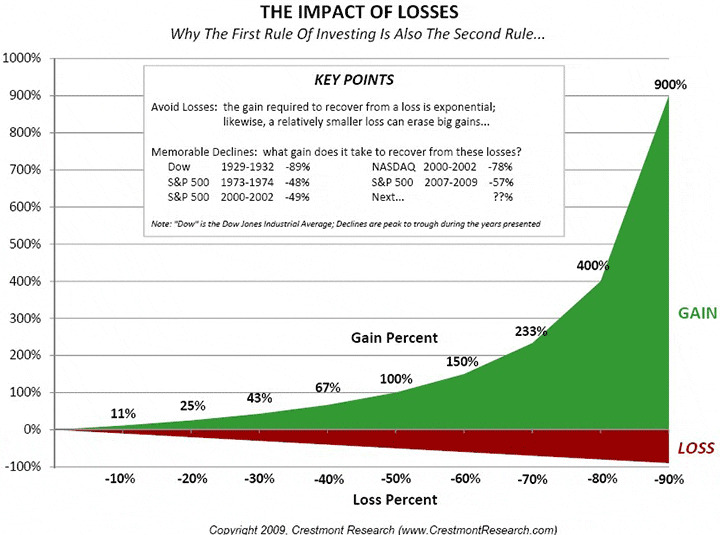
Bogleheads won’t admit it, but indexing is high-risk and has delivered low returns historically. According to CrestmontResearch.com, from 1900 through 2008, the stock market has returned just 5.8% on an annualized basis (including dividends and adjusted for inflation). To capture that 5.8% return, investors had to suffer devastating losses along the way, including an 89% loss (1929-32), a 48% loss (1973-74), another 49% loss (2000-02) and, most recently, a 57% loss (2007-09). It took investors 25 years and an almost 900% gain just to break even after the 1929-32 bear market. How many years is it going to take Bogleheads to recover from the 57% loss of 2007-09? How much time do they have?
Every quarter, in our Dynamic Investor newsletter, we publish “SCM’s 5 Rules for Investment Success.” We think they are so important that we print them every quarter – we want investors to read them time and time again.
Our Rules for Investment Success are very different from Bogle’s Pillars of Wisdom. The glaring difference is that our rules focus on risk management and acceptance of uncertainty about the future. Bogle’s Pillars of Wisdom hardly acknowledge that investing is risky. His first pillar is: “Investing Is Not Nearly as Difficult as It Looks.” Oooo-kay. I don’t know about you, but I don’t want anyone working from that premise anywhere near my retirement savings!
In contrast to Bogle’s first pillar, our first rule is “Avoid Significant Loss.” The man known as the most successful investor of all time, Warren Buffett, agrees. He often reminds investors of his two primary rules: “Rule #1: Never lose money. Rule #2: Never forget rule #1.”
That first rule tells you all you need to know about the difference between Bogle’s approach and ours. Frankly, to suggest that investing is easy is ridiculous. In the words of Gerald Loeb, author of The Battle for Investment Survival, “Any way one looks at it, nothing is more difficult than succeeding in Wall Street, yet nothing is attempted by such poorly equipped people or is considered as easy.”
“The greatest protection in all the world”
There are two reasons why I am not concerned about losing the challenge. First and foremost, active management is adaptable, and as a result it has a huge tactical advantage over passive indexing. Sophisticated investors understand this. The risk-management benefit inherent in our investment process gives us an edge that passive investing cannot match. “There is a great value in being able to realize the profit or cut short the loss,” wrote Loeb. “There is the greatest protection in all the world in the ability to shift capital quickly and at small cost.”
Second, it is highly unlikely that Bogle or anyone else will accept my challenge. I hope he does, though, because we know some very worthy charities that could benefit from his donation. If passive management truly is superior, or has some kind of built-in advantage, I won’t have any trouble finding ten passive managers to accept my challenge.
Active investing does not ensure success, and it certainly does not guarantee investors will profit. No investment manager can make such a claim, no matter how long the investment time horizon and no matter who is running the portfolio. In challenging Bogle, my objective is simple: to prove to everyone – especially individual investors who have been misled by the mainstream financial services industry – that active investing can be less risky than buy-and-hold. The proof will come when no passive manager accepts my challenge.
A safer way to reach your retirement goals
If you look objectively at the history of financial markets, it becomes clear that passive, buy-and-hold investing is a high-risk, low-return endeavor. Investors who are close to or in retirement don’t want high risk and unpredictable returns. They want low risk and more predictable returns. For retirees who own tax-deferred retirement accounts, such as IRAs, active management may offer lower risk and more consistent returns.
Investors who use active investment strategies in their retirement accounts can move between stocks, mutual funds, ETFs and cash with no tax consequences and with few or no transaction costs. The performance of our active investment strategies speaks for itself. For complete performance information on all of our investment models, please visit our web site, or contact us directly.
Investors must unlearn what people like Bogle have been telling them. The greatest threat to your retirement the uncertain future – it’s the next credit crisis, the next financial crisis, the next recession. If you accept buy-and-hold, you must expect that, at some point, your retirement savings will experience a devastating loss. I always tell investors, “Your investment process must include an exit strategy; otherwise, you shouldn’t be invested in the stock market.”
While our past is certain, the future is unknowable. Passive management is reckless and irrational because it assumes the market will provide positive returns to all investors. There is no guarantee that your returns will be positive, no matter how long you invest. I advise you to find an investment manager who truly understands risk and has a plan for both good and bad markets. Find a financial advisor that is confident enough to take on today’s uncertain markets but humble enough to know what he does not know.
Roger Schreiner is the founder and CEO of Schreiner Capital Management, Inc. (SCM), an SEC-registered investment advisor located in Exton, Pennsylvania. SCM is a third party investment manager and sponsors the Select Advisors Wrap Program, an investment platform that provides active investment solutions for Advisors and their clients.
Read more articles by Roger J. Schreiner