
The VictoryShares Small Cap Free Cash Flow ETF (SFLO) was met with intriguing changes to its portfolio composition following a recent rebalance. SFLO tracks the Victory U.S. Small Cap Free Cash Flow Index (the Index), which captures high-quality small-cap companies. The Index methodology screens for companies trading at a discount with favorable growth prospects and high free cash flow (FCF) yields. It is reconstituted four times a year — every third Friday in March, June, September, and December.
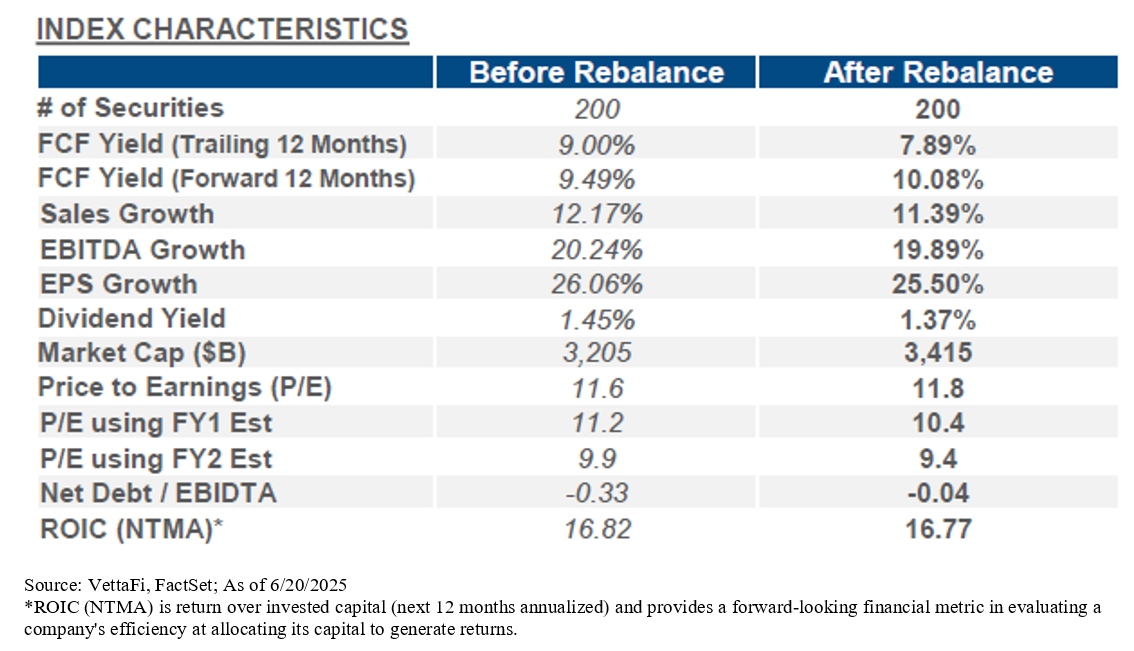
The FCF yield of the Index increased following the latest rebalance in June of 2025, while its forward price-to-earnings (P/E) ratio decreased. Meanwhile, the Index maintained consistent growth metrics, as quality and profitability remain key in this dynamic market segment.
Interesting Takeaways From Victory's Small-Cap FCF ETF Rebalance
Several intriguing themes emerged across energy, industrials, and technology sectors.
First, the energy sector has continued to become more efficient, spotlighting oil drillers (exploration and production companies and integrated oil names).
The average cost of producing a barrel of oil has significantly declined from approximately $70 to $40. This efficiency gain has allowed these companies to prioritize profitability over pure production growth. Ultimately, this typically leads to substantial debt reduction, share buybacks, and increased dividends.
Victory Capital Client Portfolio Manager Michael Mack said, “since the COVID-19 pandemic, management compensation has been tied to free cash flow instead of production volume. This shift has driven compelling free cash flow generation.”
Additionally, SFLO’s rebalance uncovered strong potential for niche players in the industrials sector. These are small companies that supply important parts, such as a specialized valve for an oil rig. In this instance, the cost of failure can be astronomical, granting these companies significant pricing power.
A prime example is Allison Transmission (ALSN), known for providing highly reliable transmissions for trucks and buses. Its product reliability allows it to command a premium, demonstrating how quality can translate into strong FCF.
Furthermore, technology exposure is on the rise within the portfolio, with a particular focus on automation and robotics, seen in online delivery apps and technology companies, according to Mack.
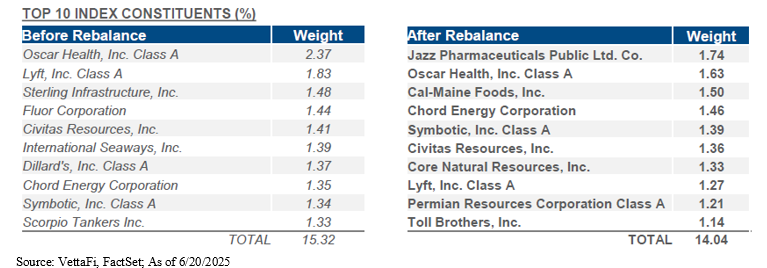
This theme includes portfolio names such as Maplebear (CART), one of the leaders in grocery delivery through the Instacart app. Another notable holding is Lyft (LYFT), the number two player in ride sharing, benefiting from industry growth, according to Mack.
Small-Cap Companies Screened Out in Latest Rebalance
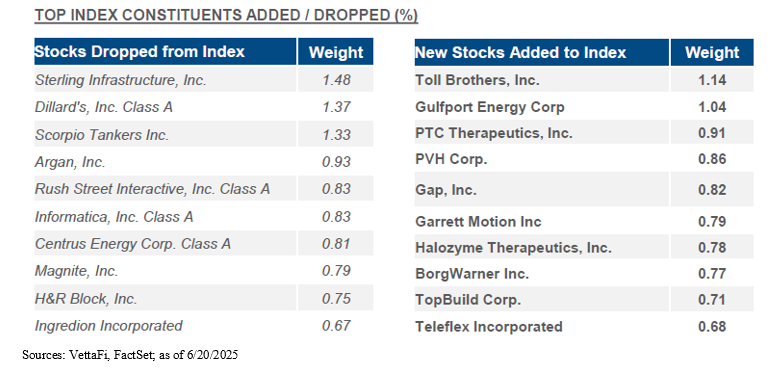
The rebalance saw some companies exit the portfolio, such as Scorpio Tankers (STNG) due to an oversupply of new tankers impacting shipping rates, effectively impacting growth. Another dropped company was American Eagle Outfitters (AEO) due to tariff and supply chain issues impacting forward-looking FCF. Additionally, Biomarin Pharmaceutical (BMRN), a rare disease pharmaceutical company, was also screened out based on forward-looking FCF.
This rebalance underscores SFLO’s focus on quality, profitability, and attractive valuations, positioning it to capture opportunities across evolving market landscapes.
For more news, information, and analysis, visit the Free Cash Flow Content Hub
VettaFi LLC (“VettaFi”) is the index provider for SFLO, for which it receives an index licensing fee. However, SFLO is not issued, sponsored, endorsed, or sold by VettaFi, and VettaFi has no obligation or liability in connection with the issuance, administration, marketing, or trading of SFLO.
Carefully consider a fund’s investment objectives, risks, charges, and expenses before investing. To obtain a prospectus or summary prospectus containing this and other important information, visithttp://www.vcm.com/prospectus. Read it carefully before investing. All investing involves risk, including the potential loss of principal.
All investing involves risk, including the potential loss of principal. The Fund has the same risks as the underlying securities traded on the exchange throughout the day. ETFs may trade at a premium or discount to their net asset value. Index Funds invest in securities included in, or representative of securities included in, the Index, regardless of their investment merits. The performance of the Fund may diverge from that of the Index. Investing in companies with high free cash flows could lead to underperformance when such investments are unpopular or during periods of industry disruptions. The fund could also be affected by company-specific factors that could jeopardize the generation of free cash flow. Investments in smaller companies typically exhibit higher volatility. Large shareholders, including other funds advised by the Adviser, may own a substantial amount of the Fund’s shares. The actions of large shareholders, including large inflows or outflows, may adversely affect other shareholders, including potentially increasing capital gains. The value of your investment is also subject to geopolitical risks such as wars, terrorism, trade disputes, environmental disasters, and public health crises; the risk of technology malfunctions or disruptions; and the responses to such events by governments and/or individual companies.
The Victory U.S. Small Cap Free Cash Flow Index aims to select high quality companies from its starting universe by applying profitability screens. It then selects companies with the strongest free cash flow yield that exhibit higher growth. The Index is rebalanced and reconstituted quarterly. This Index calculates free cash flow yield by dividing expected free cash flow by enterprise value. Expected free cash flow is the average of trailing 12-month FCF and next 12-month forward free cash flow. Enterprise value (EV) measures a company’s total value, often used as a more comprehensive alternative to equity market capitalization.
You cannot invest directly in an index.
Free cash flow yield is a financial solvency ratio that compares the free cash flow per share a company is expected to earn against its market value per share.
EBIDTA, short for earnings before interest, taxes, depreciation, and amortization, is an alternate measure of profitability to net income. It’s used to assess a company’s profitability and financial performance.
Earnings per share (EPS) is a measure of a company’s profitability that indicates how much profit each outstanding share of common stock has earned.
Dividend yield is a financial ratio that shows how much a company pays out in dividends each year relative to its stock price.
The price-to-earnings (P/E) ratio compares a company’s share price with its earnings per share.
The net debt-to-EBITDA (earnings before interest depreciation and amortization) ratio is a measurement of leverage, calculated as a company’s interest-bearing liabilities minus cash or cash equivalents, divided by its EBITDA.
VictoryShares ETFs are distributed by Victory Capital Services, Inc. (VCS). VCS is not affiliated with VettaFi.

