
North American natural gas demand is poised for a historic increase driven by growth in liquefied natural gas (LNG) exports and the demand for power, which includes data centers. This backdrop is driving unprecedented opportunities for natural gas-focused midstream companies. Learn more about the drivers of upsized midstream backlogs, some major natural gas projects, and how they’re supporting long-term EBITDA growth.
Key Takeaways:
- Driven by rising liquefied natural gas (LNG) exports and surging domestic power demand, including for data centers, North American natural gas infrastructure is seeing unprecedented growth opportunities.
- Midstream operators are executing on multibillion-dollar sanctioned project backlogs and seeing strong customer interest for pipeline capacity across the U.S.
- The scale of these project backlogs locks in visibility for long-term, fee-based EBITDA growth, which can support ongoing dividend growth.
Natural Gas-Focused Backlogs Surge Amid Historic Tailwinds
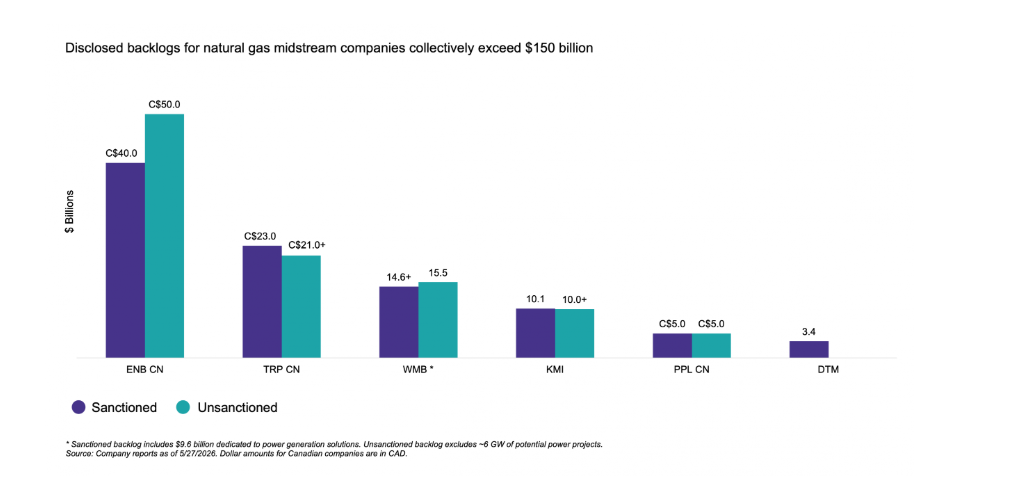
Rising international demand for LNG and growing domestic power needs, including for data centers, are requiring new and expanded natural gas infrastructure. The midstream corporations that have disclosed backlog figures have seen significant growth over the past year. This includes both sanctioned projects that are under construction and unsanctioned opportunities in various stages of development. In particular, diversified Canadian midstream name Enbridge (ENB CN), which has disclosed the largest backlog by far, has grown its secured capital program (i.e., sanctioned projects) from C$28 billion in 1Q25 to C$40 billion in 1Q26.
Since much of the new natural gas infrastructure is being driven by demand related to LNG and power, contract terms and customer quality are generally stronger now than they were a few years ago (read more). As seen below, midstream companies with natural gas infrastructure are investing tens of billions of dollars over the next few years. Importantly, these companies see even more opportunity on the horizon, as represented by the unsanctioned columns in teal. Note that MLPs like Energy Transfer (ET) and MPLX (MPLX) also have notable natural gas assets but do not disclose backlog figures.
Long-Term EBITDA Growth
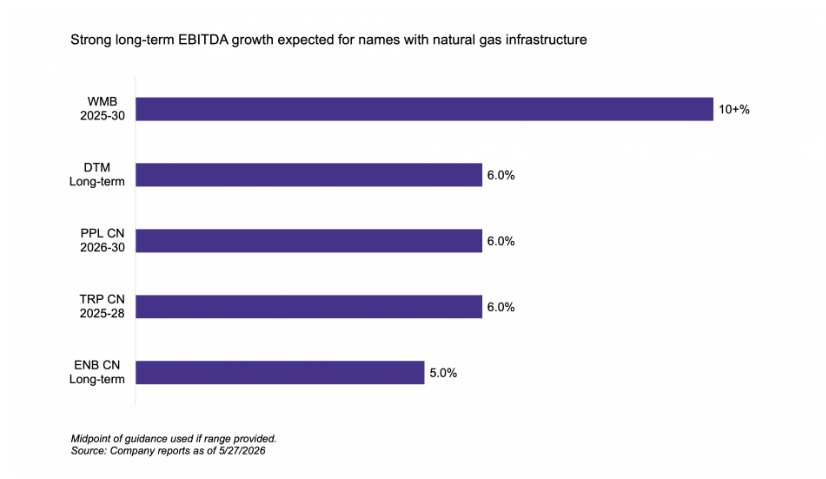
These massive backlogs translate directly into a durable runway for long-term EBITDA growth for names with natural gas infrastructure (as shown in the chart below). Importantly, natural gas pipelines tend to enjoy long-term contracts of 20 years and attractive project returns. The solid outlook for EBITDA growth can help add confidence to ongoing dividend growth in the space. Finally, midstream’s fee-based business model and long-term contracts uniquely allow companies to provide multi-year growth outlooks. This generally isn’t possible for other energy subsectors.
Growing LNG Exports Drive Bulk of the Backlogs
LNG export capacity growth represents the largest and clearest tailwind for natural gas midstream infrastructure. North American LNG export capacity has expanded rapidly over the past decade. U.S. LNG exports increased from 0.5 billion cubic feet per day (Bcf/d) in 2016 to 15.0 Bcf/d in 2025. To put this growth into perspective, the U.S. consumed 91.9 Bcf/d of natural gas in 2025.
Based on projects under construction, total U.S. LNG export capacity is set to nearly double by 2031, from 18.7 Bcf/d to 36.8 Bcf/d. U.S. LNG developers are continuing to pursue additional capacity expansions after signing 5.2 Bcf/d of long-term agreements last year. The massive demand for LNG feedgas has helped drive investment across the midstream sector.
The Pipelines and Players Powering Export Infrastructure
Notably, ENB’s extensive Gulf Coast pipeline network has the capacity to serve roughly 25% of U.S. LNG export facilities, while TRP transports approximately 30% of all natural gas bound for export across North America. Both companies are advancing further projects, with TRP currently building the Gillis Access project to move 1.5 Bcf/d of natural gas from Louisiana’s Haynesville shale towards the Gulf Coast. ENB is a joint venture partner across a slate of LNG-linked pipeline megaprojects, holding stakes in the 2.5 Bcf/d Blackcomb Pipeline, the 2.5 Bcf/d Traverse Pipeline, the 2.6 Bcf/d Bay Runner Pipeline, the 4.5 Bcf/d Rio Bravo Pipeline, and the 3.7 Bcf/d Eiger Express Pipeline.
Among U.S. operators, KMI has secured long-term contracts that will grow its LNG feedgas volumes from 8 Bcf/d today to nearly 12 Bcf/d by the end of 2028, driven by significant capacity additions like its $1.8 billion, 2 Bcf/d Trident Intrastate Pipeline. DT Midstream (DTM) is also capturing Gulf Coast LNG demand, having expanded its LEAP Gathering System in Haynesville last year to 2.1 Bcf/d with the capability to scale up to ~4 Bcf/d to support the supply of multiple LNG terminals. Targa Resources (TRGP), MPLX (MPLX), ONEOK (OKE), and privately held WhiteWater also support LNG demand through joint venture pipeline projects.
Some midstream players are investing directly in export infrastructure. Pembina (PPL CN) is advancing the 0.4 Bcf/d Cedar LNG project (49.9% stake) on Canada’s West Coast. Similarly, ENB owns 30% of the 0.3 Bcf/d Woodfibre LNG, also on Canada’s West Coast. In the U.S., Williams (WMB) has taken a 10% stake in Woodside’s (WDS) Louisiana LNG facility and 80% of the associated Driftwood Line 200 Pipeline, which is being constructed off of WMB’s flagship Transco system with 3.1 Bcf/d of capacity.
Power Generation and Data Centers Provide Another Opportunity
Aside from LNG, the other key driver of natural gas demand is power driven by data center proliferation, coal-to-gas switching, and broader electrification. Midstream companies are pursuing this opportunity through data center interconnects, dedicated power laterals, and, in select cases, direct power generation.
Power-related projects have grown to constitute a significant portion of midstream backlogs. KMI recently noted that nearly 60% of its $10.1 billion backlog is now associated with projects supporting power generation and demand from local distribution companies (LDCs). About 90% of KMI’s >$10 billion in unsanctioned opportunities are driven by power and LNG demand. Similarly, ENB is actively advancing over 50 data center opportunities that could require up to 10 Bcf/d of new pipeline capacity. TRP’s Columbia, ANR, and Crossroads systems connect to over 200 electric and gas utilities. They also sit within 15 miles of 60% of the over 350 data centers currently under development in the U.S. The company projects 5-8 Bcf/d of power generation-driven gas demand growth across the Midwest corridor.
New Areas of Expansion
To support power needs in the Southeast, KMI is advancing its 1.3 Bcf/d South System Expansion 4 (SSE4) and 2.1 Bcf/d Mississippi Crossing (MSX) projects, while WMB recently broke ground on its 1.6 Bcf/d Southeast Supply Enhancement project. Late last year, DTM sanctioned its 537 million cubic feet per day (MMcf/d) Guardian Pipeline “G3” expansion to deliver new capacity into Wisconsin and northern Illinois markets, supported by 20-year contracts with utilities.
Recent open seasons for Midwest natural gas pipelines drew massive demand, heavily oversubscribing the capacity serving regional power grids. DTM highlighted customer interest in excess of offered capacity for two pipeline expansion projects in its 1Q26 earnings release. Also in the Midwest, non-binding open seasons for expansions of TRP’s Crossroads Pipeline and Columbia Gas Transmission system were 2.5x and 3x oversubscribed, respectively.
Finally, some midstream operators are moving “behind the meter” (BTM) to provide dedicated, on-site power generation for data centers. This is to bypass utility grids struggling with long wait times for new connections. Most of WMB’s over $14.6 billion backlog is focused on power generation, with ~$9.6 billion in execution supporting 6 data centers. WMB is providing the power for 5 of the projects, with a combined capacity of 2.6 GW. WMB’s current BTM projects have contract terms ranging from 10-13 years. WMB is also evaluating partnerships and commercial agreements to serve up to 6 GW of power in the future.
Bottom Line
The structural expansion of natural gas demand from LNG exports and power needs has driven a surge in midstream project backlogs. These multi-billion-dollar backlogs, spanning both near-term construction and future opportunity sets, support a multi-year runway for fee-based EBITDA growth. Backed by strong project returns and long-term contracts, the outlook for EBITDA growth can also support ongoing dividend growth.
For investors looking to capitalize on rising natural gas demand, natural gas infrastructure companies offer a compelling option. Many of the key players at the forefront of this theme, including ENB CN, TRP CN, WMB, KMI, PPL CN, DTM, and ET are constituents of the Alerian Midstream Energy Select Index (AMEI). Energy infrastructure also tends to offer attractive yields, which can be appealing when playing a long-term theme like growing natural gas demand. AMEI was yielding 4.8% as of May 29.
Looking for midstream insights in your inbox? Subscribe here to keep a pulse on midstream investing through our weekly updates.
For more news, information, and analysis, visit the Energy Infrastructure Content Hub.
Related Research:
Surging U.S. Power Needs Drive Gas Infrastructure Opportunity
WMB Analyst Day: Power & Pipe to Drive Robust Growth
Natural Gas, Demand-Pull Pipelines & Midstream Valuations
U.S. LNG Exports Surge Despite 4Q25 Headwinds
AMEI is the underlying index for the Alerian Energy Infrastructure ETF (ENFR) and the ALPS Alerian Energy Infrastructure Portfolio (ALEFX).
vettafi.com is owned by VettaFi LLC (“VettaFi”). VettaFi is the index provider for ENFR and ALEFX, for which it receives an index licensing fee. However, ENFR and ALEFX are not issued, sponsored, endorsed, or sold by VettaFi. VettaFi has no obligation or liability in connection with the issuance, administration, marketing, or trading of ENFR and ALEFX.

