Key takeaways:
- Constraints on data center supply, specialization in artificial intelligence (AI) workloads and the physical demands of next-generation chips could extend the useful economic lives of older GPUs beyond conventional assumptions.
- Longer useful lives and additional rental income could support higher GPU residual values, strengthening collateral coverage and reducing refinancing risk for data centers.
- This increases investment opportunities across the GPU-financing stack, favoring debt and equity structures where conservative residual value assumptions may understate the potential.
Graphics processing units (GPUs) are a critical component in artificial intelligence (AI) processing. Designed to perform large numbers of calculations simultaneously, GPUs are widely used to provide the computing power required to train and run artificial intelligence models. The consensus is that GPU collateral loses value fast: for example, each new generation of GPU from NVIDIA, the technology giant, makes the last one obsolete, and lenders financing chips are ultimately lending against a melting ice cube.
We think otherwise. Three forces are moving together: politics is capping new supply; workloads are splitting into specialized jobs; and the latest silicon requires physical characteristics in buildings that most of the existing stock cannot provide. In our view, these three components make capacity that is already installed and powered worth more, not less, and argues for greater persistence in existing equipment and technology. For credit, that means better collateral coverage on deployed data centers and less refinancing risk at maturity. For equity, it means improved value accruing to those taking residual value risk.
1. Politics is now a supply constraint, and constraints hold up residuals
The bear case on residuals assumes supply is unlimited, so new capacity floods in and reprices everything older through obsolescence. We believe that argument does not hold when it is progressively harder to bring on incremental power.
As we have discussed previously, we believe the current political environment will lead to a slower, yet longer buildout. In the US mid-term elections on November 3, voters decided 41 local data center ballot measures, backing limits on data centers in 40 of them.1In Ohio, one measure in the city of Trenton blocks the land annexation path for a planned 1GW (1GW = 1,000MW), 18-building, 601-acre Amazon campus.2Meanwhile, Texas’s governor-elect has pledged to keep data center approvals paused until the legislature passes ratepayer and water protections.3Investment bank Goldman Sachs estimates that states likely to tighten data center buildout rules hold about 45% of planned US capacity.4
Our view is that this keeps new US grid capacity additions (i.e., front-of-meter) roughly capped in the 15–20GW-a-year range, with potentially more from off-grid power and conversions of facilities previously used for Bitcoin mining operations.5Front-of meter (power infrastructure located on the utility side of the electric meter, i.e., coming directly from the standard grid) is likely to continue to handle the lion’s share of data center adds. Behind-the-meter (which sits on the customer’s side and feeds directly to the site, typically resembling a “bring your own power” setup using on-site gas turbines, reciprocating engines or fuel cells) should continue to provide some level of bridge capacity. That said, behind-the-meter power generally possesses its own set of requisite permits. When new capacity is gated by permits and politics, rather than chip availability, value should accrue to the rack that is already powered.
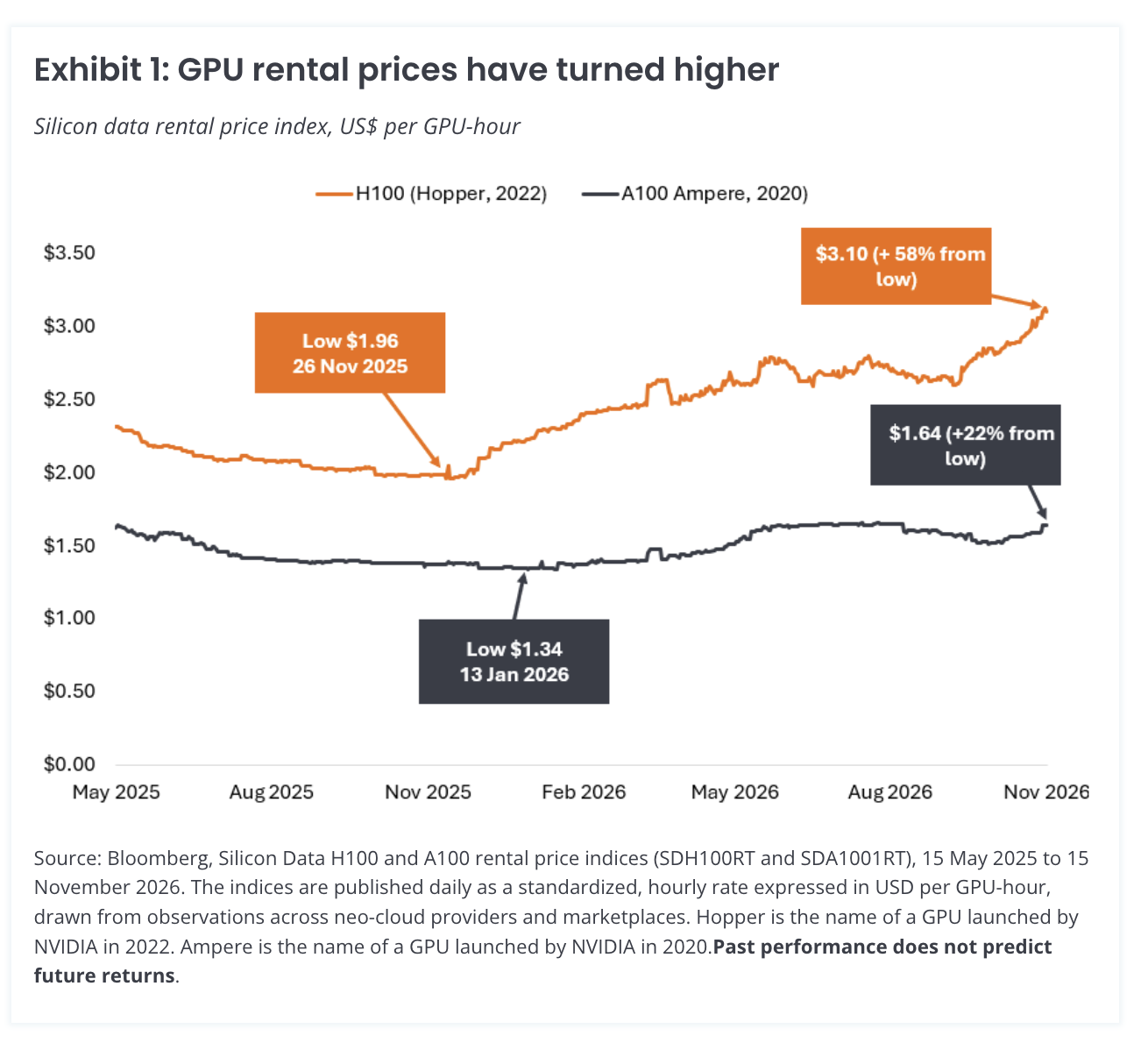
The pricing data already show this. Nebius, an AI-specialist cloud computing provider, closed Q3 2026 contracts above $25m per MW, up from $20–25M in Q2.6CoreWeave, another AI-specialist cloud computing provider, is signing A100 (2020 vintage) at contract values above where they initially signed, demonstrating that at present, GPUs appear to be appreciating, not depreciating.7
See more: After the AI IPOs: Where Private Capital Goes Next
2. Specialization gives older silicon a second and third job
In practice, workloads have split up and resemble a digital assembly line. Training, where AI analyzes datasets and is taught model rules and logic to recognize patterns, and inference (and inference sub-tasks), where AI uses the learned knowledge to complete live tasks, now run on different hardware.
Inference itself now has two phases: (i) prefill (the first phase of large language model inference)readsthe prompt in one parallel pass and is limited by compute; (ii) decodeanswersthe prompt, produces tokens one at a time, and is limited by memory bandwidth. Disaggregated serving runs the two phases on separate GPU pools that are sized independently. With the increasing role and popularity of XPUs (X being a catch-all letter to represent any or all forms of accelerated silicon, be it ASICs or GPUs), the go-forward roadmap for both users and suppliers of compute appears to accept that inference is a set of distinct jobs.
For residuals, this matters a lot. An older GPU no longer needs to be the best chip in the building. It just needs to be the cheapest chip that can handle one phase of the work. That supports a working life that runs from frontier training, to frontier inference, to decode, batch and background jobs. Every extra stage can potentially add rental income and correspond to higher residual values.
3. Adapting old buildings for new GPUs is not easy
Another detracting argument around GPU useful lives is that newer, higher performing silicon comes out on an annual cadence. That may be true, but the question is not whether a new GPU is simply better than an old one, it is whether the latest vintage of GPU can even be slotted into where the old one is.
Up to and including Hopper (a GPU launched by Nvidia in 2022), the answer was mostly ‘yes,’ but Blackwell (a GPU launched by Nvidia in 2024) changes that. While a crude analogy, prior vintages of GPUs were akin to selling an old gas vehicle and buying a new gas vehicle: they can both be slotted into your garage with no real change in physical requirements in said garage. The new paradigm is akin to buying an electric vehicle with an incremental charging station, though this is a material understatement to the changes in physical environments required in recent GPU vintages.
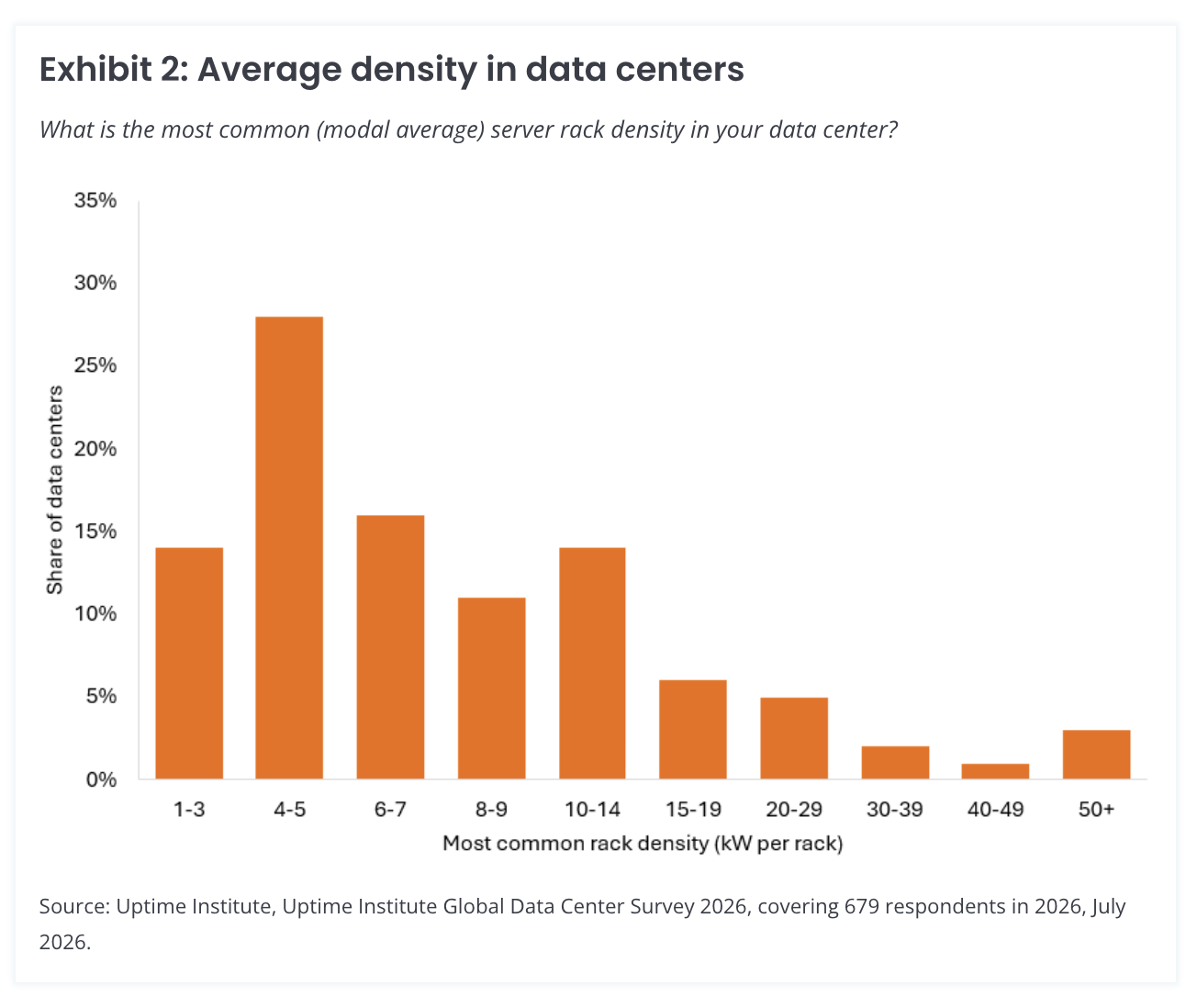
The volume product using Nvidia’s Blackwell is the rack-scale GB200 NVL72. It draws about 120 kW per rack, and requires direct-to-chip liquid cooling.8The average industry rack draws about 7.6 kW (1/15thof the power). Air cooling tops out around 20-30 kW per rack.9An NVL72 also needs coolant distribution units, manifolds and heat-rejection capacity built into the facility. As Exhibit 2 shows, the typical rack is under 15kw in 83% of data centers, with racks in the 120kw range (which would sit in the 50+ category in Exhibit 2) still relatively rare.
As a result, most of the existing data center stock cannot physically host the latest product. An operator is unable to cheaply swap Hoppers for Blackwells in a pre-2024 hall. It has to retrofit electrical and cooling systems, or build new, which runs straight into the permitting problem in section 1. In an environment as supply constrained as the present, we view it as unlikely that data center operators would undergo potentially 6+ months of downtime.
In short, we expect earlier vintages of GPU to extract higher economic rent than currently underwritten. We believe this dynamic ultimately benefits all layers of the GPU-financing stack, from the asset level down to the underlying debt and equity.
1Source: CNBC, 4 November 2026.
2Source: WVXU, 3 November 2026.
3Source: Texas Tribune, 4 November 2026.
4Source: Goldman Sachs, 4 November 2026.
5Source: Janus Henderson Investors, Wells Fargo, Wells Fargo estimates that the US grid can support ~15-30 GW of deliveries per year, 17 September 2026.
6Source: Nebius, Q3 2026 earnings results, 12 November 2026.
7Source: Coreweave, Q3 earnings call, 10 November 2026.
8Source: Nvidia DGX GB200 User Guide, 17 September 2026.
9Source: Ace Computers, Liquid Cooling vs Air Cooling for High-Density AI Racks, 3 September 2026.
References made to individual securities do not constitute a recommendation to buy, sell or hold any security, investment strategy or market sector, and should not be assumed to be profitable. Janus Henderson Investors, its affiliated advisor, or its employees, may have a position in the securities mentioned.
Fixed income securitiesare subject to interest rate, inflation, credit and default risk. The bond market is volatile. As interest rates rise, bond prices usually fall, and vice versa. The return of principal is not guaranteed, and prices may decline if an issuer fails to make timely payments or its credit strength weakens.
James Donahue is a Credit Analyst at Janus Henderson Investors, a position he has held since 2024.
John Lloyd is Global Head of Multi-Sector Credit at Janus Henderson Investors, a role he has held since 2025.
Denny Fish is a Portfolio Manager on the Global Technology and Innovation Team at Janus Henderson Investors, a position he has held since 2016.
The opinions and views expressed are as of the date published and are subject to change. They are for information purposes only and should not be used or construed as an offer to sell, a solicitation of an offer to buy, or a recommendation to buy, sell or hold any security, investment strategy or market sector. No forecasts can be guaranteed. Opinions and examples are meant as an illustration of broader themes, are not an indication of trading intent and may not reflect the views of others in the organization. It is not intended to indicate or imply that any illustration/example mentioned is now or was ever held in any portfolio. Janus Henderson Group Ltd. through its subsidiaries may manage investment products with a financial interest in securities mentioned herein and any comments should not be construed as a reflection on the past or future profitability. There is no guarantee that the information supplied is accurate, complete, or timely, nor are there any warranties with regards to the results obtained from its use. Past performance is no guarantee of future results. Investing involves risk, including the possible loss of principal and fluctuation of value.
Fixed income securities are subject to interest rate, inflation, credit and default risk. The bond market is volatile. As interest rates rise, bond prices usually fall, and vice versa. The return of principal is not guaranteed, and prices may decline if an issuer fails to make timely payments or its credit strength weakens.
Janus Henderson® and any other trademarks used herein are trademarks of Janus Henderson Group Ltd. or one of its subsidiaries. © Janus Henderson Group Ltd.
A message from Advisor Perspectives and VettaFi: Discover something new! Click here to register for our upcoming webcasts.
© Janus Henderson Investors
More Retirement Income Topics >