Key takeaways
- Analysis of multi-year trading data reveals liquidity typically drops across asset classes from November to early January, often leading to wider spreads, slower execution and higher trading costs.
- Market behavior diverges from historical norms during late November and late December as participation declines globally.
- We believe investors who plan around these seasonal patterns—adjusting timing, execution and coordination—can reduce implementation risk and cost.
Markets don’t sleep over the holidays, but they do slow down. Historical trading patterns show consistent liquidity shifts from late November through early January.
See more: Advisor Year-End Checklist: Prepare for a 2027 Move
How holidays affect trading liquidity: What the data shows
We’ve analyzed several years of global trading activity and identified recurring patterns of reduced liquidity as markets approach year-end.
Regardless of the country, multiple factors should be considered when trading near the end of the year. Why? Because from late November through New Year’s Day, there is a confluence of holidays that historically have had a significant impact on liquidity, spreads and opportunity costs.
When properly managed, these factors—across all asset classes—can yield positive outcomes. On the flip side, when these factors are managed poorly, or when the unique elements of market closures are overlooked, the probability of a suboptimal result increases.
Below, we examine the global liquidity environment across asset classes during this end-of-year timeframe. These observations are based on our decades of experience as a trading solutions provider and are intended to serve as approximate figures.
Thanksgiving week: How trading volumes fall in late November
Even though Thanksgiving is largely a U.S.-based holiday, its impact is felt globally. Because the U.S. comprises roughly 50% of the overall global market, U.S.-specific holidays can have outsized influence on liquidity and volumes worldwide.
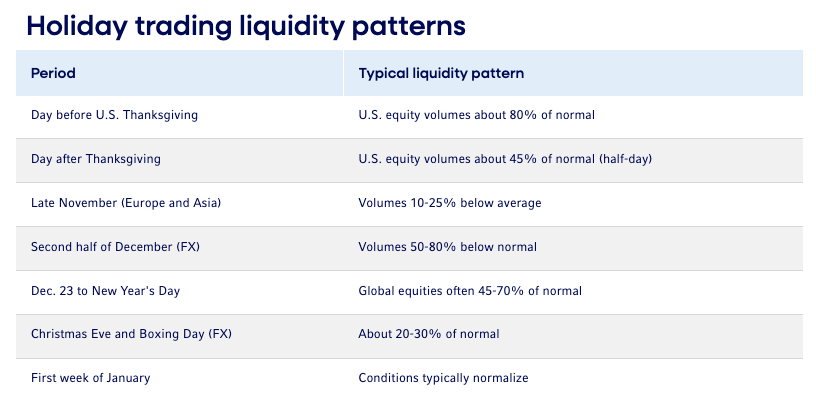
U.S. equity volumes typically fall to 80% of normal the day before Thanksgiving and roughly 45% the day after, which is a half-day session.
Europe and Asia remain active but see secondary effects, with volumes 10–25% below average.
One thing to consider is that there can be a catch-up period starting on the Monday after Thanksgiving, with outsized volumes on T+2 through T+5.
Mid-December: Why liquidity starts to fade
Across asset classes, participation starts to decline by mid-December as investors wind down positions and liquidity providers reduce exposure.
FX markets are among the first to feel it, with volumes running 50–80% (depending on the currency pair) below normal by the second half of the month should there be no major events.
In fixed income, dealer inventory thins and bid-offer spreads widen—signs of constrained liquidity across both U.S. and European markets.
Volume declines of 20–40% in Europe and up to 50% in Asia are typical.
The late December lull and early January recovery
From Dec. 23 through New Year’s Day, global equities often trade at 45–70% of normal volumes, with similar slowdowns in derivatives and credit markets.
The quietest sessions of the year tend to coincide with overlapping holidays—Christmas Eve, Boxing Day and regional banking closures.
Trading conditions typically normalize within the first week of January as participation returns.
Lower volume levels historically tend to have larger impacts when moving in or out of positions, leading to more significant cost implications. Spreads widen, implicit costs increase and opportunity costs rise as trade timelines stretch.
How holiday liquidity affects equities, fixed income, FX and derivatives
These seasonal divergences appear consistently across our multi-year dataset:
- Equities — Lower volumes magnify market impact and increase implicit costs. Investors executing transitions or large allocations face higher opportunity costs as trade timelines stretch.
- Fixed income — U.S. volumes are typically down around 20% in December, while European fixed income declines 20–40% and Asia 40–50%. Spreads widen, liquidity is constrained and execution may require longer time horizons. Less dealer inventory means fewer offerings in the marketplace—yet patience is often rewarded. Dealer balance sheets reset in Jan, which could also have big impact in liquidity.
- Foreign exchange — Liquidity declines steadily through year-end. While top-of-book pricing may remain tight, market depth weakens, making larger trades more difficult to complete efficiently. Christmas Eve and Boxing Day are historically the quietest days, with volumes roughly 20-30% of normal, especially in European currencies. The week between Christmas and New Year’s typically runs at 50–80% of normal levels.
- Derivatives — Over the past decade, global futures and options volumes in late December have averaged 30-40% below normal levels. Futures volume in Asia and Europe usually decline about 0-10%. The reduction is most pronounced during the final week of December, when liquidity decreases further.
Holiday effect: Liquidity vs. returns
Lower holiday liquidity affects how efficiently investors can trade; it does not, by itself, indicate whether markets will rise or fall. Reduced participation can widen spreads, increase market impact and extend execution timelines, raising the cost of implementing a portfolio decision. Investors should treat seasonal liquidity patterns as an execution consideration, rather than as a signal about investment returns.
How to plan trades around year-end liquidity
We view year-end not as a time to retreat from trading, but as a time that rewards preparation.
Investors who map their execution timelines to these known liquidity cycles can reduce implementation risk and achieve more consistent outcomes.
That often means completing major trades before mid-December or waiting until early January—when liquidity, dealer participation and settlement normality return.
Visibility, coordination and patience remain the key ingredients of effective execution during this seasonal divergence.
Because portfolio needs don’t always align neatly with the calendar, partnering with an experienced trading team can help manage complexity, coordinate across time zones and ensure efficient outcomes when liquidity is tight.
Holiday trading checklist for institutional investors
- Before trading during the year-end period, institutional investors can:
- Check market holidays, half-days and regional banking closures.
- Review expected liquidity conditions across the relevant asset classes and regions.
- Consider whether major trades can be completed before mid-December or delayed until early January.
- Allow more time for execution when market depth is reduced.
- Coordinate trading plans across investment, operations and regional teams.
Investor implications
Understanding how trading conditions evolve between late November and early January helps investors calibrate strategy, manage costs and avoid unnecessary volatility.
To help navigate these year-end complexities, our Institutional Trading Calendar provides an at-a-glance view of market holidays and other days with reduced liquidity. Updated regularly, this calendar is a practical tool for institutional investors to plan trades and manage liquidity across regions, helping them anticipate and navigate the reduced market activity that often occurs during holidays.
A message from Advisor Perspectives and VettaFi: Discover something new! Click here to register for our upcoming webcasts.
Important information pertaining to the hypothetical example: Past performance does not predict future returns. Return level is proportionately scaled in line with cash level to be overlaid. Source: Russell Investments. Assumptions: Average cash level 1.0%, 10-year history from 12/31/2023, gross of fees. Opportunity cost from not securitizing cash varies by asset allocation and time period, and is represented by horizontal bars as marked within the chart legend. Target asset allocation used: 0% cash, 74% MSCI World, 26% Global Aggregate (GBP Hedged). For illustrative purposes only. Does not represent any actual investment. Indexes are unmanaged and cannot be invested in directly. Performance benefit (net) of overlaying cash by last 5 individual calendar year is as follows: 2023:20 bps, 2022:-17bps, 2021:16bps, 2020:14bps, 2019:23bps.
These views are subject to change at any time based upon market or other conditions and are current as of the date at the top of the page. The information, analysis, and opinions expressed herein are for general information only and are not intended to provide specific advice or recommendations for any individual or entity.
This material is not an offer, solicitation or recommendation to purchase any security.
Forecasting represents predictions of market prices and/or volume patterns utilizing varying analytical data. It is not representative of a projection of the stock market, or of any specific investment.
Nothing contained in this material is intended to constitute legal, tax, securities or investment advice, nor an opinion regarding the appropriateness of any investment. The general information contained in this publication should not be acted upon without obtaining specific legal, tax and investment advice from a licensed professional.
Diversification and strategic asset allocation do not assure a profit or guarantee against loss in declining markets.
Please remember that all investments carry some level of risk, including the potential loss of principal invested. They do not typically grow at an even rate of return and may experience negative growth. As with any type of portfolio structuring, attempting to reduce risk and increase return could, at certain times, unintentionally reduce returns.
The Russell Investments logo is a trademark and service mark of Russell Investments
The information, analyses and opinions set forth herein are intended to serve as general information only and should not be relied upon by any individual or entity as advice or recommendations specific to that individual entity. Anyone using this material should consult with their own attorney, accountant, financial or tax adviser or consultants on whom they rely for investment advice specific to their own circumstances.
Products and services described on this website are intended for United States residents only. Nothing contained in this material is intended to constitute legal, tax, securities, or investment advice, nor an opinion regarding the appropriateness of any investment, nor a solicitation of any type. The general information contained on this website should not be acted upon without obtaining specific legal, tax, and investment advice from a licensed professional. Persons outside the United States may find more information about products and services available within their jurisdictions by going to Russell Investments' Worldwide site.
Russell Investments is committed to ensuring digital accessibility for people with disabilities. We are continually improving the user experience for everyone, and applying the relevant accessibility standards.
Russell Investments' ownership is composed of a majority stake held by funds managed by TA Associates Management, L.P., with a significant minority stake held by funds managed by Reverence Capital Partners, L.P. Certain of Russell Investments' employees and Hamilton Lane Advisors, LLC also hold minority, non-controlling, ownership stakes.
On July 2, 2026, Russell Investments Group, Ltd. (“Russell Investments”) entered into a definitive agreement and plan of merger (the “Transaction”) pursuant to which Russell Investments will be acquired by a consortium led by B Capital Group Management, L.P. that includes California Public Employees Retirement System. The Transaction is expected to close by the end of Q1 2027, subject to the receipt of regulatory approvals and other customary closing conditions.
Frank Russell Company is the owner of the Russell trademarks contained in this material and all trademark rights related to the Russell trademarks, which the members of the Russell Investments group of companies are permitted to use under license from Frank Russell Company. The members of the Russell Investments group of companies are not affiliated in any manner with Frank Russell Company or any entity operating under the "FTSE RUSSELL" brand.
© Russell Investments Group, LLC. 1995-2026. All rights reserved. This material is proprietary and may not be reproduced, transferred, or distributed in any form without prior written permission from Russell Investments. It is delivered on an "as is" basis without warranty.
© Russell Investments
Read more commentaries by Russell Investments