Key takeaways
-
Treasuries haven’t appeared to lose their safe-haven status. Yields reversed course while Middle East concerns intensified, challenging the idea that the bond market had lost faith in the US.
-
Credit discipline can be a sign of a healthy market, as investors asked tougher questions and separated stronger borrowers from weaker ones.
-
AI demand for some of the most well-known companies remained strong, as usage, revenues, and enterprise adoption grew despite questions about spending and returns.
There’s a famous line from political strategist James Carville that if he were reincarnated, he’d like to come back as the bond market because “you can intimidate everybody.”
Only a few weeks ago, a narrative emerged that the bond market had decided to intimidate the United States. Treasury yields were rising,1 and prominent investors, including Stanley Druckenmiller and Ray Dalio, raised concerns over the sustainability of US debt and the bill finally coming due. There were clear problems with that narrative, in my view. Inflation expectations remained relatively contained2 and the US dollar was strong.3 Those aren't typically the calling cards of a market losing faith in US assets.
Sure enough, Treasury yields reversed course. Last week, amid intensified concerns in the Middle East, Treasuries rallied further.4 That response challenged the idea that US government bonds had suddenly lost their traditional safe-haven appeal.
Credit market became more discerning
The bond market was doing a bit of bullying. It wasn't just bullying the US Treasury market.
Last week, I discussed the pressure facing parts of the artificial intelligence ecosystem, including CoreWeave and other neocloud companies. Borrowing costs had risen, and credit default spreads had widened.5 The moves prompted concerns that the AI boom was beginning to unravel.
I saw it differently.
The credit market had become more discerning. Companies with greater leverage, more uncertain cash flows, or business models requiring enormous amounts of capital appeared to be more scrutinized. The market had done what a healthy market should do in my view. Bull markets don’t require every company to succeed. In fact, healthy bull markets have often exposed and ultimately weeded out weaker, more speculative, or fundamentally unsound companies. That’s not a statement about CoreWeave specifically. It’s simply an observation about how functioning capital markets have tended to allocate capital. Discipline is a feature, not a bug.
And then came last week's AI news.
See more: Are Bonds Pricing In a Fed Policy Mistake?
Promising AI industry news
The message from several of the industry's biggest players was promising, even if the ultimate returns on the enormous amounts of capital being invested remained uncertain. Markets appear to have become more sensitive to announcements of increased AI investment, even as the companies making those investments continued to report impressive demand.
Anthropic continued to demonstrate rapid commercial adoption, while improvements to its latest Claude models pointed toward better performance and lower inference costs.6 OpenAI continued to report rapid growth in its enterprise business.7 Meta provided some of the clearest evidence that AI investments have begun to produce measurable benefits, with AI increasingly embedded in advertising, recommendation engines, and tools used by millions of advertisers.8
None of this guaranteed that today’s extraordinary level of AI spending may ultimately earn an adequate return. But it does challenge the notion that the investment boom has been occurring without evidence of growing underlying demand. That matters.
The AI bear case appears to have increasingly focused on the enormous amount of capital being committed to data centers, chips, power, and computing capacity. Those are fair questions. But recent results from select companies demonstrated the other side of the ledger has become increasingly difficult to ignore. Usage has been growing.9 Revenues have been growing.10 Enterprise adoption has been expanding.11 Costs have been falling.12 And some companies have begun to show tangible returns from their AI investments.
Market headwinds
Of course, it’s not all rosy. The conflict in the Middle East and the rise in oil prices13 present another legitimate headwind, potentially weighing on growth and keeping headline inflation elevated in the near term. But markets have tended to climb walls of worry. The presence of risks doesn’t necessarily mean the bull market may be ending.
Step back from the headlines. Treasuries haven’t appeared to have lost their safe-haven status.14 Credit markets appear to have been doing the healthy work of separating stronger borrowers from weaker ones. And my view of the fundamental AI story remained intact. To me, that sounds like a bull market that has been intact.
Source: Bloomberg L.P., Oct. 22, 2026, based on the 10-year US Treasury rate.
Source: Bloomberg L.P., Oct. 22, 2026, based on the 3-, 5-, and 10-year US Treasury inflation breakeven.
Source: Bloomberg L.P., Oct. 22, 2026, based on the US Dollar Index, which measures the value of the US dollar versus a trade-weighted basket of currencies.
Source: Bloomberg L.P., Oct. 22, 2026, based on the 10-year US Treasury rate.
Source: CNBC, “CoreWeave credit default swaps hit distress levels as investors sour on AI debt,” Oct. 15, 2026.
Source: The Wall Street Journal, “Anthropic S-1 Shows Red-Hot Growth, Risks and Massive Computing Costs,” Oct. 20, 2026.
Source: Bloomberg L.P., “OpenAI Expects $70 Billion in Annualized Revenue by End of 2026,” Oct. 9, 2026.
Source: CNBC, “Meta reports third-quarter revenue beat and issues strong guidance,” Oct. 21, 2026.
Source: Meta Platforms, Q3 2026 earnings call, Oct. 21, 2026. Meta reported that its new Muse AI assistant reached 10 million users in the US and Canada within six weeks of launch, with approximately 25% using it daily.
Source: Anthropic, company information reported by the Financial Times and summarized by PYMNTS, Oct. 15, 2026. Anthropic reported $16.8 billion of third-quarter revenue, up 45% from $11.6 billion in the second quarter and more than three times its revenue for all of 2025.
Source: State of AI Report 2026, published Oct. 8, 2026. The report estimated that the combined annualized revenue run rates of OpenAI and Anthropic had risen from approximately $30 billion at the beginning of 2026 to $105 billion by late summer, spanning subscriptions, coding products, and application program interfaces.
Source: State of AI Report 2026, citing Epoch AI, Oct. 8, 2026. The report found that the cost of achieving a fixed level of performance across five AI benchmarks has fallen approximately 47% per quarter since 2023, equivalent to roughly a 13-fold decline per year. Falling inference costs potentially broaden the range of economically viable AI applications.
Source: Bloomberg L.P., Oct. 22, 2026, based on US West Texas Intermediate crude sweet oil prices.
Source: Bloomberg L.P., Oct. 22, 2026, based on the 10-year US Treasury rate.
Important information
NA6047654
Image: Guille Faingold/Stocksy
All investing involves risk, including the risk of loss.
Past performance does not guarantee future results.
Investments cannot be made directly in an index.
This does not constitute a recommendation of any investment strategy or product for a particular investor. Investors should consult a financial professional before making any investment decisions.
Artificial intelligence (AI) technology companies are sensitive to specific risks such as small markets, business cycle changes, economic growth, technological progress, obsolescence, and regulation. These companies may have limited products, markets, resources, or personnel, making their securities more volatile, especially for smaller start-ups. Rapid technological changes can adversely affect their results. AI companies often rely on patents, copyrights, trademarks, and trade secrets to protect their technology, but there's no guarantee these protections will be sufficient. Significant research and development (R&D) spending doesn’t ensure product or service success.
Breakeven inflation is the difference in yield between a nominal Treasury security and a Treasury Inflation-Protected Security of the same maturity.
A bull market is an environment in which stock prices are rising or are expected to rise.
Cash flow is the net amount of cash and cash equivalents generated by a business.
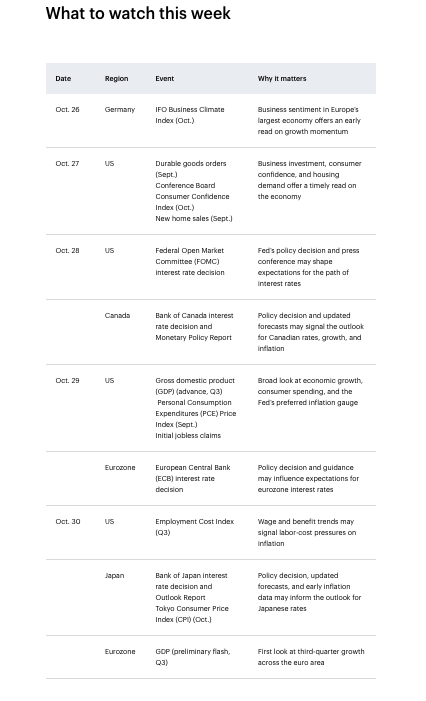
The Conference Board’s Consumer Confidence Index® is published monthly, based on a survey of US consumers’ buying attitudes and buying intentions.
The Employment Cost Index details changes in US businesses’ cost of labor. It is prepared quarterly by the Bureau of Labor Statistics. An investment cannot be made into an index.
The Federal Open Market Committee (FOMC) is a committee of the Federal Reserve Board that meets regularly to set monetary policy, including the interest rates that are charged to banks.
Fixed income investments are subject to credit risk of the issuer and the effects of changing interest rates. Interest rate risk refers to the risk that bond prices generally fall as interest rates rise and vice versa. An issuer may be unable to meet interest and/or principal payments, thereby causing its instruments to decrease in value and lowering the issuer’s credit rating.
In general, stock values fluctuate, sometimes widely, in response to activities specific to the company as well as general market, economic, and political conditions.
Gross domestic product (GDP) is a broad indicator of a region’s economic activity, measuring the monetary value of all the finished goods and services produced in that region over a specified time period.
The IFO Business Climate Index is a highly regarded early indicator of economic developments in Germany, published on a monthly basis.
Inflation is the rate at which the general price level for goods and services is increasing.
Investments focused on a particular industry or sector are subject to greater risk and can be more impacted by market volatility than more diversified investments.
Leverage measures a company’s total debt relative to the company’s book value.
Many products and services offered in technology-related industries are subject to rapid obsolescence, which may lower the value of the issuers.
Neocloud is a specialized cloud infrastructure provider dedicated to AI workloads.
Option-adjusted spread (OAS) is the yield spread that must be added to a benchmark yield curve to discount a security’s payments to match its market price, using a dynamic pricing model that accounts for embedded options.
Personal consumption expenditures (PCE), or the PCE Index, measures price changes in consumer goods and services. Expenditures included in the index are actual US household expenditures. Core PCE excludes food and energy prices.
References to specific companies aren’t buy/sell recommendations and are not intended as investment advice.
West Texas Intermediate (WTI) is a type of light, sweet crude oil that comes from the US.
The opinions referenced above are those of the author as of Oct. 22, 2026. These comments should not be construed as recommendations, but as an illustration of broader themes. Forward-looking statements are not guarantees of future results. They involve risks, uncertainties, and assumptions; there can be no assurance that actual results will not differ materially from expectations.
A message from Advisor Perspectives and VettaFi: Discover something new! Click here to register for our upcoming webcasts.
More Leveraged and Inverse Funds Topics >