The Middle Eastern waters might be calm enough to allow for energy shipments to recover toward pre-war levels, but Asia-Pacific (APAC) economies are not yet in calm waters. Tight petroleum product supplies and higher shipping costs leave the region vulnerable to further shocks. Rising living costs are already squeezing households across much of Asia, while the prospect of El Niño adds another potential source of inflation.
Growth in the region has weathered the disruptions remarkably well. The AI boom continues to power exports and investment across countries, providing an important offset to weaker consumption. That resilience, however, comes with a policy cost. With inflation pressures lingering and increasingly difficult to look through, central banks are shifting their attention back to price stability.
Following are our views on how major APAC markets are poised to perform.
Japan
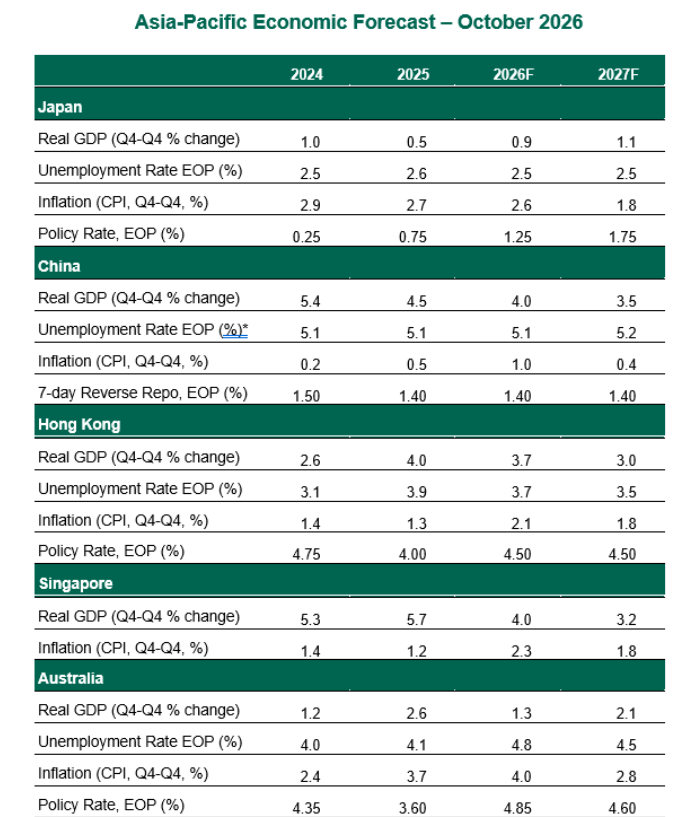
- Japan’s economy continues to expand, but the underlying picture is mixed. Strong external demand will remain a key pillar of support, but soft consumption leaves the economy vulnerable to downside surprises. Industrial activity and exports remain strong, supported primarily by AI-related demand. Second-quarter gross domestic product (GDP) was revised higher, led by exports. Higher energy costs are adding to the squeeze on household purchasing power, while government support for energy bills and a lower consumption tax on food from April 2027 should offer some relief.
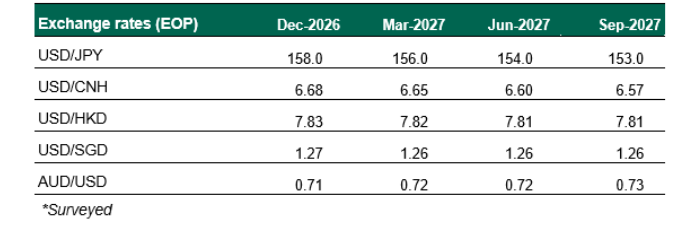
- Policy is becoming a more important part of the outlook. The Bank of Japan raised its overnight rate by 25 basis points to 1.25% in September, with Governor Kazuo Ueda putting greater emphasis on the risk that underlying inflation could overshoot the 2% target. However, soft domestic demand and the economy’s limited experience with higher borrowing costs argue for a gradual pace. Fiscal policy is another source of uncertainty that could keep long-term Japanese government yields and the yen in focus.
China
- China’s real growth picked up pace in the third quarter to 4.5% year over year. But it remains a two-speed economy, with the AI boom driving strong exports while the prolonged property slump continues to weigh on domestic demand. Exports surged 36% year over year in September, putting them on course to surpass the 2025 record. The temporary U.S.-China trade truce reduces near-term disruption, but tensions over broader strategic issues are unlikely to disappear, keeping trade policy a key risk to the otherwise resilient export outlook. Domestic momentum remains considerably weaker, particularly in property and investment. The durability of the AI cycle should continue to provide near-term support, but without a stronger revival in household consumption and investment, the recovery will remain unbalanced.
- Weak domestic momentum had been piling pressure on policymakers to provide greater and more immediate support. But with full-year growth on track to meet the official target of 4.5%-5.0%, the policy response is likely to remain measured.
Singapore
- Singapore’s economy continues to outperform, with third-quarter real GDP expanding 5.4% year over year. The outcome was supported by strong technology demand and robust manufacturing and trade activity. Electronics exports and investment should keep activity firm in the near term, although consumer-facing sectors remain somewhat soft. The outlook, however, looks less sanguine. Tighter financial conditions in major economies could weigh on external demand, while the exceptional global AI investment cycle is likely to eventually moderate.
- The Monetary Authority of Singapore (MAS) left its policy parameters unchanged after tightening earlier in the year. While core inflation has risen above 2% amid higher import costs, subdued domestic price pressures and easing demand gave the MAS room to wait. With inflation risks tilted to the upside, the policy bias may remain toward further tightening, but a prolonged hold is our base case.
Hong Kong
- Hong Kong’s economy entered the second half on solid footing. Real GDP grew 4.3% year over year in the second quarter. Trade remains an important engine of activity, and services continue to perform well. This solid first-half performance provides some cushion against softer global demand and heightened geopolitical uncertainty. Hong Kong is also less directly exposed than many Asian economies to the Middle East energy shock given its services-driven economy, although weaker global trade and tighter financial conditions could weigh on growth.
- Thanks to the U.S. dollar peg, the path of U.S. monetary policy remains the key policy driver for Hong Kong. With the Fed tightening (and another hike likely in store this year), higher rates could slow the property market recovery and weigh on capital market activity.
Australia
- Australia’s economy continues to expand, but momentum is cooling. Real GDP grew 2.1% in the second quarter from a year earlier, supported by household and public spending. But the details point to a softer path ahead. Much of the increase in consumer spending reflected vehicle purchases, while business investment eased following a strong start to the year. The labor market is also cooling, with the unemployment rate rising 0.6 percentage points to 4.7% since the start of the year. Restrictive financial conditions are weighing on households. Higher energy costs add another headwind, leaving the economy increasingly caught between slowing growth and persistent inflation.
- That tension leaves the Reserve Bank of Australia (RBA) focused firmly on inflation. The RBA expects underlying inflation to remain above its target band for some time amid higher energy costs and lingering domestic capacity pressures. We expect one more rate hike to 4.85% at the November meeting, with persistent inflation likely to keep policy restrictive for a prolonged period.
A message from Advisor Perspectives and VettaFi: Discover something new! Click here to register for our upcoming webcasts.
Information is not intended to be and should not be construed as an offer, solicitation or recommendation with respect to any transaction and should not be treated as legal advice, investment advice or tax advice. Under no circumstances should you rely upon this information as a substitute for obtaining specific legal or tax advice from your own professional legal or tax advisors. Information is subject to change based on market or other conditions and is not intended to influence your investment decisions.
© 2026 Northern Trust Corporation. Head Office: 50 South La Salle Street, Chicago, Illinois 60603 U.S.A. Incorporated with limited liability in the U.S. Products and services provided by subsidiaries of Northern Trust Corporation may vary in different markets and are offered in accordance with local regulation. For legal and regulatory information about individual market offices, visit northerntrust.com/terms-and-conditions.
