Moats vs. Inertia: Unpacking the Personal AI Agent Threat
Membership required
Membership is now required to use this feature. To learn more:
View Membership Benefits
The AI agent catalyst. Meta's September launch of Muse, a personal artificial intelligence (AI) agent designed to act on a user's behalf across digital workflows, crystallized the market's latest disruption narrative.
Moats versus friction. If AI can make consumer switching easier, which business models are truly protected by moats and which are merely monetizing friction?
Where disruption risk lies. While we are skeptical that AI agents will disrupt businesses whose moats were earned through differentiated products, services, or brands, we do see potential disruption risk for businesses that largely benefit from consumer inertia, like forgetting to cancel subscriptions or not wanting to spend time on price comparisons.
See more: How Personal AI Is Upending Consumer Business Models
Help Wanted: Personal Assistant, Humans Need Not Apply
The recent release of Meta Platforms’ (META) personal AI agent Muse brought long-hyped, but until recently hypothetical, personal AI agents into the forefront of investor’s minds. But what is a “personal AI agent”? Broadly speaking, it is a large language model (LLM) powered software platform that can carry out long-running tasks on a user’s behalf rather than simply answering questions in a chat window. A chatbot like ChatGPT tells you which flights are available and which is the cheapest, while a personal AI agent like Muse can search, compare, fill out forms, and book the flight on your behalf, and keep working after you close the app.
Of the personal AI assistant/agent products, Muse is the most visible example. OpenAI, Google, and xAI, all offer variations on the same idea. In the rapidly evolving market for AI-driven tools, the consumer-facing focus has seemingly shifted overnight from building models that give better answers to monetizing a user’s desire to delegate.
Potential Disruption from Your Personal AI Agent
Many consumer businesses earn attractive returns because customers do not revisit their purchasing decisions very often. This kind of consumer inaction is monetized throughout the economy, such as low-rate bank deposits, unused subscriptions, insurance renewals, and price-comparison businesses. Goldman Sachs has created a thematic “Consumer Inertia” stock index that is built around exactly this idea. “Consumer Inertia stocks have lagged since the release of Muse” charts equity market performance since the end of August (five trading days before the release of META’s Muse) through October 9. During this brief period, the “Consumer Inertia” index of stocks has shed 11.5%, compared to the S&P 500’s gain of 1.6%, and Goldman’s “Agentic AI” thematic index gain of 9.7%.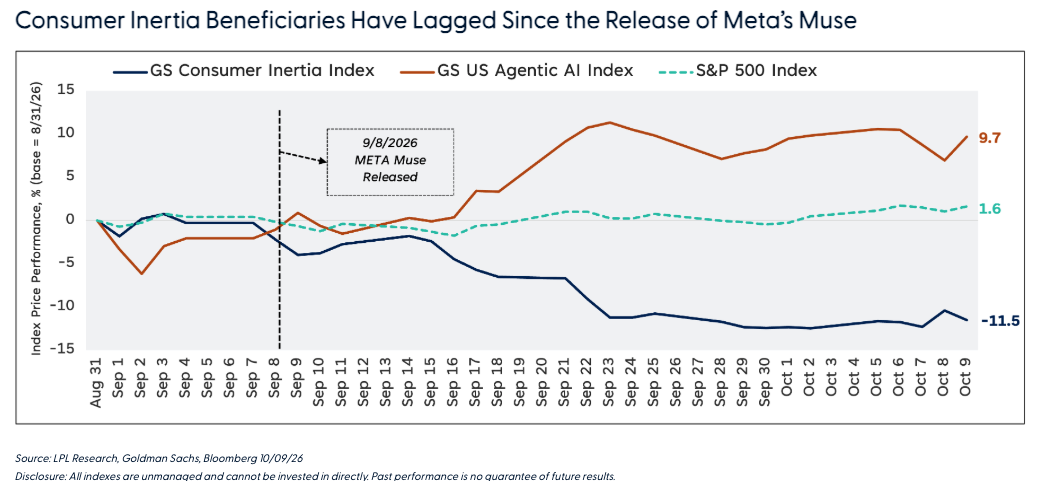
Joint research from economists at Stanford University and Texas A&M University studying subscription behavior found that when card replacement forced customers to make an active renewal decision, the monthly drop in retention was four times larger than in passive renewal periods. Their research concluded that consumer inertia raised seller revenue by 87% to 120% on average. If agents make active renewal and active comparison the default, they could pressure the inertia embedded in many business models.
E-commerce
First up, e-commerce, which depends heavily on discovery as consumers search, compare, and eventually make a purchasing decision. In a zero-click agentic commerce model, the consumer may never visit a retailer’s website, see a search-results page, or encounter the sponsored listing that funds much of the discovery ecosystem.
Potential disruption is not uniform, however. Strong brands, low-price leaders, and retailers with proprietary inventory will likely continue to do well. But the aggregation layer that monetizes the consumer’s search process, is more vulnerable. Our view is that LLMs can certainly add value to the discovery process (finding deals, parsing through reviews), which can drive some level of ad revenue disruption, similar to broader web search economics. However, we recommend a healthy dose of caution on extrapolating “LLM-enhanced search and discovery” to “agentic commerce becomes the primary way consumers transact online”.
Online Travel Agencies
Online travel agencies (OTAs) such as Expedia and Booking Holdings are essentially search, aggregation, and booking convenience layered over a fragmented supply of flights, hotel rooms, experiences, and rental cars. Why search and compare on multiple OTA websites when your agent can do that for you?
The OTA bear case suggests that if an agent can search across airlines, hotels, loyalty balances, and payment credentials, it can reduce the consumer’s need to visit one or multiple travel marketplaces. But travel is a high cost, exception-heavy, and at times emotional, purchase. The June 2026 traveler survey from global consultancy Accenture found that 87% of consumers were open to working with AI agents on travel decisions, but only 10% were willing to let an AI agent handle the actual payment without human approval. This suggests that personal AI agents may disrupt some level of travel discovery rather than fully displace OTA platforms.
Financial Institutions: Bank Deposits and Insurance Policies
Traditional deposit franchises have long benefited from customers who leave cash in low-yield accounts even when higher-yield alternatives might be available. The most likely reason, in our view, is the hassle of changing banks and the trust built with existing institutions, not that consumers don’t know that there are higher cash yields available. A personal AI agent claims to solve the hassle friction directly, by simply doing it for you. However, we’re not so sure consumers are ready to place similar levels of financial trust and comfort with big tech companies. Our view is that the personal AI agent risk to banks is marginal and financial, not disruptive. The earnings risk is that deposits become more rate-sensitive, driving greater competition for those deposits (via higher yields).
Insurance policy renewal shopping is another area where agents could reduce the value of consumer inertia. Auto, homeowners, renters, and small-business insurance often renew with limited active comparison, partly because the process is tedious. A personal AI agent could turn that annual renewal into an active auction. As such, insurance lead generation and comparison marketplaces could face headwinds, but carriers with high retention supported more by customer inertia than by differentiated underwriting, service, or bundling could also face higher shopping rates and more price-sensitive renewal behavior.
Parallels to the “SaaSpocolypse”
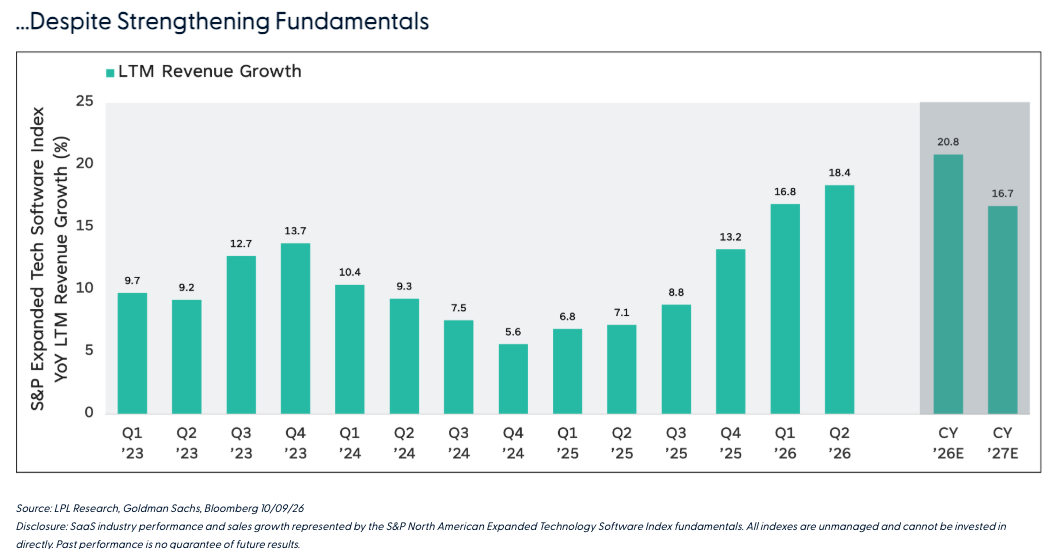
In early February 2026, software stocks sold off sharply on the fear that AI would collapse large parts of the “Software-as-a-Service” (SaaS) market, an event now widely known as the “SaaSpocalypse.” The narrative was AI coding tools could create all the software an enterprise needs and remove the need for seat-based software subscriptions, leaving only the strongest survivors. However, the fundamentals did not validate the panic, as many prominent software companies subsequently reported earnings that came in ahead of consensus revenue estimates. Meanwhile, SaaS revenue (measured using the trailing 12-month sales of the S&P North American Expanded Technology Software Index) grew ~17–18% year over year over the two quarters since the selloff, the fastest pace in several years. The takeaway here is that a disruption narrative can make sense, and stock performance can overshoot the actual fundamental impact.
The release of personal agents has legitimately pressured sentiment in the segments we discussed, but sentiment does not always map to reality. The right response is not to dismiss the disruption risk, but to separate market imagination from financial evidence. The “SaaSpocolypse Narrative Hammered Stock Prices...” and “…Despite Strengthening Fundamentals” charts illustrate the software industry’s relative underperformance, and the software industry’s accelerating sales growth.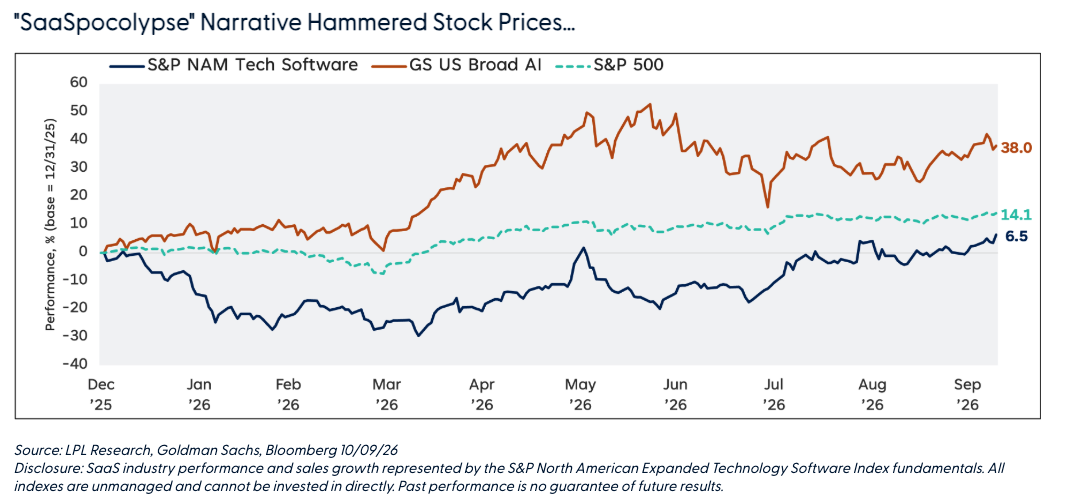
Personal Agent Economics
But what about the personal AI agent business model itself? Today, the easiest revenue models are subscription sales, usage-based models, or a combination of the two. That makes sense for early adoption, but it may not be the end state. The more powerful monetization opportunity is based on the transactions the agent undertakes on a user’s behalf, which could eventually try to capture some of the economics currently earned by OTAs, marketplaces, and payment networks.
The problem, as usual, is cost and unclear unit economics at the AI model layer. Estimates suggest only 2–3% of consumers currently pay for AI products, with average monthly spend around $31, and a bullish estimate of one billion personal AI agent subscriptions fails to keep up with accelerating estimated AI capex spending in 2026 and beyond.
That cost structure helps explain why advertising, referral fees, and transaction takes will be tempting. This creates a second problem, in our view, and that is trust. The agent’s value proposition depends on perceived alignment and the moment recommendations are visibly sponsored, the product risks becoming a search with a conversational wrapper.
Personal AI Agent Platform Durability
The personal AI agent market could evolve into a “winner-takes-most” platform with minimal competition. The first-order advantage and bull case for becoming a “winner-takes-most” platform is switching costs: as an agent accumulates preferences, permissions, workflow history, and trust, it becomes harder for the user to replace. The second-order advantage is scale: if one agent platform controls enough high-intent demand, suppliers may compete for access, creating a demand-aggregation flywheel that looks network-effect-like.
The bear case against this is that these tools in fact have weak switching costs. A competitor could offer a one-click import tool that transfers settings, etc., into a new assistant. If that happens, agents may struggle to earn durable excess returns and instead become a thin layer of convenience on top of existing platforms, making the personal agent business itself less attractive. Ironically, should a personal AI agent platform gain mass consumer traction but exhibit weak switching costs, it will likely benefit from the exact same inertia it aims to exploit.
Conclusion
We don’t see personal AI agents causing some sort of extinction event for e-commerce, OTAs, banks, or subscription businesses, at least not anytime soon. Over time, and if adoption reaches a large enough share of internet traffic, AI agents do present profit margin risks for businesses that rely on users navigating the internet (ad revenue requires eyeballs), and/or consumer inertia, whether it be subscription revenue or financial products. But these businesses will evolve, and some are likely to develop agentic tools themselves. Businesses with trusted brands, strong loyalty programs, or genuine service quality will likely prove more resilient than the early narrative suggests.
As for the business of personal AI agents themselves, the jury is still out on if these tools can move the needle in the monetization of consumer AI products. The same commodification issues present in monetizing consumer usage of chat-based products do not go away with agent-based personal assistants (generally speaking, these tools are broadly similar). Additionally, it’s easy to envision a future where these tools end up as features natively bundled into operating systems, rather than standalone products. When it comes to consumer business disruption due to personal AI agents, the fundamentals will decide whether the story is real.
Asset Allocation Insights
LPL’s Strategic and Tactical Asset Allocation Committee (STAAC) maintains its recommendation for a tactical equity overweight and fixed income underweight. We believe macroeconomic prospects will soon begin to improve and the AI-driven earnings boom will continue to support the broad equity market through 2026. The Committee favors the quality factor to express the tactical equity overweight, backed by resilient economic growth, AI innovation, and relative insulation from possible additional energy shocks.
The Committee holds a slight preference for the value style over its growth counterpart given cyclical tailwinds, relatively more attractive valuations, and energy strength. As such, we favor the energy sector, and recently upgraded the technology sector to overweight given an improved technical analysis picture, the reset of extreme positioning, and strong earnings growth. We hold an underweight stance toward the consumer discretionary and real estate sectors considering weak technicals and the backdrop of sticky inflation and higher rates.
Tom Shipp, Head of Equity Research, LPL Financial
Tucker Beale, Senior Equity Research Analyst, LPL Financial
A message from Advisor Perspectives and VettaFi: Discover something new! Click here to register for our upcoming webcasts.
Disclosures
This material is for general information only and is not intended to provide specific advice or recommendations for any individual. There is no assurance that the views or strategies discussed are suitable for all investors or will yield positive outcomes. Investing involves risks including possible loss of principal. Any economic forecasts set forth may not develop as predicted and are subject to change.
References to markets, asset classes, and sectors are generally regarding the corresponding market index. Indexes are unmanaged statistical composites and cannot be invested into directly. Index performance is not indicative of the performance of any investment and do not reflect fees, expenses, or sales charges. All performance referenced is historical and is no guarantee of future results.
Any company names noted herein are for educational purposes only and not an indication of trading intent or a solicitation of their products or services. LPL Financial doesn’t provide research on individual equities.
All information is believed to be from reliable sources; however, LPL Financial makes no representation as to its completeness or accuracy.
All investing involves risk, including possible loss of principal.
US Treasuries may be considered “safe haven” investments but do carry some degree of risk including interest rate, credit, and market risk. Bonds are subject to market and interest rate risk if sold prior to maturity. Bond values will decline as interest rates rise and bonds are subject to availability and change in price.
The Standard & Poor’s 500 Index (S&P500) is a capitalization-weighted index of 500 stocks designed to measure performance of the broad domestic economy through changes in the aggregate market value of 500 stocks representing all major industries.
The PE ratio (price-to-earnings ratio) is a measure of the price paid for a share relative to the annual net income or profit earned by the firm per share. It is a financial ratio used for valuation: a higher PE ratio means that investors are paying more for each unit of net income, so the stock is more expensive compared to one with lower PE ratio.
Earnings per share (EPS) is the portion of a company’s profit allocated to each outstanding share of common stock. EPS serves as an indicator of a company’s profitability. Earnings per share is generally considered to be the single most important variable in determining a share’s price. It is also a major component used to calculate the price-to-earnings valuation ratio.
The Russell 1000 Index consists of the 1,000 largest companies by market capitalization in the Russell 3000 Index, which represents approximately 90% of the total market capitalization of the Russell 3000 Index. It is a large-cap, market-oriented index and is highly correlated with the S&P 500 Index. Indexes are unmanaged and cannot be invested in directly.
Asset allocation does not ensure a profit or protect against a loss.
There is no guarantee that a diversified portfolio will enhance overall returns or outperform a non-diversified portfolio. Diversification does not protect against market risk.
Beta measures a portfolio's volatility relative to its benchmark. A beta greater than 1 suggests the portfolio has historically been more volatile than its benchmark. A beta less than 1 suggests the portfolio has historically been less volatile than its benchmark.
Important Scenario Analysis Disclosure: The analyses, scenarios, projections, and estimated returns discussed herein are hypothetical, are based on assumptions and estimates, and are provided solely for illustrative and educational purposes. The hypothetical "average hyperscaler" referenced in this report does not represent an actual company, portfolio, account, or investment product. Results shown are not forecasts or guarantees of future performance and are not intended to predict or project the performance of any specific security, company, sector, or market. Actual results may differ materially due to changes in economic conditions, competitive dynamics, technology adoption, capital spending, utilization rates, pricing, regulation, operating costs, and other factors.
The hypothetical results shown were not achieved by any actual investment strategy, account, or client and should not be viewed as indicative of actual investment results.
All index data from FactSet or Bloomberg.
This research material has been prepared by LPL Financial LLC.
Membership required
Membership is now required to use this feature. To learn more:
View Membership Benefits