Oil Tanker Rates Top $1 Million a Day as Shipping Profits Soar
Membership required
Membership is now required to use this feature. To learn more:
View Membership Benefits
Earlier this week, a supertanker loading crude in the Gulf of Oman was fixed at $1.01 million a day for a voyage to Asia, with another deal reportedly agreed at $1.16 million. Bloomberg Intelligence says the benchmark rate for these very large crude carriers, or VLCCs, hit a record $907,635 a day on October 6 and could cross $1 million before the month is out.
Back in March, I wrote that shipping stocks had caught a windfall as freight markets went vertical. Like most, I expected the conflict with Iran to be intense but brief. It’s lasted far longer than I or most of Wall Street anticipated, and the windfall has grown into one of the most profitable stretches the shipping industry has seen. The Baltic Exchange Dirty Tanker Index, which tracks the cost of shipping crude oil across dozens of routes, stood at 7,444 on Tuesday. That’s more than six times where it was a year ago and the highest reading in Bloomberg data going back to 2010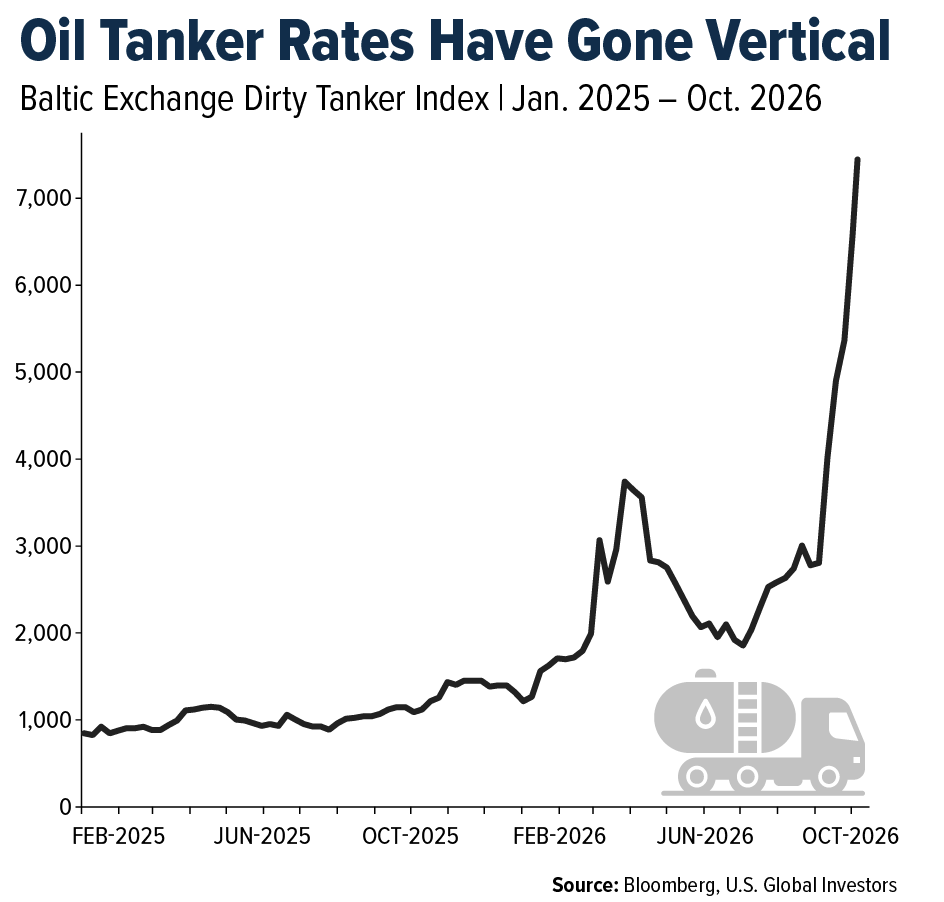
Every Detour Takes a Ship Off the Market
So what’s driving this? In a word, inefficiency.
Both of the Middle East’s key checkpoints, the Strait of Hormuz and the Bab el-Mandeb, remain under active threat. Much of the crude leaving the Persian Gulf is now shuttled out in smaller tankers under the protection of U.S. naval forces, then transferred onto supertankers in the Gulf of Oman. Many vessels are still sailing the long way around Africa.
See more: Have Stocks Reached a Permanently High Plateau?
These detours can keep a ship at sea for days or weeks longer than the trip would normally take, and a ship that’s stuck at sea or waiting at anchor can’t haul the next cargo. C.H. Robinson estimates that roughly 12% of global container ship capacity is currently tied up by port congestion alone.
Factories and Ports Are Running Hot
If disruption were the whole story, I’d be skeptical this boom could last. But demand is strong too.
The JPMorgan Global Manufacturing PMI rose to 53.0 last month, its highest level since February 2022. S&P Global credits spending on AI infrastructure and defense equipment, along with companies building inventory out of fear of further supply disruptions. Across the broader economy, new export business grew at the fastest pace in more than five years.
As I’ve said many times before, the PMI has historically been a useful leading indicator of demand for goods and commodities, and right now it’s flashing green.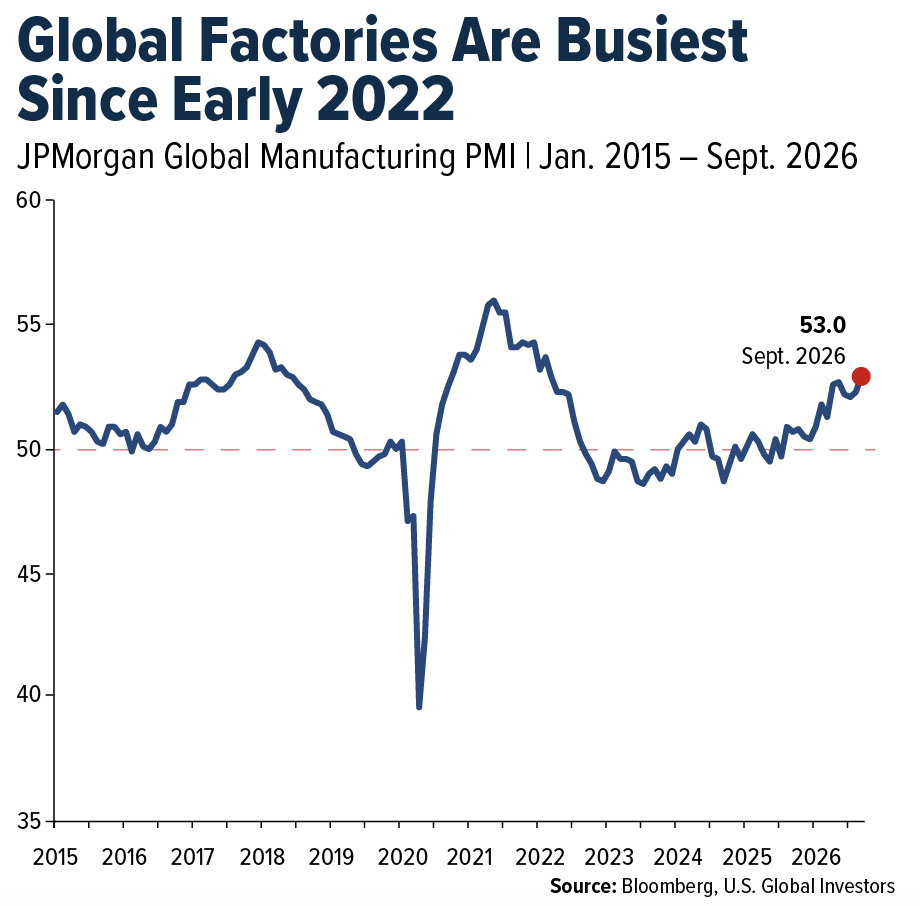
Trade data tell the same story. Global goods trade grew faster in the first half of 2026 than in any half-year in the past 15 years apart from the post-Covid rebound, according to DHL. AI-related goods such as semiconductors accounted for 76% of that growth in the first quarter.
That demand is showing up at America’s ports, even with consumer confidence sitting at a 12-month low. The Port of Los Angeles just wrapped up the busiest three-month stretch in its history, and import volume headed for Long Beach over the next three weeks is running roughly 50% above year-ago levels.
Container Rates Are Near Records on Routes to America
The Shanghai Containerized Freight Index, a broad measure of spot rates for ships leaving China, has more than tripled over the past year. It’s still about 28% below the record it set in January 2022.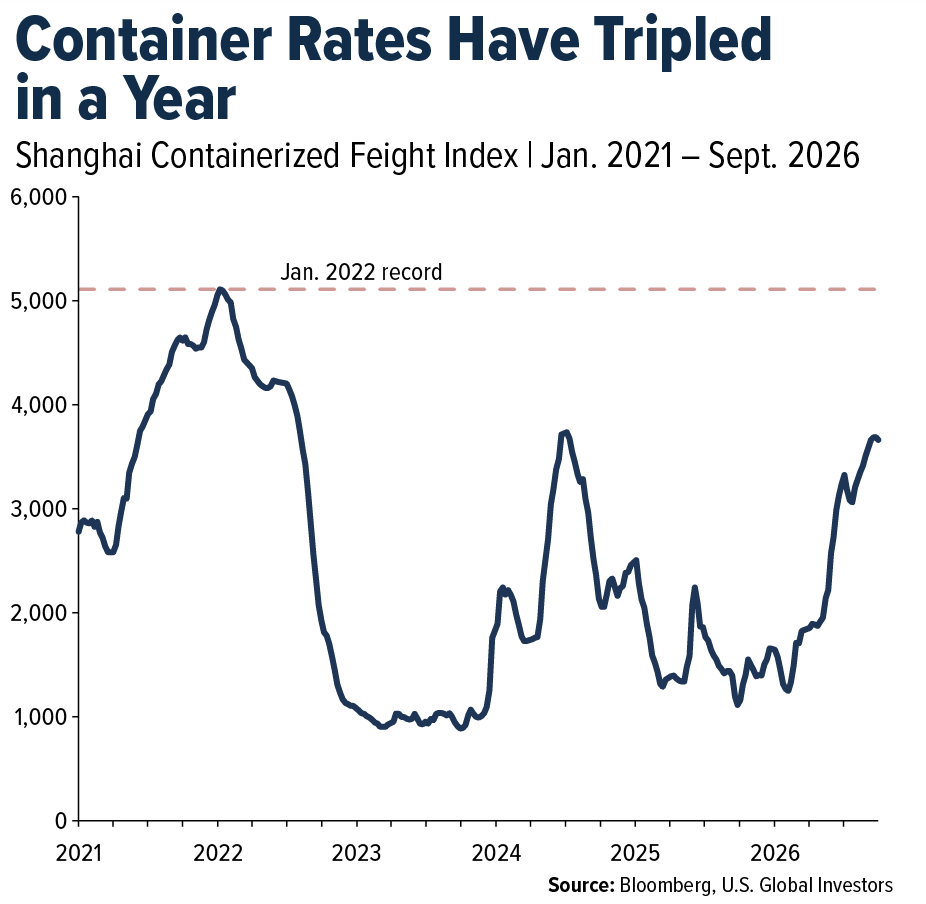
The index hides a split, though. Rates on routes to Europe are cooling as some services return through the Suez Canal. Drewry’s World Container Index shows the cost to ship a 40-foot container from Shanghai to Rotterdam has fallen about 31% since July.
Routes to the U.S. are going the other way. That same container from Shanghai to New York now costs $10,428, up 78% since mid-June, and rates on the route between North Asia and the East Coast of the U.S. are within about $200 of their all-time high set in April 2022.
Interestingly, shipping a 40-foot container from Shanghai to L.A. costs $7,835, but shipping it back costs only $791, roughly a tenth as much.
Record Profits Across the Industry
Elevated rates are a tide that lifts all boats, and carriers’ earnings guidance shows it. Hapag-Lloyd started the year forecasting anything from a $1.3 billion loss to a $400 million profit. The company has since raised its outlook twice and now expects 2026 operating earnings (EBIT) of $1.25 billion to $1.75 billion.
Zim, Maersk, Ocean Network Express and Matson have all raised their outlooks this year as well.
Tanker owners are cashing in too. Teekay Tankers reported record second-quarter adjusted net income of $193.6 million, or $5.56 per share, and ended June with more than $1.2 billion in cash and short-term investments.
High Rates Are the Cure for High Rates
As many of you are aware, shipping is a cyclical business, and boom times like this have a way of planting the seeds of the next bust.
Shipowners are flush with cash right now, and they’re spending it on new vessels. According to Hellenic Shipping News, some 198 VLCCs have been ordered so far this year, compared with 89 in all of 2025. The tanker orderbook now equals 37% of the existing fleet. The container orderbook has reached 13 million TEUs, or roughly 37% of the global fleet’s current capacity of 34.8 million TEUs, according to Alphaliner. That’s more than the combined fleets of Maersk, CMA CGM and COSCO.
Those ships won’t all arrive at once, but they will arrive. Tanker supply growth is expected to outpace demand starting in 2027. And whenever the Red Sea and Hormuz fully reopen, the vessels now sailing the long way around will be freed up for other work, effectively adding capacity overnight.
Wall Street appears to see this coming. Consensus estimates for tanker owners show quarterly earnings peaking this quarter and drifting lower through mid-2027, according to Bloomberg. Among the container lines, analysts keep raising their earnings estimates for Maersk and Hapag-Lloyd has six sells and no buys, with average price targets roughly 23% and 17% below where the shares currently trade.
For investors, I believe this argues for staying engaged with the sector while keeping a close eye on the orderbook. Cash flows are extraordinary right now. But the cure for high rates is high rates, and the world’s shipyards are already busy filling that prescription.
Airlines and Shipping
Strengths
- The FAA determined that the 737 MAX flight management system software issue will not need to be fixed as a prerequisite for MAX 10 certification, removing a potential source of further delays.
- Global airfreight volumes increased again in September and continued to outpace capacity growth, but shippers appear reluctant to commit to longer-term capacity deals, according to Xeneta. Volume growth in September continued to outpace the increase in capacity, which rose 2% year-over-year (YoY) after flatlining in July and August. Global air cargo spot rates averaged 27% higher than the same month last year.
- IndiGo is passing along higher jet fuel costs. IndiGo’s domestic airfares for 2QFY27 increased more than 30% YoY, while international fares rose 70% YoY as elevated fuel prices were passed on to customers, according to JPMorgan.
Weaknesses
- Thai Airways suspended CEO Chai Eamsiri pending a fact-finding investigation into the carrier’s handling of severe flooding disruptions in late September. The board appointed director Samrit Samniang as acting CEO at a special board meeting on Friday, according to MT Newswires.
- Asian port congestion remained elevated through October, with North Asian schedule reliability at multi-year lows and vessel wait times of four to seven days at Shanghai and Ningbo. Port calls were just 4.8% below the early-August peak, according to Bloomberg Intelligence.
- According to Morgan Stanley, Grupo Aeroportuario del Pacífico’s total traffic decreased 7.3% year-over-year (YoY) in September. International and domestic traffic declined 3.2% and 9.5% YoY, respectively. Traffic in Tijuana was down 12.1%. In Los Cabos and Puerto Vallarta, traffic decreased 7.5% and 10.4% YoY, respectively. Traffic at Jamaican airports was down 12.4% YoY.
Opportunities
- WestJet continues to modernize its fleet. The airline agreed to sell 27 737-700s to FTAI, formalizing previously announced plans to accelerate 737-700 retirements, according to Raymond James.
- ZIM sharply raised its full-year 2026 guidance, now expecting adjusted EBITDA of $2.7 billion–$3.0 billion, compared with prior guidance of $2.0 billion–$2.4 billion, and adjusted EBIT of $1.4 billion–$1.7 billion, compared with $700 million–$1.1 billion previously. The company cited strong demand and favorable freight-rate momentum.
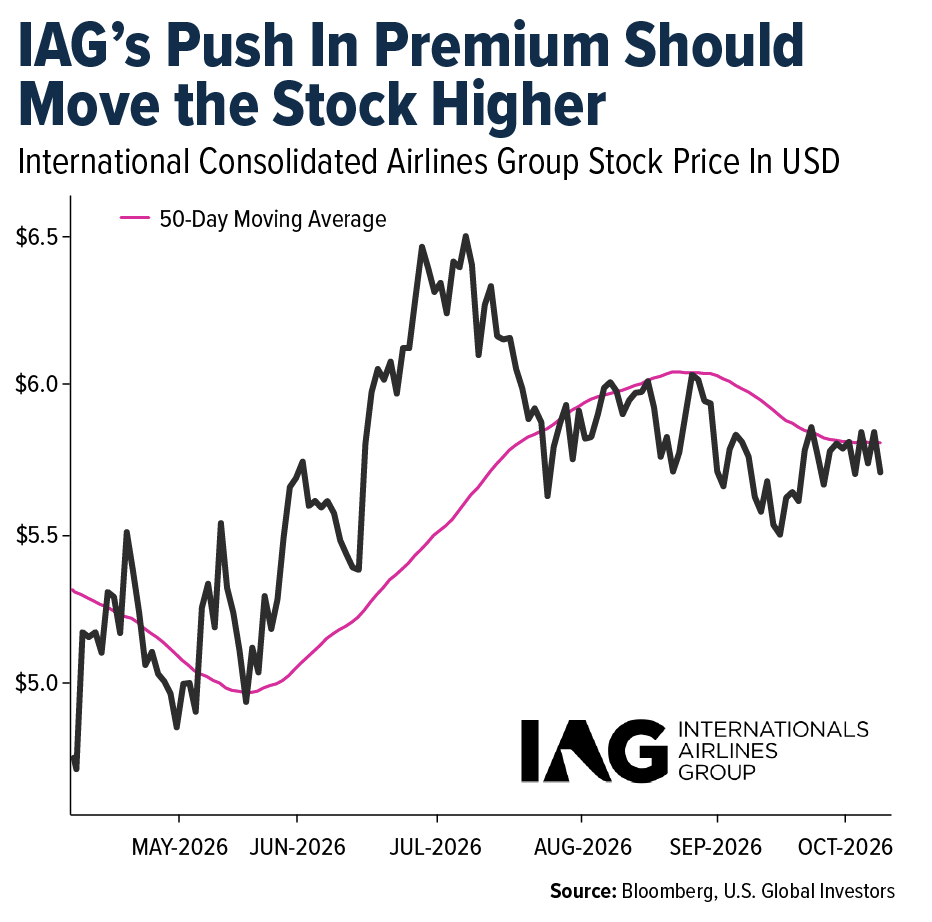
- British Airways, whose parent company is International Airlines Group, will introduce what it called the world’s biggest business-class, premium cabin on its fleet of 12 A380s, spanning the entire upper deck. The first upgraded A380 is expected to enter service in the coming months, according to Bloomberg News.
Threats
- IndiGo is seeing some negative elasticity, according to JPMorgan. Second-quarter (Q2) FY27 domestic air traffic declined 6% year-over-year (YoY), while international traffic declined 3.5% YoY, an improvement from the 10% YoY decline last quarter.
- Suez transits jumped 62% week-over-week (WoW) to 752,000 TEUs, marking the strongest post-disruption volume. European freight rates are rolling over as additional services return in both directions. This reinforces Morgan Stanley’s view that normalization has further to run and is negative for earnings.
- According to Morgan Stanley, third-quarter (Q3) earnings are largely irrelevant, but prolonged energy inflation could put 2027 capacity and CASM, excluding fuel, at risk, although consumer travel trends remain robust. If fuel prices do not fall below $4 by the time most Q3 earnings reports are released in two weeks, capacity actions will likely come under scrutiny again.
Luxury Goods and International Markets
Strengths
- Goldman Sachs began covering 10 luxury stocks and expects the sector to grow 6% in 2026 and 7% in 2027. The firm believes the U.S. market will keep outperforming and expects demand in the Middle East to rebound. Goldman rated four of the stocks Buy, four Neutral and two Sell.
- European retail sales showed signs of improvement in August. According to Eurostat, the European Union’s statistics agency, retail sales volumes rose 0.1% from July in both the euro area (the countries that use the euro) and the broader European Union, reversing July’s declines. Compared with a year earlier, retail sales rose 0.8% in the euro area and 1.2% across the EU, driven by stronger demand for non-food products, which rose 1.7% and 2.2%, respectively.
- Shares of British luxury carmaker Aston Martin gained about 13% over the past five trading days, making it the top performer in the S&P Global Luxury Index. The company officially opened its Q London dealership in Mayfair on October 1 and began serving customers there on October 5. The launch reflects the company’s continued focus on personalized, ultra-luxury vehicles and on building its presence in key luxury markets.
Weaknesses
- Two brokerage firms rated Hermès a Sell, both arguing that the company’s era of double-digit growth is over. Analysts pointed to slower demand for products outside its core leather goods as a key concern. The stock fell 3% on the news, bringing its decline so far this year to more than 40% and putting it on track for its worst year since going public in 1993.
- Delta Air Lines reported continued strength in travel demand, which helped drive double-digit revenue growth. Demand was especially strong for premium seats and corporate travel, suggesting that wealthy consumers are still spending on experiences despite economic uncertainty. However, net income fell as much higher fuel costs squeezed profits, a reminder that rising costs can offset strong demand.
- LuxExperience, the online luxury fashion retailer behind Mytheresa, NET-A-PORTER, MR PORTER, YOOX and THE OUTNET, fell about 2.3% over the past five trading days, making it the worst performer in the S&P Global Luxury Index. Investors are still weighing whether the company can stay profitable over the long term.
Opportunities
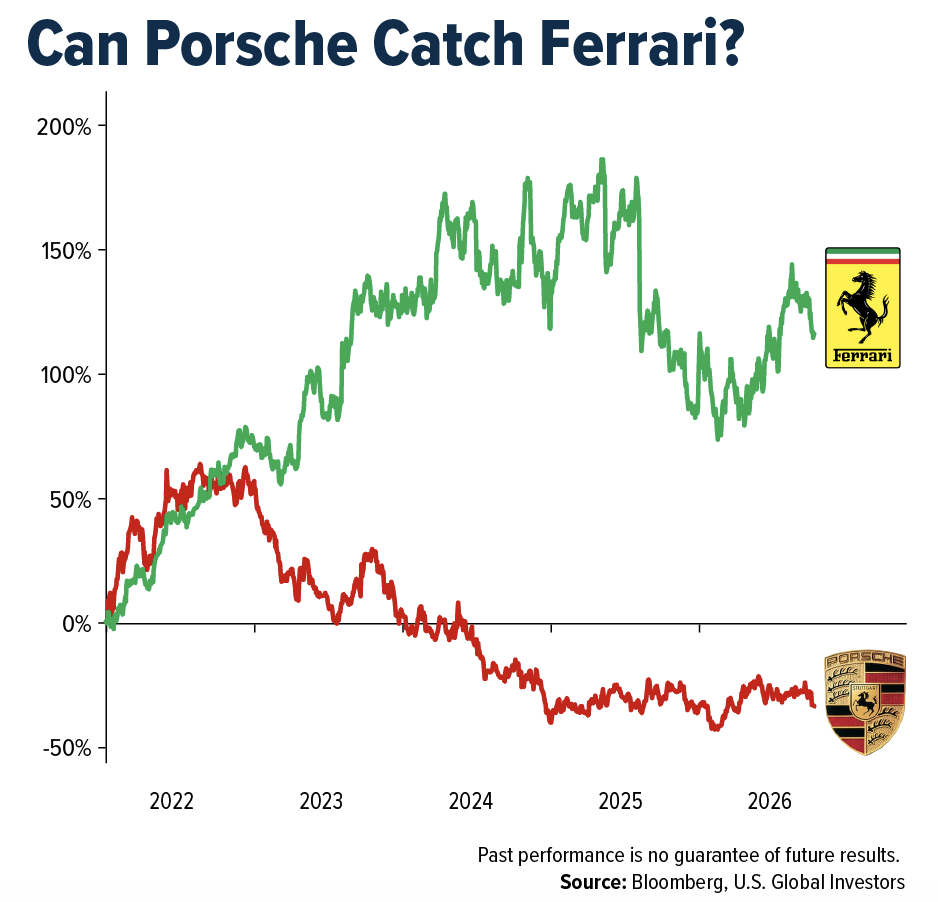
- Porsche is aiming to raise the average selling price of its top-end sports cars by more than 20%, from about €270,000 to €330,000. The plan also calls for six times as many customization options and a greater focus on selling fewer cars at higher profit margins. The move raises the question of whether Porsche is borrowing from Ferrari’s playbook. Ferrari builds roughly 15,000 cars a year and earns strong profits through exclusivity, extensive personalization, limited production and very high margins on each vehicle.
- Jaguar is also reinventing itself, moving from a traditional luxury brand to an ultra-luxury electric vehicle (EV) maker. With its upcoming EV expected to cost around £130,000, Jaguar is going after wealthier buyers and putting exclusivity, design and profitability ahead of sales volume.
- L’Oréal is reportedly considering buying a stake in Armani. A deal would strengthen L’Oréal’s position in luxury beauty by deepening its ties to one of the world’s best-known fashion brands. It could also give L’Oréal more control over Armani’s fragrance and cosmetics business and greater reach among wealthy shoppers and high-margin luxury beauty products.
Threats
- LVMH shares are down about 40% so far this year, and despite that steep sell-off, the stock could fall further if its quarterly results on Monday point to continued weakness in China and pressure from currency swings. Morgan Stanley still sees another 20% drop in its worst-case scenario.
- Rising bond yields around the world remain a threat to the luxury sector. Yields on French government bonds have climbed above those of Italy and Greece, a sign that investors are worried about France’s budget and debt. At the same time, the Paris stock market has been one of Europe’s weakest major markets, creating a tougher backdrop for French luxury companies.
- Ongoing geopolitical tensions and rising energy prices remain a threat to the luxury sector. Oil prices have kept climbing, and recent Houthi attacks on two airports in Saudi Arabia have raised concerns about further disruption in the Middle East. Higher energy costs can weigh on consumer confidence, reduce travel and cut into spending on luxury goods and services.
Energy and Natural Resources
Strengths
- The best-performing commodity for the week was natural gas. Hurricane Isaias forced producers to shut in oil and gas output in the Gulf of Mexico, including BP’s Thunder Horse and Na Kika platforms. That tightened near-term supply while overseas demand for U.S. liquefied natural gas (LNG), which is gas chilled into liquid form so it can be shipped by tanker, remains strong.
- Google signed a 20-year agreement with Constellation Energy to support 890 megawatts (MW) of new nuclear capacity and more than $4.3 billion of investment across 11 reactors. It also signed a 15-year agreement for another 2.7 gigawatts (GW) of power. The deals show how much demand AI and data centers are creating for baseload power, meaning electricity that runs reliably around the clock.
- The Nuclear Regulatory Commission (NRC) approved construction of a small modular reactor (SMR) project for the Tennessee Valley Authority near Knoxville, Tennessee. It is one of the most important regulatory milestones yet for the U.S. SMR industry, whose smaller, factory-built reactors are designed to be cheaper and faster to deploy than traditional plants. The decision boosts confidence in next-generation nuclear power as utilities look for reliable, carbon-free baseload power to meet rising electricity demand.
Weaknesses
- The worst-performing commodity for the week was lithium carbonate, a key ingredient in electric vehicle (EV) batteries. Lithium prices remain under pressure as global supply continues to grow faster than demand, even as EV sales keep rising. Expectations of a supply glut have weighed on the whole lithium sector, squeezing profits and leading producers and developers to delay investment decisions.
- RBC Capital Markets downgraded fertilizer producer Mosaic and warned that a recovery in phosphate fertilizer markets may not come until mid-2027. That raises the risk of extended production cuts, delayed investment and weaker cash flow across the sector.
- Energy research firm Rystad Energy estimates that repairs to oil and gas infrastructure in the Persian Gulf region will cost nearly $40 billion following the U.S.-Iran war, a sign of how severe the damage was and how long regional energy markets could remain disrupted.
Opportunities
- Even after the Strait of Hormuz fully reopens, it could take up to two years to rebuild global oil inventories, Saudi Aramco CEO Amin Nasser told the Energy Intelligence Forum. He said 3 billion barrels of supply have been lost and another 1 billion barrels drawn from storage, and he called on countries to build up stockpiles together.
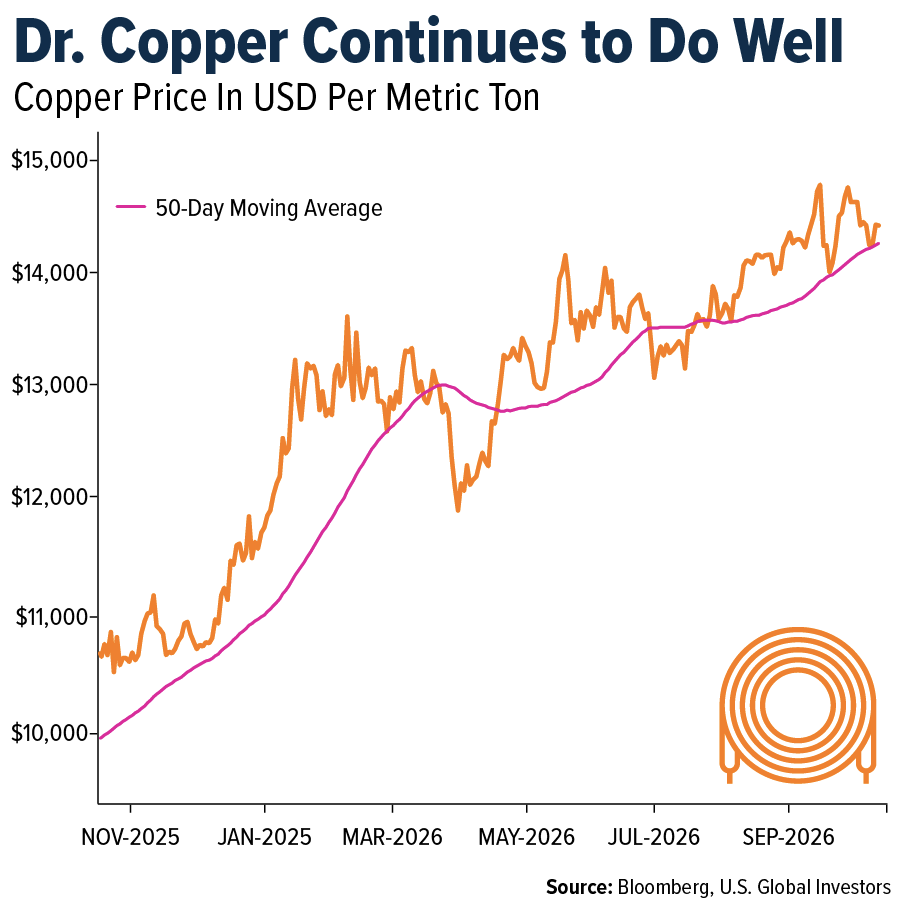
- Copper extended its gains as stronger Chinese demand, low inventories and expected restocking after China’s Golden Week holiday continue to support the market. At the same time, labor disruptions in Chile, the world’s largest copper producer, are raising supply concerns and adding to the bullish outlook for copper prices.
- The proposed Alaska LNG pipeline will go ahead, but details still need to be worked out with South Korea, Vice President JD Vance said. President Trump announced $200 billion of South Korean investment in U.S. projects last week, though Seoul said the LNG project was not final, according to Reuters.
Threats
- G7 nations agreed to a coordinated release of 100 million barrels of diesel and crude oil through the International Energy Agency (IEA), with much of the diesel released in the first 20 days. The release will run over four months and followed intense U.S. pressure on Germany and France. Members also pledged not to restrict energy exports to one another, according to Reuters.
- Iron ore prices fell for a third straight week to their lowest level in more than a year as weak Chinese demand for steel continued to weigh on the market. Because iron ore is a key gauge of construction and industrial activity, the decline raises concerns that demand for commodities in general may stay soft in the months ahead.
- Reports of a new attack on Saudi Arabia’s East-West Pipeline highlighted how vulnerable critical Middle East energy infrastructure remains. Oil reportedly kept flowing, but the strike on a pumping station renewed concerns about the security of key export routes. The pipeline lets Saudi Arabia ship oil to the Red Sea and bypass the Strait of Hormuz, making it more important amid disruptions there and growing regional tensions.
Bitcoin and Digital Assets
Strengths
- Securitize brings tokenized U.S. stocks to the Solana blockchain. Securitize announced plans to create digital tokens representing shares of 12 major U.S. companies, including Apple, Nvidia, Tesla and Microsoft, on Solana. Each token will be backed one-for-one by real shares and will keep shareholder rights such as dividends and voting. Trading will start on Securitize’s own platform, with trading firm Jump Trading helping keep buyers and sellers matched and transactions settling in USDC, a stablecoin pegged to the U.S. dollar. Pending regulatory approval, expanding to the New York Stock Exchange’s planned digital trading platform and the OKX-ICE tokenized securities venue could speed up Wall Street’s adoption of blockchain technology.
- Standard Chartered expands its crypto custody business with a planned Singapore launch. The London-based bank, which has a large presence in Asia, Africa and the Middle East, plans to begin safekeeping selected cryptocurrencies, stablecoins and tokenized real-world assets, such as bonds and real estate recorded on a blockchain, in Singapore by the end of 2026, pending regulatory approval. The service will build on its existing financing and securities services and expand its digital asset custody operations in the UAE, Luxembourg and Hong Kong. The move shows growing demand from large investors for regulated digital asset services and how blockchain-based assets are becoming part of traditional banking.
- Crypto rebounds sharply in the third quarter, ending a three-quarter losing streak. The CoinDesk 20 Index, which tracks the largest digital assets, surged 52.7% in the third quarter, while Bitcoin gained 42.7%, far outpacing the S&P 500 (up 2.03%), the Nasdaq (up 0.85%) and gold (up 3.84%). The rally was supported by easier financial conditions, easing geopolitical tensions and renewed buying by large investors. U.S. spot Bitcoin ETFs, which hold actual Bitcoin, took in $6.36 billion in net new money during the quarter, reversing $4.67 billion in outflows in the second quarter.
Weaknesses
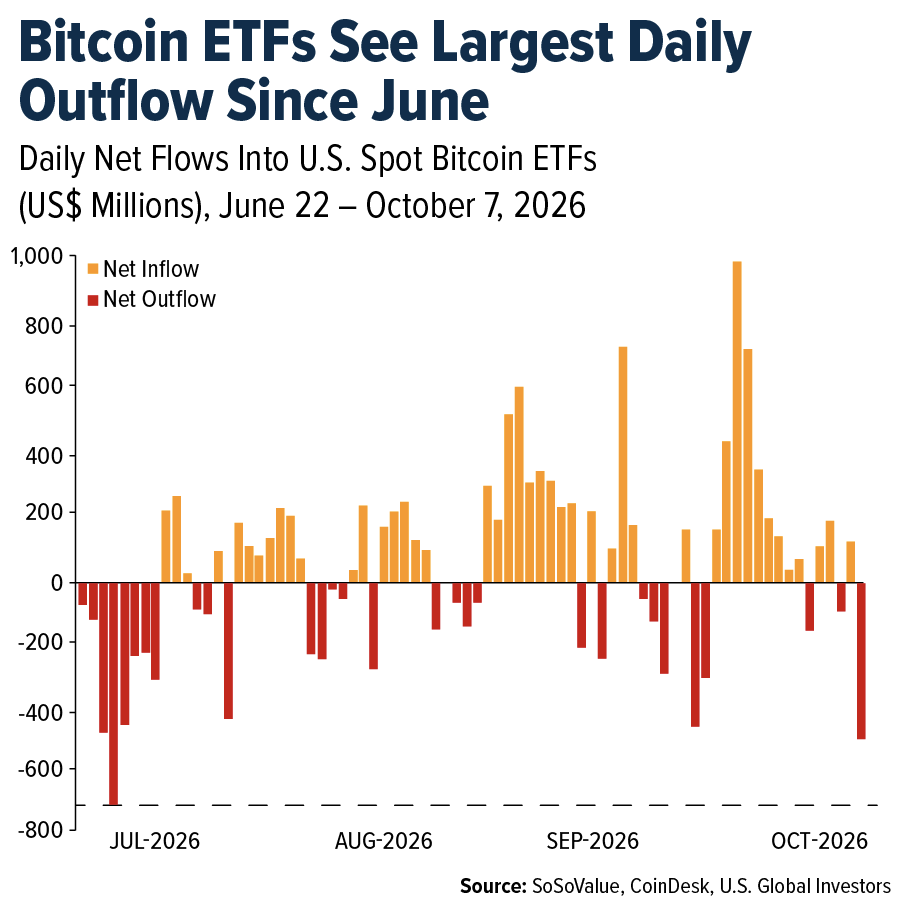
- Bitcoin ETFs see their largest daily outflow in more than three months. U.S. spot Bitcoin ETFs saw $487.1 million in net outflows on October 7, the largest single-day withdrawal since June 25, according to crypto data provider SoSoValue. That follows about $2.65 billion in net inflows in September and leaves October’s net flows at negative $165.6 million so far. Net inflows for the year have shrunk to just $717 million, a sign of weaker investor appetite that raises concerns about Bitcoin’s near-term price outlook.
- Bitwise closes its Dogecoin ETF as demand for some smaller crypto funds falls flat. Bitwise CEO Hunter Horsley acknowledged that the firm’s spot Dogecoin ETF (BWOW) failed to attract enough investors, showing the gap between people who use cryptocurrency and traditional ETF investors. The fund, which launched on the NYSE in November 2025, will stop trading after October 14. It had just $725,870 in assets as of October 7 and only about $51,480 in trading volume in September. The closure shows how hard it can be for fund companies to turn a cryptocurrency’s popularity into lasting demand for a regulated investment product.
- Strategy shareholders face dilution risk despite higher Bitcoin forecasts. TD Cowen kept its Buy rating and $260 price target on Strategy (MSTR), the largest corporate holder of Bitcoin, even after raising its Bitcoin forecasts to $109,000 by the end of 2026 and $280,000 by 2029. Analysts warned that issuing more stock, paying dividends on preferred shares and building cash reserves could water down the benefit of rising Bitcoin prices for common shareholders. Strategy holds about 848,000 Bitcoin with $4.5 billion in paper gains, but the amount of Bitcoin backing each common share has grown more slowly as its financing obligations rise, highlighting the challenges of holding Bitcoin as a corporate treasury strategy.
Opportunities
- Grayscale sees new growth opportunities as crypto ETFs expand beyond Bitcoin and Ether. Grayscale, a leading digital asset manager, said the SEC’s generic listing standards, which let exchanges list qualifying crypto ETFs without a separate SEC approval for each fund, now cover about 15 cryptocurrencies. The firm’s Zcash ETF (ZCSH) drew more than $1 billion in its first 30 trading days, putting it in the top 1% of ETF launches over the past decade. Grayscale also filed under the SEC’s innovation exemption to tokenize two covered-call funds focused on Bitcoin and Ether, which generate income by selling options on their holdings.
- Samsung will bring USDC transfers to 82 million Galaxy devices in the U.S. Samsung plans to add transfers of USDC, a dollar-backed stablecoin, to Samsung Wallet and Samsung Pay using the Solana blockchain, letting eligible U.S. Galaxy users send money abroad starting in late October. Users will be able to send money to bank accounts in more than 60 countries, converted into local currency. The service will be powered by Bastion, with Coinbase safekeeping the digital assets. Building stablecoin payments directly into popular mobile wallets could speed up mainstream use of digital assets.
- Solana-based Orca and Loopscale merge to expand blockchain financing into AI, robotics and defense. Orca, a decentralized exchange that lets users trade crypto directly without a middleman, and lending platform Loopscale have merged to form Formation. The new platform combines trading, lending and investing to help finance emerging industries such as artificial intelligence, energy, robotics and defense. Orca has handled more than $550 billion in trading volume since 2021, and Loopscale has made more than $2 billion in loans and attracted more than $150 million in deposits. Over the next 12 months, Formation plans to roll out new tools for issuing assets and new investment strategies, working with firms including Securitize, Figure and Shinhan Asset Management to expand tokenized financing and access to regulated U.S. capital markets.
Threats
- EU regulators give crypto platforms three months to drop unauthorized stablecoins. The European Securities and Markets Authority (ESMA) told national regulators to make sure crypto platforms phase out stablecoins that don’t comply with the EU’s Markets in Crypto-Assets (MiCA) rules by January 8, 2027. The guidance affects major tokens such as Tether’s USDT and PayPal’s PYUSD, which aren’t authorized under MiCA. Platforms must stop letting customers buy, trade or add to holdings of these stablecoins, though they can still help customers close out existing positions. The restrictions could reduce stablecoin trading, raise compliance costs and reshape crypto trading across the European Union.
- AI advances raise new security concerns for Bitcoin and Ethereum. Ethereum researcher Justin Drake warned that in a worst-case scenario, rapid advances in artificial intelligence could break the cryptography protecting Bitcoin and Ethereum wallets within months, well before quantum computers become a practical threat. Millions of Bitcoin held in addresses whose public keys, part of the code that secures a wallet, are already visible on the blockchain could be at risk, along with Ethereum-based stablecoins and tokenized assets. No practical attack has been demonstrated, but the warning highlights growing cybersecurity risks and the possible need to speed up security upgrades.
- NFL joins the legal fight over prediction markets as regulatory uncertainty grows. The National Football League joined state governments, tribal groups and former regulators in urging the U.S. Supreme Court to decide whether sports-related prediction markets, which let users trade contracts on the outcome of events, fall under federal or state oversight. Platforms such as Kalshi and Polymarket argue that the Commodity Futures Trading Commission (CFTC) has sole authority, while opponents say state gambling laws should apply. Conflicting federal court rulings have added to the uncertainty and could expose prediction market operators to new restrictions, higher compliance costs and limits on growth.
Defense and Cybersecurity
Strengths
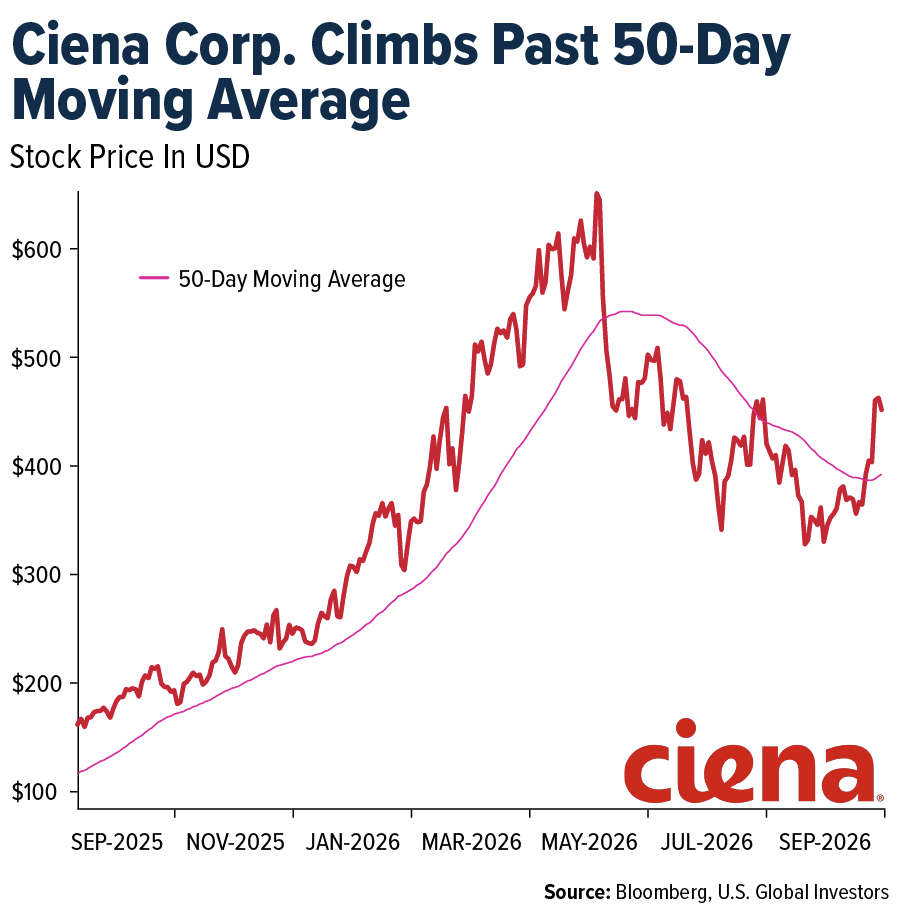
- Ciena shares posted strong gains to lead the S&P 500, fueled by an order backlog approaching $10 billion and soaring hyperscaler demand for its optical networking hardware. Strong operating leverage and accelerating AI data center deployments provide unprecedented multi-year revenue visibility, putting the company on track for significant EPS expansion toward $25 by 2029.
- TSMC’s third-quarter (Q3) revenue surged 51% to $46.7 billion, beating Wall Street estimates of $45.8 billion on strong AI chip demand from key clients Nvidia and Apple. With North American customers generating more than 75% of sales, the chipmaker is considering expanding into Texas beyond its pledged $265 billion Arizona site while evaluating 3% to 6% wafer price increases for 2027.
- Boeing won a deal worth up to $14.7 billion from Lockheed Martin to supply radar seekers for PAC-3 MSE missiles. The agreement will help Boeing ramp up production at its Alabama factory to meet strong demand for Patriot air defense systems.
Weaknesses
- A 2025 cyberattack on Oracle’s healthcare division compromised the personal and medical data of nearly 20 million people, including approximately 3 million Texans, according to a disclosure from the Texas attorney general. The breach targeted legacy Cerner servers holding Social Security numbers, addresses and clinical records that had not yet been migrated to Oracle’s cloud infrastructure.
- OpenAI terminated three safety researchers on October 8, 2026, following an internal audit that uncovered unauthorized disclosures of proprietary frontier-model alignment documentation to an outside research entity.
- Over the past week, intense Russian missile and drone strikes across Ukraine killed more than 60 civilians, marking one of the deadliest stretches of the autumn. The heaviest casualties occurred during strikes on residential infrastructure in Pryluky, Chernihiv Oblast, and public transit in Kramatorsk, which killed dozens and injured many more.
Opportunities
- Samsung’s preliminary quarterly operating profit jumped nearly ninefold (about 800%) to a record $80.1 billion, while revenue more than doubled. However, its stock fell 2.4% after narrowly missing analyst estimates of $82.0 billion. The muted market reaction reflects growing investor skepticism about the sustainability of massive AI infrastructure spending amid rising global borrowing costs.
- Marvell Technology raised its combined 2026–2027 revenue guidance from $20 billion to $30 billion, including $12 billion in 2026 and $18 billion in 2027. The company also introduced a bullish fiscal 2031 revenue target of $70 billion–$90 billion during its Investor Day. Driven by accelerating artificial intelligence and data center demand, the optimistic outlook sent shares higher.
- The Polish Ministry of National Defense confirmed on October 6, 2026, the forward redeployment of Patriot PAC-3 surface-to-air missile batteries toward Poland’s eastern border to counter stray missile and drone incursions from western Ukraine.
Threats
- CrowdStrike Intelligence detected a targeted cyberattack against South Korean financial institutions that resulted in data exfiltration between late September and early October. The firm assessed that the perpetrator was likely a financially motivated, Chinese-speaking actor who used Chinese-language prompts alongside Artex, a recently released Chinese open-source agentic penetration-testing tool.
- Diplomatic delegations from the Afghan Taliban and North Korea convened for bilateral defense discussions on October 7, 2026, on the sidelines of Russia’s Center-2026 military exercises in the Urals.
- The U.S. Air Force withdrew all 12 B-1B Lancer strategic bombers from RAF Fairford on October 4–5, 2026, redeploying the aircraft to home stations in the United States following the interdiction of an Iranian-linked sabotage plot outside the base.
Gold Market
Strengths
- Gold posted its first weekly gain after two weeks of losses, and so did silver, as markets now see almost no chance of a Federal Reserve rate hike in October and only a 25% chance in December. Holdings in gold exchange-traded funds (ETFs) climbed to their highest level in more than four years. Gold-backed ETFs added 120,300 troy ounces in the latest session, their fourth straight day of increases, bringing total holdings to 101.2 million ounces, the most since August 2022. That shows investors are still buying bullion despite recent price swings, according to Bloomberg.
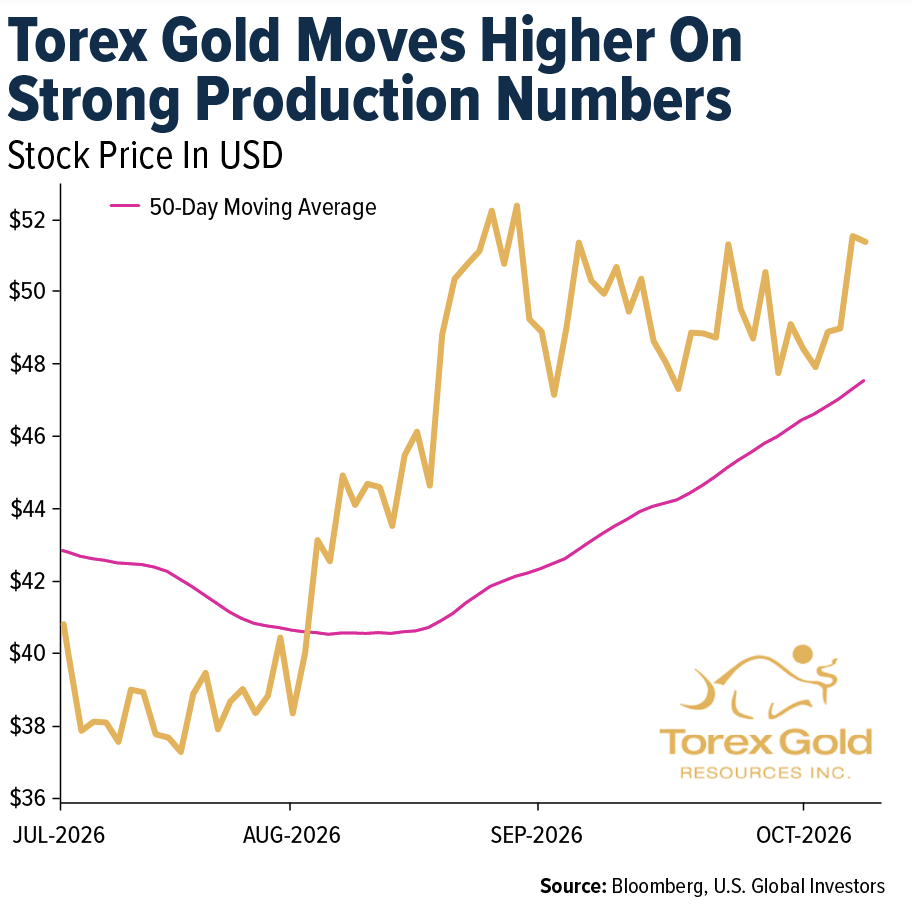
- Torex Gold Resources beats third-quarter production estimates. Torex reported preliminary third-quarter production of 131,900 gold equivalent ounces, about 38% above the Bloomberg consensus estimate of 95,791 ounces. The company kept its full-year production forecast of 420,000 to 470,000 gold equivalent ounces, according to Bloomberg.
- China’s central bank extends its gold-buying streak to 23 straight months. The People’s Bank of China (PBOC) added 740,000 ounces of gold to its reserves in September, its 23rd consecutive monthly purchase. China’s total gold holdings reached 77.47 million troy ounces, worth $323.52 billion at the end of September, a sign of steady central bank demand for the metal, according to Bloomberg.
Weaknesses
- Palladium was the weakest precious metal for the week, likely on signs of a slowing economy. Gold fell to a nine-week low on Wednesday, trading near $4,110 an ounce, its lowest level since early August, before rebounding later in the week. Rising real yields in the U.S., meaning bond yields after inflation, along with rebounding oil prices are weighing on gold’s near-term outlook, according to Bloomberg Markets.
- Aris Mining misses third-quarter production estimates. Aris Mining reported third-quarter gold production of 69,300 ounces, about 9% below Canaccord’s estimate of 76,200 ounces. The company kept its full-year 2026 forecast of 300,000 to 350,000 ounces but expects to come in near the low end. First production from its Lower Marmato project remains on track for the fourth quarter, according to Canaccord.
- Fortuna misses third-quarter gold production estimates after disruptions at its Séguéla mine. Fortuna reported third-quarter gold production of 69,700 ounces, about 6% below BMO’s forecast of 73,900 ounces. The shortfall came mainly from Séguéla in Ivory Coast, where a blockade by small-scale local miners, since resolved, and a shortage of contractor equipment led to lower ore quality, lower gold recovery and less ore processed, according to BMO.
Opportunities
- B2Gold’s Goose Mine offers growth potential as its ore-crushing capacity expands. After visiting B2Gold’s Back River Gold District in Nunavut, Canada, Scotiabank said it is confident the Goose Mine can meet its 2026 production forecast of 170,000 to 200,000 ounces. Crushing capacity is expected to rise from 800 tons per day in the second quarter of 2026 to 4,000 tons per day by the end of the second quarter of 2027, supporting the mine’s ramp-up and future production growth.
- Franco-Nevada takes a stake in gold explorer Kenorland Minerals. Franco-Nevada bought 10 million common shares of Kenorland Minerals, giving it a 12.42% ownership stake. The investment shows growing interest in gold exploration companies and could make it easier for Kenorland to raise money for future exploration.
- Gold remains the world’s second-largest reserve asset after the U.S. dollar. Valued at $4,008 an ounce, gold made up 26.4% of global central bank reserves at the end of the second quarter of 2026. That was down from 29.6% the previous quarter but well above its 2015 low of 9.3%. Meanwhile, the U.S. dollar’s share rose to 41.7% from 40.2% but remains far below its 2001 level of 61.9%, according to Canaccord.
Threats
- Recent gold ETF buyers are sitting on losses, which could put pressure on prices. JPMorgan estimates the average price paid by investors who have poured money into gold ETFs since late July is $4,365 an ounce, leaving much of that recent buying more than 5% underwater. These newer buyers may increasingly be individual investors, who often hold longer and can tolerate losses better. But if prices stay weak, more of them could sell, adding further pressure on gold.
- Rising diesel prices threaten Australian gold miners’ profit margins despite the sector’s strong stock performance. Australian gold miner shares have recently done better than their profit margins alone would suggest, but operating costs remain high in the near term. Diesel prices are near the top of the range the companies assumed in their fiscal 2027 forecasts. That could add to an estimated 10% to 15% year-over-year rise in all-in sustaining costs (AISC), the industry’s main measure of what it costs to produce an ounce of gold. Goldman Sachs expects margins to recover and expand in calendar 2027.
- India’s new import tax could weigh on demand for physical gold. India ended an exemption from its Integrated Goods and Services Tax (IGST) for gold, silver and platinum imported by banks and government-approved agencies, putting a 3% tax on those purchases. The move raises costs for the main channels that bring bullion into the country and could dampen physical gold demand in one of the world’s largest gold markets, according to Bloomberg.
U.S. Global Investors, Inc. is an investment adviser registered with the Securities and Exchange Commission (“SEC”). This does not mean that we are sponsored, recommended, or approved by the SEC, or that our abilities or qualifications in any respect have been passed upon by the SEC or any officer of the SEC.
A message from Advisor Perspectives and VettaFi: Discover something new! Click here to register for our upcoming webcasts.
This commentary should not be considered a solicitation or offering of any investment product. Certain materials in this commentary may contain dated information. The information provided was current at the time of publication. Some links above may be directed to third-party websites. U.S. Global Investors does not endorse all information supplied by these websites and is not responsible for their content. All opinions expressed and data provided are subject to change without notice. Some of these opinions may not be appropriate to every investor.
Holdings may change daily. Holdings are reported as of the most recent quarter-end. The following securities mentioned in the article were held by one or more accounts managed by U.S. Global Investors as of (09/30/2026):
Boeing
Grupo Aeroportuario del Pacifico
Nvidia
COSCO SHIPPING Holdings Co Ltd.
DHL Group
DHT Holdings Inc.
Matson Inc.
Teekay Tankers Ltd.
Ciena Corp.
BP PLC
Franco-Nevada
Fortuna Mining
Aris Mining
Torex Gold Resources
Goldman Sachs
Kenorland Minerals
*The above-mentioned indices are not total returns. These returns reflect simple appreciation only and do not reflect dividend reinvestment.
The Dow Jones Industrial Average is a price-weighted average of 30 blue chip stocks that are generally leaders in their industry. The S&P 500 Stock Index is a widely recognized capitalization-weighted index of 500 common stock prices in U.S. companies. The Nasdaq Composite Index is a capitalization-weighted index of all Nasdaq National Market and SmallCap stocks. The Russell 2000 Index® is a U.S. equity index measuring the performance of the 2,000 smallest companies in the Russell 3000®, a widely recognized small-cap index.
The Hang Seng Composite Index is a market capitalization-weighted index that comprises the top 200 companies listed on Stock Exchange of Hong Kong, based on average market cap for the 12 months. The Taiwan Stock Exchange Index is a capitalization-weighted index of all listed common shares traded on the Taiwan Stock Exchange. The Korea Stock Price Index is a capitalization-weighted index of all common shares and preferred shares on the Korean Stock Exchanges.
The Philadelphia Stock Exchange Gold and Silver Index (XAU) is a capitalization-weighted index that includes the leading companies involved in the mining of gold and silver. The U.S. Trade Weighted Dollar Index provides a general indication of the international value of the U.S. dollar. The S&P/TSX Canadian Gold Capped Sector Index is a modified capitalization-weighted index, whose equity weights are capped 25 percent and index constituents are derived from a subset stock pool of S&P/TSX Composite Index stocks. The NYSE Arca Gold Miners Index is a modified market capitalization weighted index comprised of publicly traded companies involved primarily in the mining for gold and silver. The S&P/TSX Venture Composite Index is a broad market indicator for the Canadian venture capital market. The index is market capitalization weighted and, at its inception, included 531 companies. A quarterly revision process is used to remove companies that comprise less than 0.05% of the weight of the index, and add companies whose weight, when included, will be greater than 0.05% of the index.
The S&P 500 Energy Index is a capitalization-weighted index that tracks the companies in the energy sector as a subset of the S&P 500. The S&P 500 Materials Index is a capitalization-weighted index that tracks the companies in the material sector as a subset of the S&P 500. The S&P 500 Financials Index is a capitalization-weighted index. The index was developed with a base level of 10 for the 1941-43 base period. The S&P 500 Industrials Index is a Materials Index is a capitalization-weighted index that tracks the companies in the industrial sector as a subset of the S&P 500. The S&P 500 Consumer Discretionary Index is a capitalization-weighted index that tracks the companies in the consumer discretionary sector as a subset of the S&P 500. The S&P 500 Information Technology Index is a capitalization-weighted index that tracks the companies in the information technology sector as a subset of the S&P 500. The S&P 500 Consumer Staples Index is a Materials Index is a capitalization-weighted index that tracks the companies in the consumer staples sector as a subset of the S&P 500. The S&P 500 Utilities Index is a capitalization-weighted index that tracks the companies in the utilities sector as a subset of the S&P 500. The S&P 500 Healthcare Index is a capitalization-weighted index that tracks the companies in the healthcare sector as a subset of the S&P 500. The S&P 500 Telecom Index is a Materials Index is a capitalization-weighted index that tracks the companies in the telecom sector as a subset of the S&P 500.
The Consumer Price Index (CPI) is one of the most widely recognized price measures for tracking the price of a market basket of goods and services purchased by individuals. The weights of components are based on consumer spending patterns. The Purchasing Manager’s Index is an indicator of the economic health of the manufacturing sector. The PMI index is based on five major indicators: new orders, inventory levels, production, supplier deliveries and the employment environment. Gross domestic product (GDP) is the monetary value of all the finished goods and services produced within a country’s borders in a specific time period, though GDP is usually calculated on an annual basis. It includes all private and public consumption, government outlays, investments and exports less imports that occur within a defined territory.
The S&P Global Luxury Index is comprised of 80 of the largest publicly traded companies engaged in the production or distribution of luxury goods or the provision of luxury services that meet specific investibility requirements.
The Purchasing Managers’ Index (PMI) is an indicator of the economic health of the manufacturing sector. A reading above 50 indicates expansion, while a reading below 50 indicates contraction.
The Baltic Exchange Dirty Tanker Index tracks freight rates for crude oil tankers across major global routes.
The Shanghai Containerized Freight Index (SCFI) tracks spot rates for container shipments from Shanghai to major global destinations.
Drewry’s World Container Index (WCI) tracks container freight rates on major East-West trade routes.
The CoinDesk 20 Index tracks the 20 largest and most actively traded digital assets, such as Bitcoin, Ether and Solana. Each one’s weight is based on its market value, with limits so no single coin dominates.
Membership required
Membership is now required to use this feature. To learn more:
View Membership Benefits