Key takeaways
- We expect the Federal Reserve to raise rates only modestly from here, but the path will depend on whether inflation broadens beyond energy and other supply-driven pressures.
- The artificial intelligence (AI) investment boom is helping support growth and earnings, potentially reducing the need for a prolonged hiking cycle, even as inflation remains above the Federal Reserve's 2% target.
- We suggest investors focus on oil prices, inflation trends, and credit conditions, while favoring diversified equity exposure and short- to intermediate-term bonds.
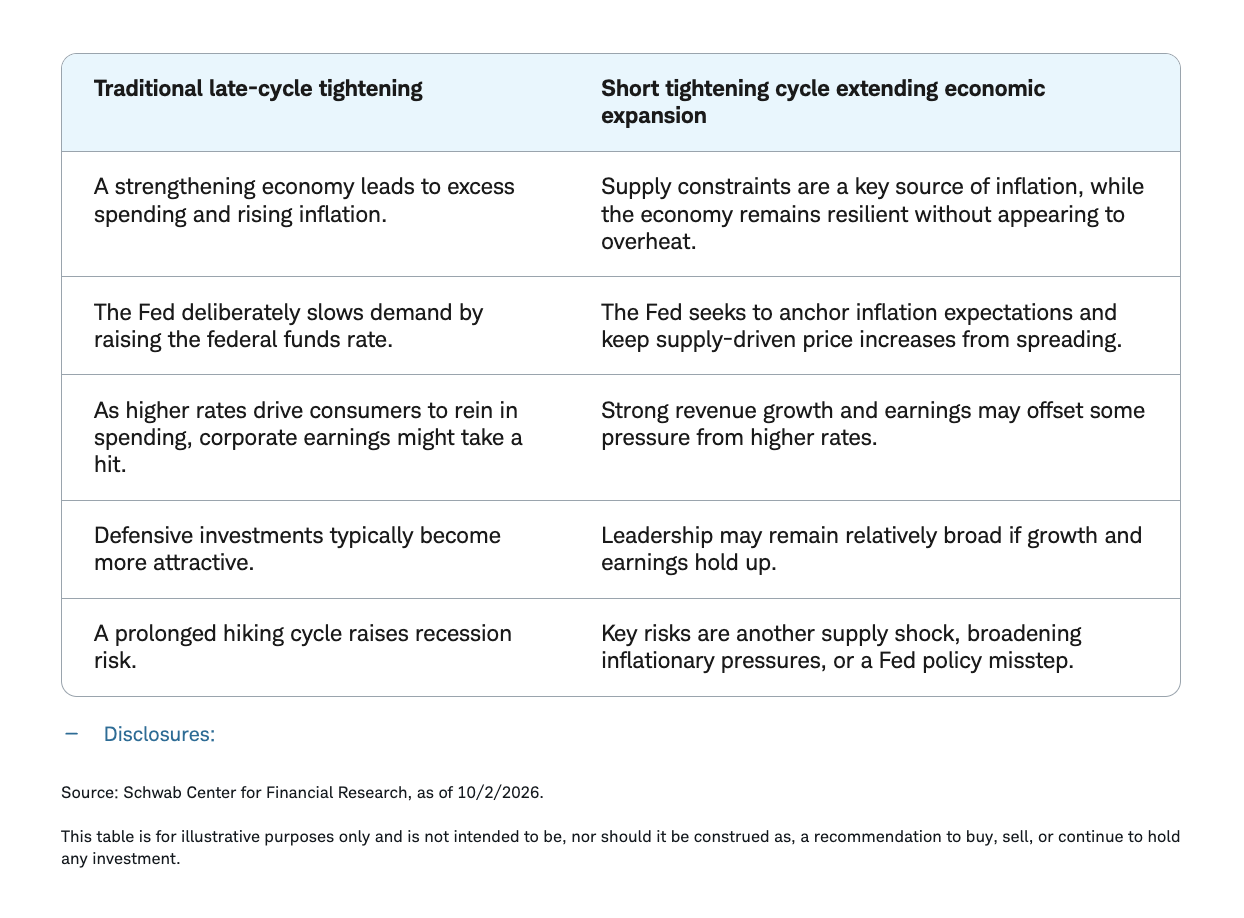
The Fed's recent rate increase may not develop into a hiking cycle as extensive as the one that began in 2022 because much of today's inflation pressure comes from supply constraints rather than broad economic overheating, where demand exceeds the economy's productive capacity. However, persistent oil-price pressure, resilient demand, or widening inflation could require additional rate increases and create greater risks for housing, credit, stocks, and long-term bonds.
With inflation remaining above its 2% target for more than five years, the Fed recently raised its benchmark rate to support a "timelier return" to its inflation goal. This is not a typical rate-hiking campaign triggered solely by excess demand. While the U.S. economy remains resilient and has seen a pick-up in activity recently, according to several leading indicators, much of the current inflation pressure comes from supply constraints, especially in energy.
Higher rates cannot produce more oil, repair disrupted supply chains, build more semiconductors, or generate more electricity. They can, however, limit the risk that the oil supply shock or AI-related investment and demand spread to wages, services prices, and inflation expectations. Containing those potential second-round effects is likely to be an important focus for the Federal Reserve.
At the same time, the U.S. economy has been supported by the AI investment boom. Spending on data centers, computing equipment, software, and research is adding to U.S. growth and offsetting some of the drag that higher rates would otherwise be expected to exert on the economy. The impact of AI on inflation, however, is more nuanced. Higher demand for semiconductors, electricity, and power infrastructure is raising costs in select producer-price categories, but there are few signs that these pressures are driving broader price increases or a change in longer-term inflation expectations.
This leaves the Fed weighing whether raising interest rates will be effective in reducing inflation. In other words, many of the forces keeping inflation elevated today originate from the supply side of the economy, where monetary policy has narrower influence.
There is an important distinction between supply-driven inflation and demand-driven inflation. If the Fed is responding mainly to supply-driven inflation rather than an overheating economy, a couple of additional increases may be needed to contain price pressures without ending the expansion. The AI capital expenditures (capex) cycle adds uncertainty to that judgment because it may strengthen near-term demand, even if it improves the economy's productive capacity over time. Even so, the likely path remains less aggressive than the cycle that began in 2022.
Our base case is for two additional rate increases, followed by a pause. But ultimately the endpoint of the hiking cycle will depend on how growth and inflation evolve. Stronger demand without a corresponding improvement in supply could require more restraint, while clearer productivity gains and easing inflation could allow the Fed to hike less than we anticipate.
The Fed will therefore need to weigh both sides of the AI dynamic alongside monthly core inflation, whether price pressures are broadening out across the economy, inflation expectations, labor-market conditions, and evidence that higher energy costs are not passing through to other goods, services, and wages.
A more aggressive or prolonged tightening cycle would most likely follow if growth remains stronger than expected while inflation stays firm, or if a worsening supply disruption or new supply-side shock broadens underlying price pressures. Conversely, softer growth or sustained disinflation—or a slowing pace of price increases rather than an outright decline in prices—would reduce the need for additional hikes. Ultimately, the precise endpoint for the Fed's rate increases is likely to be data-dependent.
See more: From TINA To TIGA: Diversification Pays Again
Why is the current Fed tightening cycle different?
How could Fed rate hikes affect the U.S. economy?
The level of economic resilience will depend on how well the economy absorbs higher borrowing costs. Three areas deserve particular attention:
-
The expansion could continue. A shallow hiking cycle does not necessarily end an expansion. If employment, business investment, and household spending remain resilient, the economy may withstand somewhat higher rates. The question is whether the Fed can restrain inflation without causing unnecessary weakness in demand.
-
Housing is a clear pressure point. Higher mortgage rates could further strain affordability and weigh on home sales, construction, housing-related investment activity, and related consumption. Fed policy does not directly control mortgage rates, but credible inflation policy can limit pressure on long-term Treasury yields. With residential investment already contracting in seven of the past 10 quarters, based on data from the Bureau of Economic Analysis available through the second quarter of 2026, housing bears watching even if it does not trigger a downturn.
-
Consumer resilience may narrow. Higher borrowing costs and prices could squeeze discretionary purchases. Spending may remain positive but rely more heavily on higher-income households. Housing affordability, delinquencies, lending standards, discretionary earnings revisions, and small-business confidence can show whether pressure is spreading.
Growth links the economic outlook to markets. Continued revenue and earnings growth would give companies more room to absorb higher financing costs.
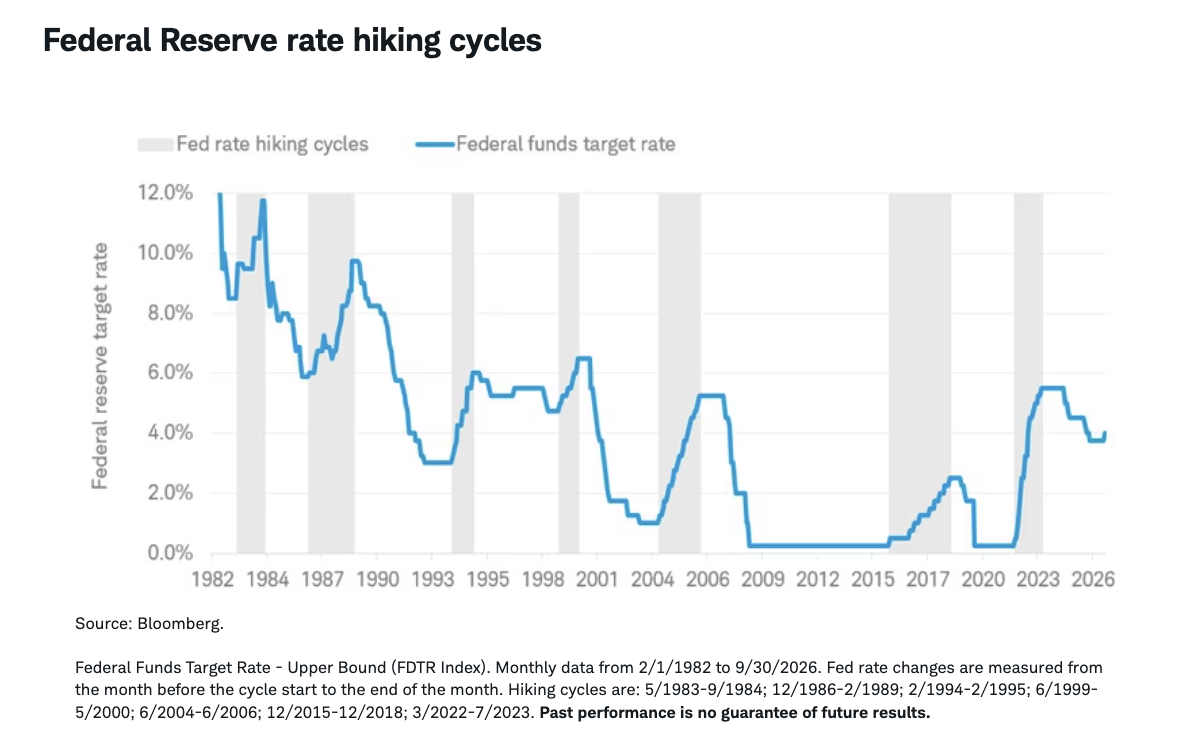
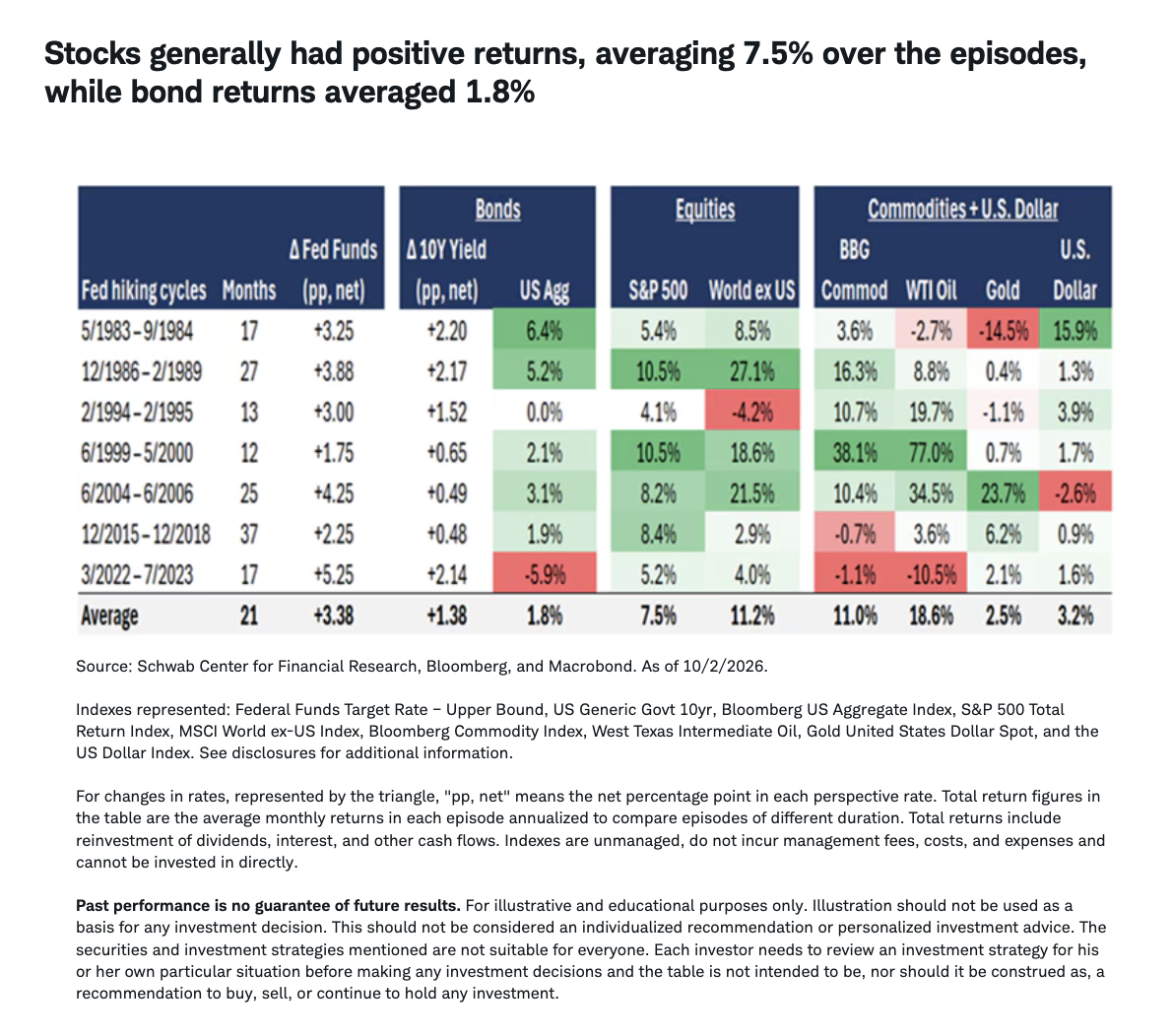
Risk assets have often posted positive returns during Fed hiking cycles, but the path is not always smooth, and outcomes vary across each cycle. The chart below highlights the last seven Fed rate hiking cycles going back to 1983 and the table below lists the average annualized returns across those episodes.
These periods lasted an average of 22 months. During them, the Fed raised its target policy rate by an average of 3.3 percentage points, while the 10-year Treasury yield increased by an average of 1.4 percentage points.
Bonds have tended to lag in real terms (real terms refers to bond returns after accounting for inflation) because tightening usually coincides with elevated inflation and rising yields. Investment outcomes can depend on whether nominal growth remains strong enough to offset tighter financial conditions (which refers to a more restrictive financing environment, such as higher borrowing costs and reduced access to credit).
The S&P 500 delivered an average annualized total return of 7.5% during Fed hiking cycles, slightly below the historical average. But developed market equities have posted stronger returns on average, as have commodities.
Past cycles offer helpful information but are not a forecast for what may transpire going forward. Equities and commodities have generally produced positive returns during tightening periods, and non-U.S. equities have outperformed U.S. equities.
What do Fed rate hikes mean for stocks?
Broadly, rising interest rates can hurt stocks by increasing borrowing costs (i.e., the cost of capital goes up) and slowing overall growth. Higher bond yields also mean investors can earn more by buying new bonds, changing the return calculus relative to stocks. But rate increases do not affect every company or industry equally. Debt levels, refinancing needs, pricing power, and exposure to capital spending matter more as financing costs rise.
Several areas may retain support if economic growth remains positive:
-
Energy may remain supported if constrained supply keeps oil prices and sector earnings firm, but could underperform in a scenario where oil falls from current levels.
-
Industrials and materials can benefit from capital investment, solid nominal growth, and commodity exposure, but are at risk from slower growth.
- Some Healthcare segments may offer durable growth above the rising cost of capital and have less direct sensitivity to potentially slower discretionary spending, but face risks that include regulatory changes and technological innovation that can alter sector economics.
-
Selective technology companies may hold up when profitability, balance sheets, and AI investment returns justify valuations. Capital-spending returns and earnings expectations remain critical. Risks include new innovations that could change the competitive dynamics of the industry, poor returns on investment, and regulatory changes.
-
Momentum, growth, and liquidity factors have historically outperformed in high-growth, high-inflation regimes, although leadership can change quickly and could lead to these factors underperforming.
-
International equities have often performed well during Fed hiking cycles. Resilient global growth can favor markets with greater commodity and cyclical exposure. Lower starting valuations may broaden the opportunity set. Slowing global growth, a stronger dollar, and higher energy prices or prolonged supply shortages are key risks.
Country selection still matters. Commodity exporters may benefit from higher prices, while importers face pressure. Currency exposure, domestic monetary policy, fiscal credibility, and geopolitics can matter as much as regional labels. Areas facing potential headwinds are:
-
Capital intensive businesses require heavier borrowing to build and maintain infrastructure, making higher borrowing costs a direct drag on profitability.
-
Defensive sectors can be more sensitive to interest rates because their returns can be more dependent on dividend yield, which is more comparable to fixed income yields like bonds.
-
Consumer businesses exposed to tighter credit and rising input costs may face slower sales and thinner margins, particularly when pricing power is limited.
-
High-valuation stocks can underperform as higher interest rates and inflation can compress stock valuations via higher capital costs (a higher discount rate applied to future cash flows) and inflation risk.
-
Highly levered and low-quality companies—those with high debt levels, relatively low profitability, and high underlying EPS (earnings per share) and price volatility—can face pressure from slower growth and interest expense, especially when debt is floating rate or near-term refinancing needs are higher.
-
Small-cap stocks with weak balance sheets or near-term refinancing needs may be vulnerable. This is a stock-selection issue, not a blanket call on the asset class.
-
Real estate investment trusts (REITs) and other long-duration assets remain sensitive to financing costs and changes in bond yields.
What do Fed rate hikes mean for bonds?
Higher Treasury yields have improved prospective income, but resilient growth and the potential or additional rate hikes could push yields even higher.
When the Fed hikes rates, investors should keep the following in mind:
-
Favor short- and intermediate-term maturities over long-term maturities. The longer the maturity, the more sensitive the bond is to interest rate changes. With more risks to the upside than the downside with long-term yields, it's too early to tactically consider long-term investments. Historically, the 10-year Treasury yield tends to peak closer to the last rate hike of a cycle, not the first. Long-term Treasury yields are becoming more attractive as yields rise, since the high yield can help offset price declines if yields continue to rise. If yields continue to move up, or if our economic outlook deteriorates, we'll likely have a more favorable view on long-term bonds. Keep in mind that if inflation pressures don't subside and the Fed ends up hiking more than expected, there could be potential price declines even with the short- and intermediate-term bonds we prefer.
-
Investment-grade and high-yield corporate bonds can still benefit from solid nominal growth, resilient earnings, and adequate liquidity. Some cracks are forming in the high-yield bond market, as CCC1 issuers (one of the lowest rungs of the high-yield rating spectrum) could be at risk if they need to refinance at higher rates. Valuation is the key risk. Credit spreads, or the extra yield corporate bonds offer above comparable Treasuries, have increased recently but remain low relative to history. There are risks, of course: if the economy slows or the corporate profit outlook deteriorates, corporate bond prices could fall relative to Treasuries. Municipal bonds generally have high credit quality, may offer attractive tax-adjusted income for investors in higher tax brackets, and their yields relative to Treasuries have risen lately.
- Consider Treasury Inflation-Protected Securities (TIPS). TIPS are a type of Treasury whose principal value is indexed to the consumer price index (CPI). We have a neutral view on TIPS, but that supports the case for them to be held as a strategic allocation. TIPS "real" yields, or inflation-adjusted yields, are positive and relatively high, and when held to maturity, a positive real yield means an investor's annualized total return should beat the annualized change in the CPI by a magnitude of that real yield. With oil prices high and the outlook murky, TIPS can help protect against additional inflation increases.
- The yield curve may continue to flatten, but investors should watch for potential steepening. Short-term yields remain closely tied to Fed policy, while long-term yields reflect expected growth, future policy rates, and the term premium. Meaningful steepening often occurs after rate cuts begin or after an extended pause. The cause matters: bear steepening driven by stronger growth is more consistent with continued expansion than steepening driven by policy easing in a downturn.
What could change the Fed rate outlook?
Three risks could materially change the outlook:
-
Oil remains a key variable because it affects inflation, consumer purchasing power, profit margins, and the Fed's reaction function. If prices stay high but stable, inflation can still improve through base effects, meaning that once the high oil prices from earlier this year enter the year-over-year calculations, the rate of change should improve. A renewed surge would be more challenging as it could raise the odds of second-round inflation, demand destruction as higher gas prices potentially result in less spending elsewhere, and additional Fed tightening.
-
Geopolitical shocks can move through several channels at once, including energy, shipping, trade restrictions, confidence, and capital spending. History shows that even promising soft-landing paths can be disrupted by events outside the Fed's control. That argues for diversification and risk monitoring.
-
AI investment trends are a key driver of corporate profit growth this year and are contributing to the strong growth environment and also driving up prices in select areas, like semiconductors. A change in these trends could lead to increased market volatility given the sheer size of the current investment cycle and elevated investor expectations around future growth.
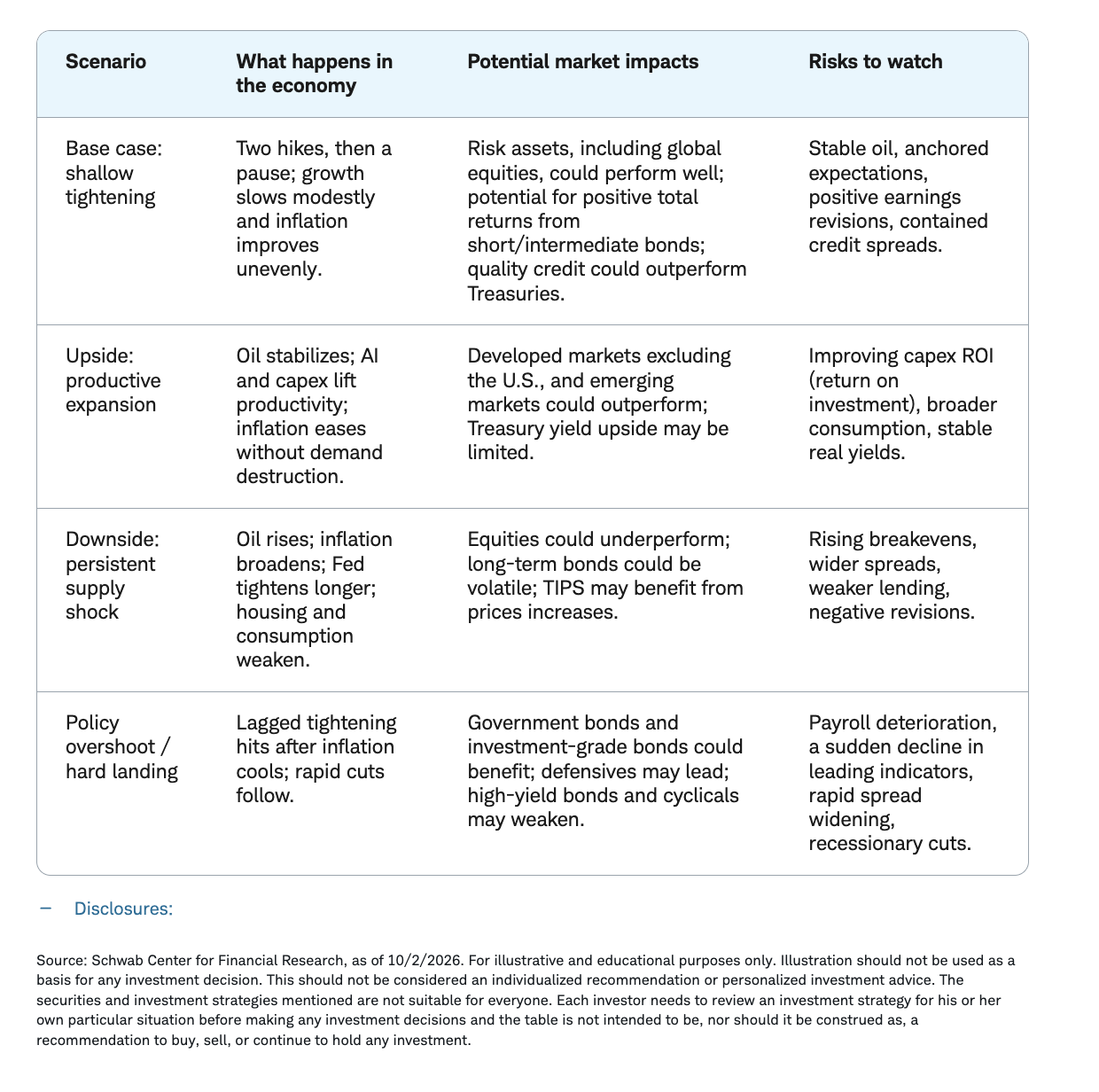
The table below shows how those risks could alter the economic and portfolio outlook. The scenarios range from a shallow tightening cycle, in which growth slows modestly and inflation improves, to a policy overshoot that produces a hard landing. Oil prices, inflation expectations, earnings revisions, lending conditions, credit spreads, and labor-market data are the main indicators distinguishing the four paths.
Fed rate scenarios and potential market impacts
What should investors watch next?
The key question today is whether the Fed can cool inflation without breaking nominal growth, earnings, or credit conditions. History supports a constructive view: hiking cycles have often coincided with continued economic expansion, positive equity returns, and resilient credit markets.
However, we caution against assuming a replay of historical trends. No cycle follows the historical script exactly—each has its own drivers. There is little room for complacency today with ongoing geopolitical turmoil, high oil prices, rapid technological innovation, and uncertainty around the path forward for inflation. Moreover, investor allocations to equities are at the high end of historical ranges, valuations are elevated, housing is under pressure, and consumer strength may be narrowing. Those crosscurrents make incoming data more important than any single forecast for the next Fed meeting.
We continue to suggest that clients remain aligned with their strategic portfolio allocations and long-term goals and be selective about any positioning in the current environment:
- Retain target portfolio risk allocations and look for high-quality growth opportunities.
- Bond yields are becoming more attractive but it's too early to tactically extend duration.
-
Diversify internationally but be selective across countries and sectors, distinguishing those who are positively versus negatively exposed to higher interest rates.
- In a more temperamental regime, flexibility and diversification should age better than a heroic call on the next Fed meeting.
1 The Moody's investment-grade rating scale is Aaa, Aa, A, and Baa, and the sub-investment-grade scale is Ba, B, Caa, Ca, and C. Standard and Poor's investment-grade rating scale is AAA, AA, A, and BBB and the sub-investment-grade scale is BB, B, CCC, CC, and C. Ratings from AA to CCC may be modified by the addition of a plus (+) or minus (-) sign to show relative standing within the major rating categories. Fitch's investment-grade rating scale is AAA, AA, A, and BBB and the sub-investment-grade scale is BB, B, CCC, CC, and C.
This material is intended for general informational and educational purposes only. This should not be considered an individualized recommendation or personalized investment advice. The securities, investment products and investment strategies mentioned are not suitable for everyone. Each investor needs to review an investment strategy for his or her own particular situation before making any investment decisions. For illustrative purposes only. Individual situations will vary and are no guarantee of future performance or success. Not intended to be reflective of results you can expect to achieve and are not intended to be, nor should they be construed as, a recommendation to buy, sell, or continue to hold any investment.
Past performance is no guarantee of future results. The value of investments and the income derived from them can go down as well as up. Future returns and the achievement of stated goals are not guaranteed, and a loss of principal may occur.
Investing involves risk, including loss of principal.
Diversification and asset allocation strategies do not ensure a profit and do not protect against losses in declining markets.
International investments involve additional risks, which include differences in financial accounting standards, currency fluctuations, geopolitical risk, foreign taxes and regulations, and the potential for illiquid markets. Investing in emerging markets may accentuate this risk.
Emerging Markets Risk. Emerging market countries may be more likely to experience political turmoil or rapid changes in market or economic conditions than more developed countries. Such countries often have less uniformity in accounting and reporting requirements and greater risk associated with the custody of securities. In addition, the financial stability of issuers (including governments) in emerging market countries may be more precarious than in other countries.
Fixed income securities are subject to increased loss of principal during periods of rising interest rates. Fixed income investments are subject to various other risks including changes in credit quality, market valuations, liquidity, prepayments, early redemption, corporate events, tax ramifications, and other factors. Lower rated securities are subject to greater credit risk, default risk, and liquidity risk.
Treasury Inflation Protected Securities are inflation-linked securities issued by the US Government whose principal value is adjusted periodically in accordance with the rise and fall in the inflation rate, measured by the Consumer Price Index. Thus, the semiannual interest amount payable is also impacted by variations in the inflation rate, as it is based upon the principal value of the bond. It may fluctuate up or down. Repayment is guaranteed by the US Government, and at maturity investors will receive the greater of the original principal amount at issuance or the inflation-adjusted principal amount. Treasury Inflation-Protected Securities are guaranteed by the US Government, but inflation-protected bond funds do not provide such a guarantee.
Tax-exempt bonds are not necessarily a suitable investment for all persons. Information related to a security's tax-exempt status (federal and in-state) is obtained from third parties, and Charles Schwab & Co., Inc. does not guarantee its accuracy. Tax-exempt income may be subject to the Alternative Minimum Tax (AMT). Capital appreciation from bond funds and discounted bonds may be subject to state or local taxes. Capital gains are not exempt from federal income tax.
Commodity-related products carry a high level of risk and are not suitable for all investors. Commodity-related products may be extremely volatile, may be illiquid, and can be significantly affected by underlying commodity prices, world events, import controls, worldwide competition, government regulations, and economic conditions.
Real estate investment trusts (REITs) -Risks of the REITs are similar to those associated with direct ownership of real estate, such as changes in real estate values and property taxes, interest rates, cash flow of underlying real estate assets, supply and demand, and the management skill and creditworthiness of the issuer. Investing in REITs may pose additional risks such as real estate industry risk, interest rate risk, risks related to the uncertainty of and compliance with certain tax regime rules, and liquidity risk.
Small-Cap Company Risk. Small-cap companies may be more vulnerable to adverse business or economic events than larger, more established companies and their securities may be riskier than those issued by larger companies. The value of securities issued by small-cap companies may be based in substantial part on future expectations rather than current achievements and their prices may move sharply, especially during market upturns and downturns. In addition, small-cap companies may have limited financial resources, management experience, product lines and markets, and their securities may trade less frequently and in more limited volumes than the securities of larger companies. Further, small-cap companies may have less publicly available information and such information may be inaccurate or incomplete.
This information is not intended to be a substitute for specific individualized tax, legal, or investment planning advice. Where specific advice is necessary or appropriate, you should consult with a qualified tax advisor, CPA, Financial Planner, or Investment Manager.
Schwab does not recommend the use of technical analysis as a sole means of investment research.
Indexes are unmanaged, do not incur management fees, costs, and expenses and cannot be invested in directly. For more information on indexes, please see schwab.com/indexdefinitions.
The policy analysis provided by the Charles Schwab & Co., Inc., does not constitute and should not be interpreted as an endorsement of any political party.
All expressions of opinion are subject to change without notice in reaction to shifting market, economic or political conditions. Data contained herein from third party providers is obtained from what are considered reliable sources. However, its accuracy, completeness or reliability cannot be guaranteed.
The Schwab Center for Financial Research is a division of Charles Schwab & Co., Inc.
Source: Bloomberg Index Services Limited. BLOOMBERG® is a trademark and service mark of Bloomberg Finance L.P. and its affiliates (collectively "Bloomberg"). Bloomberg or Bloomberg's licensors own all proprietary rights in the Bloomberg Indices. Neither Bloomberg nor Bloomberg's licensors approves or endorses this material or guarantees the accuracy or completeness of any information herein, or makes any warranty, express or implied, as to the results to be obtained therefrom and, to the maximum extent allowed by law, neither shall have any liability or responsibility for injury or damages arising in connection therewith.
Federal Funds Target Rate – Upper Bound (FDTR Index) is the upper end of the Federal Reserve's target range for the federal funds rate.
U.S. Generic Govt 10 Yr (USGG10YR Index) is a Bloomberg generic yield series representing the yield on a 10-year U.S. Treasury security.
West Texas Intermediate (WTI) Oil measures the spot price of West Texas Intermediate crude oil, a widely used benchmark for U.S. crude oil markets.
Gold United States Dollar Spot measures the spot market price of one troy ounce of gold quoted in U.S. dollars.
A message from Advisor Perspectives and VettaFi: Discover something new! Click here to register for our upcoming webcasts.
© Charles Schwab
More Tax Loss Harvesting Topics >