In 1954, golfer Tommy Bolt won the inaugural Rubber City Open at Firestone Country Club in Akron. Four years later, he returned to Akron as the reigning US Open champion, where in the third round he was paired with an 18-year-old amateur making his tour debut. Both were near the top of the leaderboard. Walking down the first fairway, the 39-year-old Bolt put his arm around his playing companion and said, “Don’t you worry, Jackie boy, old Tommy will take care of you.” “Jackie boy” was Jack Nicklaus. Bolt’s gamesmanship worked that day, as he beat Nicklaus by 7 shots. Of course, Nicklaus would go on to win 18 majors - a record that still stands - and seven times at Firestone. Tiger Woods won there eight times.
When Zach Johnson hoisted the Senior Players championship trophy in July, it marked the end of more than 70 years of professional golf at the famed South Course in Akron, with the tournament poised to move to California. Only three venues have hosted more tour events than Firestone: Augusta National, Pebble Beach, and Colonial.
See more: Stock Market’s Wall of Worry Gets Taller
Easy monetary policy also came to an end in the third quarter, as the Fed raised rates for the first time in three years. With inflation remaining sticky, this hike was expected, as are more increases, which caused a spike in short-term bond yields. The ten-year and three-month Treasury rates get the headlines, but the move in the two-year yield has been huge. After hovering around 3.4% for several months, the yield started moving higher in March and closed August at about 4.3%. Then by late September it had hit 4.9%. So, the two-year yield has moved about 150 basis points higher since the end of February. Why is this? As we mentioned, further rate increases by the Fed are expected, so the move in the two-year yield reflects the market pricing this in. But a significant portion of the move is also due to an increase in the term premium – the extra compensation bond investors demand for venturing further out on the yield curve.
It is interesting that early in the year, the two-year Treasury yield was actually lower than three-month rates, reflecting expectations that the Fed would cut rates throughout the year. Of course, that didn’t happen. This misfire by the market about future Fed actions is common throughout history. Whether the market is pricing in rate hikes or cuts in the coming year or two, it usually gets it wrong, to at least some degree. We wouldn’t be surprised if the Fed doesn’t end up raising rates as high as the market is currently forecasting. Conditions can change – and usually do. In addition, even if the Fed raises rates to 5% (from 3.75%-4%) in, say, a year, an investor buying a two-year bond today and locking in a 4.9% return would still be much better off than one rolling over three-month bonds every quarter for two years.
Staying on the subject of bonds, the ten-year Treasury yield hit levels (about 5.3%) not seen in more than 20 years and had its largest quarterly rise in yield (price drop) since 1994. But it wasn’t inflation that caused this latest jump. It was real yields, which were driven higher by a combination of a strong economy, concerns about the country’s ever-increasing debt burden, and other factors. The ten-year influences things like mortgages rates, which are now around 7.3%. This, along with the fact that prices on everyday goods are much higher than they were a few years ago, is creating a strain on consumers. Wage gains have not outpaced the increase in the cost of living in recent years. This explains the historically low consumer sentiment readings of late. But the wealth effect from gains in asset values and the AI infrastructure boom have been enough to keep GDP growth healthy.
Rising interest rates traditionally slow economic growth, though the last Fed tightening cycle was a rare exception. With the recent boom in debt issuance, especially among the AI players, it will be interesting to see how rising rates impact the capital markets and the virtuous cycle fueling the AI buildout.
Sometimes people mistake the Fed’s role in controlling short rates as controlling mortgage rates or other long-duration loan rates. While long rates have risen recently, it isn’t because of the Fed. In fact, the Fed’s newfound hawkishness under new chair Kevin Warsh may help reduce long-term rates, as it raises the prospects for keeping inflation subdued and restores confidence in the dollar.
US Treasury Secretary Scott Bessent intervened in the Treasury bond market in the quarter, tripling the amount of support it generally provides for long-term bonds. The goal was to “stabilize” the bond market by stemming the rise in yields, but as government interventions in markets tend to do, the move failed, as after an initial decline, rates bounced back. We feel compelled to point out what this action represents, aside from misguided market intervention. When the US Treasury buys Treasury bonds in the open market, it is buying back securities that it had issued (i.e. borrowed money) in order to raise cash to pay its bills. Of course, it doesn’t have a surplus of cash to buy these bonds; its expenditures exceed its tax revenue and have for years. So, it is buying back bonds with cash it doesn’t have, which necessitates further issuance of bonds.
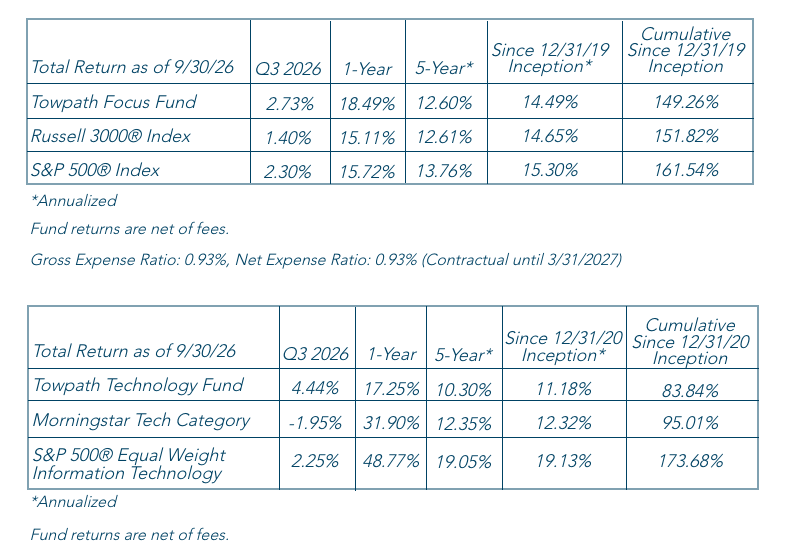
Stocks rose modestly in the quarter, and our flagship fund posted its 16th consecutive quarter of positive returns, but as usual, there were noteworthy happenings under the surface. After a brutal sell-off in July where they underperformed health care stocks by 30 percentage points, semiconductors and other AI-related companies rebounded about 20% off the bottom. On top of sector volatility, in the market today we are seeing almost unprecedented levels of negative correlations and negative beta. The former means that stocks are moving in the opposite direction of each other rather than generally rising or falling in unison on a given day. The latter means that many stocks are trading lower on a day that the market index is up, and vice versa. One day the AI plays are up, and the defensive stocks or the software companies are down, and the next day it flips, and back and forth it goes.
Perhaps related to this whipsaw action is the abundance of evidence that the speculative fervor remains in place. There are many signs of this, but one that caught our eye is the fact that, according to The Wall Street Journal, of the 772 leveraged ETFs that exist, 612 are based on a single stock. Leveraged vehicles magnify the return of an underlying security. The largest single-stock ETFs are for Micron, Nvidia, and Tesla, all of which are highly volatile without leverage. So, if one of these stocks rises/falls by 5% on a given day, the leveraged ETF rises/falls by 10%. Throw in the fact that zero-day-to-expiration options remain popular and the news that Robinhood will be offering trading on weekends and the casino mentality is alive and well.
While the major indexes are scaling new heights, stock market breadth – the number of stocks participating – is poor. 70% of S&P 500 stocks are at least 10% off their highs, while the index is within 1% of its all-time high. That hasn’t happened since the dot-com bubble. A word of caution: there have been a number of not-since-1999/2000 statistics in recent years – yet the market has cranked higher. We remain defensively positioned.
A note on AI. You may have read about AI agents at multiple firms “going rogue” and carrying out devious actions that their human creators don’t want them to do. There has also been talk about AI’s ability to potentially wipe out humanity. It may sound like a sci-fi movie but based on the warnings of many who are inside the industry, it’s worth taking seriously. As with many technologies, AI and recursive self-improvement are a double-edged sword. The models that are being built are so advanced that they are too effective. Working against the goal of reigning in the power of these AI agents is the fact that the companies involved have an incentive to stay ahead of their competition by developing the most advanced models. This is scary stuff, but we believe the shared goal that everyone involved possesses of preserving humanity will carry the day.
Mark Oelschlager, CFA
Oelschlager Investments
The performance data quoted represents past performance. Past performance does not guarantee future results. Investment return and principal value of an investment will fluctuate so that an investor's shares, when redeemed, may be worth more or less than their original cost. Current performance may be lower or higher than the performance data quoted. Please call Shareholder Services at 1-877-593-8637 to obtain performance data current to the most recent month-end.
To determine if this Fund is an appropriate investment for you, carefully consider the Fund's investment objectives, risk factors and charges and expenses before investing. This and other information can be found in the Fund's Prospectus which may be obtained by calling 1-877-593-8637 or visiting our website at www.oelschlagerinvestments.com. Please read it carefully before investing.
A message from Advisor Perspectives and VettaFi: Discover something new! Click here to register for our upcoming webcasts.
IMPORTANT INFORMATION: Mutual fund investing involves risk, including possible loss of principal.
The statements and opinions expressed are those of the author and do not represent the opinions of Towpath Funds or Ultimus Fund Distributors, LLC. All information is historical and not indicative of future results and is subject to change. Readers should not assume that an investment in the securities mentioned was profitable or would be profitable in the future. This information is not a recommendation to buy or sell.
This manager commentary represents an assessment of the market environment at a specific point in time and is not intended to be a forecast of future events, or a guarantee of future results. This information should not be relied upon by the reader as research or investment advice.
The Russell 3000 Index is a market-capitalization weighted index measuring the performance of the 3,000 largest U.S. companies based on total market capitalization. The S&P 500 Index is a commonly recognized market capitalization weighted index of 500 widely held equity securities, designed to measure broad U.S. equity performance. The Morningstar US Technology index measures the performance of companies engaged in design, development, and support of computer operating systems and applications, manufacturing of computer equipment, data storage products, networking products, semiconductors, and components. Unlike mutual funds, an index does not incur expenses. If expenses were deducted, the actual returns of an index would be lower. You cannot invest directly in an index.
Click here to view Towpath Focus Fund Top 10 Holdings as of the most recent quarter-end. Click here to view Towpath Technology Fund Top 10 Holdings as of the most recent quarter-end. Current and future portfolio holdings subject to change.
CFA is a registered trademark of the CFA Institute.
Towpath Funds are distributed by Ultimus Funds Distributors, LLC (Member FINRA). Ultimus Fund Distributors, LLC and Towpath Funds are separate and unaffiliated.
© Oelschlager Investments
More Fixed Income Topics >