Key takeaways
- Artificial intelligence (AI) has yet to cause broad labor-market disruption, but hiring remains choppy and job losses are concentrated in AI-exposed industries, such as information and finance.
- AI investment appears to be boosting productivity and corporate profits more than payrolls, reinforcing narrow market leadership and the divide between capital and labor.
- AI-related job creation remains limited and uneven, while import-heavy capital spending may limit the technology buildout's near-term benefit to U.S. growth and employment.
Plenty of folks are busy debating whether AI will wipe out humanity, but we'll leave the robot apocalypse to the philosophers. For this month's report, we'll settle for the more modest question of whether it will wipe out your job. Before we do a deeper dive into the world of AI, a review of the September jobs report is in order.
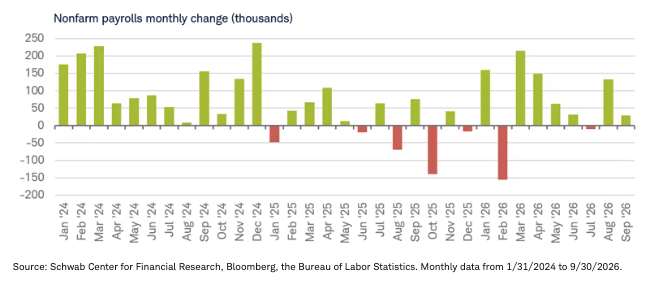
Not only was the preliminary 29,000 increase in nonfarm payrolls significantly below the Bloomberg consensus estimate of 90,000, it was a sharp deceleration from August's revised 133,000 gain. Downward revisions for the prior two months totaled 60,000, keeping the three-month average gain at just 51,000.
As shown below, 2026 has been a choppy year for the labor market. Two months of net losses, combined with surprising strength in August (a month that has historically tended to come in below expectations, then be revised higher), have reinforced how sporadic the recovery in U.S. labor has been. This has mostly been the story over the past year-and-a-half, though, and is consistent with the descriptor we've been using for the modern economic environment: unstable.
Choppy payroll recovery
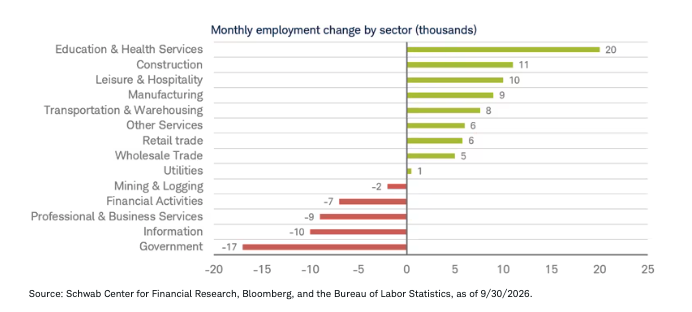
At the sector level, the breadth of payroll gains was nearly neutral in September, which didn't do much to disrupt the strengthening trend over the past several months. That said, there were some notable weak spots in Government, Information, and Professional Services, while Education and Health Services continued to drive a good chunk of gains. Interestingly, the "tails" of this chart in September alone look strikingly similar to the dynamic in the modern AI era: since the release of ChatGPT in November 2022, Education and Health Services has added the most jobs, while Information has shed the most.
September payroll breadth neutral
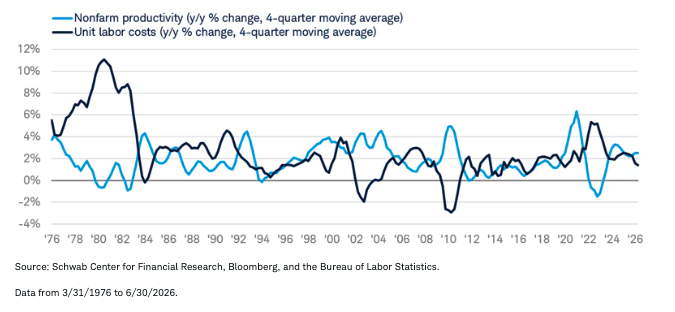
Looking at the relationship between productivity and unit labor costs, shown below, we see another fit with the "profits without payrolls" story. Companies are getting more output from slow-growing hours worked, and labor costs are rising more slowly than prices, which flatters profit margins. The open question is whether this is the early signature of an AI-driven productivity boom, or simply the cyclical result of companies holding the line on hiring.
Productivity is OK and labor costs are tame
AI-related disruption? Yes and no
Since the launch of widely available AI tools, companies across industries have poured capital into the infrastructure behind them. That spending has powered a large share of equity market gains and has become an increasingly important contributor to economic growth. The harder question is: who benefits? Past technology waves eventually raised productivity and created new kinds of work, but the gains arrived unevenly and often with lags. Early on, the rewards tended to accrue for the companies building and selling the technology, while the broader labor market adjusted more slowly.
The AI cycle is likely following a similar pattern, with corporate profits accelerating even as hiring has slowed. The jobs AI is creating are real but limited in number and skewed in mix, and a large portion of the investment in the build-out (and the hardware associated with it) is sourced via imports from abroad (more on that below). Taken together, they describe an expansion that looks robust from the vantage point of corporate earnings, but far more muted from the vantage point of workers and the domestic economy.
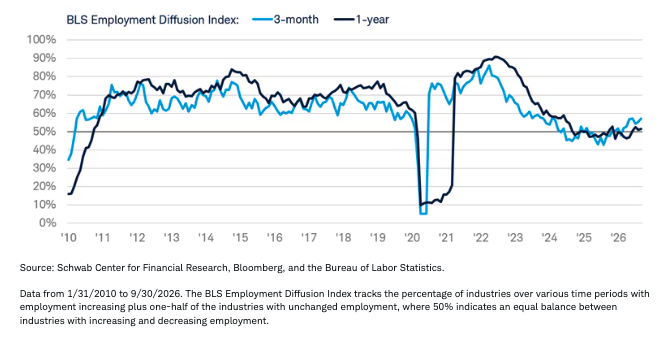
Thus far, at a broad level, payroll growth has been disappointing relative to what is typically seen in an economic expansion; but at the same time, there has not been a major disruption to the labor market. Shown below, the Employment Diffusion Index from Bureau of Labor Statistics (BLS), which measures the balance of industries seeing net hiring, shows that hiring activity started to slow as the modern AI era kicked off. Even worse, hiring breadth fell into contraction territory in 2025, which was arguably driven mostly by the geopolitical and trade uncertainty associated with the aggressive increase in tariff rates.
Importantly, though, employment diffusion never fell into territory associated with prior recessions from 2024 through 2025. Not only that, but it has continued to improve over the past year, ever since the labor market bottomed in the fall of 2025. That rings true on a short-term (three-month) and long-term (one-year) basis.
Hiring breadth is rebounding (slowly)
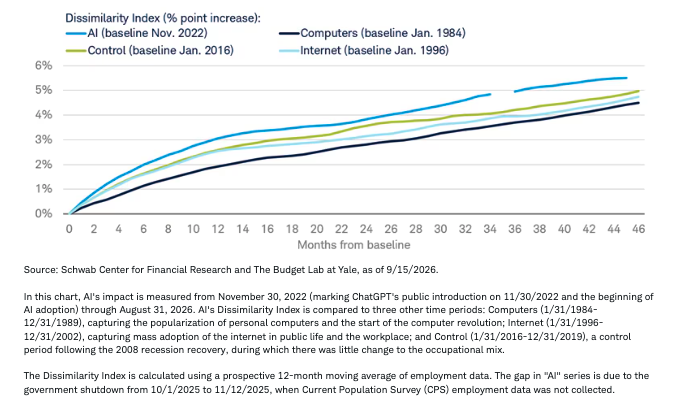
That is corroborated by the fact that the churn in the labor market in the post-ChatGPT era hasn't been dramatically different from the post-financial crisis expansion or other technological booms. Shown below is the Dissimilarity Index, which is interpreted as the percentage point shift in the occupational composition of the labor force, tracked by folks at the Budget Lab at Yale. A higher and steeper line indicates more churn, which has been the case for the modern AI era. At the same time, the move hasn't been aggressive relative to prior technological booms, nor has it been extreme relative to Yale's "control" series, which captures the labor market recovery after the financial crisis.
Not that dissimilar
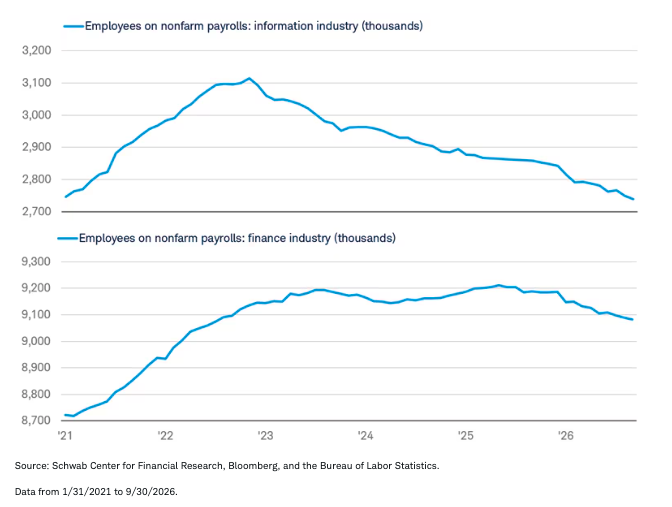
At the sector level, the story is a bit different, with more evidence of adjustments to the labor force taking place in rapid fashion. This rings especially true for the Information (i.e., Technology) sector, which has seen a marked decline in payrolls since November 2022. While not shown on the chart below, excluding the pandemic-related swings, the level of Information payrolls is hovering near its lowest since 2015.
Not matching in magnitude but more recently in direction, the financial industry's payrolls have struggled to increase in the past three years. Since the peak last year, the decline in net hiring has turned more aggressive, matching the trend seen in the Information industry. Both industries remain outliers, though. Since February 2026—when payroll growth started reaccelerating—they have shed a combined 120,000 jobs, while total U.S. nonfarm payrolls have increased by 608,000.
A(I)pparent disruption
Getting more granular
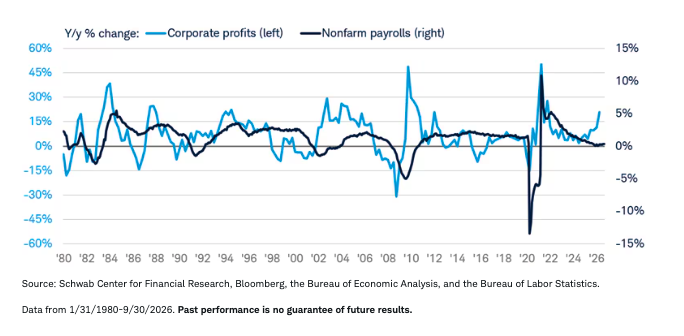
Corporate profits and nonfarm payrolls usually moved together over the past four decades. That relationship has now frayed, with profit growth significantly higher than payroll growth, as shown below. Gaps like this have historically mostly appeared in "jobless recoveries," such as 2002 to 2003 and 2010. In those periods, profits rebounded from recession lows, while hiring lagged. The difference today is that there was no recession from which to recover. Profits are surging late in an expansion, while hiring has been subdued.
Profits inflect without payrolls
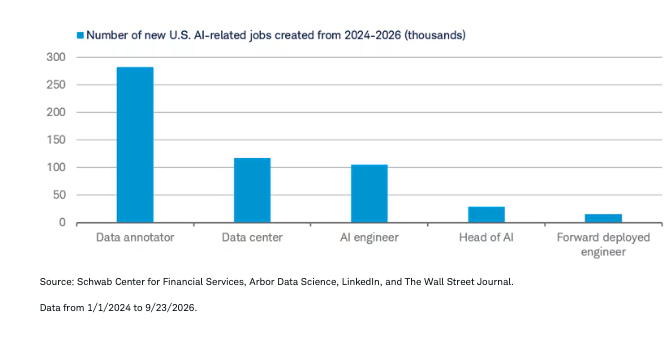
AI-related hiring is real, but limited and narrow so far. More than a half-million AI-related jobs were created from 2024 to 2026 (to date), with data annotator jobs dominating the total, as shown below. The mix matters given that the jobs in data annotator category tend to be lower-paid and often contract-based. The higher-skill jobs only number in the tens of thousands rather than hundreds of thousands.
Data jobs dominate
Capex boom is leaking abroad
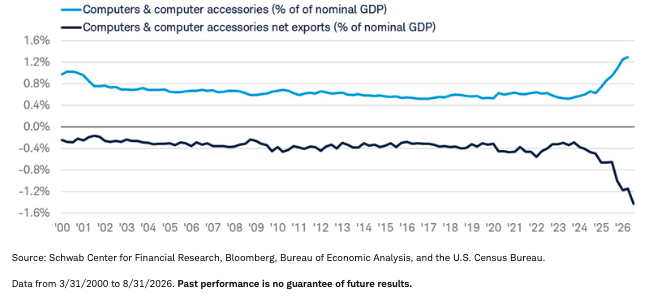
Spending on computers and accessories has more than doubled as a share of gross domestic product (GDP) since 2023, the highest level since at least 2000 and well above the dot-com era peak. At the same time, net exports of these goods have plunged to a record deficit. In other words, as shown below, much of the AI buildout is imported. That boosts the companies doing the buying and the overseas suppliers, but it dampens the impact on domestic GDP and on U.S. jobs. The chart below has become a poster child for the K-shaped economy.
K-shaped trade relationship
Implications
The gap between booming profits and weaker payrolls isn't just a statistical curiosity, it reshapes the risks facing investors, workers, and policymakers. Four implications deserve particular attention, and investors should keep them in mind when it comes to the impact of AI on the labor market.
Concentration risk: Profit gains have been skewed toward AI-exposed and mega-cap companies rather than spread broadly. That reinforces the stock market's narrow leadership.
K-shaped dynamics: Strong earnings growth, alongside subdued hiring, may point to diverging outcomes between capital and labor, with potential consequences for consumer spending.
Policy tension: The Federal Reserve faces an uneven, sluggish labor market recovery at the same time as robust corporate profits pour in, which complicates the monetary policy outlook, in our view.
Sustainability: If AI-driven productivity gains don't eventually spread to broader hiring, profit growth that rests on capital spending and cost discipline could prove vulnerable.
A message from Advisor Perspectives and VettaFi: Discover something new! Click here to register for our upcoming webcasts.
This material is intended for general informational and educational purposes only. This should not be considered an individualized recommendation or personalized investment advice. The investment strategies mentioned are not suitable for everyone. Each investor needs to review an investment strategy for his or her own particular situation before making any investment decisions.
All expressions of opinion are subject to change without notice in reaction to shifting market, economic or political conditions. Data contained herein from third party providers is obtained from what are considered reliable sources. However, its accuracy, completeness or reliability cannot be guaranteed.
Past performance is no guarantee of future results.
Investing involves risk, including loss of principal.
Performance may be affected by risks associated with non-diversification, including investments in specific countries or sectors. Additional risks may also include, but are not limited to, investments in foreign securities, especially emerging markets, real estate investment trusts (REITs), fixed income, and small capitalization securities. Each individual investor should consider these risks carefully before investing in a particular security or strategy.
All corporate names and market data shown are for illustrative purposes only and are not a recommendation, offer to sell, or a solicitation of an offer to buy any security.
Diversification and asset allocation strategies do not ensure a profit and do not protect against losses in declining markets.
The policy analysis provided by the Charles Schwab & Co., Inc., does not constitute and should not be interpreted as an endorsement of any political party.
Indexes are unmanaged, do not incur management fees, costs, and expenses and cannot be invested in directly. For more information on indexes, please see schwab.com/indexdefinitions.
The Schwab Center for Financial Research is a division of Charles Schwab & Co., Inc.
Source: Bloomberg Index Services Limited. BLOOMBERG® is a trademark and service mark of Bloomberg Finance L.P. and its affiliates (collectively "Bloomberg"). Bloomberg or Bloomberg's licensors own all proprietary rights in the Bloomberg Indices. Neither Bloomberg nor Bloomberg's licensors approves or endorses this material, or guarantees the accuracy or completeness of any information herein, or makes any warranty, express or implied, as to the results to be obtained therefrom and, to the maximum extent allowed by law, neither shall have any liability or responsibility for injury or damages arising in connection therewith.
The Charles Schwab Corporation provides a full range of brokerage, banking and financial advisory services through its operating subsidiaries. Its broker-dealer subsidiary, Charles Schwab & Co., Inc. (member SIPC), and its affiliates offer investment services and products. Its banking subsidiary, Charles Schwab Bank, SSB (member FDIC and an Equal Housing Lender) provides deposit and lending services and products. Its banking subsidiary, Charles Schwab Premier Bank, SSB (member FDIC) provides cryptocurrency services and products.
This site is designed for U.S. residents. Non-U.S. residents are subject to country-specific restrictions. Learn more about our services for non-U.S. residents, Charles Schwab Hong Kong clients, Charles Schwab U.K. clients.
© 2026 Charles Schwab & Co., Inc. All rights reserved. Member SIPC. Unauthorized access is prohibited. Usage will be monitored.
© Charles Schwab
More Emerging Markets Topics >