For decades, investors have used growth and value allocations as a foundational block of equity portfolio construction. The distinction has been intuitive and practical. Investors expected growth to provide exposure to faster-growing companies, often with higher valuation multiples and greater sensitivity to earnings expectations. They expected value allocations to deliver a counterweight through lower multiple businesses, broader sector diversification, and more exposure to economically cyclical or defensive industries.
They owned both because they believed each would respond differently to changing market conditions.
See more: AI, Higher Rates Raise the Bar for Diversification
Those assumptions merit a closer look today. Equity allocations that include a value tilt may be more exposed to AI investment cycles, cloud spending, hyperscaler capital expenditures and mega-cap technology earnings than investors believe. As growth and value become less distinct, investors should more closely question the risks they’re taking within their value allocations.
Large-Cap Value’s Changing Identity
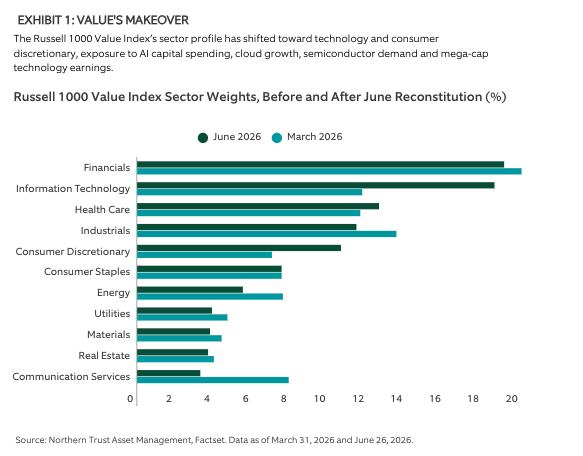
Take the recent reconstitution of the Russell value and growth illustrates how value’s profile is evolving. Amazon is now the largest constituent in the Russell 1000 Value Index . Information technology exposure increased to 18.6% from 11.7% (Exhibit 1), while Magnificent Seven exposure rose to 16% from 6%. The index remains a legitimate value benchmark according to Russell's methodology, but it is increasingly influenced by forces that investors historically associated with growth.
Historically, interest rates, credit conditions, bank profitability, industrial activity, energy prices and broader economic cyclicality primarily influenced value stocks. Today, many companies in the value index are increasingly tied to AI capital spending, cloud growth, semiconductor demand, platform monetization, regulatory developments and earnings expectations for a small number of technology giants.
As a result, value is looking a lot more like growth. With the reconstitution, overlap within the Russell 1000 Value Index rose to roughly 34.5%, meaning about one-third of the value benchmark now sits in securities that also appear in growth. A 50/50 allocation to Russell 1000 Growth and Russell 1000 Value could therefore hold about 15% to 17% in the same companies. Further, correlation between the indexes has risen to nearly 0.3, from almost zero just a couple years ago.
A Challenge to What Value Means
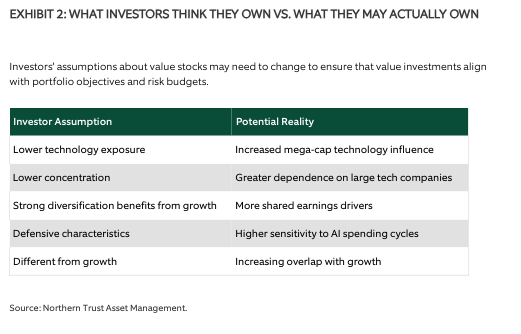
With the striking evolution of the value profile, will value indexes still provide a strong proxy for value investing? The answer depends on what investors mean by “value.” If value is defined strictly according to Russell’s published methodology, then the Russell 1000 Value Index remains a valid and rules-based expression of that methodology.
However, if investors use the Russell 1000 Value Index as a proxy for other objectives — such as lower concentration, lower technology exposure, lower multiple risk, greater defensiveness, or stronger diversification versus growth — then the answer is more complicated (Exhibit 2).
Russell’s indices are not alone in the growth-value dilemma. S&P Dow Jones Indices is considering changes to its style methodology, including adding intangible assets and free cash flow as measures of value and removing price momentum as a measure of growth. The proposal reflects a longstanding concern that conventional metrics such as price-to-book can understate the economic value of internally developed intellectual property and research, which accounting rules generally treat as expenses rather than balance-sheet assets.
Great benchmark design does not eliminate the need for portfolio-level interpretation. A rules-based index can be methodologically sound while still evolving in ways that may reduce its usefulness for certain investor objectives.
Playbook: Investigating the Portfolio Impact of Value
Growth and value remain useful categories, but they are not substitutes for bottom-up assessments of holdings, factor exposures, sector weights, valuation characteristics, macro sensitivities and concentration risk. For investors with dedicated growth and value allocations, several questions are worth asking:
- How much name-level overlap exists across the combined U.S. equity portfolio?
- Are the overlapping names concentrated among the largest contributors to active and absolute risk?
- Has the portfolio’s effective exposures to mega-cap technology increased, even if the stated allocation to value has not changed?
- Does the combined growth/value structure still provide the intended diversification benefit?
- Are the factor exposures such as value, quality, momentum, size, and low volatility aligned with the portfolio’s objectives?
- Is the value allocation intended to track a benchmark, diversify growth risk, reduce concentration, lower valuation exposure, provide potential downside resilience, or some combination of these goals?
The point is not to abandon value, but to stop assuming the label tells investors enough. As benchmarks evolve, portfolio construction has to evolve with them — starting with a clearer view of the risks embedded across growth and value allocations.
A message from Advisor Perspectives and VettaFi: Discover something new! Click here to register for our upcoming webcasts.
Glossary
Correlation: The extent of which two securities move with each other, where highly correlated securities have similar return patterns. Low correlation between securities often contributes to diversification, a way to lower portfolio risk.
Free cash flow: Cash available to a company’s investors after the company has made all investments necessary to maintain the company as an ongoing enterprise.
Hyperscaler: Large computing companies that operate massive data center networks, such as Amazon, Microsoft, Google, Meta and Oracle.
Magnificent Seven: These seven companies include Alphabet, Amazon, Apple, Meta, Microsoft, Nvidia, and Tesla.
Momentum: This factor targets companies that have strong market sentiment and analyst sentiment. Momentum strategies seek to provide excess returns by investing in companies with strong tailwinds for higher growth than the benchmark.
Russell 1000 Growth Index: Measures the performance of U.S. large-cap growth stocks, including Russell 1000 companies with higher price-to-book ratios, forecasted earnings growth and historical sales growth.
Russell 1000 Value Index: Measures the performance of U.S. large-cap value stocks, including Russell 1000 companies with lower price-to-book ratios, forecasted earnings growth and historical sales growth.
Valuation: The process of determining the value of an asset based on the analysis of variables related to investment returns or comparisons with similar assets.
Valuation multiples: Financial metrics used to compare a company's stock price to its financial performance or other relevant factors, aiding in assessing relative valuation and making informed investment decisions.
IMPORTANT INFORMATION
This content may not be edited, altered, revised, paraphrased, or otherwise modified without the prior written permission of Northern Trust Asset Management (NTAM). The information contained herein is intended for use with current or prospective clients of Northern Trust Investments, Inc (NTI) or its affiliates. The information is not intended for distribution or use by any person in any jurisdiction where such distribution would be contrary to local law or regulation. NTAM and its affiliates may have positions in and may effect transactions in the markets, contracts and related investments different than described in this information. This information is obtained from sources believed to be reliable, its accuracy and completeness are not guaranteed, and is subject to change. Information does not constitute a recommendation of any investment strategy, is not intended as investment advice and does not take into account all the circumstances of each investor.
This information is provided for informational purposes only and is not intended to be, and should not be construed as, an offer, solicitation or recommendation with respect to any transaction and should not be treated as legal advice, investment advice or tax advice. Recipients should not rely upon this information as a substitute for obtaining specific legal or tax advice from their own professional legal or tax advisors. References to specific securities and their issuers are for illustrative purposes only and are not intended and should not be interpreted as recommendations to purchase or sell such securities. Indices and trademarks are the property of their respective owners. Information is subject to change based on market or other conditions.
All securities investing and trading activities risk the loss of capital. Each portfolio is subject to substantial risks including market risks, strategy risks, advisor risk, and risks with respect to its investment in other structures. There can be no assurance that any portfolio investment objectives will be achieved, or that any investment will achieve profits or avoid incurring substantial losses. No investment strategy or risk management technique can guarantee returns or eliminate risk in any market environment. Risk controls and models do not promise any level of performance or guarantee against loss of principal. Any discussion of risk management is intended to describe NTAM’s efforts to monitor and manage risk but does not imply low risk.
Past performance is not a guarantee of future results. Performance returns and the principal value of an investment will fluctuate. Performance returns contained herein are subject to revision by NTAM. Comparative indices shown are provided as an indication of the performance of a particular segment of the capital markets and/or alternative strategies in general. Index performance returns do not reflect any management fees, transaction costs or expenses. It is not possible to invest directly in any index. Net performance returns are reduced by investment management fees and other expenses relating to the management of the account. Gross performance returns contained herein include reinvestment of dividends and other earnings, transaction costs, and all fees and expenses other than investment management fees, unless indicated otherwise. For U.S. NTI prospects or clients, please refer to Part 2a of the Form ADV or consult an NTI representative for additional information on fees.
Forward-looking statements and assumptions are NTAM’s current estimates or expectations of future events or future results based upon proprietary research and should not be construed as an estimate or promise of results that a portfolio may achieve. Actual results could differ materially from the results indicated by this information. Historical trends are not predictive of future results.
This information is intended for purposes of NTI and/or its affiliates marketing as providers of the products and services described herein and not to provide any fiduciary investment advice within the meaning of Section 3(21) of the Employee Retirement Income Security Act of 1974, as amended (ERISA). NTI and/or its affiliates are not undertaking to provide a recommendation or give investment advice in a fiduciary capacity to the recipient of these materials, which are for marketing purposes and are not intended to serve as a primary basis for investment decisions. NTI and/or its affiliates may receive fees and other compensation in connection with the products and services described herein as well as for custody, fund administration, transfer agent, investment operations outsourcing, and other services rendered to various proprietary and third-party investment products and firms that may be the subject of or become associated with the services described herein.
Northern Trust Asset Management is composed of Northern Trust Investments, Inc., Northern Trust Global Investments Limited, Northern Trust Fund Managers (Ireland) Limited, Northern Trust Global Investments Japan, K.K., NT Global Advisors, Inc., 50 South Capital Advisors, LLC, Northern Trust Asset Management Australia Pty Ltd, and investment personnel of The Northern Trust Company, The Northern Trust Company (Singapore Branch), and The Northern Trust Company of Hong Kong Limited.
Issued in the United Kingdom by Northern Trust Global Investments Limited, regulated by the Financial Conduct Authority (License Number 191916); issued in the European Economic Area (EEA) by Northern Trust Fund Managers (Ireland) Limited, regulated by the Central Bank of Ireland (License Number C21810); issued in Australia by Northern Trust Asset Management (Australia) Limited (ACN 648 476 019), which holds an Australian Financial Services Licence (License Number 529895) and is regulated by the Australian Securities and Investments Commission (ASIC); issued in Hong Kong by The Northern Trust Company of Hong Kong Limited, which is regulated by the Hong Kong Securities and Futures Commission; and issued in Singapore by The Northern Trust Company (Singapore Branch), which is regulated by the Monetary Authority of Singapore.
For Canada, Asia-Pacific (APAC) and Europe, Middle East and Africa (EMEA) markets, this information is directed to institutional, professional and wholesale clients or investors only and should not be relied upon by retail clients or investors. For U.S. NTAM, the information contained herein is intended for use with all current or prospective clients of Northern Trust Investments, Inc (NTI).
Not FDIC insured | May lose value | No bank guarantee
© Northern Trust
More Factor-Based Investing Topics >