A breeze knocks loose a small piece of ice at the top of a mountain. As it rolls downhill, more and more snow clings to it. Before long, an unstoppable snowball is making its descent.
A snowball effect of asset values can similarly empower wealth effects: the tendency for consumers to spend more as the value of their investments rises. Wealth effects are surprising at first glance: household investments may be illiquid and tend not to produce substantial cash flow. However, a rising net worth builds a consumer’s confidence in their ability to afford purchases.
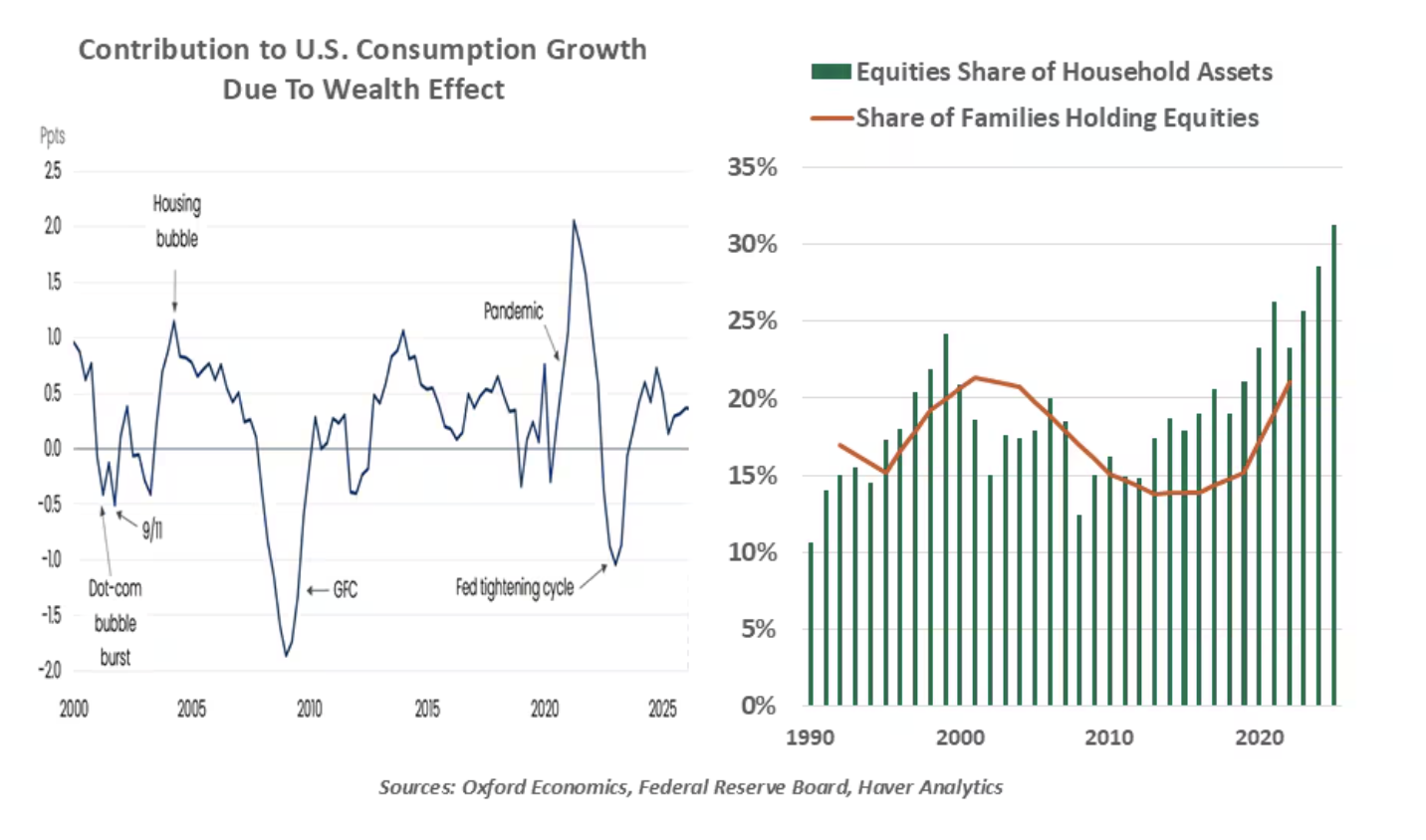
Households’ two primary investments are typically homes and stocks. Both have had a very strong run in the decade to date: the U.S. FHFA house price index has cumulatively gained 59% since January 2020, while the S&P 500 index has more than doubled. The wealth effect is not directly observable, but asset gains have a statistically significant relationship with personal consumption. Oxford Economics estimates that for each $1 gain in value, the current marginal propensity to consume is $0.04 for equity portfolios and $0.02 for homes.
Wealth effects help to explain some of the surprises in this cycle. Persistent inflation has not deterred consumption, as investments have given consumers a cushion. Labor force participation by older workers has trended down, as appreciating retirement savings equipped them to leave the workforce. The saving rate is holding near historic lows; an asset reserve allows workers to save less of their wage income. And wealth effects are naturally unequal: households with more investments will enjoy greater gains, adding to a feeling of an uneven, K-shaped expansion.
See more: Discipline Through Uncertainty
Wealth effects have been evident in past expansions. In the Dot Com boom of the 1990s, consumption growth exceeded 5% in 1998 and 1999; in much of the property bubble of the 2000s, it held over 3%. Wealth contributed about one percentage point to growth in those cycles. Real consumption in the past year grew 2.3%, implying a more modest wealth effect now.
But the wealth effect feels larger in this cycle because individual participation in financial markets has never been easier. The Federal Reserve has found an ascending share of households own stocks (setting records for younger cohorts), and equities’ share of household wealth continues to climb. An aging population and easy access to financial platforms have kept market performance top of mind. And while the rate of homeownership is holding steady around 65%, that still represents increasing net worth for a majority of households.
Past cycles taught the lesson that wealth effects are a force multiplier in both directions. Incremental spending from wealth is the first to be halted when belts are tightened. This can compound the breadth of a contraction, spreading a market shock to the broader economy.
The spending that flows from wealth gains is more discretionary, especially major purchases like automobiles and home improvement. These feel affordable during run-ups, and easy to defer when values are plunging. Wealth effects may also empower more consumers to trade up to luxury brands and premium experiences; trading down will always be an option.
We worry about the lingering damage that can be done after a fall in wealth. Behavioral economics teaches us about loss aversion: Humans feel greater pain from a loss than pleasure from a gain. After a substantial contraction, skittish investors may stay on the sidelines, prolonging a downturn and preventing a return to productive investment.
The descending snowball cannot grow forever; it will eventually settle on firm ground. Today’s market gains will inevitably settle, too. We hold out hope for a smooth landing, not a meltdown.
Ryan James Boyle is the Chief U.S. Economist within the Global Risk Management division of Northern Trust.
Information is not intended to be and should not be construed as an offer, solicitation or recommendation with respect to any transaction and should not be treated as legal advice, investment advice or tax advice. Under no circumstances should you rely upon this information as a substitute for obtaining specific legal or tax advice from your own professional legal or tax advisors. Information is subject to change based on market or other conditions and is not intended to influence your investment decisions.
© 2026 Northern Trust Corporation. Head Office: 50 South La Salle Street, Chicago, Illinois 60603 U.S.A. Incorporated with limited liability in the U.S. Products and services provided by subsidiaries of Northern Trust Corporation may vary in different markets and are offered in accordance with local regulation. For legal and regulatory information about individual market offices, visit northerntrust.com/terms-and-conditions.
A message from Advisor Perspectives and VettaFi: Discover something new! Click here to register for our upcoming webcasts.
© Northern Trust
More Behavioral Finance Topics >