Key takeaways
- Market concentration, driven largely by artificial intelligence (AI), has indexes behaving like a single stock with major upside skew, making the tradeoff between managing absolute and relative risk arguably the steepest since the 2000 cycle.
- While the AI trade absorbs nearly all available investor attention, the market has priced an ongoing energy crisis as largely solved. With energy’s correlation to the index negative over the past year, owning energy covers our AI relative risk more effectively.
- Today’s energy sector—defined by capital discipline, fortress balance sheets and stocks still embedding oil prices anchored in the US$70s—is far more defensive than in past cycles. We expect energy proves to be an investment while many parts of AI prove to be a trade.
An Index Behaving Like a Single Stock
A lot of life, and certainly the challenge of portfolio construction, is about tradeoffs. Portfolio construction has a key constraint: many of the tradeoffs emerge because of uncertainty, with one of the main ones being that we are looking for signals in a very noisy environment. Even when we get the signal right, it doesn’t always translate as expected at the portfolio level or takes longer to cut through the noise than we thought. This matching problem between signals and outcomes directly lowers your edge at a given time scale and is why diversification is such a critical tool in portfolio construction: concentration is only justified when edge is high, but when edge is reduced the solution is to diversify more.
Right now, indexes are increasingly concentrated, effectively behaving as if they have significant edge, and record-low correlation, coupled with the “stock up, volatility up” dynamic, has them acting more like a single stock with major upside skew. Managing relative risk against this dynamic is extremely challenging: how do you manage against a single stock with a diversified portfolio? Especially when we think the actual edge is low, correlations cannot sustain current levels, and equity risk premiums are at levels that have historically called for caution.
The result is an incredibly steep tradeoff between managing absolute and relative risk—arguably the steepest since the 2000 cycle. Our investment process is anchored by managing absolute risk through an absolute valuation discipline, with our primary goal being to generate a double-digit absolute return across a full market cycle. We do this by exploiting price-to-value gaps specifically where we expect convergence because future fundamentals have a higher probability of a good outcome than the market has priced. We then look to manage the resulting volatility tax with differentiated portfolio construction, combining stocks across a much wider correlation spectrum than most peers would consider.
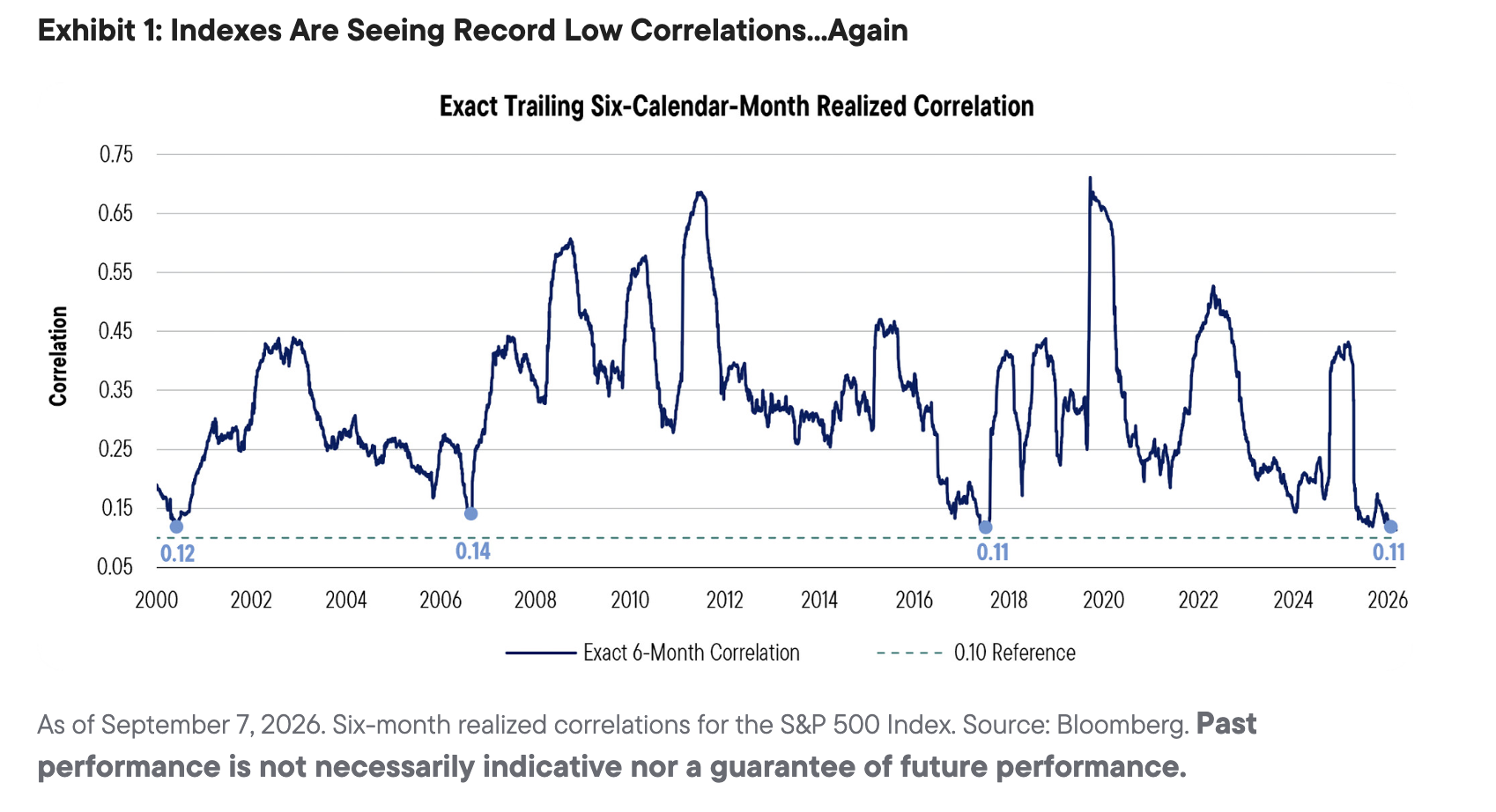
This entire regime depends on correlations staying at extremes. The only other times realized correlations were this low were just before the 2007 housing crisis and just before “Volmageddon”1 in early 2018 (Exhibit 1). The likely driver of this low-correlation extreme is AI: there is AI and everything else. The paradox is that while the ultimate outcomes for AI are inherently uncertain, the market is behaving as if it has a lot of edge around these AI unknowns. Ultimately, we believe that correlations will spike higher, and our guess is the timing will be measured in quarters rather than years.
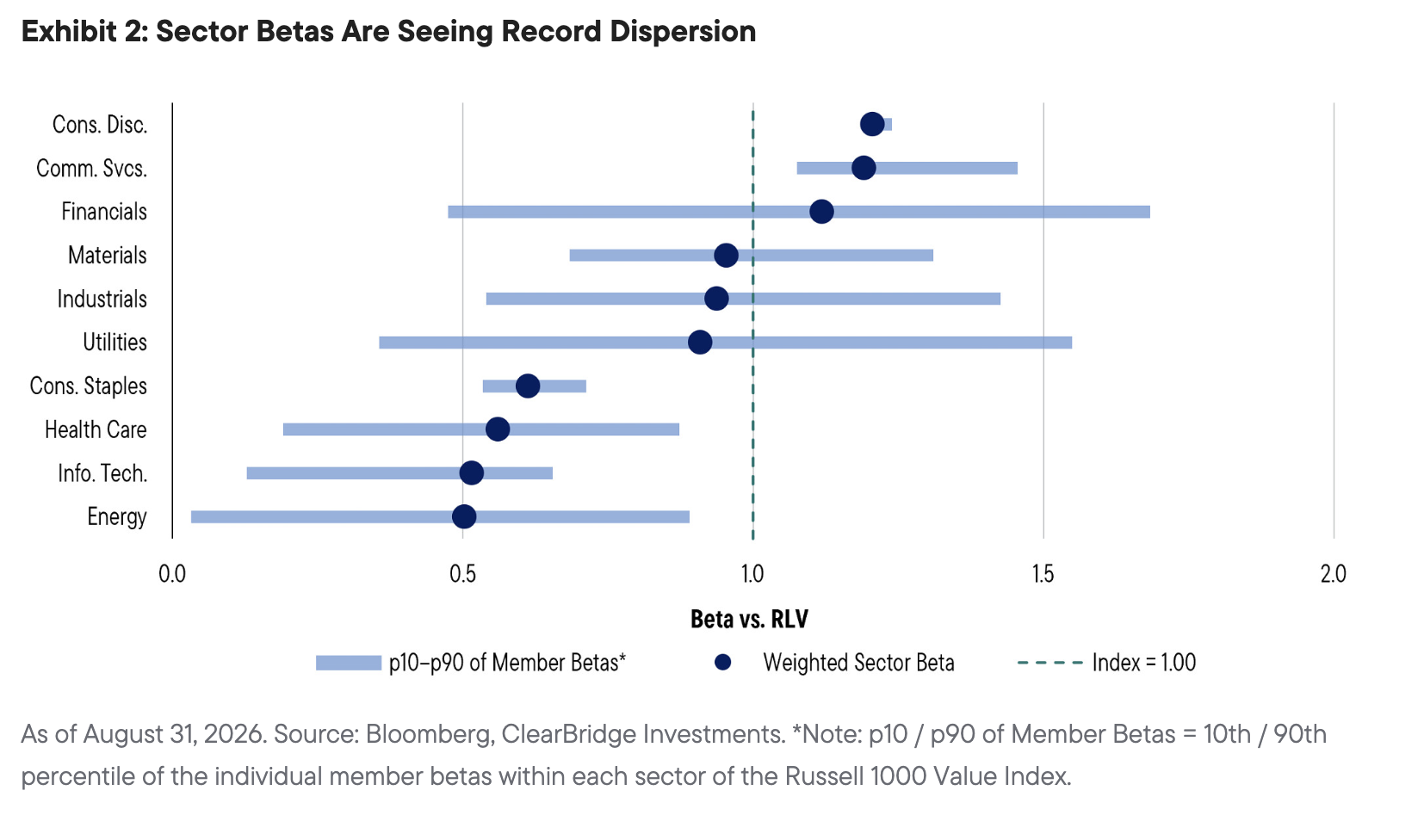
Another key driver of this low-correlation market is record dispersion in stock betas, emerging not only across sectors but within them (Exhibit 2). If you don’t manage this dispersion directly, the gap in beta between a prudently diversified portfolio and the index creates an active beta drag—a relative risk tax.
See more: The Skill That Fades When AI Does the Prep
The Ultimate Risk Hedge in an Energy Crisis
What we have not done is sacrifice the diversification that manages our absolute risk. Rather, we believe this record dispersion provides a great opportunity for active managers, and for us it starts with energy. With the beta of tech at roughly 1.2x and energy at 0.6x, energy’s risk behavior is even more extreme if we look at the past year, when the sector’s correlation to the index has been below –50% and its correlation to the portfolio roughly –20%.
This highlights energy as the ultimate risk hedge in, well, an energy crisis. When energy spikes, pretty much everything else goes down. What amazes us is that we are still in an energy crisis—one that gets worse as the cumulative probability of a bad outcome rises with each passing month—yet the market has priced this crisis as largely solved, despite the feedback from higher energy prices into interest rates. Historically, the only areas of the market that do well when energy and rates rise together are financials, up to a point, and real assets, more consistently. Yet investors are broadly making very little effort to manage this risk as the AI trade dominates all available attention. The key is that owning energy covers our absolute risk while creating the risk budget to cover the AI relative risk more effectively.
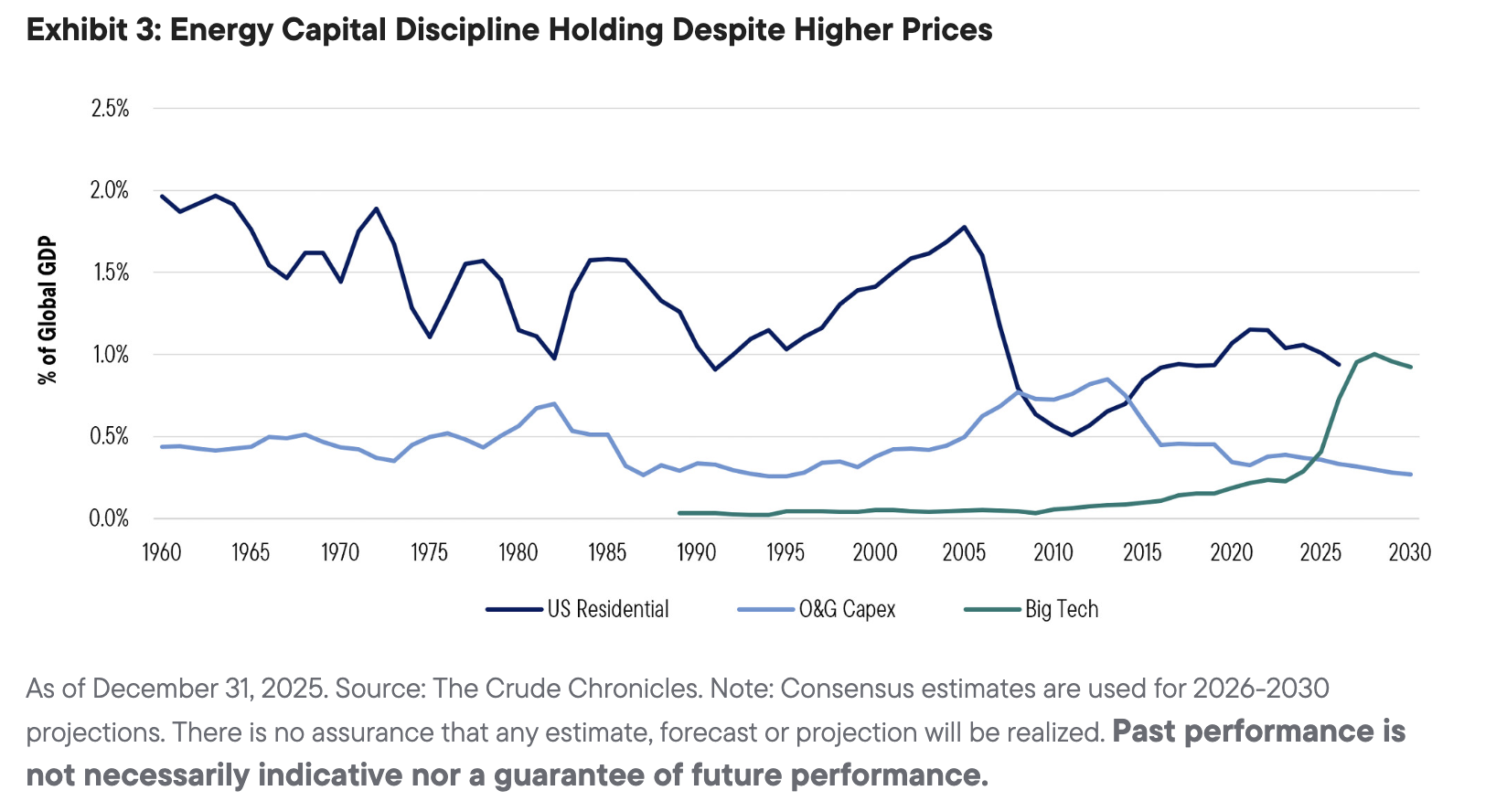
As the great Charlie Munger always emphasized, “show me the incentive and I will show you the outcome.”2 Despite higher energy prices, capital spending on energy, and on commodities broadly, has stayed extremely disciplined (Exhibit 3). After the shale boom and bust, energy executive compensation shifted from growth-based—which is insane in a commodity business—to returns-based. Ironically, major tech companies’ incentives are focused almost entirely on growth, not returns.
At least for now, the market is treating the AI investment boom as if it is completely insulated from a global energy crisis and higher interest rates, despite the increasing use of debt financing to keep the show going. What is surprising is that the AI trade also seems to be ignoring mounting political risk around data center expansion and increasingly loud warnings from the frontier labs themselves about existential risk from AI. Anthropic CEO Dario Amodei has repeatedly argued that the industry must “pace the frontier,” slowing capability gains before recursive self-improvement outruns our ability to control them. We are not sure what risk premium the market should assign to such tail risks, but investors may want to start considering one.
Unstable Extremes Favor Energy Exposure
Energy stocks have never been this negatively correlated to the market, but we believe these correlations will inevitably turn positive again. The key, as always, is context: we think energy stocks are much more defensive than in the past, when terrible capital discipline destroyed massive amounts of capital through excess investment into downturns, exacerbated by much weaker balance sheets. Today’s reality is the complete opposite. The key risk scenario, however, is that energy prices spike in the coming quarters to levels that cause a global recession. On the way to that level, energy stocks would arguably be the only truly defensive sector, but we would likely reduce our energy weight and pivot to a more defensive position as recession risk increased. Even then, energy stocks still embed oil prices anchored in the US$70s, which we think is a downside floor, as global oil inventories and geopolitical buffers will have to be rebuilt when the crisis finally ends.
Thus, we think the ongoing bull market in real assets that emerged from the COVID cycle has, if anything, been strengthened by the crisis. We expect the energy weight in indexes, which remain near historic lows, to keep rising over the coming years as energy proves to be an investment while many parts of AI prove to be a trade.
The tradeoff for active managers between relative and absolute risk has never been steeper, as diversifying to manage absolute risk increasingly comes with higher relative risk against ever more concentrated indexes. Ultimately, many of the current extremes, especially correlation, are not sustainable, and we think the inevitable journey back to normal will greatly favor disciplined active managers—with energy and real assets covering the flank the AI trade leaves exposed.
Samuel Peters, CFA
EndNotes
- “Volmageddon,” the February 2018 spike in volatility that wiped out short volatility strategies, illustrates the dangers of hedge and leverage rebalancing in highly concentrated and volatile markets.
- Munger, Charles T. "The Psychology of Human Misjudgment." In Poor Charlie’s Almanack: The Wit and Wisdom of Charles T. Munger, edited by Peter D. Kaufman, 431–87. Virginia Beach, VA: PCA Publication, 2005.
WHAT ARE THE RISKS?
All investments involve risks, including possible loss of principal.
Equity securities are subject to price fluctuation and possible loss of principal.
Small- and mid-cap stocks involve greater risks and volatility than large-cap stocks.
Investment strategies which incorporate the identification of thematic investment opportunities, and their performance, may be negatively impacted if the investment manager does not correctly identify such opportunities or if the theme develops in an unexpected manner. Focusing investments in the health care and biotechnology sectors carries much greater risks of adverse developments and price movements in such industries than a strategy that invests in a wider variety of industries.
Any companies and/or case studies referenced herein are used solely for illustrative purposes; any investment may or may not be currently held by any portfolio advised by Franklin Templeton. The information provided is not a recommendation or individual investment advice for any particular security, strategy, or investment product and is not an indication of the trading intent of any Franklin Templeton managed
Important Information
This material is intended to be of general interest only and should not be construed as individual investment advice or a recommendation or solicitation to buy, sell or hold any security or to adopt any investment strategy. It does not constitute legal or tax advice. This material may not be reproduced, distributed or published without prior written permission from Franklin Templeton.
The views expressed are those of the investment manager and the comments, opinions and analyses are rendered as at publication date and may change without notice. The underlying assumptions and these views are subject to change based on market and other conditions and may differ from other portfolio managers or of the firm as a whole. The information provided in this material is not intended as a complete analysis of every material fact regarding any country, region or market. There is no assurance that any prediction, projection or forecast on the economy, stock market, bond market or the economic trends of the markets will be realized. The value of investments and the income from them can go down as well as up and you may not get back the full amount that you invested. Past performance is not necessarily indicative nor a guarantee of future performance. All investments involve risks, including possible loss of principal.
Any research and analysis contained in this material has been procured by Franklin Templeton for its own purposes and may be acted upon in that connection and, as such, is provided to you incidentally. Data from third party sources may have been used in the preparation of this material and Franklin Templeton ("FT") has not independently verified, validated or audited such data. Although information has been obtained from sources that Franklin Templeton believes to be reliable, no guarantee can be given as to its accuracy and such information may be incomplete or condensed and may be subject to change at any time without notice. The mention of any individual securities should neither constitute nor be construed as a recommendation to purchase, hold or sell any securities, and the information provided regarding such individual securities (if any) is not a sufficient basis upon which to make an investment decision. FT accepts no liability whatsoever for any loss arising from use of this information and reliance upon the comments, opinions and analyses in the material is at the sole discretion of the user.
Franklin Templeton has environmental, social and governance (ESG) capabilities; however, not all strategies or products for a strategy consider “ESG” as part of their investment process.
Products, services and information may not be available in all jurisdictions and are offered outside the U.S. by other FT affiliates and/or their distributors as local laws and regulation permits. Please consult your own financial professional or Franklin Templeton institutional contact for further information on availability of products and services in your jurisdiction.
Issued in the U.S. by Franklin Templeton, One Franklin Parkway, San Mateo, California 94403-1906, (800) DIAL BEN/342-5236, franklintempleton.com. Investments are not FDIC insured; may lose value; and are not bank guaranteed.
You need Adobe Acrobat Reader to view and print PDF documents. Download a free version from Adobe's website.
CFA® and Chartered Financial Analyst® are trademarks owned by CFA Institute.
A message from Advisor Perspectives and VettaFi: Discover something new! Click here to register for our upcoming webcasts.
© ClearBridge Investments
More Commodities Topics >