So Far, AI Is Reshaping More Than Cutting the Workforce
Membership required
Membership is now required to use this feature. To learn more:
View Membership Benefits

Artificial intelligence (AI) technologies are developing faster than investors anticipated just a few years ago, fueling a popular narrative that AI will trigger widespread job cuts. Yet there’s little evidence to back this view. Instead, we find that AI is changing hiring patterns, altering skill requirements and shifting the mix of work performed within firms.
Our 2026 Capital Market Assumptions (CMA) theme, Rising Innovation, Declining Demographics, argues that AI, automation and robotics will reshape labor markets, as previous technological revolutions have. While it remains early in the AI revolution and evidence continues to emerge, our key takeaway is that AI's most significant labor-market effect may not be mass unemployment but workforce reallocation.
We believe investors should focus on identifying which companies and industries will redeploy their talent to boost productivity and growth in a durable way, potentially leading to long-term investment gains.
New Work Rather Than Less Work
While new technologies create risks of displacement, history suggests innovation often changes more than it eliminates jobs. Sixty percent of workers are in jobs that didn’t exist in 1940 and 85% of employment growth since 1940 resulted from technology-driven, new positions.1
In fact, companies investing most aggressively in generative AI, as measured by AI spend per employee, increased white-collar employment by 10.2% more than their peers in the first two years following adoption.2 While these firms are often fast-growing businesses that may expand regardless — so some caution is warranted in interpreting results — the findings challenge assumptions that AI adoption automatically leads to lower employment.3 This research adds weight to our view that AI may lead to changes in hiring patterns rather than mass unemployment.
See more: ESG Attribution Analysis: What Traditional Attribution Doesn’t Explain About Values-Based Portfolios
AI’s Uneven Impact on the Workforce
Academic research paints a more nuanced picture of this evolution. A Harvard study examining more than 65 million U.S. workers across approximately 280,000 firms links adoption of generative AI to declines in junior employment relative to senior employment in occupations most exposed to AI. Examples include software developers, customer service representatives, writers and accountants.4 Importantly, slower hiring drove this trend more than outright job cuts. Notably, the authors posit possible alternative causes, including post-pandemic hiring dynamics and the expansion of remote work. Similarly, while they found no evidence of widespread economywide job displacement, Stanford researchers using payroll data from ADP found that early-career workers in AI-exposed occupations experienced a 19% relative employment decline compared with more experienced workers, while experienced workers showed no comparable gap (Exhibit 1).5
One possible reason: AI better replicates codified knowledge and routine tasks traditionally performed by junior workers, while automating more experience-based knowledge is more difficult.
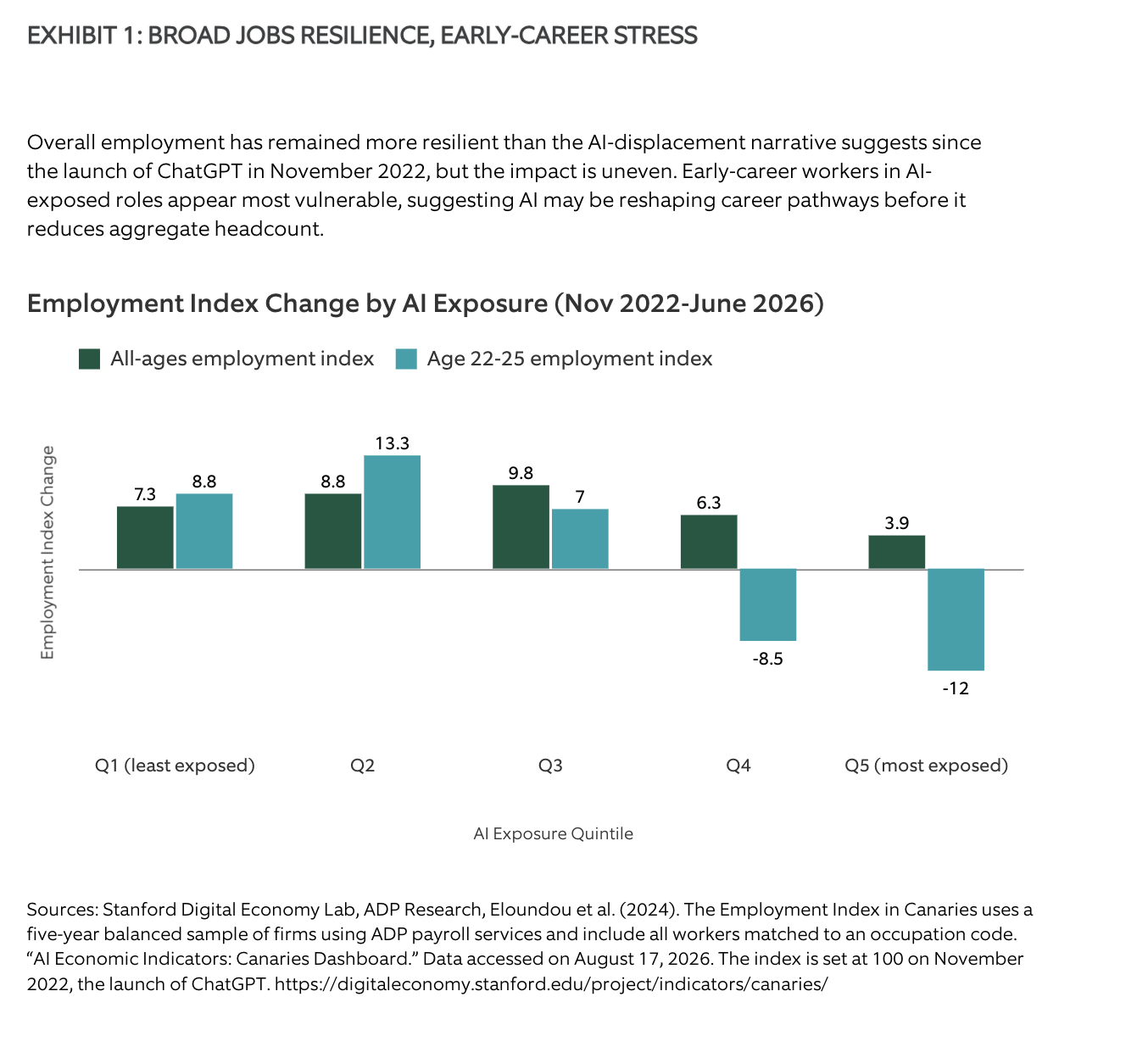
Taken together, these studies suggest that AI's initial impact may be concentrated on a smaller subset of entry-level work in AI-exposed industries rather than the broader workforce. Career pathways that historically relied on routine tasks as a training ground may face disruption.
We believe it is important to consider longer-term implications for career progression and lifetime earnings for impacted junior and early-career workers. Long-term economic effects will depend on the speed with which displaced workers are absorbed into productive employment. Evidence indicates that delayed labor market entry can generate earnings losses that fade gradually but persist for years into workers’ careers.6 Indeed, adaptability, along with greater flexibility, judgment and AI fluency, is emerging as a key attribute of new hires.7
Academic research notwithstanding, Federal Reserve Bank of New York research compared job trends before and after the release of ChatGPT in 2022. It found that AI was not the main driver of a slowdown in entry-level hiring and that firms intend to incorporate AI mainly through retraining, limiting the impact on hiring.8
Retraining Rather Than Job Cuts
Indeed, corporate leaders appear increasingly focused on augmentation rather than replacement. In a recent survey, CEOs are less focused on reducing hiring than in 2024, when nearly half were considering cuts. Instead, nearly half of CEOs are now turning their attention to reskilling and retaining workforces to better leverage AI in the workplace, while a similar number said they are redesigning roles to combine human and AI capabilities.9 The conversation appears to have shifted from reducing headcount to increasing productivity.
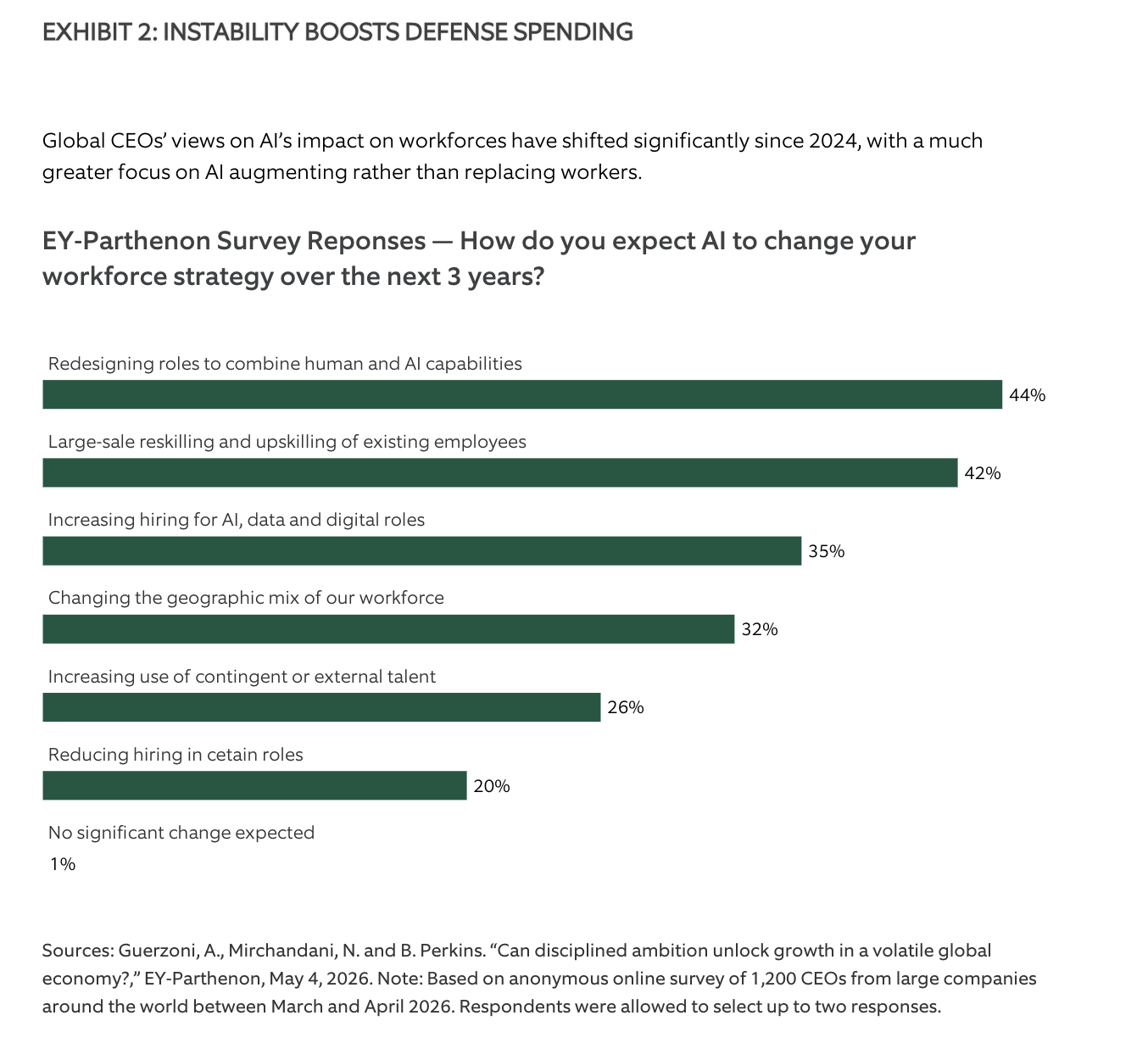
This distinction matters for long-term economic outcomes since a shift to maintaining workforces while increasing overall productivity would have a more positive impact on long-term growth. While this survey may be encouraging for job growth, we remain focused on actual labor market outcomes as evidence that executives are not simply “talking the talk” but also “walking the walk,” since the risk exists that some jobs are impacted, or replaced, by AI and automation, particularly as AI becomes more pervasive than it is today.
AI’s Case for More Productivity and Less Inflation
Most major economic studies conclude that AI will likely boost productivity and economic growth over the coming decade. The OECD estimates AI could add between 0.4% and 1.3% to annual labor productivity growth in G7 economies with high AI exposure (e.g., U.S., U.K.) until 2034, and 0.2% to 0.8% in countries less impacted by AI (e.g., Japan, Italy).10
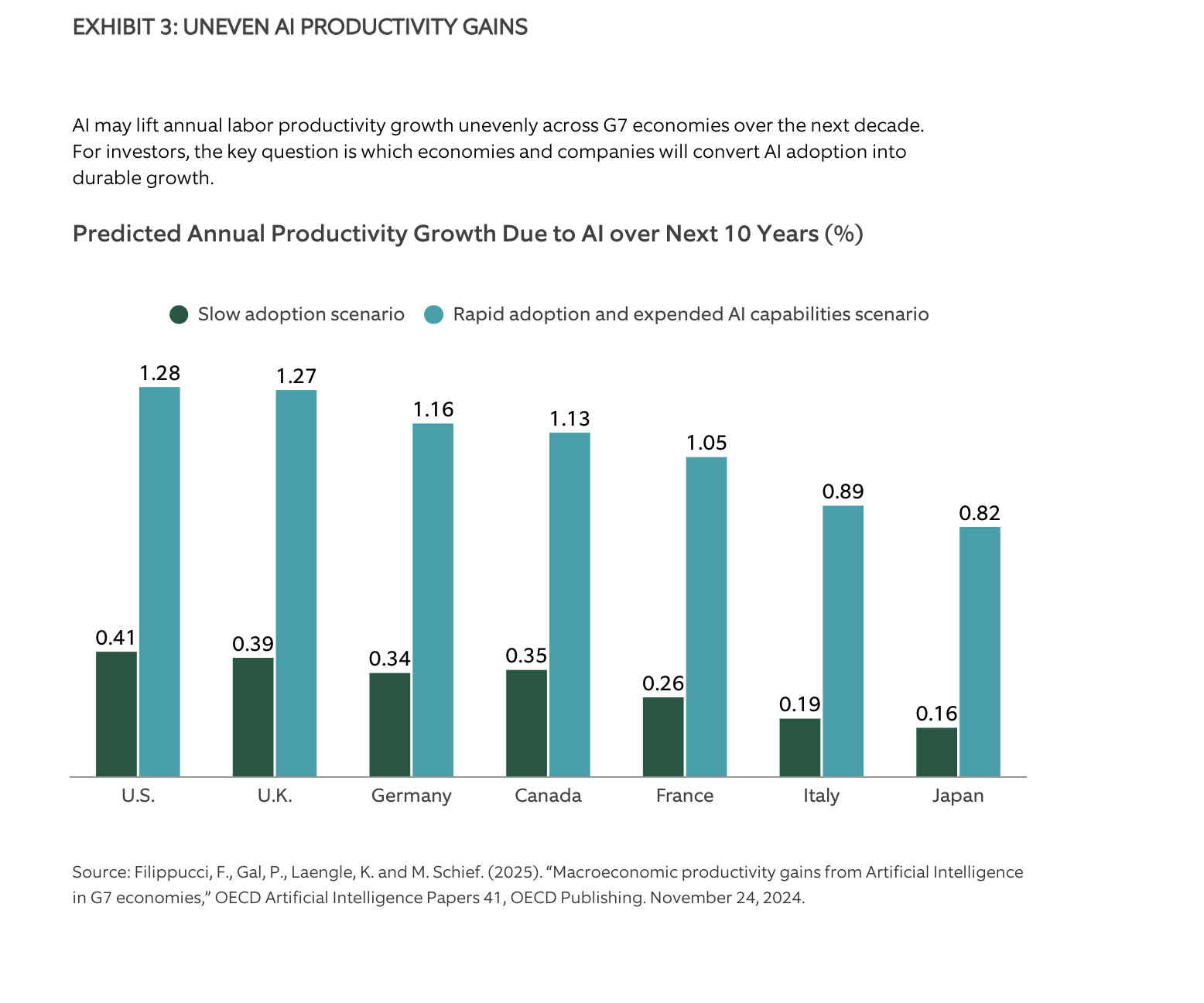
Over the longer-term horizon aligned with our capital market assumptions, we also believe widespread AI adoption should reduce production costs and raise productivity. The result is likely to be higher gross domestic product (GDP) growth and a more disinflationary environment than would otherwise occur, although the effects may vary across geographies and economies depending on their AI exposure.
A key risk to these growth estimates is whether labor market disruptions may in turn threaten consumer spending. Later job entrants, job losses or job uncertainty could lead to lower spending and therefore lower growth. However, this uncertainty is likely to have shorter-term effects as the labor market adjusts and rebalances.
Playbook: Invest for Talent Evolution
We are in the early days of AI-related labor developments, making it difficult to separate AI’s labor impact from other factors. However, we think companies are developing a better understanding of what AI does well, what it doesn’t and how to recalibrate.
As AI progresses, we think investors should seek the industries and businesses remaking their workforces to leverage AI for growth. Companies that successfully combine AI with human expertise may capture productivity gains while maintaining employment growth. Innovative sectors like technology, health care and renewable energy most likely will drive this workforce reinvention, creating opportunities especially in private equity, which, in particular, may help scale promising ventures benefiting from digital transformation.
Glossary
ADP: A payroll and human capital management company whose employment data is often used in labor market research.
Capital market assumptions: Long-term forecasts for asset class returns, risks and correlations that investors use to guide strategic asset allocation decisions.
Generative AI: A type of artificial intelligence that can create new content — such as text, images, audio, video or software code — based on patterns learned from existing data.
Labor productivity: A measure of economic output produced per hour worked.
Organisation for Economic Co-operation and Development (OECD): An international organization that provides economic research, policy analysis and data for member and partner countries.
Private equity: Private equity refers to stakes or ownership in businesses that do not trade on public stock markets.
Footnotes
1 Source: Autor, D., Chin, C., Salomons, A., and B. Seegmiller. (2022) New Frontiers: The Origins and Content of New Work, 1940–2018. NBER Working Paper 30389, August 2022. https://doi.org/10.3386/w30389
2 Source: Kharazian, A., Simon, L., & Stevens, R. (2026). A New Look at AI’s Impact on Jobs: Firm-Level AI Spending and Workforce Adjustment. Ramp Economics Lab. June 30, 2026. https://ramp.com/data/ai-jobs-impact
3 Sources: Murray, C. “Heavy corporate AI spenders add staff faster than peers,” Financial Times, June 29, 2026; Kharazian, A., Simon, L., & Stevens, R. (2026). A New Look at AI’s Impact on Jobs: Firm-Level AI Spending and Workforce Adjustment. Ramp Economics Lab. June 30, 2026. https://ramp.com/data/ai-jobs-impact
4 Source: Maasoum, H., Mahdi, S. and G. Lichtinger. (2025) Generative AI as Seniority-Biased Technological Change: Evidence from U.S. Résumé and Job Posting Data. August 31, 2025. Last Revised: June 6, 2026. Available at SSRN: https://ssrn.com/abstract=5425555
5 Source: Brynjolfsson, E., Chandar, B., and R. Chen. (2025). Canaries in the Coal Mine? Six Facts about the Recent Employment Effects of Artificial Intelligence. Stanford Digital Economy Lab. REVISED AUG 12, 2026. https://digitaleconomy.stanford.edu/publications/canaries-in-the-coal-mine/
6 Source: Schwandt H. and T. von Wachter. (2019). Unlucky Cohorts: Estimating the Long-Term Effects of Entering the Labor Market in a Recession. NBER Working Paper 25141. Available at NBER: https://www.nber.org/papers/w25141
7 Source: Cognizant, Pearson. The AI workforce pulse: The adaptability imperative. June 2026. https://www.cognizant.com/en_us/insights/insights-blogs/documents/whitepapers/ai-workforce-pulse-the-adaptability-imperative.pdf
8 Source: Audoly, R., Miles Guerin, M. and G.iorgio Topa., “Do Job Postings Show Early Labor‑Market Effects of AI?,” Federal Reserve Bank of New York Liberty Street Economics., May 14, 2026., https://doi.org/10.59576/lse.20260514
9 Sources: EY. “Geopolitics tops the CEO agenda as leaders tighten focus on profitability, AI and strategic deals,” Press Release, May 4, 2026; Guerzoni, A., Mirchandani, N. and B. Perkins. “Can disciplined ambition unlock growth in a volatile global economy?,” EY-Parthenon, May 4, 2026.
10 Source: Filippucci, F., Gal, P., Laengle, K. and M. Schief. (2025). "Macroeconomic productivity gains from Artificial Intelligence in G7 economies," OECD Artificial Intelligence Papers 41, OECD Publishing. November 24, 2024.
IMPORTANT DISCLOSURES
Northern Trust Asset Management (NTAM) is composed of Northern Trust Investments, Inc., Northern Trust Global Investments Limited, Northern Trust Fund Managers (Ireland) Limited, Northern Trust Global Investments Japan, K.K, NT Global Advisors, Inc., 50 South Capital Advisors, LLC, Northern Trust Asset Management Australia Pty Ltd, and investment personnel of The Northern Trust Company of Hong Kong Limited and The Northern Trust Company.
Issued in the United Kingdom by Northern Trust Global Investments Limited, issued in the European Economic Association (“EEA”) by Northern Trust Fund Managers (Ireland) Limited, issued in Australia by Northern Trust Asset Management (Australia) Limited (ACN 648 476 019) which holds an Australian Financial Services Licence (License Number: 529895) and is regulated by the Australian Securities and Investments Commission (ASIC), and issued in Hong Kong by The Northern Trust Company of Hong Kong Limited which is regulated by the Hong Kong Securities and Futures Commission.
For Canada, Asia-Pacific (APAC) and Europe, Middle East and Africa (EMEA) markets, this information is directed to institutional, professional and wholesale clients or investors only and should not be relied upon by retail clients or investors. For US NTAM, the information contained herein is intended for use with all current or prospective clients of Northern Trust Investments, Inc (NTI). This document may not be edited, altered, revised, paraphrased, or otherwise modified without the prior written permission of NTAM. The information is not intended for distribution or use by any person in any jurisdiction where such distribution would be contrary to local law or regulation. NTAM may have positions in and may effect transactions in the markets, contracts and related investments different than described in this information. This information is obtained from sources believed to be reliable, its accuracy and completeness are not guaranteed, and is subject to change. Information does not constitute a recommendation of any investment strategy, is not intended as investment advice and does not take into account all the circumstances of each investor.
This report is provided for informational purposes only and is not intended to be, and should not be construed as, an offer, solicitation or recommendation with respect to any transaction and should not be treated as legal advice, investment advice or tax advice. Recipients should not rely upon this information as a substitute for obtaining specific legal or tax advice from their own professional legal or tax advisors. References to specific securities and their issuers are for illustrative purposes only and are not intended and should not be interpreted as recommendations to purchase or sell such securities. Indices and trademarks are the property of their respective owners. Information is subject to change based on market or other conditions. Unless otherwise noted, the statements expressed herein are solely opinions of Northern Trust. Northern Trust does not make any representation, assurance, or other promise as to the accuracy, impact, or potential occurrence of any events or outcomes expressed in such opinions.
All securities investing and trading activities risk the loss of capital. Each portfolio is subject to substantial risks including market risks, strategy risks, advisor risk, and risks with respect to its investment in other structures. There can be no assurance that any portfolio investment objectives will be achieved, or that any investment will achieve profits or avoid incurring substantial losses. No investment strategy or risk management technique can guarantee returns or eliminate risk in any market environment. Risk controls and models do not promise any level of performance or guarantee against loss of principal. Any discussion of risk management is intended to describe NTAM’s efforts to monitor and manage risk but does not imply low risk.
Past performance is not a guarantee of future results. Performance returns and the principal value of an investment will fluctuate. Performance returns contained herein are subject to revision by NTAM. Comparative indices shown are provided as an indication of the performance of a particular segment of the capital markets and/or alternative strategies in general. Index performance returns do not reflect any management fees, transaction costs or expenses. It is not possible to invest directly in any index. Net performance returns are reduced by investment management fees and other expenses relating to the management of the account. Gross performance returns contained herein include reinvestment of dividends and other earnings, transaction costs, and all fees and expenses other than investment management fees, unless indicated otherwise. For U.S. NTI prospects or clients, please refer to Part 2a of the Form ADV or consult an NTI representative for additional information on fees.
Forward-looking statements and assumptions are NTAM’s current estimates or expectations of future events or future results based upon proprietary research and should not be construed as an estimate or promise of results that a portfolio may achieve. Actual results could differ materially from the results indicated by this information.
© 2026 Northern Trust Corporation. Head Office: 50 South La Salle Street, Chicago, Illinois 60603 U.S.A.
A message from Advisor Perspectives and VettaFi: Discover something new! Click here to register for our upcoming webcasts.
Membership required
Membership is now required to use this feature. To learn more:
View Membership Benefits