Every runner has a natural pace: the speed that we maintain under optimal conditions like flat terrain, cool temperatures and a good night of sleep. Runners can train to speed up to meet a target time, or slow down for endurance.
Interest rates also have a natural setting. When they are raised above this level, the pace of the economy slows to ensure endurance. When they are lowered, the speed of economic growth will increase. The neutral rate of interest (or r*) cannot be precisely measured, but understanding its influence is critical. All current estimates suggest that the neutral rate is moving up, carrying other yields with it and complicating central bank decisions.
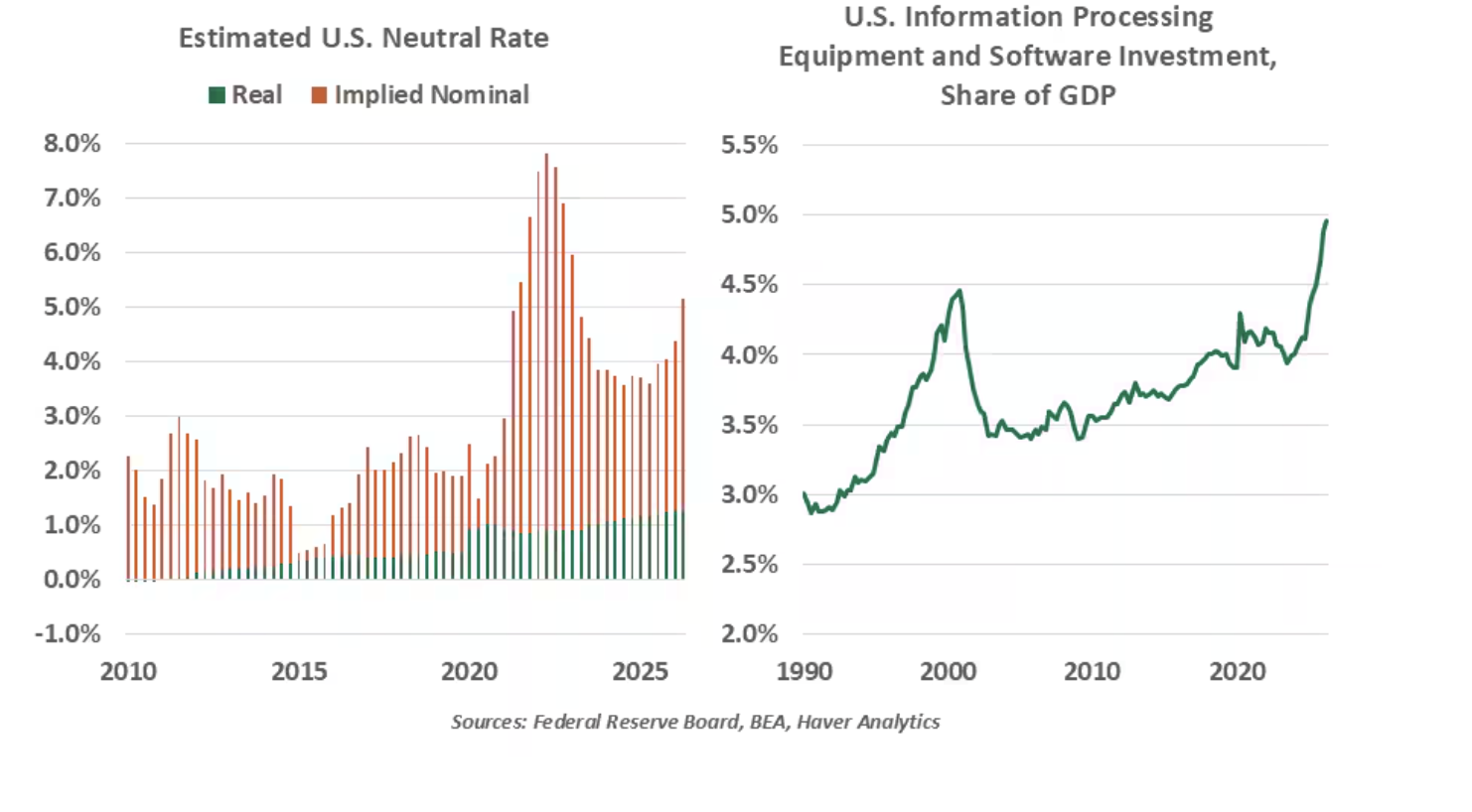
The fundamental factor driving neutral rates is the balance between the supply of capital and demand for investment. Neutral interest rates rise when investment opportunities increase faster than the supply of savings. For much of the 2010s, abundant global savings, weak productivity growth and demand for safe assets held neutral rates down.
Today, investment opportunities have reignited, led by technology: Businesses are investing heavily in data centers, software, semiconductors and power infrastructure to support AI deployment. Stronger expected productivity growth raises the prospective return on investment, increasing demand for capital and compounding the run-up of yields.
See more: Rising Rates, Rising Income: The Time Is Now for Dividend Growth ETFs
Growth of government debt is also pushing up r*. Investors need additional compensation to hold more government securities as deficits grow; the rising risk-free benchmark rate pulls up other yields with it.
A higher neutral rate raises the bar for monetary policy to be considered restrictive. This week, Fed Chairman Kevin Warsh characterized the Fed’s rate increase as “removing a dose of accommodation,” implying the rate had been below neutral. The Fed estimate charted above implies a nominal neutral rate of over 4%, affirming an outlook of at least one more hike in store.
The structural factors pushing up r* are unlikely to subside. Demand for AI is still growing, and deficits are difficult to reduce. If the Fed is to steer the U.S. economy to an appropriate pace, a push to stay above neutral will be necessary.
Ryan James Boyle is the Chief U.S. Economist within the Global Risk Management division of Northern Trust.
Information is not intended to be and should not be construed as an offer, solicitation or recommendation with respect to any transaction and should not be treated as legal advice, investment advice or tax advice. Under no circumstances should you rely upon this information as a substitute for obtaining specific legal or tax advice from your own professional legal or tax advisors. Information is subject to change based on market or other conditions and is not intended to influence your investment decisions.
© 2026 Northern Trust Corporation. Head Office: 50 South La Salle Street, Chicago, Illinois 60603 U.S.A. Incorporated with limited liability in the U.S. Products and services provided by subsidiaries of Northern Trust Corporation may vary in different markets and are offered in accordance with local regulation. For legal and regulatory information about individual market offices, visit northerntrust.com/terms-and-conditions.
A message from Advisor Perspectives and VettaFi: Discover something new! Click here to register for our upcoming webcasts.
© Northern Trust
More Tax Planning Topics >