From the 2020 pandemic to today’s oil shocks, we’re often reminded in recent years that inflation can flare up unexpectedly. We’ve also likely entered an era in which higher inflation may linger for some time. As a result, bond-heavy and income-oriented investors may need to shore up their inflation defense, which we think should combine strategic positioning with tactical maneuvering.
Muni Investors Need Multiple Inflation Defenses
The increased frequency of “black swan” geopolitical shocks has made them more the norm than anomalies, with current and lasting implications for investors. After years at or below 2%, inflation roared back in the 2021 post-COVID economy. Since then, disruptions from Russia–Ukraine hostilities, a global trade war, the AI buildout and soaring oil prices due to a widening Middle East conflict have jolted inflation and strained markets, heightening investor anxieties.
Although the Consumer Price Index (CPI) rose a relatively modest 2.4% annually as of August, the metric has remained stubbornly above the Federal Reserve’s 2% target, and average consumers continue to struggle with high costs. The Fed is playing its policy cards close to the vest, but new Chair Kevin Warsh admits that inflation levels are “concerning.”
See more: Extension Swaps: Locking in Income for Longer
Other inflation factors? One is soaring US debt, a record $40 trillion that over time could erode market confidence, weaken the dollar and raise import prices even more. We also see structural inflation drivers among demographic trends redefining how people live and work, further straining natural resources, labor, energy and other global economic pillars.
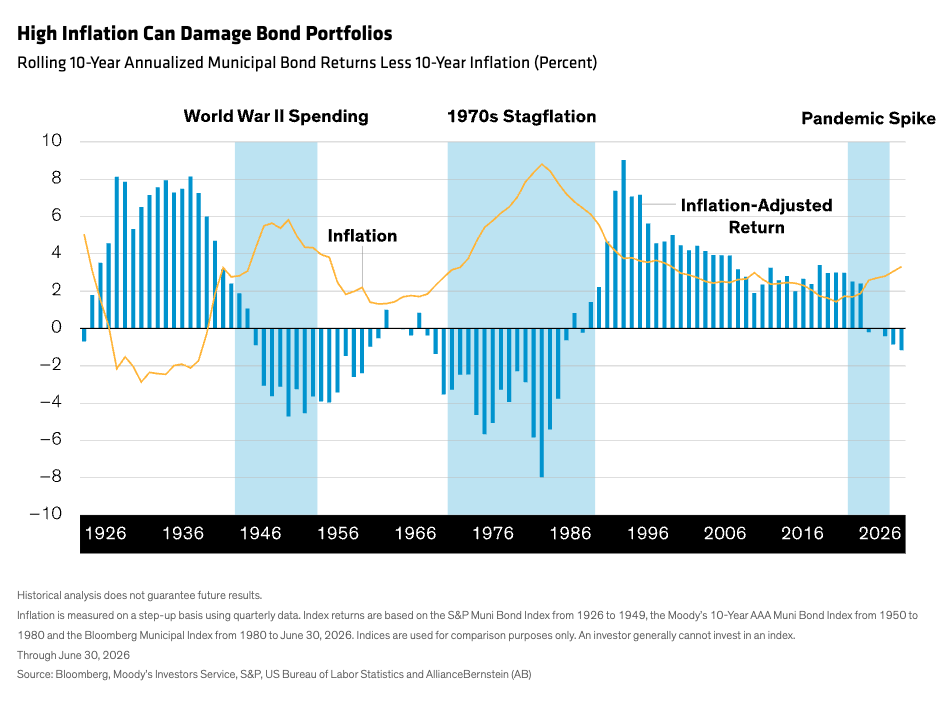
Putting it all together, inflation is not only elevated, but collective pressures also remain skewed to the upside and inflation remains vulnerable to unexpected surges. Why does it matter to investors? Inflation erodes the real value of bond returns, sometimes to the point that inflation-adjusted returns are negative (Display).
What’s more, investors don’t have to wait for inflation to accelerate before taking action. In our view, an effective inflation defense combines strategic allocations with tactical opportunities.
Traditional Inflation Hedges Have Limitations
Buying Treasury Inflation-Protected Securities (TIPS) is the most common and direct way to defend against inflation. TIPS adjust the principal value of the investment based on changes in the CPI and then pay interest on the adjusted principal.
TIPS help investors keep up with inflation and offer a real rate of return. But TIPS are notoriously tax inefficient since the underlying interest—and inflation adjustment—are taxed as ordinary income. Worse, the inflation adjustment is received when the TIPS mature but is taxed in the year in which it was realized. That makes it “phantom income.”
The tax-exempt market has its own form of inflation-protected securities, known as municipal inflation-protected securities (MIPS). Unfortunately, the MIPS market is very small and frequently illiquid, and MIPS often trade at higher prices than comparable TIPS.
Fortunately, there’s another path.
CPI Swaps: The Front Line of Strategic Inflation Defense
By combining tax-exempt municipal bonds and CPI swaps, investors who pay taxes can tap into two very large and highly liquid markets. CPI swaps are agreements in which investors arrange to “swap” fixed-interest payments for floating-rate payments tied to inflation rates for a predetermined length of time.
The combination offers two layers of tax efficiency. First, the underlying municipals are exempt from federal taxation. Second, the CPI swaps, when held longer than 12 months, are taxed at generally more favorable capital gains rates, which can be sheltered through the realization of losses. Plus, there’s no phantom income.
We think allocating to CPI swaps also offers a strategic inflation defense. That’s because inflation securities get more expensive when inflation expectations rise and markets start to worry. A strategic allocation to CPI swaps can help manage against such surprises. Most importantly, investors don’t need to predict inflation but can prepare for it.
Tactical Maneuvers Matter Too
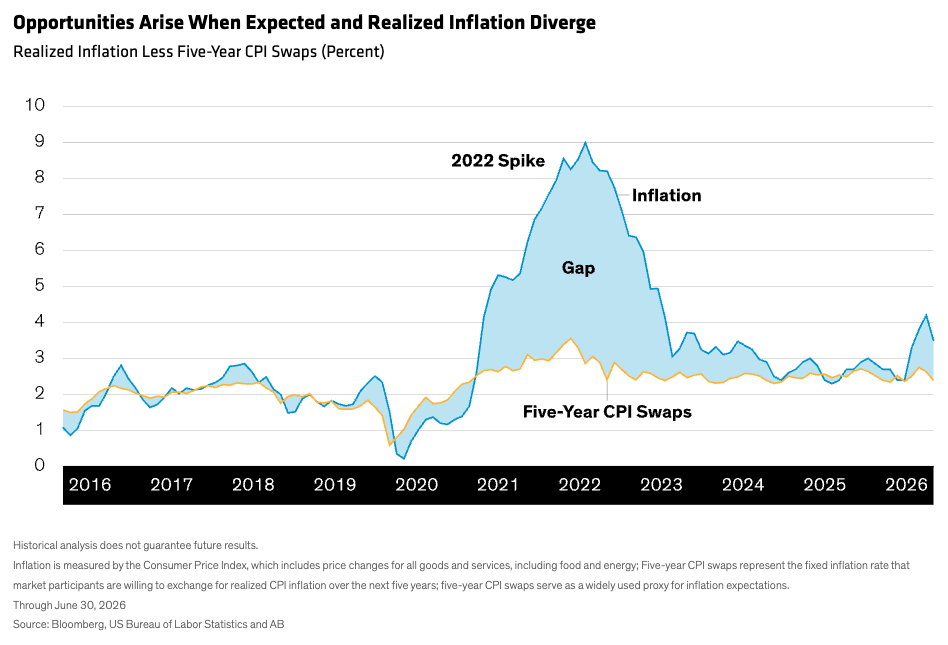
A strategic allocation to CPI swaps can provide the foundation for inflation defense but shifts in inflation expectations can also create tactical opportunities. Think of a CPI swap as an agreement that locks in the market's expectation for future inflation. If actual inflation is higher than expectations, the swap gains value. The bigger the gap between realized inflation and what the market had priced in, the greater the potential benefit.
Over the last 10 years, actual inflation has exceeded expectations by an average of 95 basis points. We believe that when the gap grows wider than that average, the market may be underpricing inflation risk, creating a potentially attractive entry point for investors. This divergence was especially pronounced during the COVID-era inflation spike of 2021 to 2023 (Display).
Given today’s inflation backdrop, investors shouldn’t treat inflation defense as an afterthought. We believe it requires a thoughtful, two-pronged approach: Strategic inflation positioning can provide a defensive foundation, while tactical, opportunistic positioning capitalizes on temporary market mispricings.
A message from Advisor Perspectives and VettaFi: Discover something new! Click here to register for our upcoming webcasts.
The views expressed herein do not constitute research, investment advice or trade recommendations and do not necessarily represent the views of all AB portfolio-management teams. The views should not be considered to be legal or tax advice. The tax rules are complicated, and their impact on a particular individual may differ depending on the individual’s specific circumstances. Views are subject to revision over time.
© AllianceBernstein
More Tax Planning Topics >