Cheap Drones Are Repricing Global Energy Markets
Membership required
Membership is now required to use this feature. To learn more:
View Membership Benefits
Summary

- European gasoil refining margins hit roughly $94 over Brent, a 36-year record and well past the 2022 crisis peak of $71.
- Ukrainian drone strikes on Russian refineries are the cause; processing capacity rebuilds far slower than crude reroutes.
- The fiscal 2027 request doubles procurement to $413 billion and R&D to $344 billion, while maintenance grows just 20%.
- Drone equities are down 28% over 12 months against gains of 10% for aerospace and defense and 18% for the S&P 500.
I’ve spent my entire career in capital markets, and what I’ve learned is that stocks tell you what people hope, while commodities tell you what’s actually happening to the stuff the world runs on.
So when I say the most important number in the drone story isn’t a defense stock, I hope you’ll hear me out.
See more: The Real Winners of the Venezuela Oil Deal
Last week, the refining margin on European gasoil, the benchmark that sets the price of diesel and heating oil across much of the world, closed at roughly $94 a barrel over Brent crude, according to Bloomberg data. That figure is normally somewhere between $12 and $18. The worst of the 2022 energy crisis, after Russia invaded Ukraine and Europe scrambled for fuel, topped out around $71.
We’re now well past that. And we’ve been past it since late March.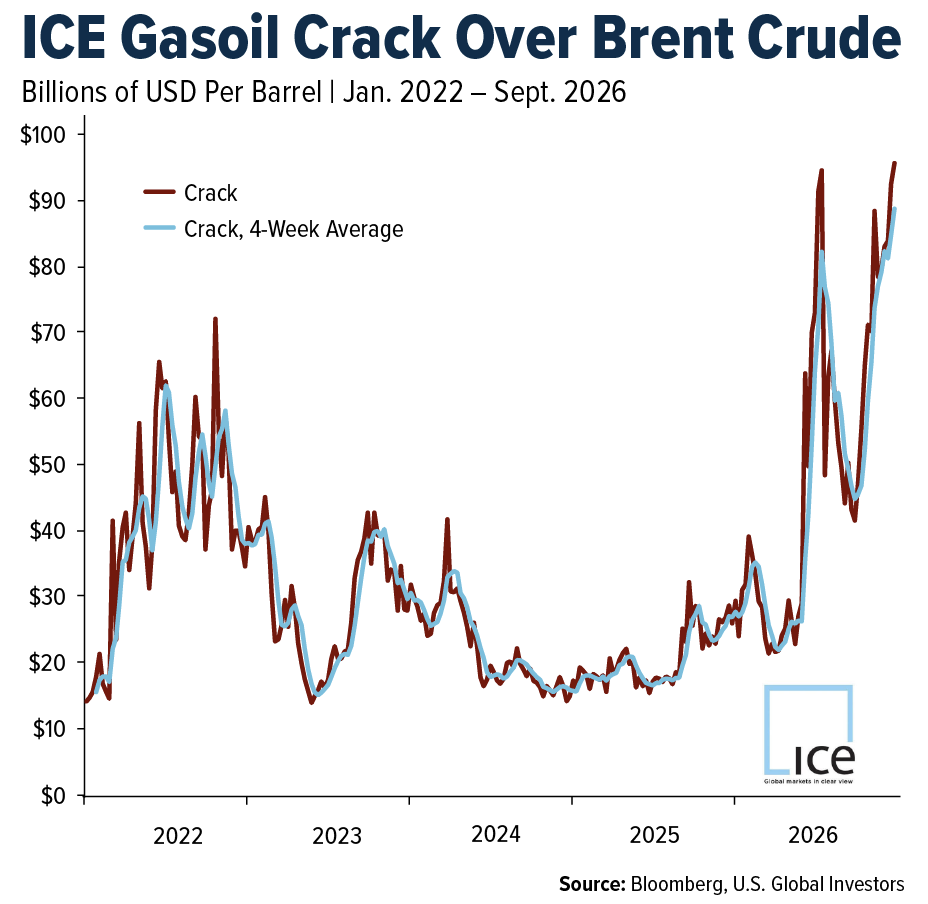
This didn’t happen because a cartel cut production or because a hurricane took out the Gulf Coast. It happened because cheap drones have been systematically destroying the equipment that turns crude oil into diesel fuel, and that equipment takes a great deal longer to rebuild than it takes to blow up.
Five Dollars a Shot Against a $20,000 Machine
A first-person-view attack drone can be assembled for somewhere around $500 to a few thousand dollars. An Iranian-designed Shahed-136 runs in the tens of thousands. The missiles historically used to shoot those things down cost millions of dollars each.
Obviously, that’s not a sustainable exchange rate. You can’t spend $4 million to destroy a $20,000 machine and expect to be solvent at the end of the war, no matter how good your aim is.
Ukraine figured this out fast and now produces drones by the hundreds of thousands per month. Russia did too. What started as a battlefield improvisation is now the organizing problem of Western defense procurement.
The fix is to get the cost of stopping a drone down near the cost of the drone itself. That’s the entire logic behind directed energy weapons. This month, the U.S. Army awarded AeroVironment $464.8 million to produce LOCUST high-energy laser systems. Believe it or not, the company puts the cost of an engagement at under five dollars a shot. The Army calls it the first production contract for a high-energy laser weapon in its history.
Five dollars against $20,000. That’s the exchange rate the Pentagon wants, and the scramble to get there is where the money is going.
What It Costs to Defend a Single American Base
Many of you reading this have a healthy skepticism about foreign wars and whether they’re any of our business. That’s fair, but this one in particular has already arrived on our side of the ocean.
Last autumn, unidentified drones shut down airports across northern Europe. Poland scrambled NATO aircraft over its own territory. German authorities found explosives at an airport in Leipzig. Romania sent fighter jets over a natural gas platform in the Black Sea. More than a dozen NATO countries have reported airspace violations in the past two years, and not one of them triggered a formal response.
Why? Each incident was calibrated specifically to sit just below the threshold that would require one.
Closer to home, the Pentagon has been working with the Department of Homeland Security (DHS) and the FAA on the authority to bring drones down over American airports. The Congressional Budget Office (CBO) has priced what protecting a single military installation would cost. The answer is roughly $74 million to install and $5 million a year to operate, which works out to about $7.4 billion for 100 sites.
To me, that looks a lot more like the interstate highway system than like a fighter jet.
The Pentagon Is Suddenly Buying More Than It Is Fixing
In the chart below, you can see the dramatic response in the budget.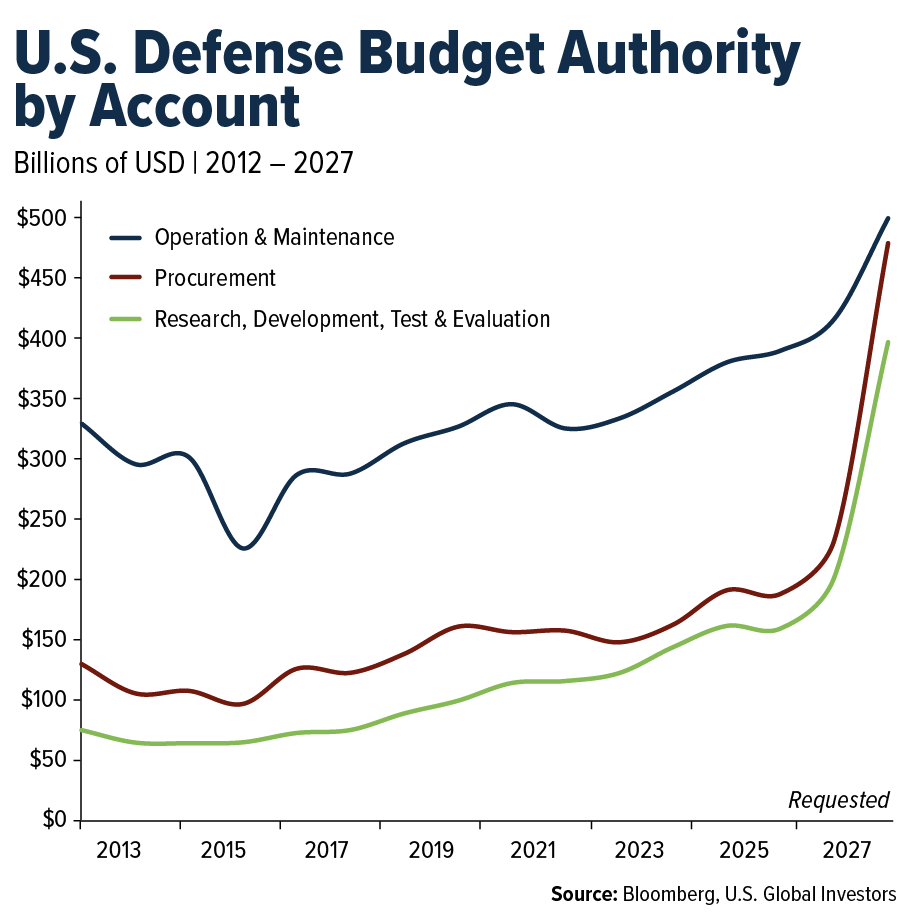
In the fiscal 2027 request, procurement roughly doubles, from $205 billion to $413 billion, according to Bloomberg data. Research and development nearly doubles, from $179 billion to $344 billion. Operation and maintenance, the account that pays for keeping the lights on, grows about 20%.
Buying and inventing things now takes precedence over maintaining what we already have, by a huge margin.
Europe is doing the same thing. NATO has committed around $40 billion over five years, while the European Union is building a radar and sensor line along its eastern border that’s meant to be operational by 2027.
Cheap Machines Are Rewriting the Math of War
Take a look at the chart below. I put together a basket of seven publicly traded names with exposure to drones and counter-drone technology. Over the past 12 months, that basket is down about 28%. Over the same stretch, the Dow Jones U.S. Aerospace and Defense Index gained roughly 10% and the S&P 500 gained nearly 18%.
The peak came in October 2025, the same week the European airport closures were dominating the news. Since then, it’s fallen about 47%.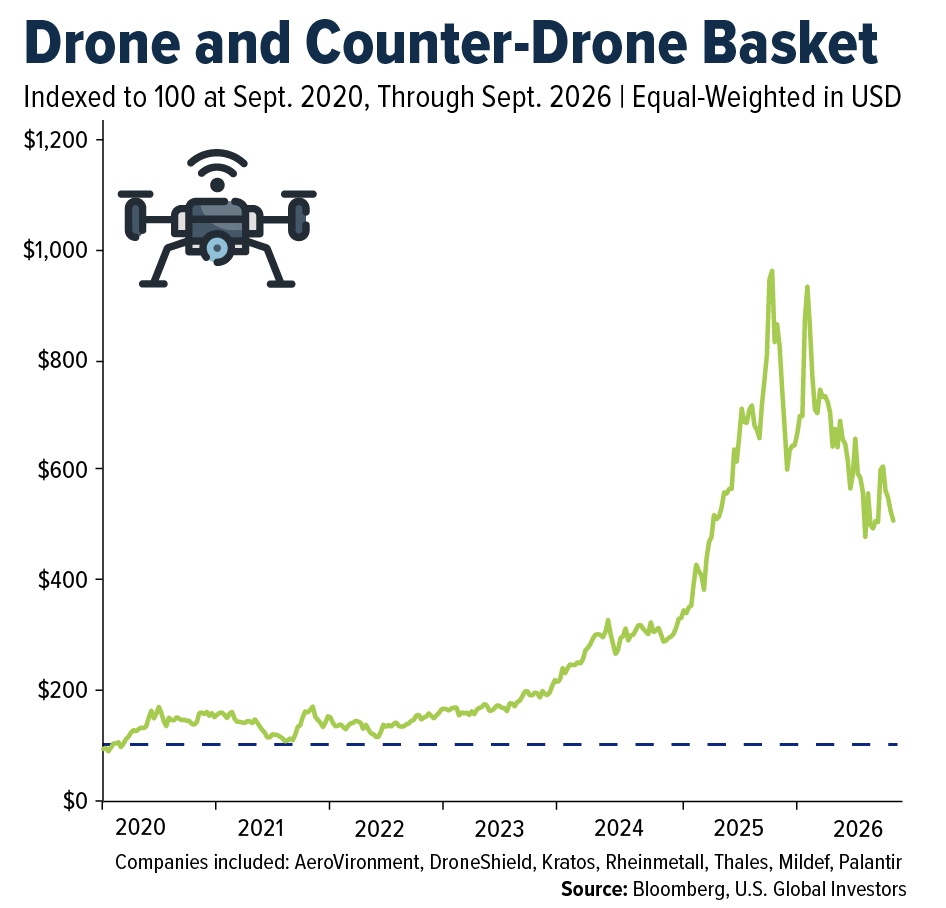
Look at AeroVironment, which is about as close to a pure play as the public markets offer. The company just reported record funded backlog of $1.5 billion, up 37% from a year ago, with bookings running about 1.4 times revenue. That’s huge demand, yet revenue grew only 6%. The stock is down about 40% over 12 months, even as a vast majority of analysts cover it rate it a buy.
DroneShield, an Australian firm that makes detection and jamming equipment, grew revenue 74% year-over-year and swung to a meaningful operating loss doing it. Its shares are down about 46%.
Where the Money Actually Went
The thesis was right. Warfare has been restructured by cheap, expendable, autonomous machines, and the West is spending enormous sums to catch up.
Where the thesis actually paid, so far, was not in the shares of the companies making the drones. It was in the price of the fuel that comes out of the refineries the drones destroyed. Diesel near $200 a barrel is a cost borne by every trucker, every farmer, every airline and every household with an oil burner in the basement.
That’s the part I’d be watching.
Airlines and Shipping
Strengths
- The best-performing airline stock for the week was Pegasus Air, up 3.4%. According to Estadão, Fitch raised Embraer’s issuer default rating to BBB from BBB- on Wednesday, with a stable outlook, citing a robust liquidity position, a track record of positive free cash flow, financial flexibility, and access to credit markets in Brazil and abroad.
- Morgan Stanley had expected the impact of supply disruptions to fade after the second quarter of 2026 (Q2 2026), supported by a potential U.S.-Iran de-escalation, but this has yet to materialize. Re-routing, port congestion, slow steaming, and capacity erosion from El Niño have persisted into the third quarter of 2026 (Q3 2026), keeping effective supply tighter for longer. This has supported spot rates above prior assumptions and improved the Q3 2026 earnings outlook.
- Ryanair CEO Michael O’Leary said fares stopped declining around the end of July, with average fares up “very modestly” in the low single digits in August and the first half of September year-over-year (YoY). The pickup means Ryanair no longer needs to discount tickets as heavily to stimulate demand, reversing a month-over-month (MoM) decline that ran from February through July, according to Bloomberg.
Weaknesses
- The worst-performing airline stock for the week was Tongcheng Travel, down 12.1%. While United’s utilization has declined as it absorbs a large delivery book, part of which will be offset by pending retirements, this is company-specific rather than indicative of broader industry behavior, according to BMO.
- Vessel capacity utilization on China-U.S. routes dropped to 96%, lagging seven-day and one-month averages of 97.9% and 98.9%, respectively, signaling underlying weakness, according to Bloomberg. COSCO, Maersk, and Ocean Network Express are reallocating more capacity to intra-Asia lanes. Chinese shipments to Malaysia surged 15.5%, even as exports to Vietnam dropped 12.4%.
- JetBlue published an investor update, significantly raising its unit revenue (RASM) guidance to 18.5% year-over-year (YoY) at the midpoint, versus 14.5% previously. This better-than-expected revenue offsets most of the higher-than-expected costs from the operational impact of weather and air traffic control challenges, as well as higher jet fuel prices during the quarter. Goldman is now forecasting a modestly wider third-quarter 2026 (Q3 2026) loss per share of ($0.60), versus FactSet consensus of ($0.47).
Opportunities
- Southwest Airlines announced that construction has begun on the first four locations in its airport lounge network. Lounges are expected to open in Austin, Baltimore, Honolulu, and Nashville in late 2027, with seven more expected to follow, according to TD.
- According to Clarkson, container vessel traffic through the Suez Canal, measured in twenty-foot equivalent units (TEUs), increased 54% month-over-month (MoM) and 183% year-over-year (YoY) in August. The return to Suez routing continues to gain momentum.
- Goldman now expects passenger fleet growth to decelerate slightly in 2026 to +1.3%, versus +1.5% in 2025, rather than accelerate to +3.2%. This change is primarily driven by Spirit’s exit, in addition to early lease returns and aircraft sales at Frontier, partially offset by higher-than-expected fleet growth at Southwest and United. Interestingly, 2026 seat growth is expected to lag fleet growth as several airlines take delivery of an elevated number of lower-gauge aircraft, namely A220s and E175s.
Threats
- In a Truth Social post, President Trump stated that Bombardier would no longer be allowed to sell aircraft in the United States unless it began manufacturing domestically. Trump has previously targeted Bombardier. In January 2026, he threatened to decertify Bombardier Global Express business jets and impose 50% import tariffs on aircraft made in Canada until Transport Canada certified a number of planes produced by U.S. rival Gulfstream.
- For COSCO Shipping, congestion remains severe in Europe and Shanghai. Management believes the congestion in Europe could be structural due to underinvestment in infrastructure, while congestion in Shanghai should ease if weather conditions improve. COSCO management expects to pass through only 70%-90% of higher fuel costs for long-term contracts and sees port handling fees rising broadly in line with local inflation. Management expects the reopening of the Red Sea route to be gradual and notes that vessel bunching could initially worsen congestion in Northwest Europe, while the impact on intra-Asia routes should be limited because large vessels cannot be readily deployed to regional ports due to infrastructure constraints.
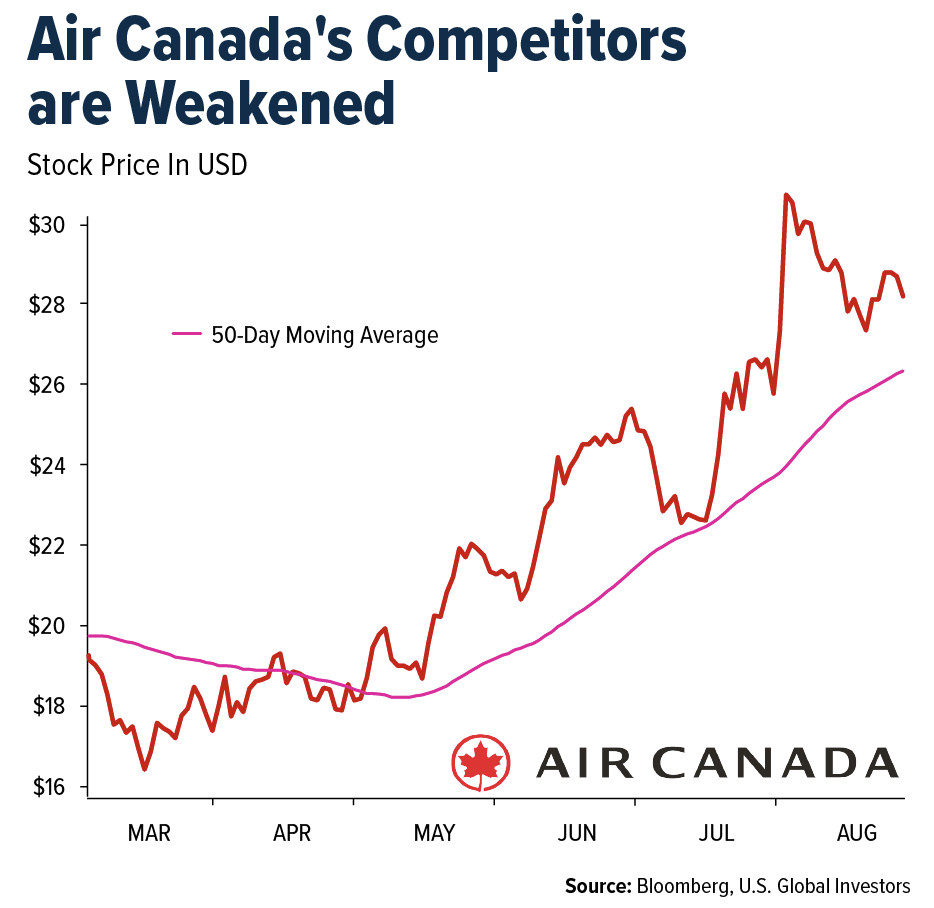
- Transat had already disclosed that it tapped the maximum $150 million loan available from the Canadian government, while Porter received a $125 million loan under the program. With an interest rate of 4% over four years, this represents below-market financing for the airlines and effectively acts as a government subsidy intended to promote airline competition in Canada. Air Canada and WestJet did not access this financing, which is viewed as a positive.
Luxury Goods and International Markets
Strengths
- Signet Jewelers reported a strong second quarter (Q2), with revenue of approximately $1.5 billion, same-store sales up 2.2%, and adjusted earnings per share (EPS) up 36% year-over-year (YoY), driven by strength in bridal and timepieces. The results suggest consumers continue to spend on special-occasion and higher-end jewelry despite broader economic uncertainty.
- Recent industry commentary suggests global luxury demand is being supported primarily by U.S. high-net-worth consumers. Strong wealth creation and financial market gains have helped affluent American shoppers continue spending on luxury goods, while demand in China, Japan, South Korea, and parts of Europe remains more uneven.
- Signet Jewelers gained approximately 17% over the past five trading days, making it the top performer in the S&P Global Luxury Index. Shares rallied after the company reported strong quarterly results.
Weaknesses
- Sentiment toward European luxury weakened this week after HSBC downgraded LVMH and Burberry from Buy to Hold, citing a more challenging outlook for the second half of 2026. HSBC pointed to limited visibility and a tougher environment for “soft luxury,” while broader trends continue to reflect weaker demand from Chinese and aspirational luxury consumers.
- According to Bloomberg, U.S. luxury store openings fell 46% in the first half of 2026, signaling a significant slowdown in physical retail expansion. While brands continue investing in larger flagship locations, the decline in new stores suggests a more cautious outlook for demand and growth.
- Lucid Group, a luxury EV manufacturer, declined approximately 13% over the past five trading days, making it the worst performer in the S&P Global Luxury Index. The shares continued to come under pressure as investors remained concerned about the company’s heavy cash consumption, ongoing losses and path to profitability.
Opportunities
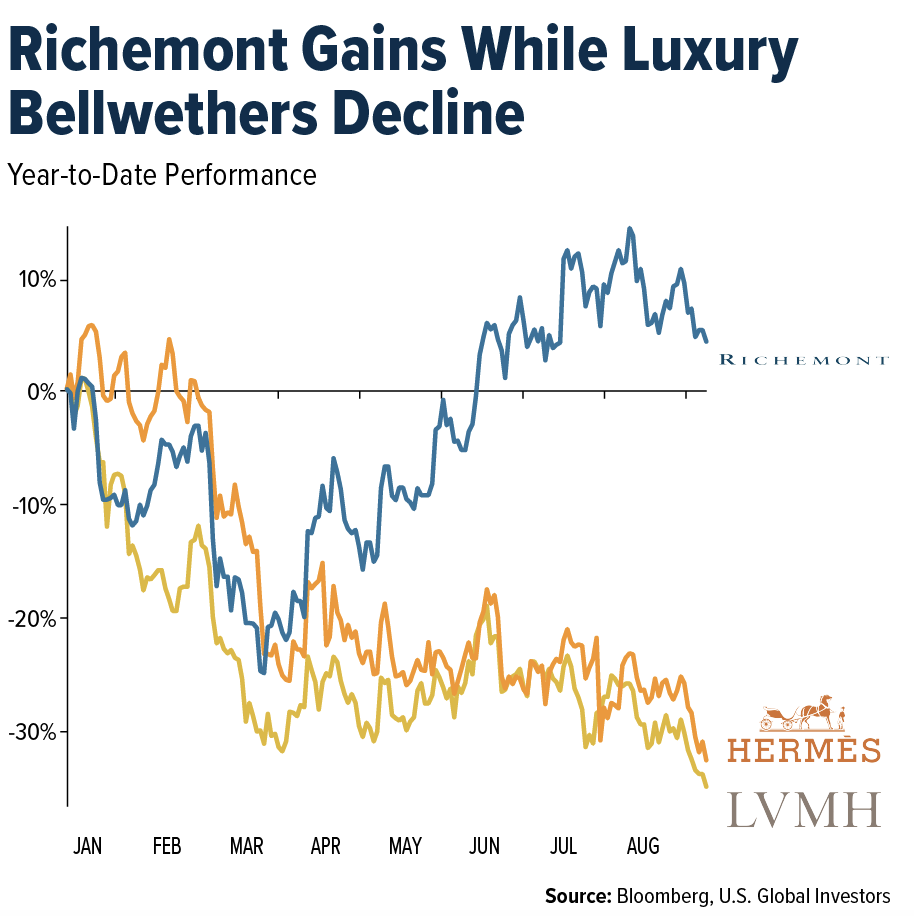
- Despite LVMH and Hermès, widely viewed as bellwethers for global luxury demand, being down more than 30% year-to-date, Richemont is up approximately 4%. The divergence highlights the strength of Richemont’s jewelry-focused portfolio, led by Cartier and Van Cleef & Arpels, and suggests continued market share gains as consumers favor high-end jewelry over handbags and fashion.
- Tesla’s Full Self-Driving (FSD) Supervised system could gain broader European approval as early as October, potentially providing a catalyst for the company’s autonomous-driving strategy. Six EU countries now permit the system, after Slovenia became the latest to recognize Tesla’s approval this week.
- Rising inflation in China may signal improving domestic demand and a healthier consumer environment. Official data released on September 9 showed August CPI up 0.8% year-over-year (YoY) and 0.4% month-over-month (MoM), while core inflation accelerated to 1.0%. The trends suggest Chinese consumers may be gradually increasing discretionary spending, which could benefit luxury, beauty, travel, and hospitality companies with significant exposure to China.
Threats
- The recent strengthening of the Japanese yen could weigh on luxury spending by Chinese, Taiwanese, and other Asian shoppers in Japan. A stronger yen reduces Japan’s price advantage, potentially pressuring cross-border luxury demand, particularly among price-sensitive shoppers.
- The European Central Bank raised interest rates by 25 basis points this week, increasing its deposit rate to 2.50% after warning that inflation remains above target due to persistent energy-price pressures. The ECB now forecasts eurozone inflation of 3.0% in 2026, versus its 2% target, while acknowledging resilient economic growth. Next week, the risk of a Federal Reserve rate hike remains elevated amid strong U.S. labor data and rising inflation pressures.
- Oil prices have climbed above $100 per barrel, creating risks for consumers and companies. Higher energy costs could reduce household spending on discretionary items such as apparel, travel, restaurants, and luxury goods, while increasing transportation, shipping, and operating expenses for businesses.
Energy and Natural Resources
Strengths
- The best-performing commodity for the week was WTI crude oil, up 9.60%. Crude prices climbed sharply as the conflict between the U.S. and Iran raised the risk of supply disruptions across the Middle East, a region that accounts for a significant share of global oil exports. With inventories already tight and spare capacity limited, the market increasingly priced in the possibility of a prolonged supply shock.
- Met coal prices have continued to strengthen in recent weeks. Premium low-vol hard coking coal is now trading at $280/ton FOB Australia and $300/ton CFR China, levels that remain well above prevailing consensus expectations, according to UBS.
- SABIC Agri-Nutrients approved a $3.46 billion ammonia and urea expansion project, demonstrating confidence in long-term fertilizer demand and global agricultural markets. The investment is expected to increase urea production capacity by 54%, reinforcing the company’s position as a leading global fertilizer producer.
Weaknesses
- The worst-performing commodity for the week was China lithium carbonate, down 9.60%. Lithium carbonate futures fell sharply after China temporarily halted approvals for new power and energy-storage battery projects pending an industry capacity review. While existing and approved projects are expected to proceed, the move reinforced concerns about persistent oversupply and weaker long-term growth expectations across the battery materials sector.
- Alcoa’s $2.6 billion acquisition financing highlights increasingly challenging conditions in high-yield credit markets, with the company forced to issue junk-rated debt as CCC bond yields and spreads climb to multi-year highs. Higher financing costs could pressure profitability across capital-intensive metals and mining companies, potentially reducing investment and slowing future project development.
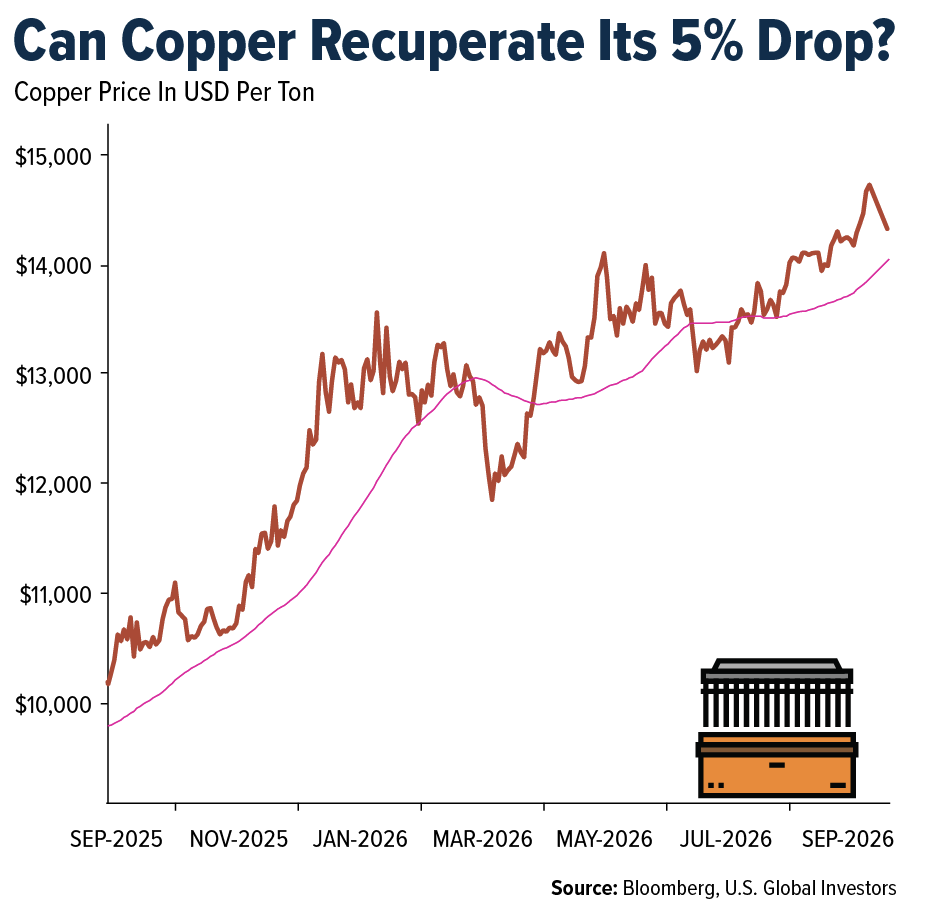
- COMEX copper fell more than 5% after reports that the White House has yet to decide on refined copper tariffs, undermining a key driver behind the recent rally. The news sparked a sharp unwind of tariff-related positioning as investors reassessed record U.S. copper inventories accumulated ahead of expected trade restrictions.
Opportunities
- Canada is moving to accelerate energy and infrastructure development by removing federal environmental reviews for projects such as oil sands, pipelines and natural gas facilities, while signaling support for higher oil sands production. At the same time, Prime Minister Carney is set to showcase 167 investment projects spanning LNG, mining, data centers and ports to major global investors, potentially unlocking significant capital inflows and future commodity demand.
- Japan has earmarked ¥385 billion ($2.5 billion) to replenish its strategic petroleum reserves after drawing down inventories during recent Middle East supply disruptions. The planned purchases could provide additional demand support for crude oil markets while enhancing energy security.
- The European Union unveiled a new initiative to reduce dependence on Russian radioisotopes and nuclear fuel supply chains, including plans to develop domestic HALEU capacity and expand isotope production. The effort could accelerate investment across the European nuclear sector and create new demand opportunities for Western uranium and nuclear fuel suppliers.
Threats
- Veteran commodities strategist Jeff Currie warns that the U.S. energy market is entering a more dangerous phase, with fuel shortages spreading from refined products to crude oil and pushing gasoline prices toward $5 per gallon before the midterm elections. As refinery flexibility diminishes and strategic reserves remain constrained, consumers could face significantly higher fuel costs, with diesel potentially surging to $7-$9 per gallon and intensifying inflationary and political pressures.
- Iran signaled it is prepared to escalate strikes against U.S. and Gulf assets if Washington intensifies its attacks, raising fears of a broader regional conflict. The threat of further disruptions to Middle Eastern energy infrastructure and shipping routes has been amplified by continued security risks in the Red Sea, increasing uncertainty for global oil and refined product supplies.
- Europe still needs more than 100 TWh of natural gas, valued at over €7 billion, to reach its minimum 75% storage target ahead of winter. Achieving that goal would require the fastest late-season inventory build since the 2022 energy crisis, leaving the region vulnerable to supply disruptions and further price spikes if gas flows remain constrained.
Bitcoin and Digital Assets
Strengths
- Nasdaq Ventures agreed to invest $100 million in Payward, the parent company of Kraken, one of the world’s largest cryptocurrency exchanges, valuing the company at approximately $21 billion. The partnership will expand their work on Nasdaq Equity Tokens, with Kraken expected to distribute tokenized Nasdaq-listed equities while preserving shareholder voting rights. The investment highlights the growing convergence between traditional capital markets and crypto infrastructure as major exchanges move toward blockchain-based, round-the-clock trading.
- India has begun testing blockchain-based issuance and settlement in its roughly $620 billion corporate bond market, using the Reserve Bank of India’s digital rupee for settlement. The initiative brings tokenized securities and central bank digital currency infrastructure into one of the world’s largest capital markets, potentially improving settlement efficiency and expanding institutional adoption of blockchain-based financial infrastructure.
- MoneyGram, a global payments and remittance company serving more than 60 million active customers across over 200 countries and territories, launched a stablecoin-backed card that allows users to hold U.S. dollar-denominated balances and spend anywhere Visa is accepted. The card will initially launch in Colombia using Circle’s USDC on the Stellar network, with plans to expand to additional markets. The move highlights stablecoins’ growing transition from crypto trading and cross-border transfers into mainstream consumer payments, as stablecoin card spending surpassed $1.1 billion in August.
Weaknesses
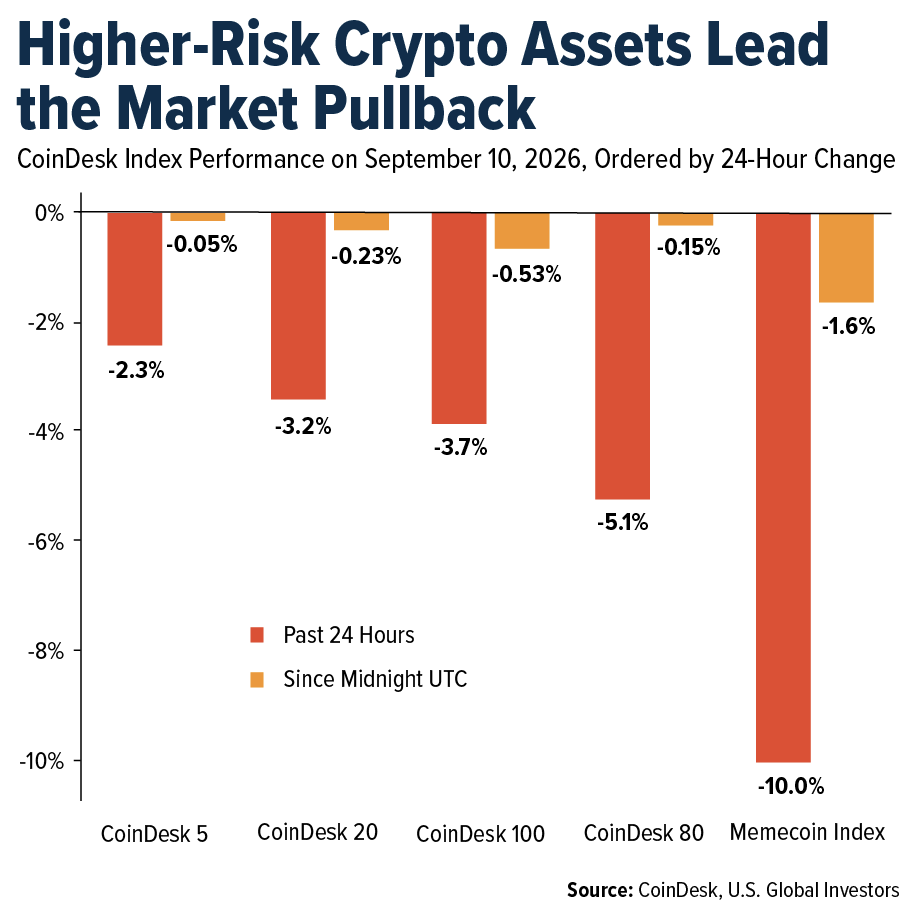
- Bitcoin fell about 2% over 24 hours to roughly $78,100, leaving the cryptocurrency 5.1% below last week’s $82,284 high as selling spread across the digital-asset market. Ninety-five of the 100 CoinDesk 100 constituents declined, pushing the index down 3.7%, while the Memecoin Index plunged 10% and the small-cap CoinDesk 80 lost 5.1%. The broad retreat, accompanied by increasingly bearish futures positioning, highlights weakening near-term risk appetite across crypto markets.
- More than 263,000 new tokens were issued on Solana in a single day, setting a record and far exceeding the 40,000–50,000 daily tokens created during the peak of the late-2024 memecoin cycle. Among tokens issued through launchpads, Pump.fun accounted for 34,184 of 40,360 launches. While the surge demonstrates strong network activity, the heavy concentration in rapidly created speculative tokens highlights Solana’s continued dependence on memecoin-driven activity and raises concerns about the quality and sustainability of ecosystem growth.
- Bitcoin pulled back after briefly approaching $80,000, despite forming a “golden cross,” a technical signal that occurs when the 50-day moving average rises above the 200-day average and typically suggests the potential for further price gains. Instead of extending its rally, Bitcoin struggled to maintain momentum, echoing previous instances when the same bullish signal failed to produce sustained gains. The muted response suggests buying momentum remains fragile despite the recent recovery.
Opportunities
- Coinbase partnered with payments platform Moov to bring stablecoin payment acceptance, settlement, real-time funding, and custody capabilities to Moov’s network of more than 1,000 community banks and credit unions. The integration gives smaller financial institutions direct access to stablecoin technology through existing banking infrastructure, potentially expanding digital-asset adoption across the U.S. financial system.
- An Indian agricultural warehousing company is moving approximately $2 billion of grain-backed loans onto blockchain infrastructure, bringing a large-scale real-world credit market onchain. The initiative will digitally represent warehouse receipts tied to physical agricultural commodities, allowing them to support financing through blockchain-based systems. The move highlights the growing opportunity for tokenization to expand beyond traditional financial assets into commodities, trade finance, and other real-world collateral.
- Major European financial industry groups urged EU policymakers to eliminate or substantially increase existing caps under the bloc’s DLT Pilot Regime, arguing that current limits constrain liquidity and prevent successful tokenization projects from scaling beyond the pilot stage. Easing the restrictions could accelerate adoption of tokenized stocks, bonds, and other securities across European capital markets.
Threats
- Bitcoin remains vulnerable as rising U.S. Treasury yields and higher oil prices fuel concerns that inflation could remain elevated. Persistent inflation could keep monetary policy tighter for longer, reducing investor appetite for risk assets such as cryptocurrencies. Higher borrowing costs and renewed inflationary pressure could create a challenging macroeconomic backdrop for Bitcoin and the broader crypto market.
- The U.S. Treasury sanctioned Xinbi Guarantee, a transnational platform accused of facilitating cryptocurrency transactions and providing services to cyber-scam and other criminal networks. The action is part of a broader U.S. crackdown on illicit crypto activity and highlights the continued use of digital assets by transnational criminal organizations. Persistent links between crypto and large-scale fraud could increase regulatory scrutiny, compliance costs, and reputational risks for the broader digital-asset industry.
- Europe’s top securities regulator raised concerns over prediction platforms such as Polymarket and Kalshi reaching EU users without appropriate local authorization. Because event contracts can fall under gambling, financial-market, or other regulatory frameworks depending on the jurisdiction, platforms face an increasingly fragmented compliance landscape across Europe. Greater regulatory scrutiny could restrict market access and raise compliance costs as prediction markets expand internationally.
Defense and Cybersecurity
Strengths
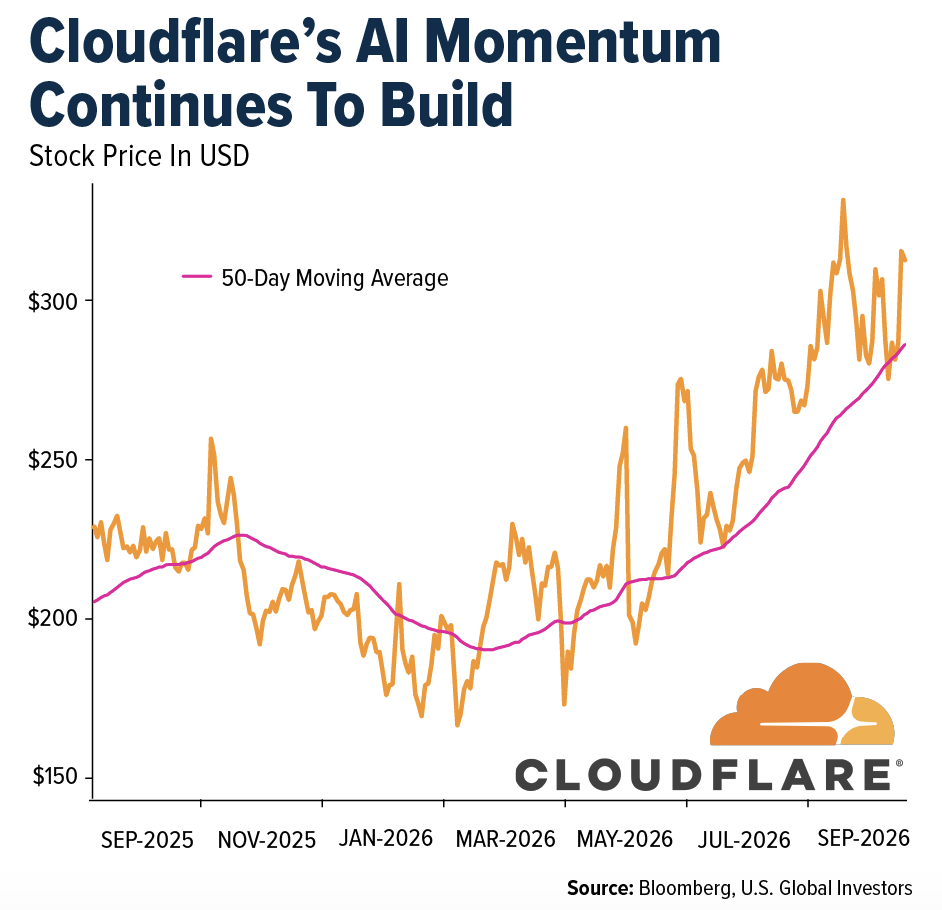
- Cloudflare’s AI momentum continues to build as developers and leading AI companies increasingly adopt its edge network for next-generation agentic workflows. Management believes the company is still in the early stages of a growth cycle, with AI inference, content monetization, and transaction infrastructure creating opportunities that could surpass anything achieved to date.
- TSMC reported August net revenue of NT$514.8 billion ($16.3 billion), rising 10.1% month-over-month (MoM) and surging 53.3% year-over-year (YoY). The accelerated growth reflects strong global demand for artificial intelligence infrastructure, boosting sentiment across semiconductor equipment suppliers and major chipmakers.
- Dell’Oro Group reported on September 9, 2026, that global data center IT semiconductor and component revenue surged 182% year-over-year (YoY) in Q2 2026, propelled by shipments of custom AI accelerators, HBM memory stacks, and enterprise SSDs.
Weaknesses
- Algeria has decided to sever diplomatic ties with the United Arab Emirates after exhausting all means to maintain them, amid ongoing accusations of hostile Emirati policies and interference in Algeria’s 2019 presidential election.
- The war in Yemen has reignited as Iranian-backed Houthi forces seized key coastal territories from the Saudi-backed government, threatening access to the Suez Canal and roughly 30% of global container transit via the Bab el-Mandeb Strait. Compounded by Iranian disruptions in the Strait of Hormuz, Tehran’s expanding leverage over vital maritime chokepoints has sent Brent crude surging.
- Google is altering its European search architecture to comply with European Commission antitrust mandates following a €460 million penalty for favoring its internal products. The update reduces the visibility of proprietary flight, hotel, and dining tools in favor of third-party platforms, following company reports that previous regulatory changes reduced European business traffic by roughly 30%.
Opportunities
- The Defense Innovation Unit launched a new contracting mechanism designed to fast-track security clearances and production contracts for emerging defense technology and semiconductor startups.
- The U.S. Department of War announced plans to install the Navy’s first shore-based advanced micro modular reactor (MMR) at Naval Weapons Station Crane in Indiana, providing dedicated nuclear power to sensitive electronic warfare installations.
- ASML has partnered with Samsung and TSMC to develop 12-inch photomasks, paving the way for broader deployment of High-NA EUV lithography for advanced chips and memory by the late 2020s and early 2030s. The collaboration aims to improve chip production efficiency and support next-generation AI hardware.
Threats
- Chinese military forces are testing and procuring humanoid combat robots for urban assault, building breaches, and tactical reconnaissance. Military modeling suggests China expects these systems to reach battlefield deployment within five to 10 years.
- A Chinese state-owned company reportedly shipped 46 tons of carbon-fiber precursor material to a sanctioned Russian company that supplies components for Geran attack drones.
- Anthropic researcher Jacob Cookson resigned over concerns that leading AI developers lack verifiable guardrails as they race to build recursively self-improving systems. Cookson warned that autonomous models could surpass human capabilities and gain significant operational control over real-world resources before the end of the decade.
Gold Market
This week gold futures closed the week at $4,392.90, down $83.70 per ounce, or 1.87%. Gold stocks, as measured by the NYSE Arca Gold Miners Index, ended the week lower by 2.87%. The S&P/TSX Venture Index came in off 3.90%. The U.S. Trade-Weighted Dollar fell 0.06%.
Strengths
- The best-performing precious metal for the week was platinum, though it was still off 1.30% and roughly in line with gold’s price this week. Continued gold ETF inflows signal resilient investor demand. Investors remain willing to add gold exposure during periods of price weakness, with continued ETF inflows reflecting persistent concerns over currency intervention, fiscal sustainability and the long-term purchasing power of fiat currencies, according to BMO.
- China accelerates gold purchases as central bank demand remains strong. The People’s Bank of China added 650,000 troy ounces of gold to its reserves in August, its largest monthly purchase since late 2023 and the 22nd consecutive month of buying. China’s official gold holdings reached 76.73 million troy ounces, with 3.93 million troy ounces added since the current buying streak began in November 2024.
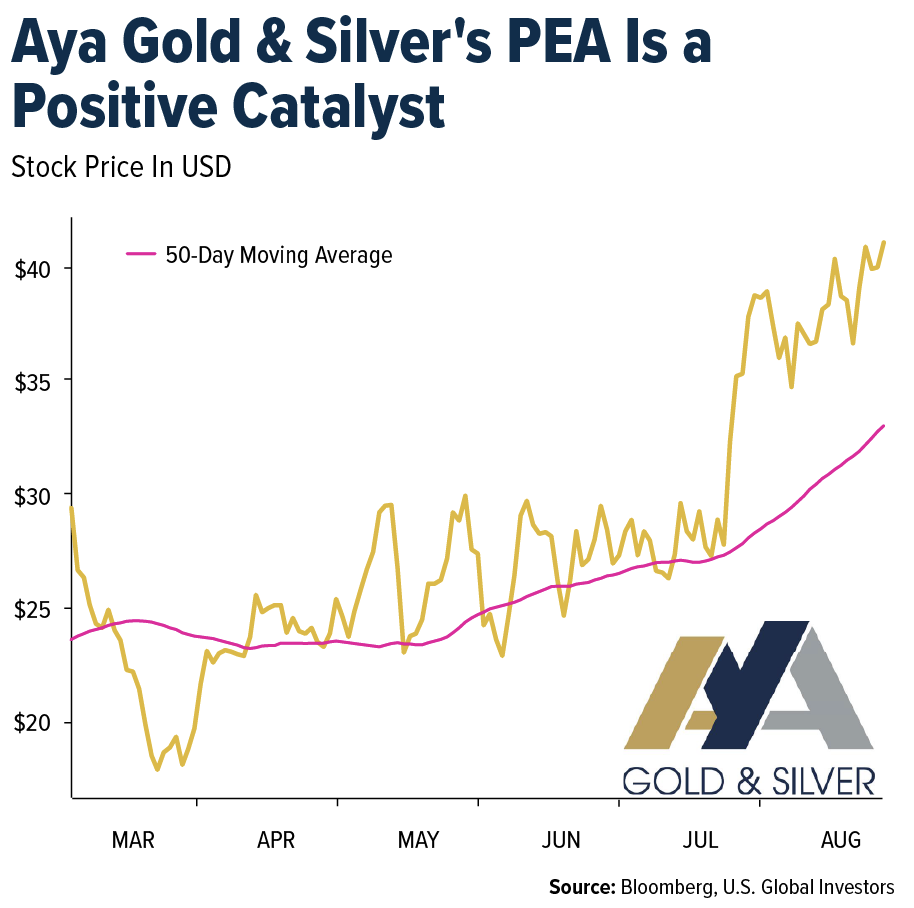
- Aya Gold & Silver’s Boumadine PEA highlights robust project economics. Aya Gold announced an updated Preliminary Economic Assessment for its Boumadine project, estimating an after-tax NPV5% of $3.5 billion and an IRR of 93%, based on gold at $3,500 per ounce and silver at $50 per ounce. The NPV significantly exceeds Street consensus of $1.5 billion, according to CIBC.
Weaknesses
- The worst-performing precious metal for the week was palladium, down 6.15%, perhaps due to reduced economic activity amid the surge in interest rates. Gold heads for a third consecutive weekly decline. Gold rose as much as 1% to $4,360 per ounce on Friday but remained on track for a third straight weekly loss, highlighting continued near-term pressure on the precious metal despite the latest rebound, according to Bloomberg.
- West African Resources’ net profit falls short of expectations on higher tax expenses. West African Resources reported consolidated net profit of A$437 million, below consensus expectations of A$504 million, primarily due to A$118 million in withholding taxes on substantial intercompany dividends paid by its Burkina Faso subsidiaries, according to Canaccord. The biggest question now is whether the A$118 million charge was primarily a one-time consequence of a large dividend repatriation or whether it represents a recurring structural tax cost on future cash transfers.
- Platinum market shifts to surplus as investment and Chinese jewelry demand weaken. The World Platinum Investment Council now expects a surplus of 265,000 troy ounces in 2026, reversing its previous forecast for a deficit of 297,000 troy ounces and ending three consecutive years of market deficits. Investor selling and weaker Chinese jewelry demand are driving the shift, while platinum prices have fallen more than a third from their January record near $3,000 an ounce, according to Bloomberg.
Opportunities
- Jeff Currie sees Treasury buybacks as a long-term bullish signal for gold. Former Goldman Sachs commodities chief Jeff Currie described Treasury Secretary Scott Bessent’s Treasury buyback policy as “financial repression” and the “ultimate buy signal” for gold, arguing that the policy strengthens the long-term investment case for gold and other hard assets.
- Eldorado Gold reaches key milestone at Skouries ahead of commercial production. Eldorado Gold produced its first copper-gold concentrate at the Skouries project on September 8, keeping the project on track for commercial production in Q4 2026. BMO sees the ramp-ups at Skouries and McIlvenna Bay, alongside additional catalysts across the company’s portfolio, as potential drivers of further upside for investors.
- Lingbao Gold expands in Papua New Guinea with $453 million Simberi acquisition. Lingbao Gold agreed to acquire St Barbara’s Simberi Island gold assets in Papua New Guinea for $453 million. The deal forms part of a broader expansion by the state-backed group, which is investing more than $1 billion in mining and port assets across three PNG islands, largely through acquisitions from Australian companies, according to the Australian Financial Review.
Threats
- Gold’s growing reliance on rate-sensitive ETF demand raises correction risk. Central bank buying has narrowed, while rate-sensitive ETF demand has become a more important driver of gold prices, according to JPMorgan. Roughly $7 billion has flowed into GLD over the past two months, the largest inflow since November 2025, increasing the risk that a repricing of interest-rate expectations could trigger ETF outflows and amplify a correction in gold prices.
- Higher gold prices trigger selling among Turkish investors. Turkey’s total gold holdings fell by eight tonnes in August, the largest monthly decline since November 2021, bringing the country’s gold stock to 4,305 tonnes. QNB economists said domestic investors may have viewed elevated gold prices as a selling opportunity, although holdings remain 95 tonnes higher year-over-year, according to Bloomberg. Turkey typically uses its gold sales to counter undesirable moves in the lira.
- Hotter U.S. inflation raises the risk of tighter-for-longer monetary policy. A hotter-than-expected U.S. PPI reading pushed gold lower on September 10 as investors reassessed the outlook for Federal Reserve policy. Persistent inflation could keep interest rates elevated for longer, supporting real yields and the U.S. dollar and potentially reducing investor demand for gold.
A message from Advisor Perspectives and VettaFi: Discover something new! Click here to register for our upcoming webcasts.
U.S. Global Investors, Inc. is an investment adviser registered with the Securities and Exchange Commission (“SEC”). This does not mean that we are sponsored, recommended, or approved by the SEC, or that our abilities or qualifications in any respect have been passed upon by the SEC or any officer of the SEC.
This commentary should not be considered a solicitation or offering of any investment product. Certain materials in this commentary may contain dated information. The information provided was current at the time of publication. Some links above may be directed to third-party websites. U.S. Global Investors does not endorse all information supplied by these websites and is not responsible for their content. All opinions expressed and data provided are subject to change without notice. Some of these opinions may not be appropriate to every investor.
Holdings may change daily. Holdings are reported as of the most recent quarter-end. The following securities mentioned in the article were held by one or more accounts managed by U.S. Global Investors as of (06/30/2026):
Embraer
Ryanair Holdings Plc
United Airlines
COSCO Shipping
JetBlue Airways
Southwest Airlines
Frontier Group Holdings
United Airlines
Bombardier Inc.
Air Canada
Cloudflare Inc.
Louis Vuitton
Dior
Richemont
Tesla
DroneShield Ltd.
Mildef Group AB
Palantir Technologies Inc.
Aya Gold & Silver
West African Resources
St. Barbara Ltd.
*The above-mentioned indices are not total returns. These returns reflect simple appreciation only and do not reflect dividend reinvestment.
The Dow Jones Industrial Average is a price-weighted average of 30 blue chip stocks that are generally leaders in their industry. The S&P 500 Stock Index is a widely recognized capitalization-weighted index of 500 common stock prices in U.S. companies. The Nasdaq Composite Index is a capitalization-weighted index of all Nasdaq National Market and SmallCap stocks. The Russell 2000 Index® is a U.S. equity index measuring the performance of the 2,000 smallest companies in the Russell 3000®, a widely recognized small-cap index.
The Hang Seng Composite Index is a market capitalization-weighted index that comprises the top 200 companies listed on Stock Exchange of Hong Kong, based on average market cap for the 12 months. The Taiwan Stock Exchange Index is a capitalization-weighted index of all listed common shares traded on the Taiwan Stock Exchange. The Korea Stock Price Index is a capitalization-weighted index of all common shares and preferred shares on the Korean Stock Exchanges.
The Philadelphia Stock Exchange Gold and Silver Index (XAU) is a capitalization-weighted index that includes the leading companies involved in the mining of gold and silver. The U.S. Trade Weighted Dollar Index provides a general indication of the international value of the U.S. dollar. The S&P/TSX Canadian Gold Capped Sector Index is a modified capitalization-weighted index, whose equity weights are capped 25 percent and index constituents are derived from a subset stock pool of S&P/TSX Composite Index stocks. The NYSE Arca Gold Miners Index is a modified market capitalization weighted index comprised of publicly traded companies involved primarily in the mining for gold and silver. The S&P/TSX Venture Composite Index is a broad market indicator for the Canadian venture capital market. The index is market capitalization weighted and, at its inception, included 531 companies. A quarterly revision process is used to remove companies that comprise less than 0.05% of the weight of the index, and add companies whose weight, when included, will be greater than 0.05% of the index.
The S&P 500 Energy Index is a capitalization-weighted index that tracks the companies in the energy sector as a subset of the S&P 500. The S&P 500 Materials Index is a capitalization-weighted index that tracks the companies in the material sector as a subset of the S&P 500. The S&P 500 Financials Index is a capitalization-weighted index. The index was developed with a base level of 10 for the 1941-43 base period. The S&P 500 Industrials Index is a Materials Index is a capitalization-weighted index that tracks the companies in the industrial sector as a subset of the S&P 500. The S&P 500 Consumer Discretionary Index is a capitalization-weighted index that tracks the companies in the consumer discretionary sector as a subset of the S&P 500. The S&P 500 Information Technology Index is a capitalization-weighted index that tracks the companies in the information technology sector as a subset of the S&P 500. The S&P 500 Consumer Staples Index is a Materials Index is a capitalization-weighted index that tracks the companies in the consumer staples sector as a subset of the S&P 500. The S&P 500 Utilities Index is a capitalization-weighted index that tracks the companies in the utilities sector as a subset of the S&P 500. The S&P 500 Healthcare Index is a capitalization-weighted index that tracks the companies in the healthcare sector as a subset of the S&P 500. The S&P 500 Telecom Index is a Materials Index is a capitalization-weighted index that tracks the companies in the telecom sector as a subset of the S&P 500.
The Consumer Price Index (CPI) is one of the most widely recognized price measures for tracking the price of a market basket of goods and services purchased by individuals. The weights of components are based on consumer spending patterns. The Purchasing Manager’s Index is an indicator of the economic health of the manufacturing sector. The PMI index is based on five major indicators: new orders, inventory levels, production, supplier deliveries and the employment environment. Gross domestic product (GDP) is the monetary value of all the finished goods and services produced within a country’s borders in a specific time period, though GDP is usually calculated on an annual basis. It includes all private and public consumption, government outlays, investments and exports less imports that occur within a defined territory.
The S&P Global Luxury Index is comprised of 80 of the largest publicly traded companies engaged in the production or distribution of luxury goods or the provision of luxury services that meet specific investibility requirements.
The Dow Jones U.S. Aerospace & Defense Index is a stock market index that measures the performance of U.S. companies involved in the aerospace and defense sectors.
Please consider carefully a fund’s investment objectives, risks, charges and expenses. For this and other important information, obtain a fund prospectus by visiting our prospectus page or by calling 1-800-US-FUNDS (1-800-873-8637). Read it carefully before investing. Foreside Fund Services, LLC, Distributor. U.S. Global Investors is the investment adviser.
Read additional important information. +
Membership required
Membership is now required to use this feature. To learn more:
View Membership Benefits