While the name is new, Syzygy is not. Syzygy, formerly Research Affiliates, will extend our multi-decade sub-advisory relationships in asset allocation and long-only active equities and expand into other active diversification strategies in the coming quarters. These strategies will augment existing ones and comprise a full client-focused product suite featuring a diverse set of instruments, with different risk budgets and investment horizons. All will be underwritten by the standard that an idea must survive contact with actual economics before earning its place. That’s alignment, that’s the part we can control. The market we are entering today is a different story. It is a story of dispersion, and the opportunity it provides for those willing to be different.
Two Ways to Measure the Same Thing
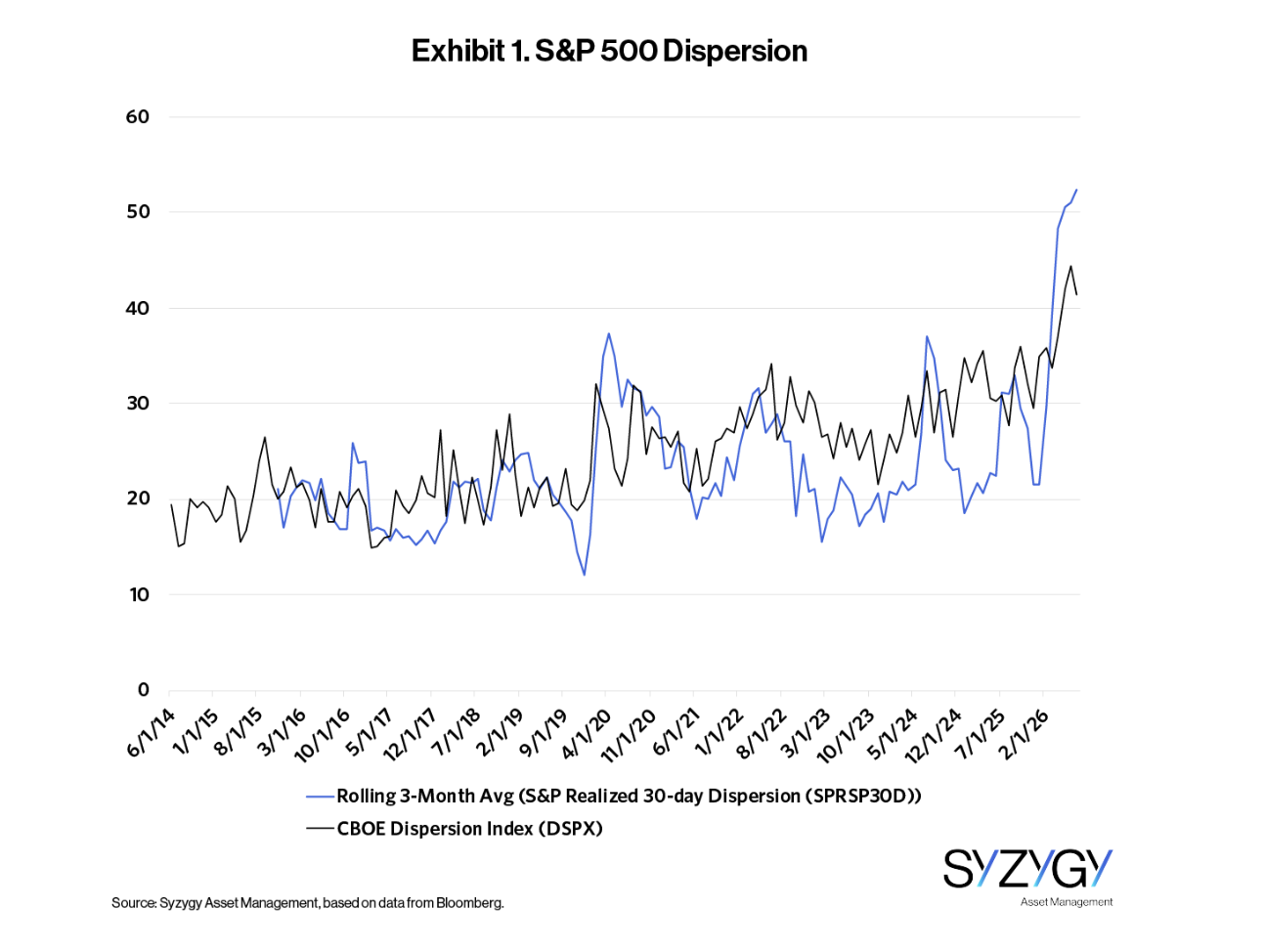
Dispersion and correlation are two sides of the same coin. Dispersion asks how differently stocks are performing, or are priced to perform, relative to one another. Correlation asks how much they are moving together. When correlation falls, dispersion tends to rise, and in equity markets this year, as Exhibit 1 shows, dispersion has moved a long way from where it was for most of the last decade.
See more: Rethinking Diversification in the AI Economy
On the implied side, the CBOE S&P 500 Dispersion Index, which infers expected 30-day dispersion from the gap between single-stock and index option pricing, soared much higher during the second quarter, eclipsing 40. On the realized side, the narrative matches: The rolling three-month 30-day realized dispersion of the S&P 500 constituents has also reached new highs.
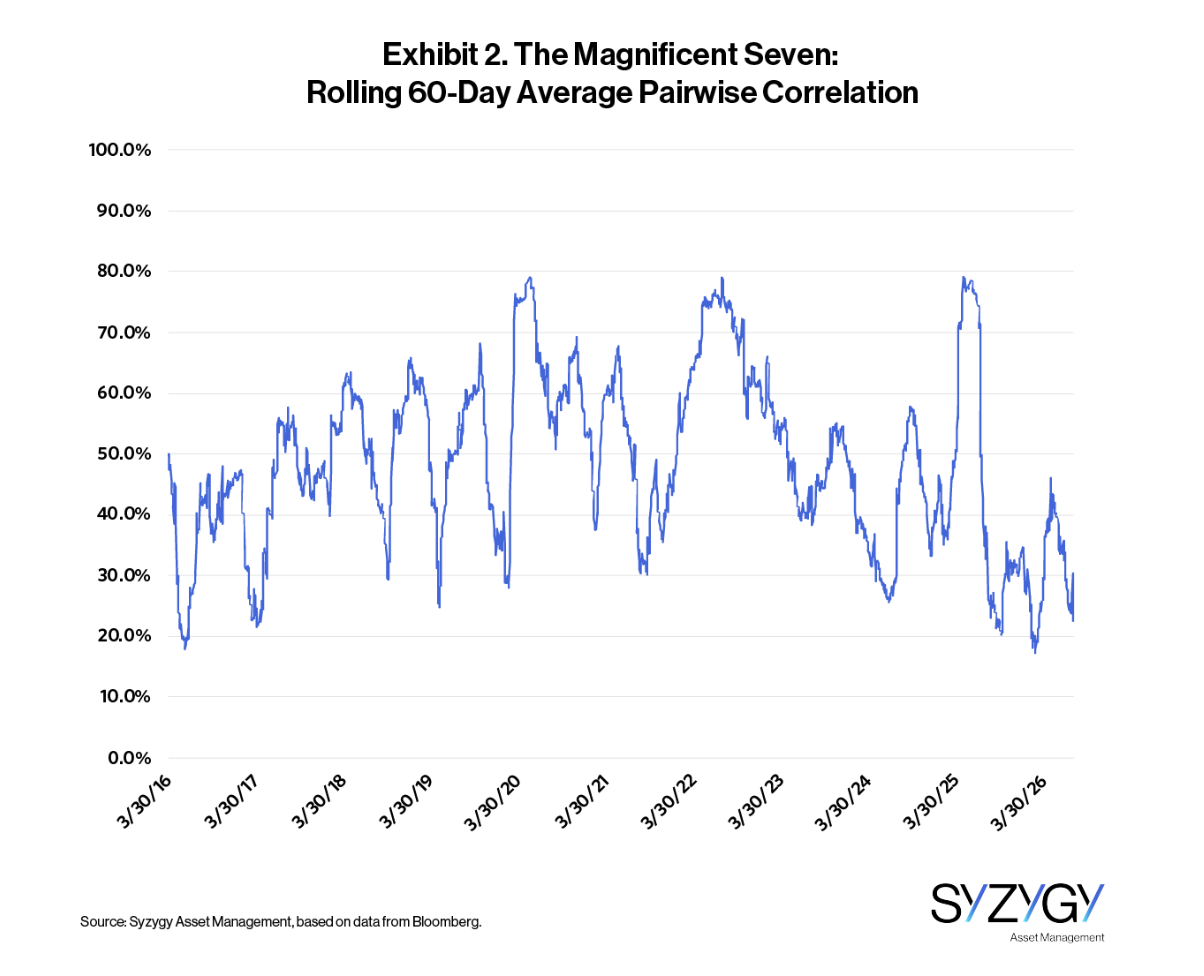
Even the Magnificent Seven, which traded for most of 2023 and 2024 as a single macro factor with a fancy name, have splintered. As Exhibit 2 shows, their average rolling 60-day correlation peaked near 80% but is now down to 22%, close to its early 2026 lows.
The practical result is that while the S&P 500 has looked mostly orderly, reacting mainly to the Iran conflict and energy scares while reaching new highs, beneath the surface, its constituents are moving in enough different directions that the median stock and the benchmark are barely on speaking terms.
Why This Is the Backdrop, Not the Obstacle
For a business based on picking winners, dispersion is the opportunity set, not the risk factor. Every basis point of idiosyncratic variance is a basis point that skill rather than beta has a chance to capture. When correlation is high, active managers are, in effect, holding slightly different flavors of the same trade, and outcomes cluster near the benchmark almost by design. Dispersion inverts that.
That’s the case for launching an active shop into this environment. Dispersion usually surfaces in commentary as a symptom of stress, something to hedge against with correlation swaps or dispersion trades on the options desk. Fair enough. That’s a legitimate use of the same data. But for active equity managers, asset allocators, or long/short managers, today’s dispersion isn’t a volatility statistic to be endured; it’s an opportunity to be harvested.
The Discomfort Isn’t Fully Unwarranted
Such wide dispersion makes many investors uneasy and for good reason. Dispersion this pronounced, correlation this low, usually signals something other than a stable equilibrium.
The current regime traces to several shocks that have so far coursed through markets somewhat independently of one another: A Strait of Hormuz disruption briefly repriced energy and reshuffled sector leadership; an artificial intelligence (AI) capital-spending cycle has started to separate the companies monetizing the buildout from those that are funding it; a European rearmament push has redirected capital toward names that had been afterthoughts for years; and the Japanese yen has required meaningful intervention to buffer its fall. Each shock, on its own, is a source of individualized, stock-specific return, but together they create the kind of environment that can snap back into a single correlated move if any one turns systemic.
Options markets have already begun pricing some probability of that outcome. That is precisely why alignment belongs with dispersion in the title of this piece. A process that only rides idiosyncratic dispersion, without a rigorous view of the economic forces producing it, isn’t equipped to recognize when those forces will converge into something that behaves like a single risk factor again. As we all know, stock selection without an economic anchor is just overfitting to the past.
What Alignment Buys You in a Dispersed Market
This is where alignment and dispersion meet. Alignment is the internal discipline to ground ideas in economic rationale, develop signals that measure what they claim to measure, and construct portfolios that reflect real conviction rather than accumulated clutter. This is how we can exploit dispersion without being whipsawed by the regime shift that eventually ends it. It’s the difference between owning idiosyncratic risk on purpose and owning it by accident.
We built and continue to build Syzygy’s strategies around that premise rather than a single-house view on where dispersion goes next. Asset allocation stands to benefit from dispersion across asset classes and geographies rather than individual names. That matters if the present stock-level dispersion is an early indicator of a broader macro repricing rather than a contained equity phenomenon, while active equity portfolios are direct expressions of stock-level dispersion. The strategies we’re thinking about next are those that find alternative ways to capitalize on both correlated and dispersed markets. Stay tuned!
None of this is a forecast that today’s low correlations will persist. History says they won’t last indefinitely. Dispersion regimes end, often abruptly, and usually around the sort of systemic catalyst that turns various distinctive stories back into one macro narrative. What we’re creating is a process that doesn’t need to call that turn correctly before it happens to be useful and doesn’t fall apart when it does.
Where This Leaves Us
Markets are not obligated to make active management easy. For long stretches of the last cycle, they didn’t. A market where a handful of names drove index returns, where correlations sat near all-time highs, and where the honest answer to “Why didn’t you just buy the benchmark – or better yet – a smart beta alternative?” was uncomfortable. This doesn’t mean such strategies can’t remain profitable, but we believe a new story has emerged. This one rewards the willingness to be different, asset by asset, sector by sector, name by name, and the rigor to do so with a process aligned enough not to mistake a temporary divergence for a structural one, or vice versa.
That’s it, that’s the philosophy behind Syzygy Asset Management. We look forward to serving our clients through our existing strategies and by developing new ideas to help them navigate both dispersion and correlation, whichever is leading markets.
Please read our disclosures concurrent with this publication: https://www.researchaffiliates.com/legal/disclosures#investment-adviser-disclosure-and-disclaimers
1. Some syzygies, new moons and full moons, for example, are quite common, while others, like solar and lunar eclipses and those involving other planets, are much rarer.
A message from Advisor Perspectives and VettaFi: Discover something new! Click here to register for our upcoming webcasts.
© Syzygy Asset Management
More Factor-Based Investing Topics >