QuantStreet September 2026 Letter: Interest Rate Worries
Membership required
Membership is now required to use this feature. To learn more:
View Membership Benefits
August was a good month in financial markets, with the S&P 500 up around 2.7%. The market leaders came from the commodity complex, with gold and bitcoin (not sure how this should be classified) being the two top performers. High up as well was GSG, an ETF tracking the broad commodities market, with a roughly 50% weight in the energy complex. Stocks also had a good month, led by emerging markets ex-China (EMXC), which represents a bounceback of the semiconductor-heavy Korean and Taiwanese markets after their massive rally and subsequent correction. Tech did well in the U.S. as well, with NASDAQ up 4%. Finally, the non-AI complex held its own, with low volatility (USMV) and value (VTV) stocks doing well.
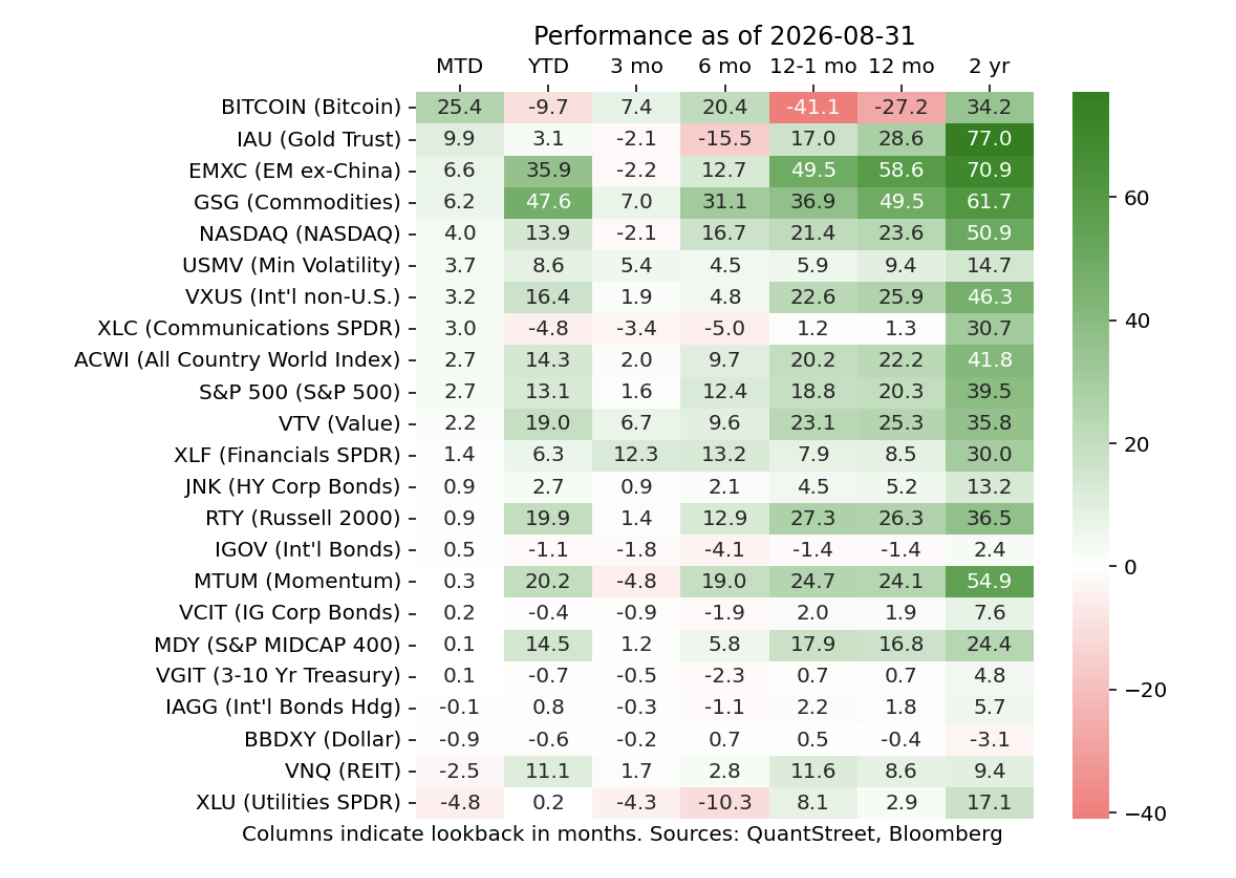
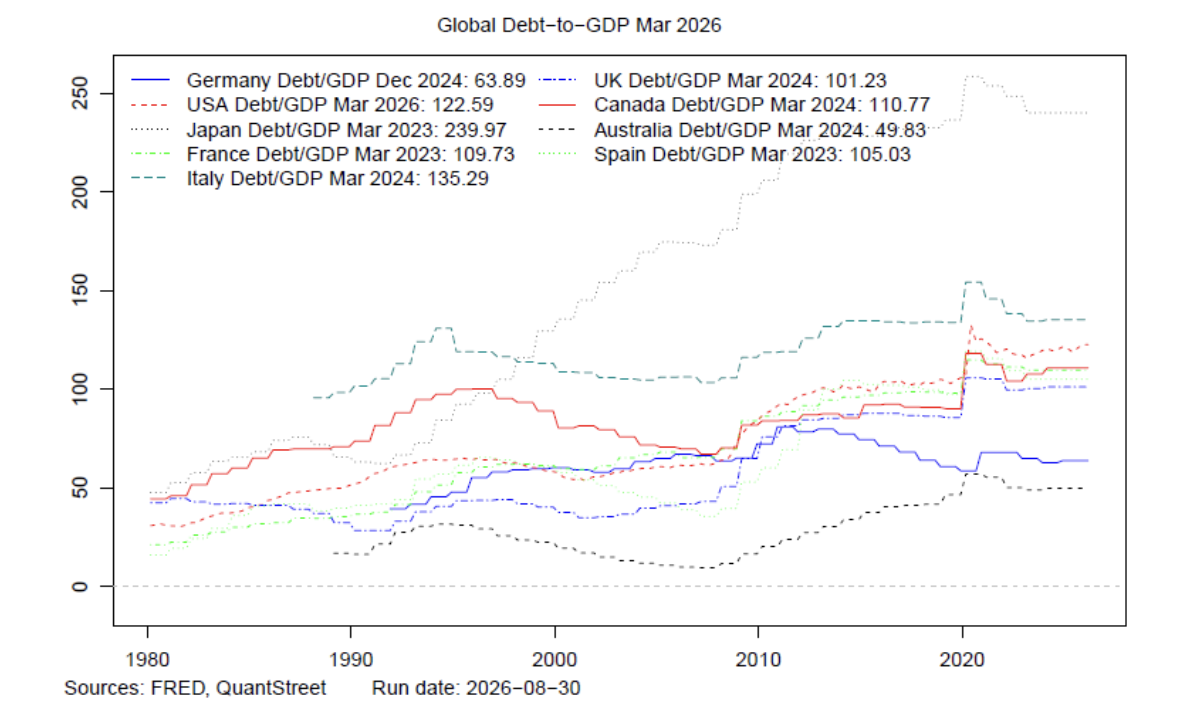
The market’s consternation was focused on the long-end of the Treasury curve, as well as on government debt markets globally. A lot of the concern centers around large and growing government debt loads, and though the US experience is not particularly anomalous across either level or rate of change of government debt to GDP (see below), the dollar bore the brunt of investor concerns. The rate-sensitive parts of the stock market, utilities and REITs, were the worst-performing sectors in the month.
QuantStreet’s performance remains strong. We track the performance of several strategies, and you can see those performance numbers here. More detailed analysis of our performance relative to benchmarks is available via our strategy-level tearsheets. Please reach out at [email protected] if you would like to see these.
See more: When Rates Begin to Bite
Interest rates
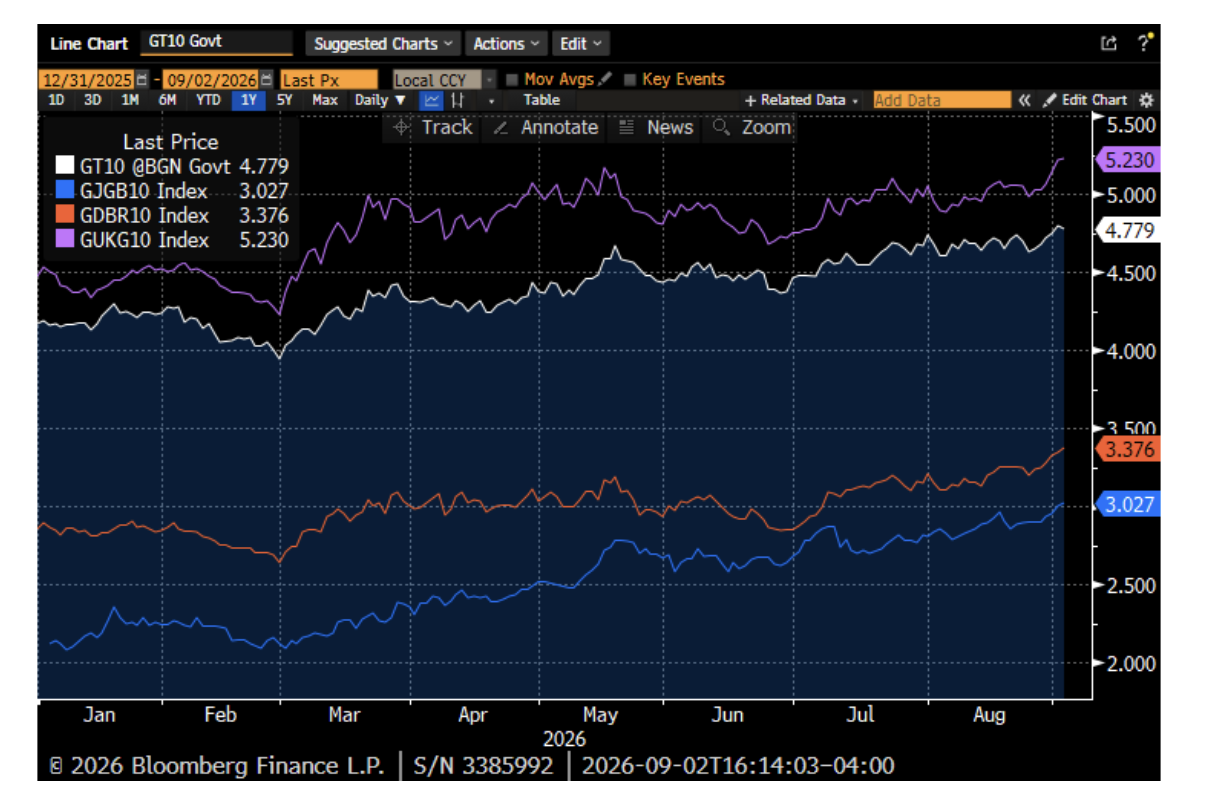
Since the start of the year, longer-term interest rates have increased around the globe. U.S. 10-year rates (GT10) are about 50 basis points higher than they were at the start of the year. UK (GUKG10) and Japanese (GJGB10) 10-year rates have increased even more. Even Germany, a stalwart of fiscal conservatism, has seen its 10-year rates rise so far this year.
The rate increases have been associated with ominous-sounding news headlines, like this recent one warning that Treasury secretary “Scott Bessent Has a $40 Trillion Problem as Interest Rates Are Closing in on a Multi-Decade High”. The Treasury’s recent intervention in the long-end of the yield has not as of yet achieved the desired results of calming investor fears, with the FT warning that “Scott Bessent’s intervention to prop up the market failed to soothe investor jitters.” Even CNN, not usually known for its front-page economics coverage, has weighed in with “The war is raising the price of money. That’s a problem for the global economy.” Sentiment surrounding interest rates remains tense.
Importantly, the U.S. is hardly the only country with debt and spending issues. The next chart plots the government debt-to-GDP levels across several developed economies. The U.S. is not the worst of the bunch. Our general debt trajectory has mirrored that of other developed countries.
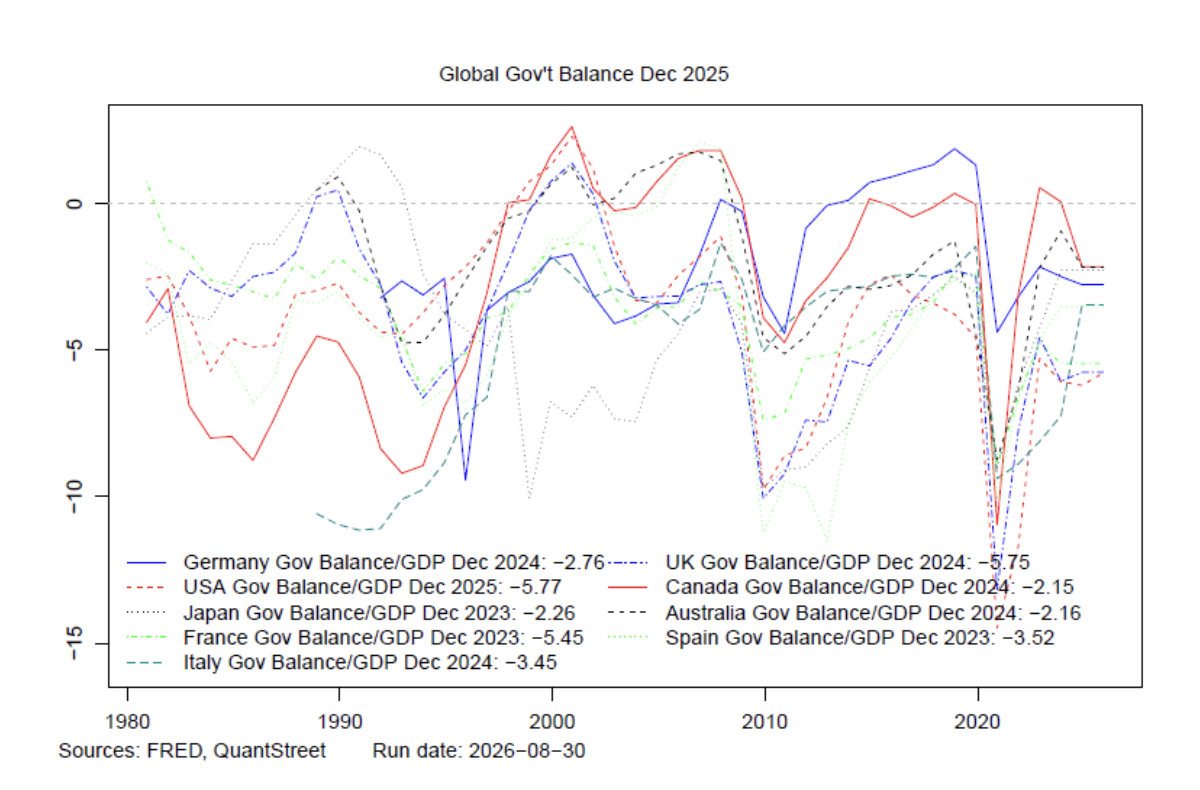
The same is true about our fiscal deficits. The next chart shows that the U.S. budget deficit of roughly 5.8% (as of the end of 2025), while in the bottom rung of peer economies, has followed a very similar pattern to the budget deficits of other countries. Excessive government spending is a global problem and the sell-off seen across government bonds is really a global issue.
Theories
There are many theories out there for what’s been happening with long-term interest rates. One is that the higher level of short- and long-dated interest rates simply reflects market expectations for higher future growth; indeed, the currently elevated stock price-to-earnings ratios suggest that the market expects rapid economic and earnings growth. Much of the AI data center build out is being financed with debt, again in anticipation of high future growth, and this additional supply is leading to increased interest rates to induce investors to invest.
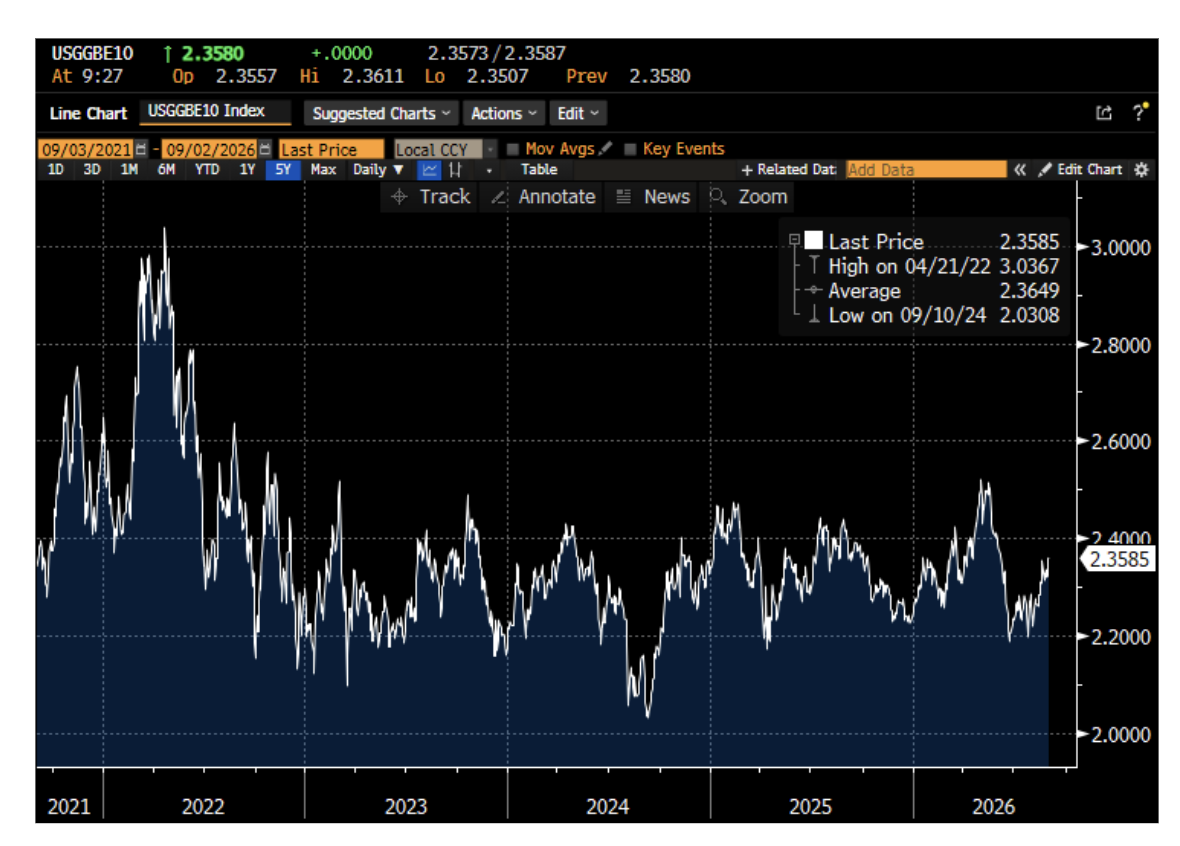
Supporting this view, inflation breakevens–the difference between 10-year nominal and real interest rates–are well-contained. Outside of inflation risk premium considerations, this suggests that market participants believe the Fed is in control of inflation expectations.
The long-end of the yield curve contains two components. One is the market’s expectation about future short-term interest rates. The other is the term premium investors demand to hold Treasuries relative to shorter-dated and less price sensitive securities. According to a recent piece by Apollo’s Torsten Slok, the 10-year Treasury term premium has remained stable over the last 12 months, suggesting that the increase in 10-year rates reflects investor expectations about higher future short-term rates (and growth), and not an additional risk premium due to fiscal concerns. Though another recent piece from Stanford’s Hanno Lustig questions this interpretation, arguing that the term premium has, indeed, increased when looked at over the last several years.
Hanno Lustig also shows that the Treasury convenience yield, which is the difference in yields between highly rated corporate bonds and Treasuries, has largely disappeared over the past few years, suggesting that the specialness of Treasuries is diminishing relative to comparable high-quality non-Treasury bonds. It’s hard to attribute the recent disappearance of the Treasury convenience yield to anything other than investor concerns about lending money long-term to the U.S. government.
Consistent with this theme is a recent FT article about European countries repatriating their gold reserves back to Europe. According to the FT, this is out of a fear that an “unreliable American government under President Donald Trump may otherwise seize them amid growing transatlantic tensions.” If this is where people’s minds are at, it is no surprise that Treasuries are also losing their appeal as an impregnable store of value.
Our own take is that multiple factors are at work. First, higher rates undoubtedly reflect elevated growth expectations. The AI boom is for real, and whether or not all of the current investment proves justified, the investment will get made for the next few years, which will pressure bond yields as a large supply of new bonds comes to market. Second, it is unlikely that inflation concerns are behind the selloff, especially in light of inflation breakevens remaining well anchored. Third, while current fiscal deficits combined with growing government debt loads and increasing interest rates are almost certainly not sustainable in the long-term, a short-term, bond-vigilante driven Treasury selloff also seems unlikely. (The level of credit default swaps which track U.S. government debt is not elevated and the level of U.S. national wealth, however one might measure the latter, is surely much higher than our annual GDP, suggesting that the U.S. debt-to-national wealth ratio is far lower than our roughly 120% debt-to-GDP.)
Keep in mind, these are our current views based on the information available to us, and our analysis of this highly complex topic may well prove incorrect as economic and market conditions evolve.
(As usual, John Cochrane of the Hoover Institution also has an interesting take on things, which you can read about here. Cochrane discusses many potential reasons for the increase in yields, without taking a stand on which reason is the most probable.)
Portfolio positioning
Looking to the month ahead, we continue our attempt to find exposures that are not directly AI-related: as AI adoption increases, our view is that the non-AI parts of the economy stand to benefit, and this is exactly the types of companies that represent the value and low-volatility parts of the market. We maintain slightly conservative positioning by reducing the allowed tail risk limits at each of our portfolio risk levels (the latter determined using portfolio realized volatility). Across all of our portfolios outside of the one targeting 100% stock-level risk, these tightened tail risk limits led to an increase in our short-term Treasury exposure and a decrease in our S&P 500 exposure. We are not turning bearish, but perhaps are turning slightly more cautious as a lot of good news has already been priced in.
On the Treasury front, we admit that 10-year rates in the 4.8% range and 30-year rates in the 5.25% range are beginning to look appealing. Despite that we maintain our model allocation discipline and stick with low duration exposures until our model return forecasts for and the return trends of longer-dated bonds become more attractive. (The caveat is that these are just model forecasts, and future returns on longer-dated bonds may be much more attractive than our models suggest.)
In addition, we exited the commodities position we initiated at the start of last month. Our model still likes a commodities allocation as trend, model forecast, and diversification all point in the same direction. However, as we regularly warn, the model could always be wrong, especially if there is salient information the model does not have access to. And with regard to that, we were struck by a Bloomberg article which quoted Secretary Bessent as saying he believes the Strait of Hormuz may become a “worthless piece of water” in a couple of years as oil shipments bypass the Strait. Add to that evidence that more ships continue to pass through the Strait, and it raises the possibility that the war in Iran will continue, while the global oil market will remain well supplied. We do not want to get stuck in an oil-heavy position in such a scenario, and so we exit the trade.
Working with QuantStreet
QuantStreet offers financial planning and wealth management services for individuals and families. For the advisor community, we offer model portfolios, portfolio analytics, and a platform for those looking to gain independence. The firm’s investment approach is systematic, data-driven, and shaped by years of investing experience. To work with or learn more about QuantStreet, join our mailing list or contact us at [email protected]. Also, please sign up for our Substack.
QuantStreet is a registered investment advisor. Registration does not imply a certain level of skill or training. All financial forecasts are fraught with risk and uncertainty. Our views may prove incorrect and market outcomes may be materially worse than we anticipate. Please see our full disclosure about the limitations of forward-looking statements and the risks of investing at https://quantstreetcapital.com/blog_disclosure/.
A message from Advisor Perspectives and VettaFi: Discover something new! Click here to register for our upcoming webcasts.
Membership required
Membership is now required to use this feature. To learn more:
View Membership BenefitsSponsored Content
Live Virtual Event: Join Now

Upcoming Virtual Events View All