Key takeaways
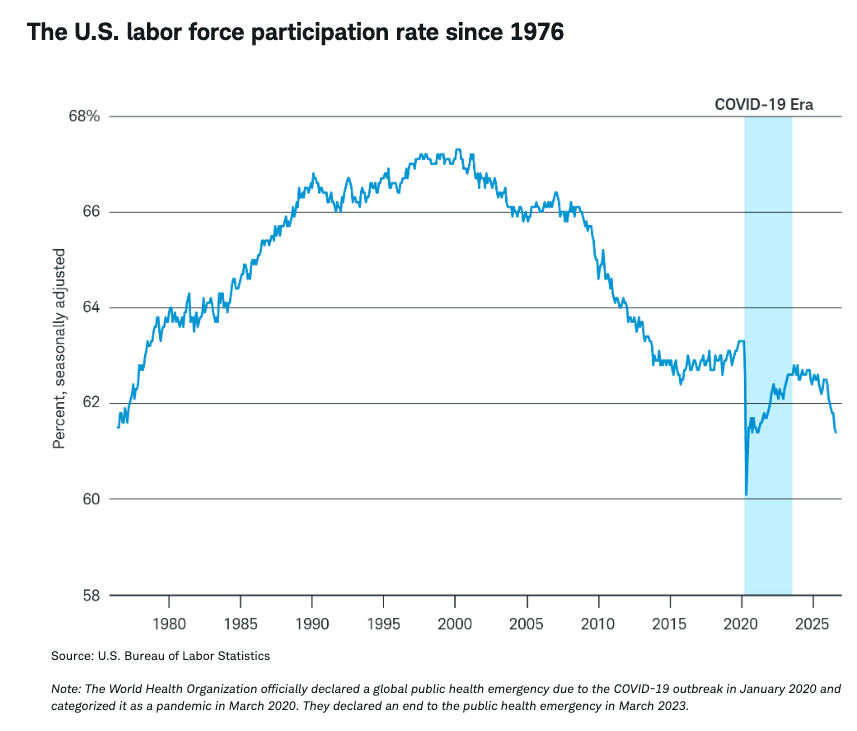
- Labor force participation fell to 61.4% in July. That's a 50-year low, excluding the COVID era.
- The decline reflects several forces, including population revisions, an aging workforce, lower participation among younger workers, and reduced immigration, with aging likely to remain the most persistent drag.
- Investors may want to watch labor force participation because a smaller worker pool can limit economic growth, keep wage and inflation pressures elevated, and complicate the Fed's interest rate decisions.
Investors received an unwelcome surprise earlier this month when the Bureau of Labor Statistics (BLS) reported that employers slashed 23,000 jobs in July. The figure was particularly worrying considering forecasters had expected the economy to add 80,000 jobs, per Bloomberg. Job gains for May and June were also revised lower, sparking concerns about a softening labor market.
See more: Employment Report: 23K Jobs Shed in July, Worse Than Expected
Despite the surprise decline in hiring, the unemployment rate fell slightly to 4.1% last month. While that may sound like good news, the decline in the unemployment rate was largely driven by 264,000 people leaving the workforce. And unfortunately, this isn't a new trend. The U.S. labor force is shrinking.
In fact, since November, more than 2.1 million Americans have left the working world. As a result, the U.S. labor force participation rate—the percentage of the population that is either working or actively looking for work—sank to just 61.4% in July. Excluding the COVID-era, that's the lowest level since June of 1976.
Declining labor force participation can be a real problem for an economy. It tends to slow overall economic growth, reduce government tax revenues, and strain entitlement programs like Social Security and Medicare. A shrinking worker pool may also limit how fast the economy can expand without triggering price hikes. This could complicate the Federal Reserve's battle against inflation.
There was one spot of potentially encouraging news in the July jobs report, however. The so-called prime-age labor force participation rate—which tracks only those aged 25 to 54—remained relatively strong, coming in at 83.4%. This all leads to a few pressing questions. First, why is labor force participation declining? And second, what does it all mean for investors?
"I think the most important thing to keep in mind is that weaker growth in the labor force will continue to shift the burden to productivity. That will have to be an offsetting force for the economy to continue to grow," said Kevin Gordon, head of macro research and strategy at the Schwab Center for Financial Research. "Of course, things like immigration policy are subject to change in the future, but for now, a slower flow of immigrants—combined with the aging domestic workforce—will exert downward pressure on potential growth."
Why is the labor force participation rate falling?
There are four main factors that have contributed to the recent decline in the labor force participation rate. A few of these factors are more temporary shifts, while some are long-term trends that could continue to weigh on participation.
First, in January, the BLS lowered its estimate of the size of the civilian labor force by more than 1.4 million people. This was a part of the annual population-control revision, which attempts to align BLS population data with the latest estimates from the U.S. Census Bureau.
Alexander Bick, a senior economic policy advisor at the Federal Reserve Bank of St. Louis, noted in early August that this revision was a significant driver of the decline in the labor force participation rate earlier this summer. However, while this revision contributed to the reported decline in labor force participation, it didn't cause the underlying shift. Instead, it essentially revealed that the size of the labor force was previously overestimated.
The second factor that has weighed on labor force participation—the aging population—could be much more impactful moving forward. An aging population slowly lowers the labor force participation rate because older Americans simply tend to work less. "This is a force that is real and relentless, but slow and best judged over years, not months," Bick wrote in his early August article.
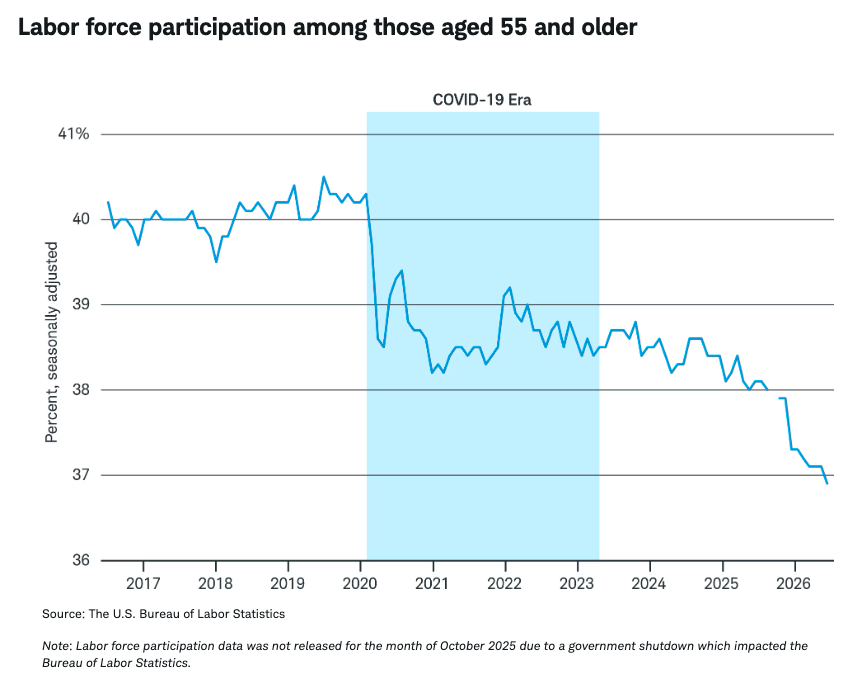
COVID also triggered a surge in early retirements among older Americans, as evidenced by the fact that their participation rate has never fully recovered since the pandemic. The labor force participation rate for those aged 55 and older has dropped sharply in recent years, hitting just 36.9% in July. That's well below pre-COVID levels of over 40%.
The third factor that's impacted labor force participation is that younger Americans are simply working less than past generations did at the same age. The labor force participation rate for those aged 16 to 19 has steadily declined over the past five decades, falling from a peak of nearly 60% in 1978 to just 34.9% in July. It's been a similar story for those aged 20 to 24. In the mid-1980s, nearly 80% of these young adults were part of the workforce, while in July their labor force participation rate came in at just 70.2%.
Finally, a significant decline in immigration has also lowered labor force participation in recent years. This is because participation rates tend to be higher among immigrants. In 2025, the foreign-born labor force participation rate was 66.3%, versus 61.6% for native-born Americans, according to BLS data. While foreign-born workers only represent roughly 19% of the civilian labor force, a reduction in immigration is still driving the labor force participation rate lower on the margin, according to the Federal Reserve Bank of Kansas City.
Why investors—and the Fed—are paying attention
Most investors don't focus on labor force participation when attempting to gauge the strength of the labor market. Instead, they often track things like nonfarm payroll numbers, the unemployment rate, and average hourly earnings. However, changes in labor force participation can reveal structural shifts in the economy that could influence corporate earnings, and by extension, markets for years to come.
With labor force participation stuck in an enduring secular decline that's only accelerated since the start of the year, investors may want to put this metric on their radar. Beyond the impact it could have on earnings, declining labor force participation can weaken the economy's growth potential. And when labor supply becomes scarcer, it can keep wage growth and inflation elevated—even if the labor market is weakening. As previously mentioned, this can complicate the Fed's interest rate decisions.
Seasoned investors understand how important it is to gauge where interest rates may be headed. Rates drive valuations, borrowing costs, economic growth, and the flow of capital in global markets. Failing to account for changes in labor force participation could lead investors to misread the labor market and, ultimately, the path of interest rates. That can expose investors to unexpected investment risks.
A message from Advisor Perspectives and VettaFi: Discover something new! Click here to register for our upcoming webcasts.
This material is intended for general informational and educational purposes only. This should not be considered an individualized recommendation or personalized investment advice. The securities, investment products and investment strategies mentioned are not suitable for everyone. Each investor needs to review an investment strategy for their own particular situation before making any investment or trading decisions.
All expressions of opinion are subject to change without notice in reaction to shifting market conditions. Data contained herein from third party providers is obtained from what are considered reliable sources. However, its accuracy, completeness or reliability cannot be guaranteed.
For illustrative purposes only. Individual situations will vary. Not intended to be reflective of results you can expect to achieve.
Investing involves risk, including, for some products, more than your initial investment.
Past performance is no guarantee of future results.
The Schwab Center for Financial Research is a division of Charles Schwab & Co., Inc.
The Charles Schwab Corporation provides a full range of brokerage, banking and financial advisory services through its operating subsidiaries. Its broker-dealer subsidiary, Charles Schwab & Co., Inc. (member SIPC), and its affiliates offer investment services and products. Its banking subsidiary, Charles Schwab Bank, SSB (member FDIC and an Equal Housing Lender) provides deposit and lending services and product. Its banking subsidiary, Charles Schwab Premier Bank, SSB (member FDIC) provides cryptocurrency services and products.
This site is designed for U.S. residents. Non-U.S. residents are subject to country-specific restrictions. Learn more about our services for non-U.S. residents, Charles Schwab Hong Kong clients, Charles Schwab U.K. clients.
© 2026 Charles Schwab & Co., Inc. All rights reserved. Member SIPC. Unauthorized access is prohibited. Usage will be monitored.
© Charles Schwab
More Factor-Based Investing Topics >