Should You Consider High-Yield Municipal Bonds?
Membership required
Membership is now required to use this feature. To learn more:
View Membership Benefits
Key takeaways
- We believe high-yield munis are an asset class that carries additional risks, but a small allocation may be appropriate for some investors, especially those in higher tax brackets with longer investment time horizons.
- High-yield munis differ from investment-grade municipal bonds because they have credit ratings that are below investment grade, or have no credit rating at all.
- Although high-yield munis offer some benefits, they do carry additional risks. One such risk is the size of the high-yield muni market.
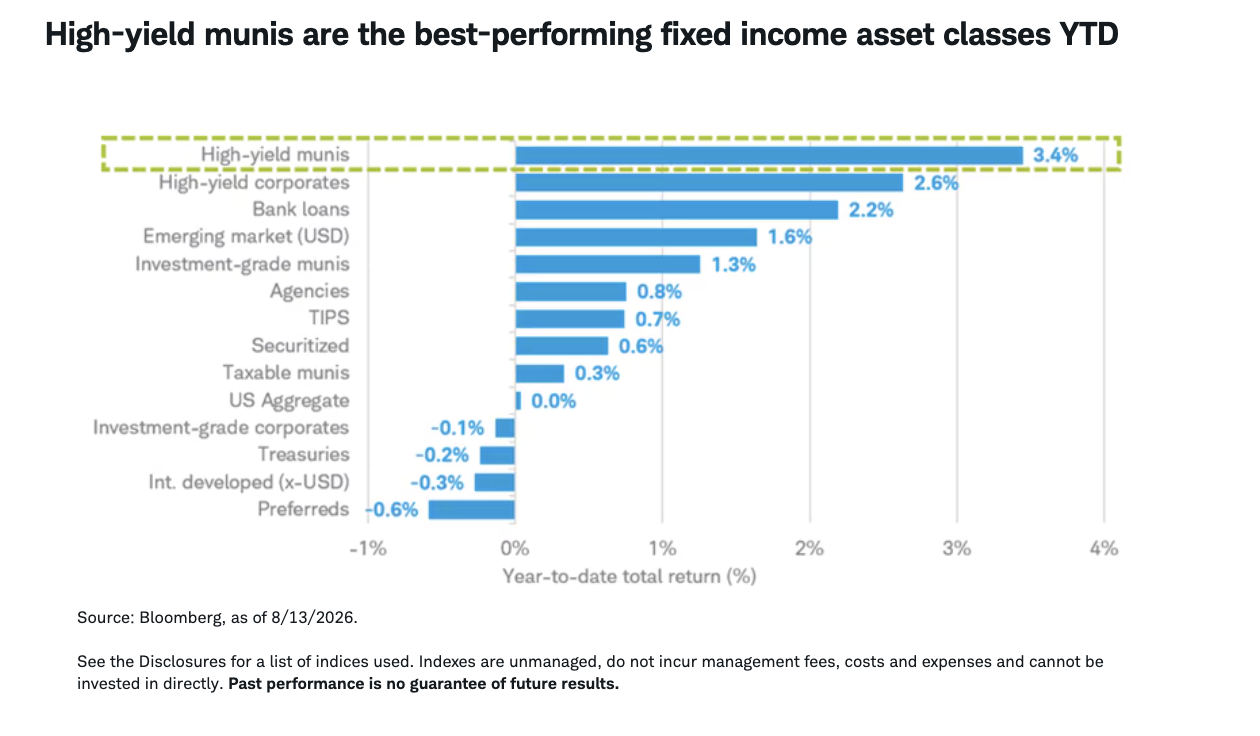
High-yield municipal bonds are one of the best performing asset classes this year but that doesn't mean we think all investors should consider adding them to their portfolio. Generally, they offer higher yields than investment-grade munis, but they also carry higher risks. Even so, we think a small allocation may be appropriate for some investors in higher tax brackets with longer investment horizons.
The caveat, however, is that the entry point now isn't that attractive. Valuations are low and if the economy begins to falter, returns for high-yield munis will likely suffer more than investment-grade munis.
See more: Earnings Strong. Bond Yields a Risk.
A primer on high-yield munis
High-yield municipal bonds are like other municipal bonds in that they're issued by municipalities and their interest payments are generally exempt from federal and potentially state and local income taxes. But that's where most of the similarities end, in our view. High-yield munis differ from investment-grade municipal bonds because they have credit ratings that are below investment grade, or they have no credit rating at all.
Lower credit ratings mean high-yield bond issuers are considered more vulnerable to missing interest payments or even failing to repay principal. In exchange for the increased risks, yields for high-yield munis are usually greater than yields for investment-grade munis. For example, the yield to worst (the lowest possible yield an investor can receive from a callable bond, barring default) for the Bloomberg Municipal Bond High Yield Index, which is a broad index of high-yield munis, is 5.6%, compared with 3.8% for the Bloomberg Municipal Bond Index, which is a broad index of investment-grade munis according to Bloomberg, as of August 13, 2026.
Before deciding whether to invest in the high-yield muni market, here are some points that we believe investors should be aware of:
1. Yields for high-yield munis aren't that attractive, in our view. Yields for many major fixed income asset classes have increased since the start of the year, making the entry point more attractive, but that isn't the case with high-yield munis, as illustrated in the chart below. In fact, the yield on the Bloomberg Municipal Bond High Yield Index started the year at 5.6% and was 5.6% as of August 13. It did, however, fluctuate throughout the year. Note that one basis point (bps) is equal to 0.01%.
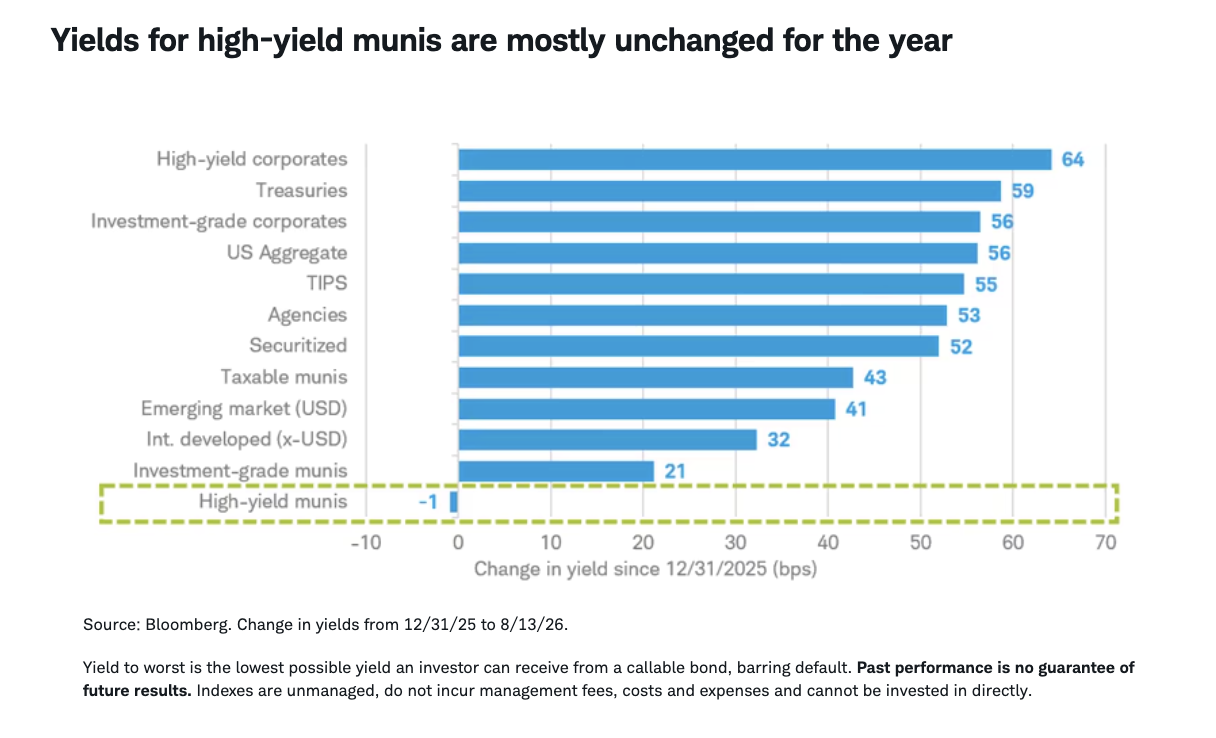
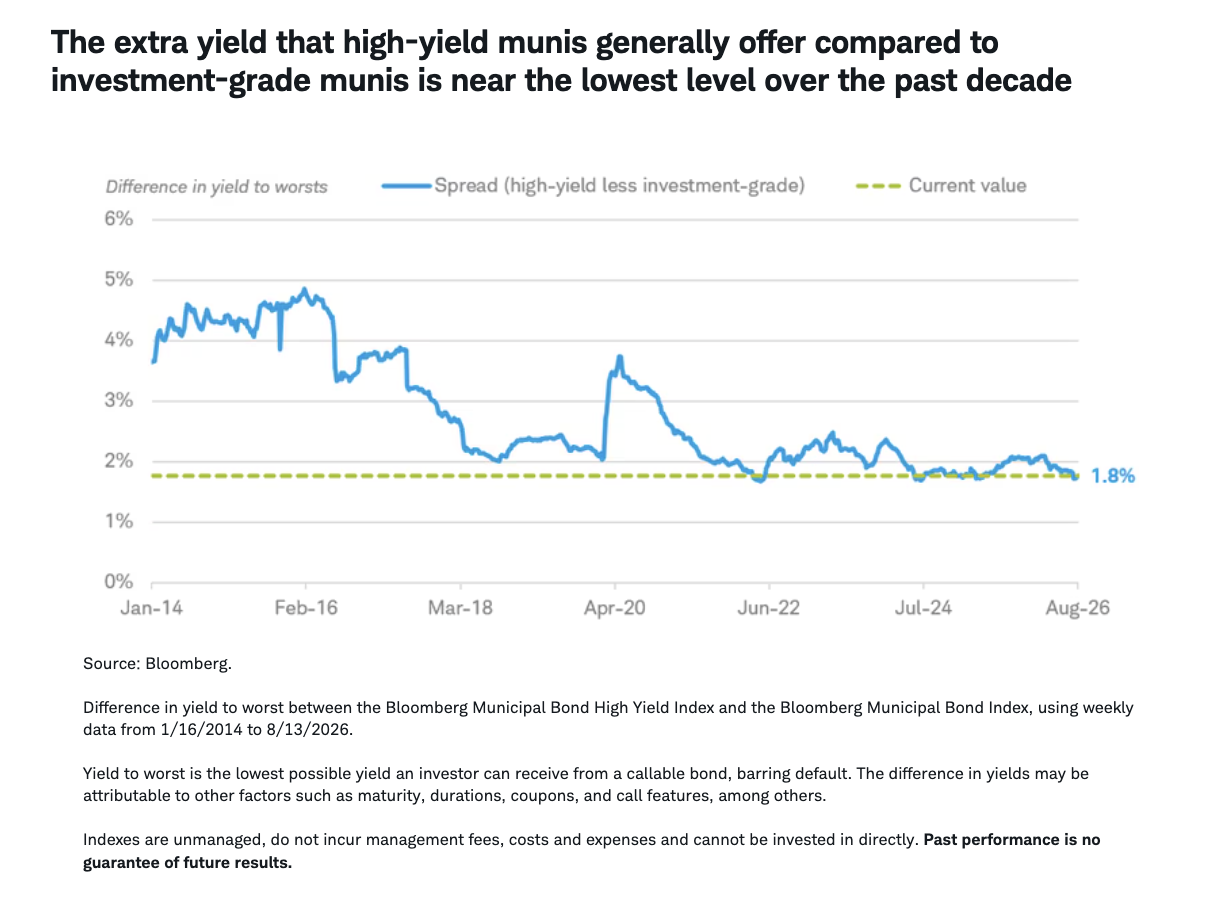
While a tax-advantaged yield of 5.6% may seem attractive, especially after factoring in the tax benefits that munis may offer, we don't think it is relative to investment-grade munis. As shown in the chart below, high-yield munis only offer a yield advantage of 1.8% more than investment-grade munis. That is close to the lowest level in over a decade. In other words, the extra yield that high-yield muni investors are receiving for taking on the extra risk isn't that great, in our view.
Additionally, a reason why the index of high-yield munis has a higher yield is because it also has a longer duration. Duration is a measure of interest-rate sensitivity and prices for bonds with longer durations are generally more volatile if interest rates fluctuate. As a result of the increased risk, bonds with longer durations generally yield more than bonds with shorter durations. One method to isolate the yield regardless of duration is to look at the yield per unit of duration. This is a simple ratio of the index's yield to worst divided by its duration. It is essentially a measure of reward, measured by yield, relative to risk, measured by duration. Theoretically, bonds with greater credit risks should offer higher yields after stripping away the impact of duration, but that isn't the case with high-yield munis. For example, high-yield corporate bonds, which have a large amount of credit risk, have the highest yield per unit of duration. The yield per unit of duration is lower for high-yield munis than it is for investment-grade munis. This means that when factoring in duration risk, investors are getting a lower yield with high-yield munis even though they have greater credit risk.
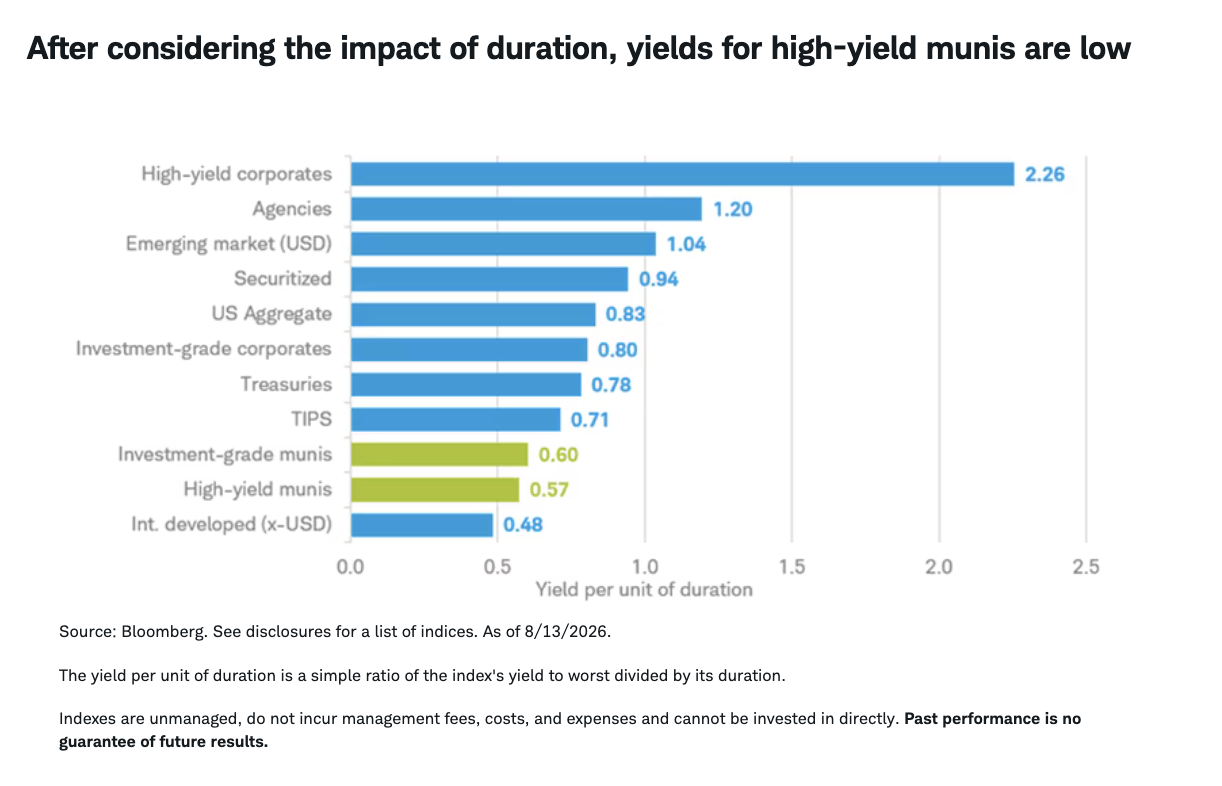
The caveat is that some high-yield mutual funds and exchange-traded funds (ETFs) track different benchmarks and therefore may have a shorter duration. This can result in a different yield per unit of duration ratio than what is shown above.
2. High-yield munis are very different from investment-grade munis. In general, the high-yield muni market is made up of issuers that function with a greater degree of operational risk compared to issuers in the investment-grade muni market.
We like to say that there's a difference between "municipal bonds" and "tax-exempt bonds." The two phrases are often used interchangeably, sometimes rightly so. However, while high-yield munis pay tax-exempt interest and have the word "municipal" in their name, we wouldn't consider them "municipal" bonds in the traditional sense. To illustrate, some of the largest issues in the Bloomberg Municipal Bond High Yield Index are bonds that are backed by settlement payments from lawsuits related to tobacco and cigarette use. The risk profile of these types of issuers compared to that of the average city, state, or essential services revenue bond is vastly different in our view.
Although muni defaults historically are rare, when they happen, they've most often been in the high-yield portion of the muni market. This is due partly to their greater operational risks. Of all the munis that are currently in default, roughly 84% were initially unrated, and unrated bonds make up approximately two-thirds of the high yield universe, according to Municipal Market Analytics, as of August 4, 2026.
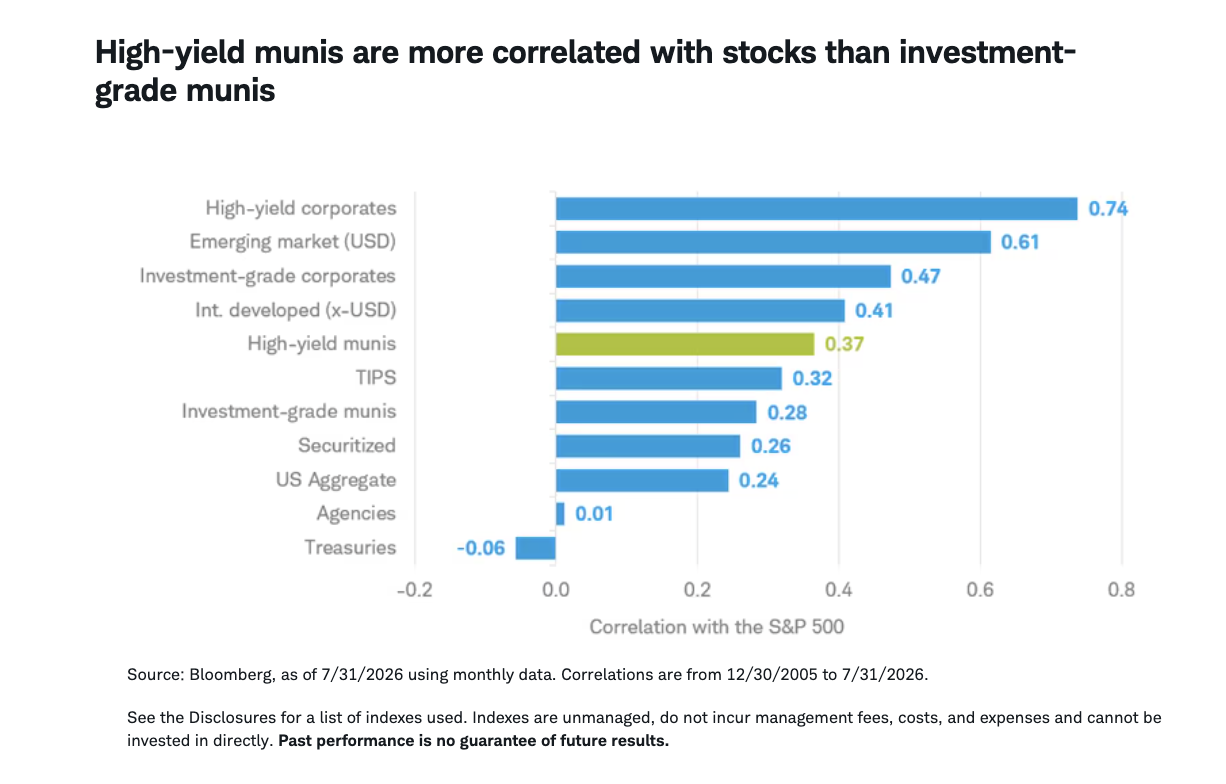
3. High-yield munis lack some of the diversification benefits of investment-grade munis. Additionally, high-yield munis have not provided the same diversification benefits that investment-grade munis have. As illustrated in the chart below, high-yield munis tend to have a higher correlation to equities than investment-grade munis do. Correlation is a measure of how closely returns move with one another. A correlation closer to 1 means that returns for the two assets move closely together and do not provide the diversification benefits when added to a portfolio, whereas the opposite is true for a correlation of negative 1. This means that in instances where equities are falling, high-yield municipal bonds have not provided the same level of diversification as investment-grade municipal bonds.
This means that investors looking for stability during times when riskier investments, like stocks, are falling may be disappointed with high-yield munis.
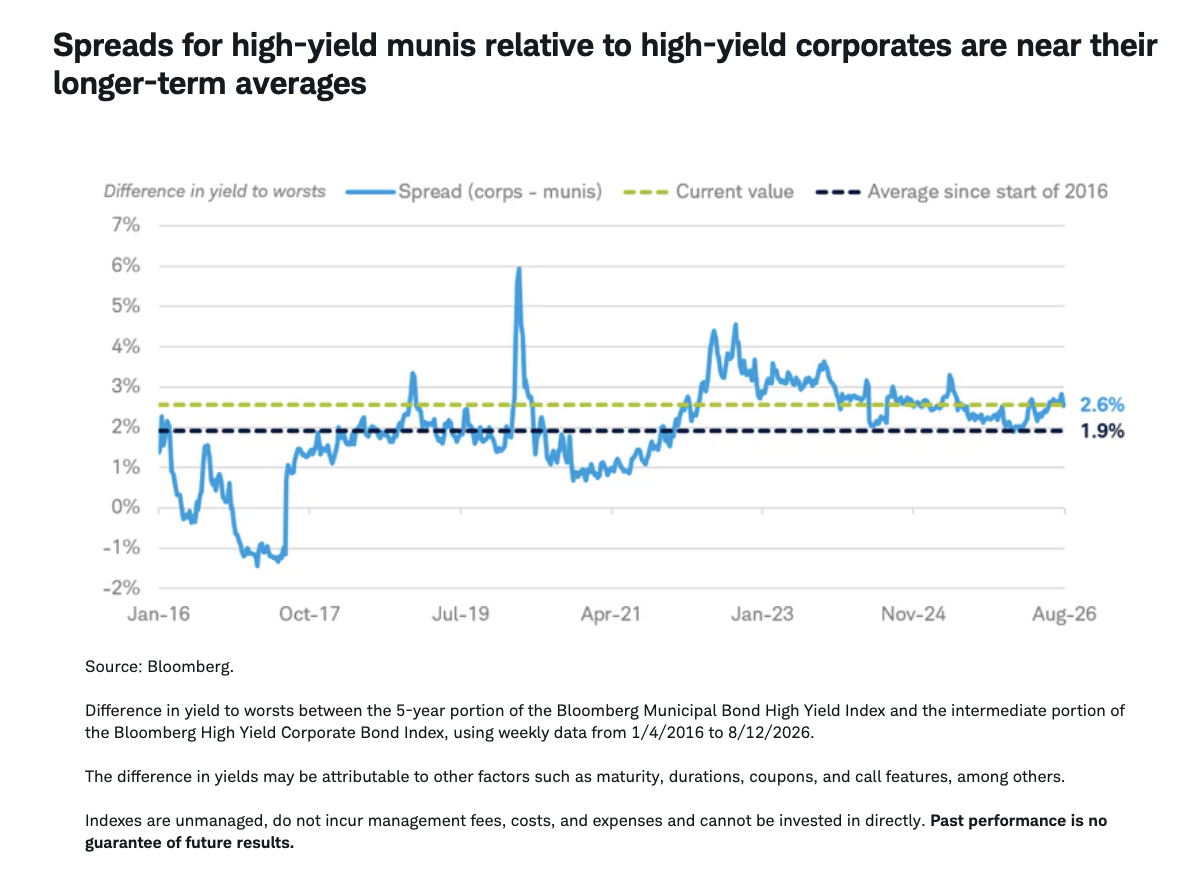
4. High-yield munis can make sense relative to high-yield corporate bonds but only for high-net-worth investors with longer time horizons. It's a slightly different story when comparing high-yield munis to high-yield corporates—but only for investors in a higher tax bracket with longer time horizons. Since the start of 2016, a broad index of intermediate-term high-yield corporate bonds has yielded about 190 basis points more than a broad index of intermediate-term high-yield munis, on average (a basis point is one one-hundredth of a percentage point, or 0.01%). The difference in yields fluctuates, but more often than not, high-yield corporate bonds yield more than high-yield munis because of their lack of tax benefits. Today, the difference in yields is about 2.6% which is slightly above the longer-term average. In other words, high-yield munis are not overly attractive at these levels, but also not overly unattractive, in our view.
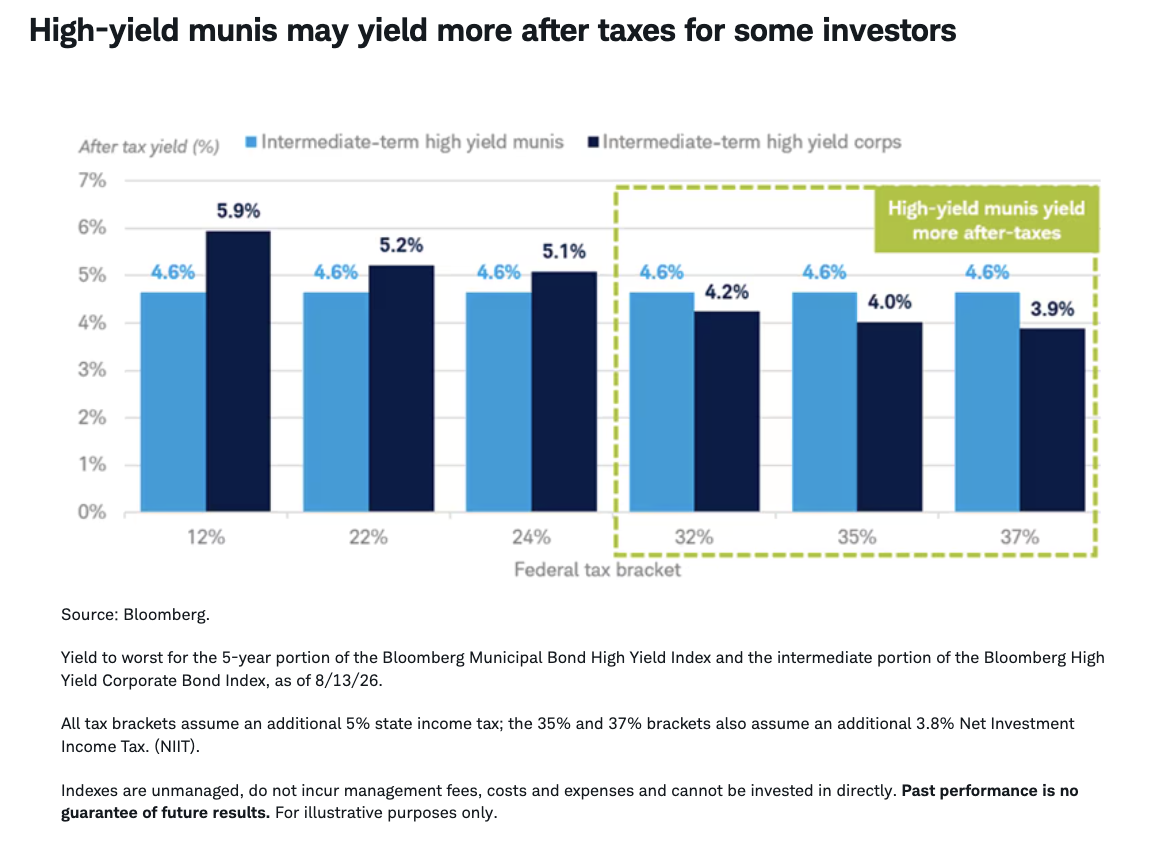
After considering taxes, high-yield munis might look more attractive for investors in higher tax brackets. For investors in the 32% and above brackets, high-yield munis currently yield more than high-yield corporate bonds after taxes.
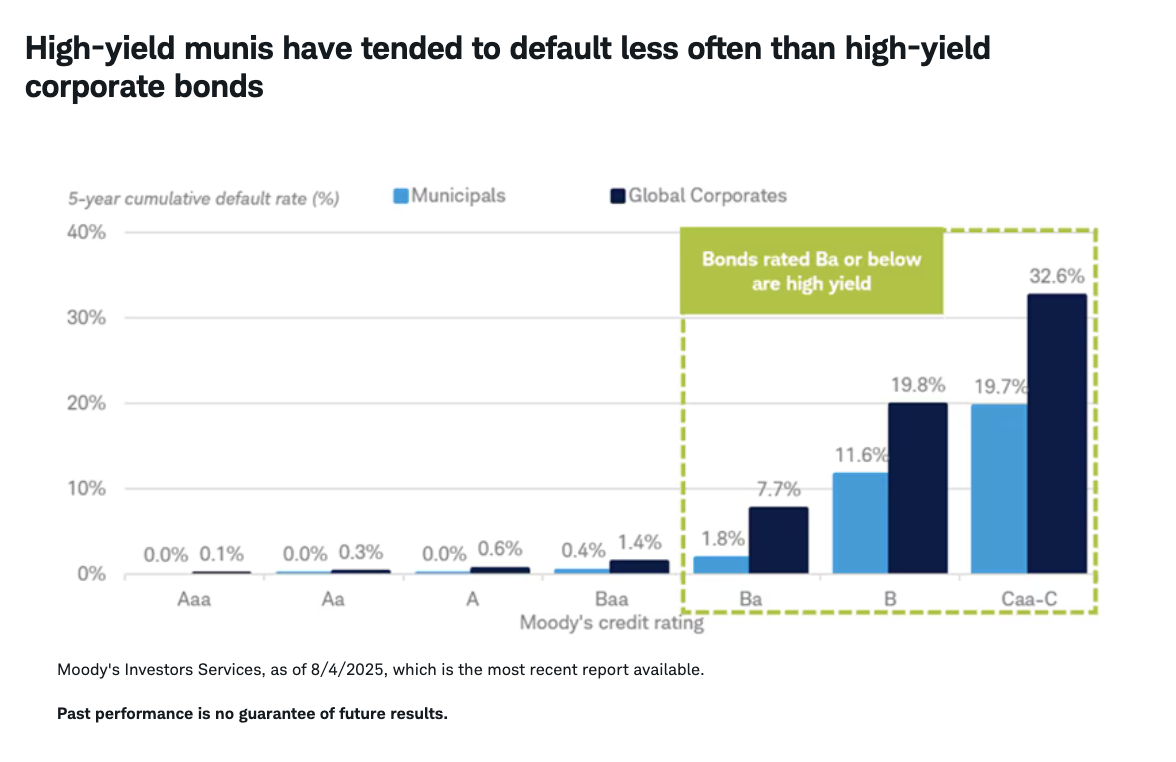
In addition to potentially higher after-tax yields relative to high-yield corporate bonds, high-yield muni issuers historically have made timely interest and principal payments more frequently than have issuers of high-yield corporate bonds with similar credit ratings. Over a five-year period, 11.6% of munis rated B by Moody's defaulted, compared with 19.8% of corporates rated B by Moody's, as illustrated in the chart below.1
It's important to note that these figures likely understate the number of defaults because the study only includes bonds rated by Moody's. That's important because roughly two-thirds of the bonds in the Bloomberg Municipal Bond High Yield Index contain bonds that are not rated by Moody's. In fact, according to a Federal Reserve Bank of New York study from 2012, which is the latest data available, if all munis were included as part of the default study, not just bonds rated by Moody's, the number of defaults would be 36 times more than what Moody's reported.2 Although there is no more recent data available, we cite this study because it provides insight into one of the many factors to keep in mind when assessing high-yield muni bond default risk—the data is old but the point is still valid.
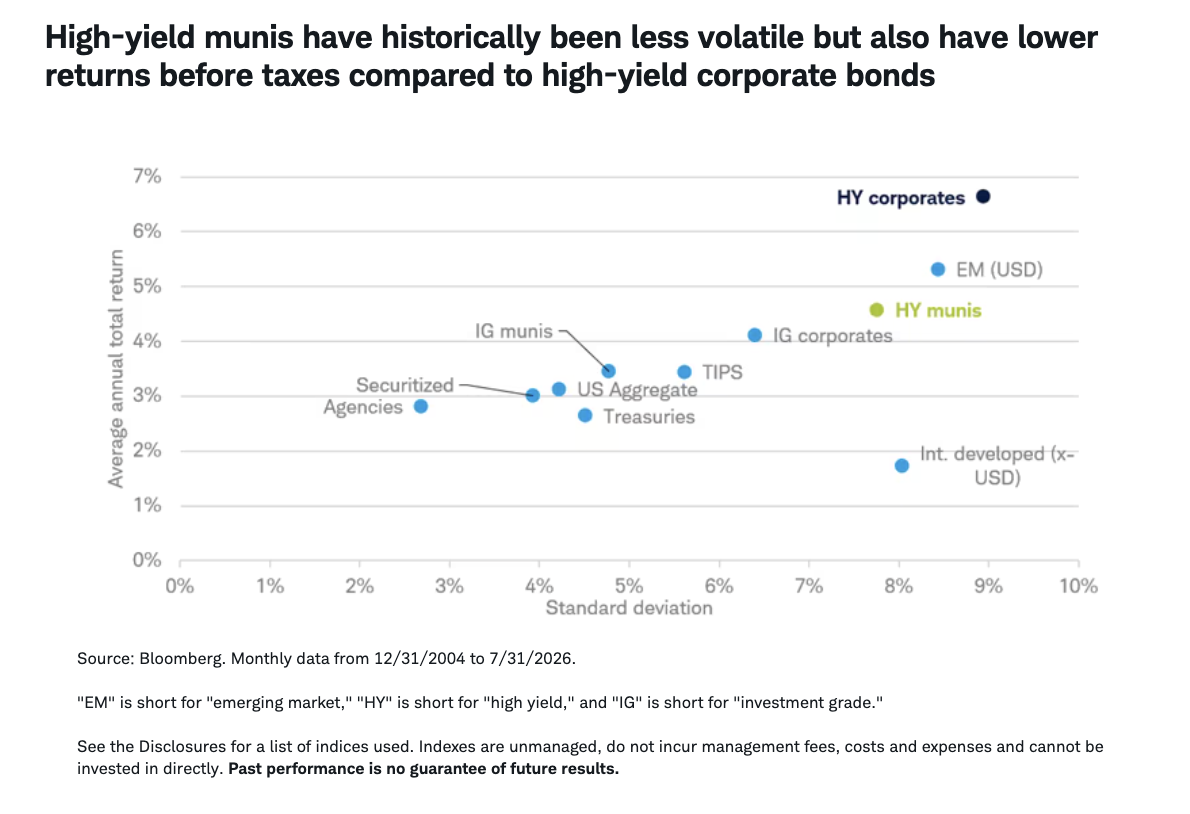
The longer-term risk and reward characteristics of high-yield munis also look favorable compared to high-yield corporates. For example, over roughly the past decade, the average annual return before taxes for an index of high-yield munis is about 4.6% versus 6.6% for an index of high-yield corporate bonds. However, returns for high-yield corporate bonds would be lower after considering the impact of taxes. Additionally, the standard deviation, which is a measure of risk, is lower for high-yield munis versus high-yield corporates. Securities with a higher standard deviation are more volatile than those with a lower standard deviation. In other words, after considering taxes, high-yield munis have historically had similar returns as high-yield corporate bonds but with less volatility.
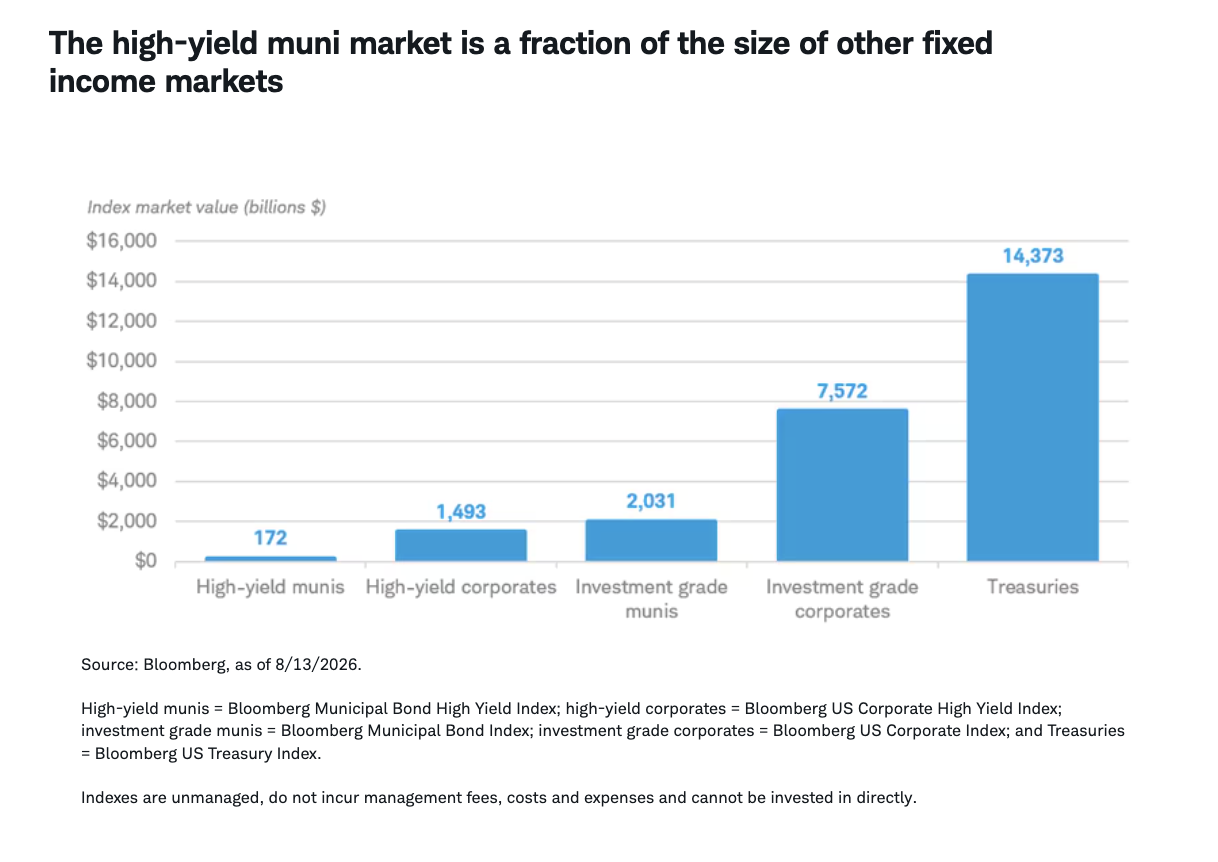
Although high-yield munis offer some benefits, they do carry additional risks. One such risk is the size of the high-yield muni market. In the bond market, the size of the market matters because unlike stocks or ETFs, bonds don't trade on an exchange. This can pose a challenge for investors in parts of the bond market because nobody is required to execute a trade when you want to or at a price you may reasonably expect.
Lower liquidity can affect bond funds and ETFs that hold high-yield munis. If it's difficult to trade the underlying investment, the fund may have to revalue the bond at a lower price. As a result, the funds that hold less-liquid bonds could see their net asset value drop more precipitously in a down market.
What to consider now
If you do choose to invest in high-yield munis, we strongly suggest you consider investing with a professionally managed solution, such as a mutual fund, ETF, or separately managed account. Due to the combination of unique risks that high-yield munis exhibit, a professional manager can help with diversification and ongoing credit monitoring. However, using a professionally managed solution doesn't eliminate all of the risks associated with high-yield munis. Before investing in any fund, you should consult the fund's prospectus to understand its investment objectives, risks, charges, and expenses. Schwab clients can log in and research a list of pre-screened mutual funds and ETFs by accessing the Schwab Select Lists.
1 The Moody's investment grade rating scale is Aaa, Aa, A, and Baa, and the sub-investment grade scale is Ba, B, Caa, Ca, and C. Standard and Poor's investment grade rating scale is AAA, AA, A, and BBB and the sub-investment-grade scale is BB, B, CCC, CC, and C. Ratings from AA to CCC may be modified by the addition of a plus (+) or minus (-) sign to show relative standing within the major rating categories. Fitch's investment-grade rating scale is AAA, AA, A, and BBB and the sub-investment-grade scale is BB, B, CCC, CC, and C.
2 Appleson, J., Parsons, E., and Haughwout, A.F., "The Untold Story of Municipal Bond Defaults," Liberty Street Economics, Federal Reserve Bank of New York, August 15, 2012.
Membership required
Membership is now required to use this feature. To learn more:
View Membership Benefits