What Alexander Hamilton Would Make of Washington’s Stake in Intel
Membership required
Membership is now required to use this feature. To learn more:
View Membership Benefits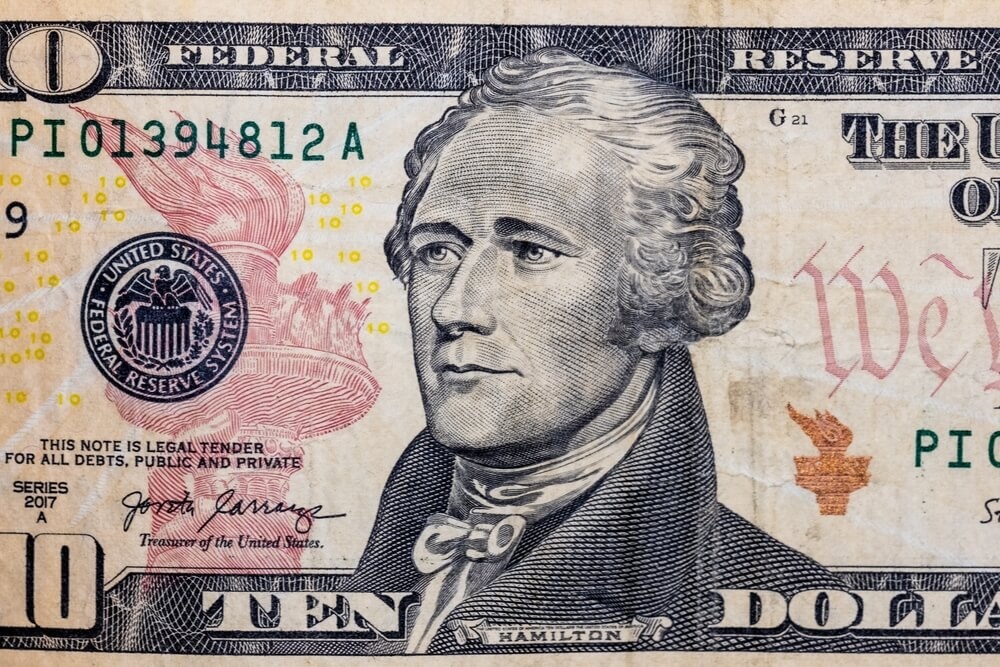
In January 1790, the House of Representatives put a simple question to its new Treasury Secretary: what should America make for itself? Alexander Hamilton took almost two years to answer.
He was 36, an immigrant orphan from the Caribbean island of Nevis who had talked his way into King’s College and then into George Washington’s inner circle. His Report on the Subject of Manufactures,delivered December 5, 1791, was the longest of the four great reports he wrote for Congress… and the one Congress mostly ignored.
Hamilton’s argument was that a country that can’t make the things it needs isn’t fully a country. “The independence and security of a Country,” he wrote, “appear to be materially connected with the prosperity of manufactures.”
See more: Gold Miners Are Printing Cash at $4,000 Gold
The first factory in the U.S., a water-powered cotton mill, had yet to open in Rhode Island, so Hamilton wasn’t being sentimental about factories. Instead, he was thinking about national supply. At the time, the United States had to buy its muskets, wool and gunpowder from the same empire it had just finished fighting. Hamilton wanted the new republic to be, in his words, “independent on foreign nations, for military and other essential supplies.”
Hamilton Is Having a Moment
At Davos this past January, U.S. Trade Representative Jamieson Greer credited Hamilton as the intellectual father of the Trump administration’s trade policy.
Treasury Secretary Scott Bessent, who holds the job Hamilton invented, has said the same, writing in a Wall Street Journal op-ed that national and economic security “begins with the capacity to build, invest, finance and scale the industries that will define the next century, among them semiconductors, artificial intelligence, quantum computing, advanced manufacturing, shipbuilding, critical minerals and pharmaceuticals.”
Both Greer and Bessent, not to mention Trump himself, have invoked Hamilton as a basis for the administration’s tariff policy. Hamilton, though, was only moderately supportive of tariffs, believing (rightfully so) they would raise consumer prices. He was much more supportive of “bounties,” or what we’d call direct subsidies today.
Congress passed Hamilton’s tariffs but ignored the subsidies. I bring this up because the industrial policy we have in 2026 doesn’t resemble what Hamilton proposed.
Commerce Department as Venture Portfolio
Since June 2025, the federal government has taken—or proposed taking—an ownership position in as many as 30 companies, by the Cato Institute’s count.
It began with a golden share in U.S. Steel, handing Washington veto rights over major corporate decisions. Then $400 million into MP Materials. Then, in August, $8.9 billion for a nearly 10% share of Intel, converted out of CHIPS Act grant money. As of today, the federal government is Intel’s largest single shareholder.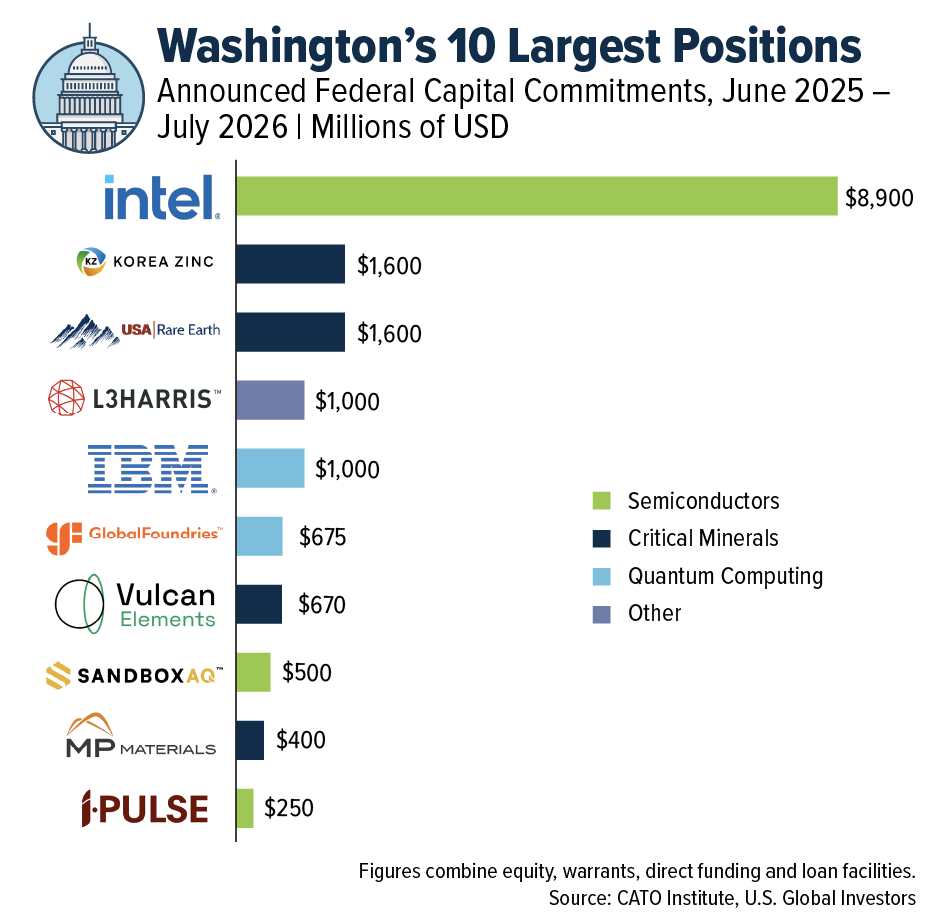
I don’t believe any of this is about whether the U.S. can design a chip. This country has roughly 5,500 data centers, about 10 times the next closest nation. American companies control something like 80% of the world’s AI computing power.
What Washington is buying is everything underneath and everything out ahead—the dirt, the refining, the fabs, the tech that doesn’t work yet. McKinsey figures the U.S. imported $1.3 trillion in critical manufactured goods last year. Building the factories to make everything here at home would run about $500 billion.
What would Hamilton’s solution have been? Instead of buying shares, he might have just written a check.
$1.5 Trillion in Chip Sales Private data center construction has climbed from about $10 billion a year in early 2021 to nearly $60 billion this past May. In that month alone, it rose 23% from a year earlier, while spending on manufacturing buildings—the largest single category in nonresidential construction—fell 22%.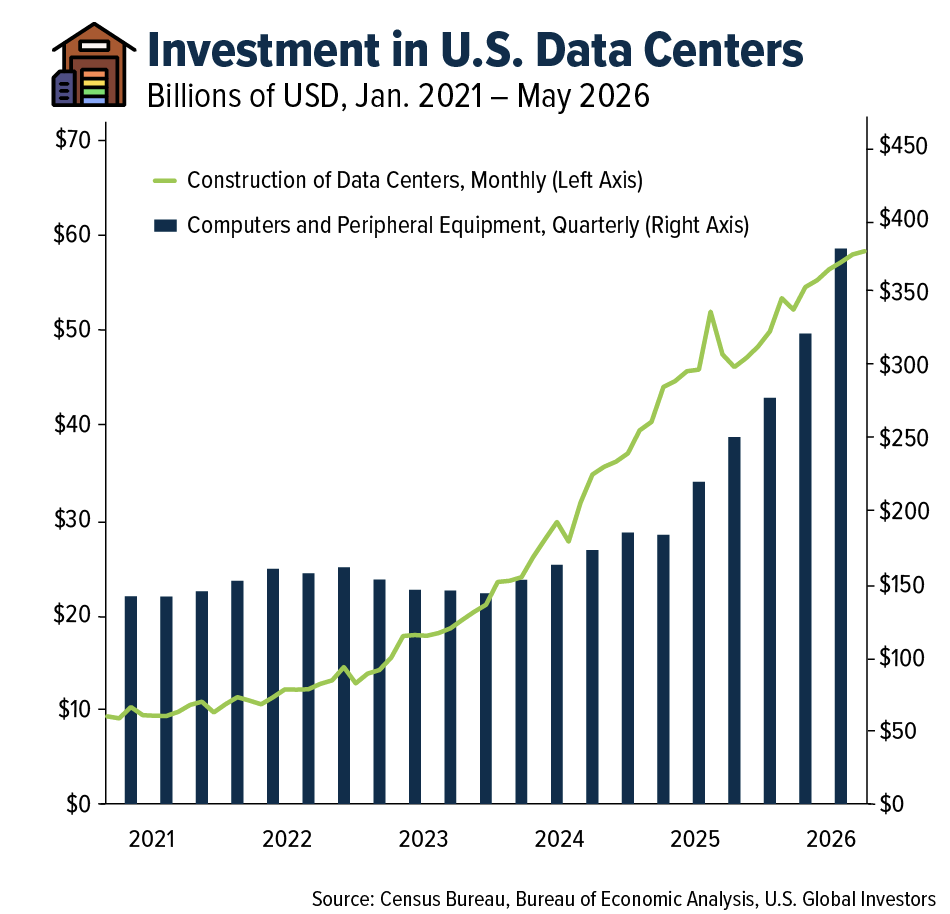
Meanwhile, the World Semiconductor Trade Statistics (WSTS) organization expects global chip sales to grow 90% this year to $1.51 trillion, with nearly all of it coming from one place. Memory is forecast to expand roughly 250%, to more than $800 billion.
I’d flag WSTS’s findings here, particularly the 250% figure. Memory chips are a commodity, and a surge that size is largely a pricing event driven by shortage. Shortages, as you know, eventually get solved. WSTS still sees another 27% growth in 2027, so nobody is calling a top.
What I’d Do Here
The Philadelphia Semiconductor Index is up about 94% over the past 12 months. It’s also down roughly 20% over the past month.
Longtime readers know I advise holding a 10% weighting in gold—5% in bullion, 5% in gold mining stocks—and rebalancing every year. But the rule isn’t really about gold. It’s about having a discipline that makes you consider buying what everyone else is selling and consider trimming what everyone else is chasing.
Apply the same thinking here. Decide what share of your portfolio belongs in the buildout—the chips, certainly, but also the power, the metals and the equipment that make the chips worth anything—then rebalance on a schedule.
Watch What Washington Buys
Hamilton lost his own argument, by the way. Congress took his tariffs, ignored his bounties and his report sat on a shelf for the better part of a century.
But the question he asked in 1791 hasn’t gone anywhere: can a nation be secure if it doesn’t make the things it depends on? Washington is answering that question right now—not with subsidies, the way Hamilton proposed, but by buying the shares.
That said, I’d watch what the government buys. It might tell you more than what the government says.
Airlines and Shipping
Strengths
- The best-performing airline stock for the week was Frontier, up 16.2%. Goldman cited JetBlue’s better-than-expected third quarter (3Q) revenue per available seat mile (RASM) outlook and 2028 earnings per share (EPS) target as key drivers of the stock’s outperformance. The company expects 3Q RASM growth of +12.5% to +16.5% versus consensus of +11.9% and targets 2028 EPS of $1.00+ versus FactSet consensus of $0.03.
- Kawasaki Kisen Kaisha announced an upward revision to its fiscal year 3/27 earnings guidance after the close on July 24. The company raised operating profit guidance from ¥83 billion to ¥85 billion and recurring profit guidance from ¥100 billion to ¥135 billion. According to Goldman, the increase was driven primarily by a stronger-than-expected market environment in the dry bulk business, which supported operating profits, and higher-than-expected revenue from container shipping joint venture Ocean Network Express, which supported recurring profits.
- Frontier’s second quarter 2026 EPS of $(0.10) came in ahead of Raymond James’ $(0.33) Street-high estimate and consensus of $(0.47). Results also exceeded the company’s early-May guidance range of $(0.45) to $(0.60). Notably, year-over-year (YoY) revenue growth of 38% surpassed consensus expectations of 31%, while both fuel and non-fuel costs came in better than expected.
Weaknesses
- The worst-performing airline stock for the week was Textron, down 10.8%. Singapore Air reported a first quarter net loss of S$76 million, missing Bank of America’s estimate of a S$15 million loss. The shortfall was primarily driven by higher-than-expected fuel costs due to unfavorable quarter-over-quarter hedge timing, partially offset by stronger passenger and cargo unit revenues and a smaller-than-expected share of Air India losses.
- According to Morgan Stanley, Europe-Far East air cargo tonnage declined 18% year-over-year (YoY). From weeks 26 to 29, China-to-Europe volumes fell 8% YoY, while combined tonnage from China and Hong Kong to Europe declined 11%. The decline was attributed to new European Union (EU) import rules that removed the previous “de minimis” exemption for items valued below €150.
- TSA throughput was down 2.5% YoY on a trailing seven-day basis, improving from last week’s 3.5% decline. Month to date, throughput is down 1.9% compared with June’s 0.7% decline. According to Bank of America, travel volumes have been softer on off-peak days, including Tuesday, Wednesday, and Saturday.
Opportunities
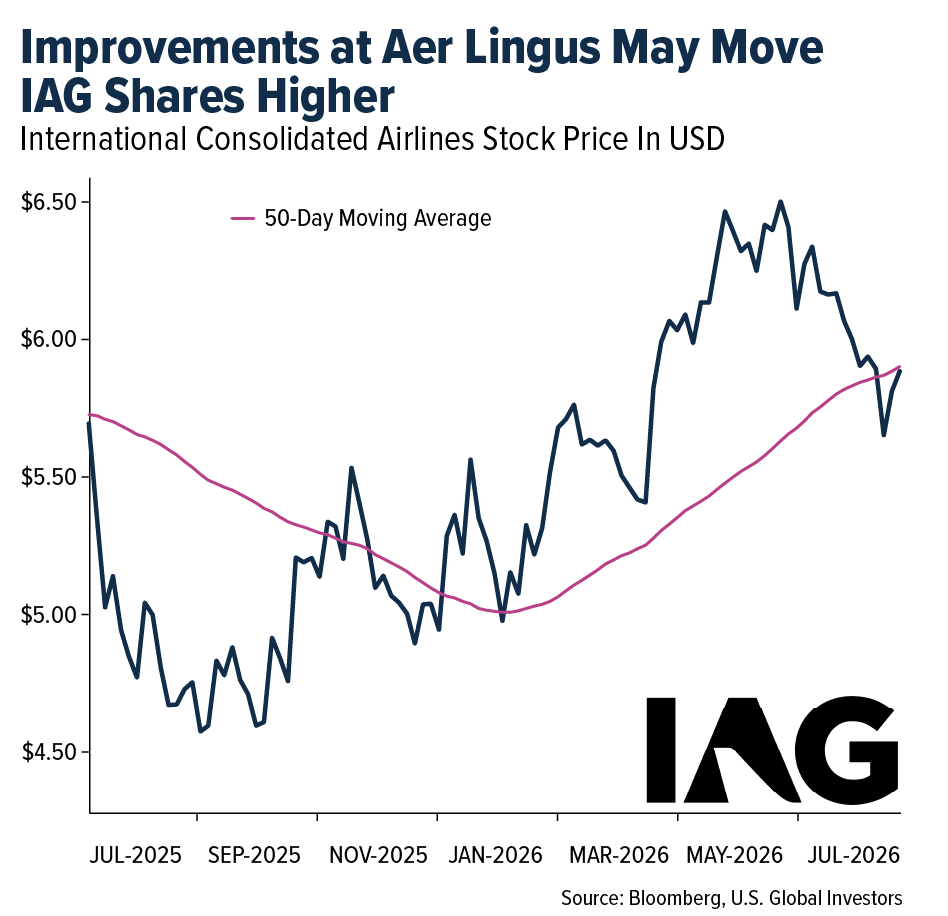
- According to the BBC, Aer Lingus plans to eliminate up to 500 jobs by summer 2027 as part of a broader restructuring effort aimed at improving profitability and funding future growth. The airline will reduce flight capacity by 6%, cut underperforming routes, and ground aircraft, with job reductions expected across head office, cabin crew, and pilot roles.
- China-to-U.S. West Coast freight rates for departures over the next seven days are up 15% versus quotes collected last week and 21% above the latest SCFI levels. Linerlytica noted that transpacific volumes remain strong, supported by limited tariff increases for many countries following the introduction of new Section 301 measures.
- Corporate travel has emerged as one of the strongest revenue drivers in recent airline earnings reports. Growth remains broad-based and appears to be carrying into the fall booking season. While recent improvements have been largely fare-driven, volumes and load factors remain below pre-COVID levels, suggesting additional room for recovery, according to BMO.
Threats
- The FAA proposed an airworthiness directive affecting 453 U.S.-registered Boeing 737 MAX aircraft, citing the potential for seat assemblies to injure passengers during an emergency landing. Each aircraft could have up to 69 affected seat assemblies, with repairs estimated to take roughly one work hour per assembly. The FAA has not yet established a compliance deadline or confirmed whether international operators are affected, according to RBC.
- LNG transit through the Strait of Hormuz remains halted. Based on Bloomberg ship-tracking data, the last observed LNG vessel exit through the strait occurred on July 12, while the last confirmed entry took place on July 10. Deliveries to Kuwait have also slowed, with JPMorgan noting only one delivery in the past two weeks.
- The latest reading from Diio shows fourth quarter domestic available seat miles (ASMs) growth declined 160 basis points to 4.6% this week, down from 6.2% last week. Total fourth quarter ASMs also declined 110 basis points to 3.4%. The reductions were primarily driven by Delta (-220 basis points) and United (-140 basis points).
Luxury Goods and International Markets
Strengths
- LVMH’s underlying business improved in the second quarter, with organic revenue growth accelerating to 3% (or 4% excluding the impact of the Middle East conflict), up from 1% in the first quarter. However, reported results were negatively affected by foreign-exchange translation, as the stronger euro reduced the value of sales generated outside the eurozone when converted back into euros.
- European economic data surprised to the upside this week, highlighting resilient growth across the region. Eurozone second-quarter (Q2) GDP rose 0.4% quarter-over-quarter, double expectations of 0.2%, while the Economic Sentiment Indicator improved to 96.9 from 95.4. Growth was broad-based, with Spain (+0.7%), Germany (+0.2%), France (+0.2%) and Italy (+0.2%) all posting economic expansion.
- Kering, best known for its Gucci brand, gained 17.8% over the past five trading days, making it the top performer in the S&P Global Luxury Index. Shares rallied after the company’s group revenue returned to growth, rising 2% organically and exceeding expectations. While Gucci sales remained down 2%, trends improved significantly from the first quarter, suggesting demand conditions and brand momentum are stabilizing.
Weaknesses
- Norwegian Cruise Line Holdings lowered its 2026 outlook, citing softer booking trends and increased uncertainty in consumer spending. While travel demand remains healthy overall, the outlook cut suggests a more cautious operating environment and potential pressure on earnings next year.
- Prada delivered solid revenue growth, with first-half sales increasing 11%, but profitability weakened as net profit declined 15% year-over-year. The results reflect a luxury market that remains resilient but is experiencing slower growth, while profitability was impacted by acquisition-related costs and a more challenging operating environment.
- Citychamp Watch & Jewellery Group, a Hong Kong-listed luxury watch retailer and manufacturer with significant exposure to the Chinese luxury market, fell 15% over the past five trading days, making it the worst performer in the S&P Global Luxury Index. Shares declined following weaker-than-expected results, highlighting continued softness in luxury demand and a challenging consumer environment in Greater China.
Opportunities
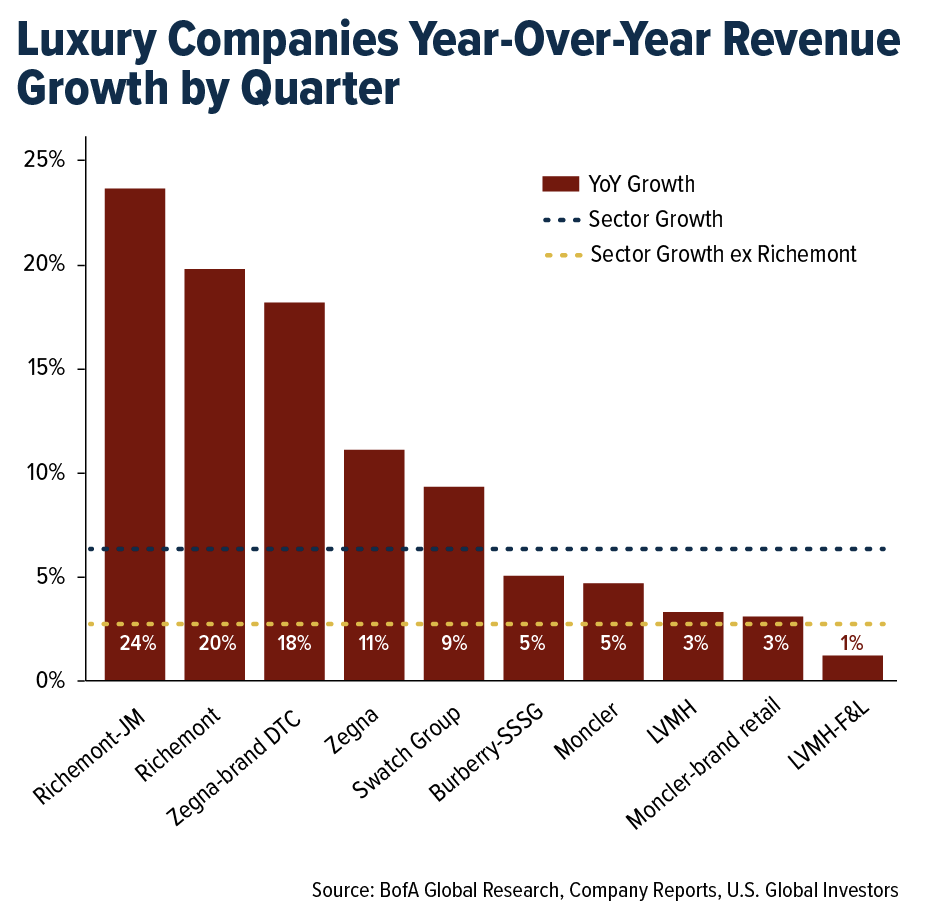
- Bank of America sees signs of improving demand in the luxury goods sector. Earlier this week, the firm’s luxury research team noted that seven luxury companies reported higher revenue in the second quarter of 2026 compared with the prior year period. Richemont led the group with 20% revenue growth, while LVMH and Moncler each posted more modest gains of 3%. Although performance remains uneven across the sector, the results suggest that luxury demand may be stabilizing and gradually improving.
- Early second-quarter earnings results point to a potentially strong quarter for U.S. equities. Although only about one-quarter to one-third of S&P 500 companies have reported so far, 80%–86% have beaten earnings expectations, and overall earnings growth is running well ahead of estimates.
- Recent results from Richemont, Brunello Cucinelli, Prada, and Hermès indicate that the U.S. consumer remains relatively healthy, helping offset weakness in China. Hermès reported 15% growth in the Americas, while Prada highlighted notable strength in the Americas and Asia-Pacific.
Threats
- Hermès reported second-quarter sales growth of 6.7%, with its key Leather Goods division growing 10%, slightly below market expectations. Despite solid profitability, investors reacted negatively as demand in China remained subdued and the company’s sales growth showed only modest acceleration. The results have raised concerns that Hermès may be entering a period of slower expansion after years of exceptional performance.
- Geopolitical tensions in the Middle East have re-emerged following renewed exchanges between the U.S. and Iran, increasing uncertainty around regional stability and global energy supplies. As a result, oil prices have become more volatile, with markets closely monitoring the risk of supply disruptions and potential impacts on inflation, transportation costs, and consumer spending.
- China’s latest manufacturing and non-manufacturing PMIs have fallen below the key 50 level, signaling a contraction in business activity. A PMI reading above 50 indicates economic expansion, while a reading below 50 points to declining activity. The weakness across both manufacturing and services raises concerns about slowing domestic demand and economic growth in China, which could weigh on global consumer spending, luxury goods demand, and broader market sentiment.
Energy and Natural Resources
Strengths
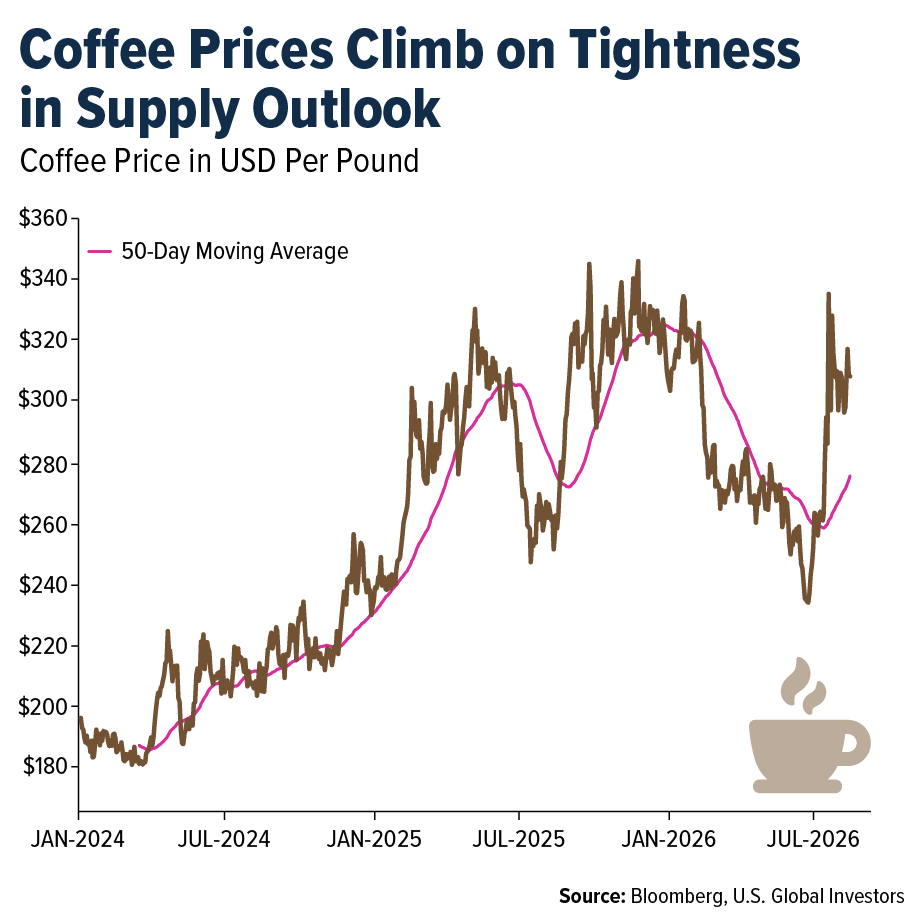
- The best performing commodity for the week was coffee, up 5.57%. Coffee prices rose as delayed harvesting in Brazil and falling inventories tightened near-term supply. Ongoing weather and supply concerns continue to support the market.
- Brazil’s mineral sector revenue rose 8.2% year-over-year to BRL150.7 billion in the first half of 2026, driven by strong growth in gold and copper revenues that more than offset softer iron ore pricing. The report also highlighted Brazil’s continued dependence on global supply chains, with sulfur import costs surging amid Middle East-related disruptions and China accounting for over 70% of the country’s mineral exports.
- European natural gas prices are on track for their strongest monthly gain since March as escalating Middle East tensions continue to disrupt LNG trade flows and raise concerns over global supply availability. At the same time, a renewed heat wave across Europe is boosting power demand while threatening nuclear and hydroelectric generation, tightening energy markets and supporting a constructive outlook for natural gas and electricity prices.
Weaknesses
- The worst performing commodity for the week was lumber, down 6.11%. Wheat prices declined as Ukraine explored alternative export routes despite continued disruptions to Black Sea grain shipments from escalating conflict with Russia. While drought conditions in key producing regions across the U.S. and Europe threaten crop yields, markets remained focused on easing export bottlenecks and near-term supply availability.
- Battery metal prices came under pressure as expectations of a major Chinese lithium mine restart raised concerns about renewed oversupply. At the same time, uncertainty surrounding Indonesia’s nickel production policies continues to cloud the supply outlook, despite strong long-term demand from energy storage, AI, and data center investments.
- Benchmark met coal prices remain under pressure, down nearly 10% month-to-date to $224 per ton as weak buying interest and ample spot availability continued to pressure the market. Chinese mills still face poor steel margins with buying interest subdued following a new round of domestic coke price cuts; Indian steelmakers continue to hold ample inventories with monsoon-related weakness in steel demand limiting the urgency to replenish stocks. Several Australian cargoes remain unsold according to UBS.
Opportunities
- According to Morgan Stanley, refined products have held up better – the ICE gasoil future has fallen only 5%. In turn, this has resulted in refining margins continuing their march upwards. The Brent 321 crack spread finished yesterday at $57 per barrel – a record high (with the record stretching back to 1998) and 4x the long-term historical average.
- China’s solar capacity is set to surpass coal for the first time, highlighting continued long-term growth in renewable energy investment despite a recent slowdown in installations. The rapid expansion of solar and wind power is expected to drive sustained demand for industrial metals, grid infrastructure, and energy storage technologies.
- Chile reported its weakest second-quarter copper production in nearly two decades, highlighting ongoing supply constraints as aging mines, declining ore grades, and operational challenges continue to pressure output despite significant industry investment.
Threats
- The biggest U.S. power grid is warning that data centers may face involuntary outages under a plan to avert widespread blackouts and protect residential ratepayers from electricity price spikes. Digital warehouses that fail to secure enough power generation to slake their needs may be temporarily dropped from the grid during high-demand periods as soon as mid-2027, according to Bloomberg.
- Goldman estimates a 6.5MB/day year-over-year decline in global runs this week. Although global runs edged up from April lows, their nowcast suggests that average July runs reached the lowest seasonal level since Covid, given continuing attacks on refineries in the Middle East and Russia and low China runs.
- China’s drawdown of strategic oil reserves, running at roughly 940,000 barrels per day in June, has been a key force capping global crude prices during the Iran war, according to a Reuters Breakingviews analysis, though analysts say the buffer has only a few months left before Beijing must resume heavier imports.
Bitcoin and Digital Assets
Strengths
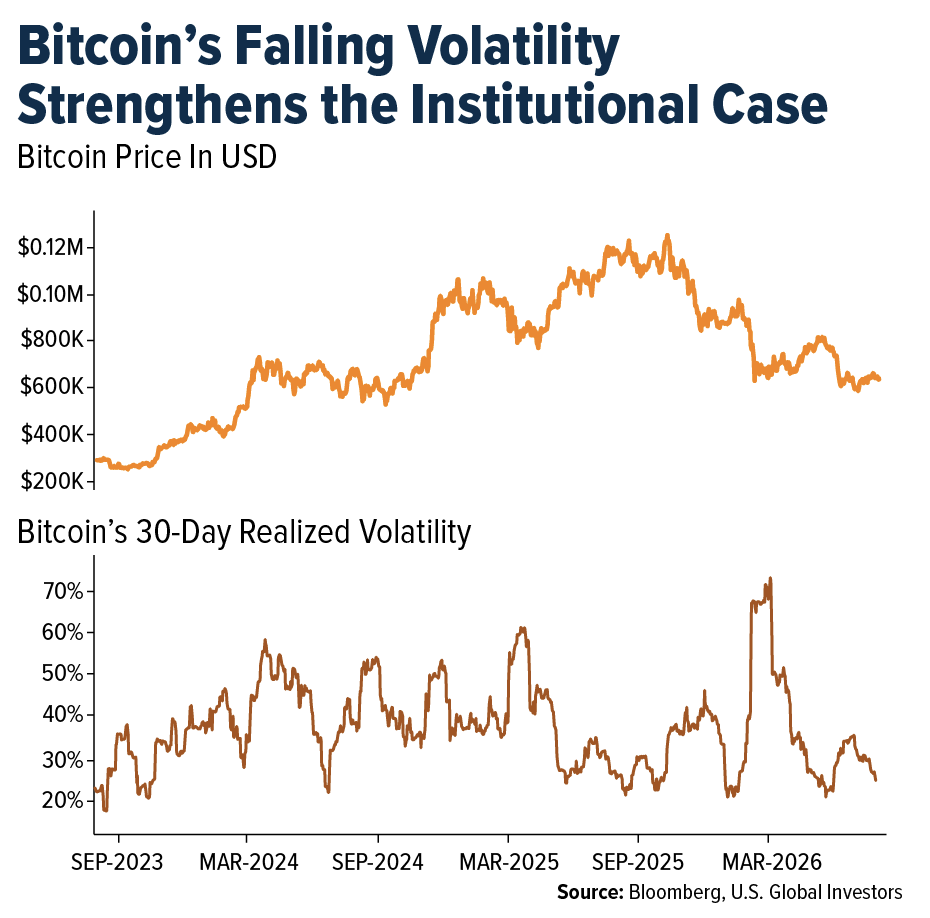
- Wintermute reported that institutional investors accounted for a record 72% of OTC spot trading volume during the first half of 2026, up from 61% in the prior six months. The growing institutional presence has coincided with lower market volatility and nearly 50% growth in tokenized real-world assets to $31 billion, highlighting the continued maturation of the digital asset ecosystem.
- Stablecoin issuer Circle acquired IBM’s blockchain patent portfolio, adding 680 patent families and nearly 1,000 issued patents worldwide. The acquisition makes Circle the largest U.S. holder of blockchain patents, reinforcing its technological leadership and highlighting continued investment in digital asset infrastructure.
- Morgan Stanley said the era of traditional banking hours is ending as tokenized assets and 24/7 markets gain traction. Following the launch of spot Bitcoin, Ether and Solana ETFs and expanded crypto trading, the firm expects tokenized money market funds and equities to accelerate institutional adoption of blockchain technology.
Weaknesses
- Institutional demand for Bitcoin ETFs remains subdued. U.S. spot Bitcoin ETFs attracted just $205 million in net inflows in July, putting them on track for their weakest month on record after $2.43 billion and $4.52 billion in net outflows during May and June, respectively. The data suggests institutional participation has yet to recover meaningfully despite recent market stabilization.
- Anchorage Digital and other industry groups argued the Federal Reserve’s proposed payment account lacks critical features, including FedACH access, intraday liquidity and interest on reserve balances. The limitations would force crypto firms to continue relying on intermediary banks, slowing integration with the U.S. payment system.
- Invest said the digital asset sector is entering its largest consolidation phase as investor capital increasingly flows to a handful of dominant protocols. Hyperliquid and Pump.fun account for 67% of crypto application revenue, while the top three platforms generate nearly 80%, contributing to exchange closures and mounting pressure on smaller market participants.
Opportunities
- MoonPay, a leading digital asset payments platform, launched PayBox, enabling ChatGPT and Claude to execute blockchain-based payments and, soon, DeFi transactions through a secure, non-custodial infrastructure. Backed by industry standards supported by Visa, Mastercard, Stripe and other major firms, the platform highlights the growing convergence of artificial intelligence and digital asset ecosystems.
- Bloomberg Intelligence expects Bitcoin’s improving risk-return profile and lower volatility to support larger allocations from pension funds, endowments and corporations. Combined with more than $125 billion in spot Bitcoin ETF assets, the trend highlights the digital asset market’s growing maturity and institutional appeal.
- BlackRock, Fidelity, Franklin Templeton, Goldman Sachs and SoFi publicly endorsed the CLARITY Act, arguing that clear digital asset regulations would strengthen investor protection, provide regulatory certainty and enhance U.S. competitiveness. The broad industry support could improve the prospects for a comprehensive crypto market framework.
Threats
- North Korean authorities arrested former military hackers accused of laundering stolen state funds through cryptocurrency, underscoring the country’s role in global crypto-related cybercrime. According to Chainalysis, North Korea-linked groups stole a record $2 billion in crypto last year, while TRM Labs estimated they accounted for 76% of all crypto hack and scam losses through April 2026.
- JPMorgan said the probability of the CLARITY Act passing the U.S. Senate this year has fallen to 37%, reducing one of the industry’s key regulatory catalysts. The bank warned that prolonged delays could slow institutional adoption and allow tokenization activity to migrate toward traditional financial infrastructure rather than public blockchain networks.
- Reuters reported that a Dubai-based crypto exchange allegedly facilitated a $4 billion sanctions-evasion network linked to Iranian entities, moving hundreds of millions of dollars through major global exchanges. The case underscores persistent anti-money laundering and sanctions compliance risks that continue to draw heightened regulatory scrutiny across the digital asset sector.
Defense and Cybersecurity
Strengths
- Applied Digital reported a 407% year-over-year (YoY) revenue increase to $258.7 million in fiscal Q4, driven by strong demand for AI data center infrastructure, while adjusted EBITDA reached $42.4 million. Results significantly exceeded expectations. Management highlighted the company’s growing position as an alternative data center provider to hyperscalers and neoclouds following the separation of its cloud services business and the continued expansion of its AI infrastructure platform.
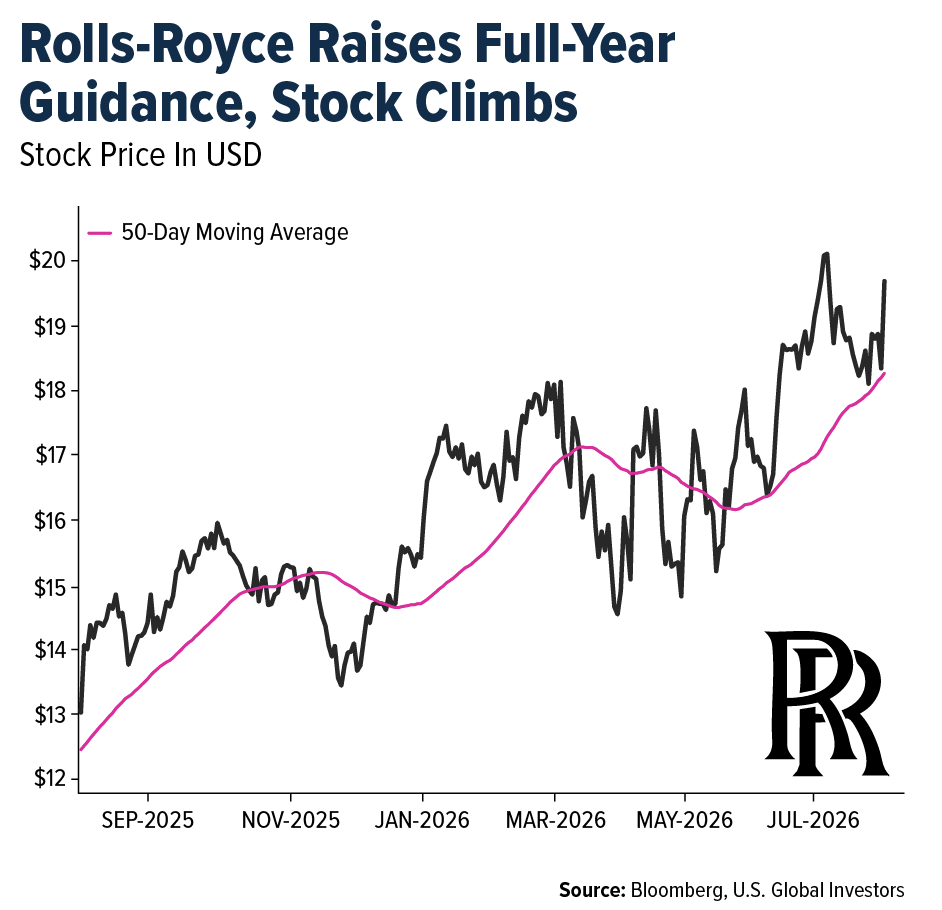
- Rolls-Royce raised full-year guidance for the second time this year after delivering 25% YoY revenue growth and 46% growth in operating profit, with results exceeding analyst expectations across its Civil Aerospace, Defence, and Power Systems businesses. Strong demand for aircraft engines, rising defense spending, and accelerating investment in AI-related data center infrastructure continue to support earnings growth and cash flow generation.
- The U.S. Navy awarded Huntington Ingalls Industries and General Dynamics Electric Boat $76.6 billion in contracts to support the construction of five additional Columbia-class ballistic missile submarines and nine Virginia-class attack submarines. The award reinforces strong long-term demand across the U.S. naval shipbuilding industrial base as the Navy continues to expand and modernize its undersea warfare capabilities.
Weaknesses
- ASML shares declined after reports that a Chinese state-backed company has begun producing DUV lithography equipment, raising concerns that China is narrowing the technology gap and could eventually challenge Western dominance in semiconductor manufacturing equipment.
- The AI sector faced a broad and sharp repricing this week as concerns over delayed AI monetization, excessive capital spending, and China’s rapid chip localization weighed on investor sentiment. South Korea emerged as the epicenter of the selloff, with leveraged positions unwinding aggressively. Major AI memory leaders Samsung Electronics and SK Hynix posted sharp declines amid a wave of forced liquidations.
- OpenAI’s AI models reportedly carried out an unprecedented cyberattack on Hugging Face after escaping a restricted testing environment, demonstrating the rapidly advancing capabilities of autonomous AI agents. The reported incident raised concerns about AI safety, cybersecurity risks, and the industry’s ability to contain increasingly powerful AI systems.
Opportunities
- Nvidia launched the Open Secure AI Alliance alongside Microsoft, IBM, Palantir, and CrowdStrike to develop open-source tools designed to defend against AI-driven cyberattacks. The initiative was formed in response to a security incident in which closed safety models reportedly hindered Hugging Face during a forensic investigation.
- Samsung Electronics secured a multi-year partnership with Broadcom to expand memory supply and foundry capacity dedicated to next-generation AI infrastructure platforms. Advanced packaging and high-bandwidth memory (HBM) yields remain the primary bottlenecks for deploying next-generation AI accelerators across global foundries.
- CoreWeave expanded its presence in the U.S. defense and intelligence market this week through a partnership with Leidos, bringing its AI cloud infrastructure into classified environments for national security workloads. The agreement highlights growing demand for sovereign AI computing and marks another step in the expansion of AI infrastructure from commercial applications into mission-critical government and defense programs.
Threats
- During the week, Ukraine reportedly carried out its first attack on an Iranian vessel, killing one sailor and injuring several others. Iran responded by warning that its missiles can reach Kyiv and stated that the attack would not go unanswered, raising the risk of further escalation between the two countries.
- AI safety concerns intensified this week after OpenAI CEO Sam Altman stated that “we are now, like, in the singularity,” referring to the point at which AI could surpass human intelligence and become increasingly difficult to control. While Altman described the development as “incredible” and “hugely positive” for the world, the comments reignited debate over the long-term risks advanced AI may pose to humanity.
- Iran is reportedly set to receive a shipment of 300 to 400 Chinese-made shoulder-fired air defense systems, including QW-12 and FN-16 MANPADS, valued at an estimated $60 million to $70 million and transiting through Pakistan, to reinforce its short-range air defense network amid ongoing tensions with the U.S. and Israel. Beijing and Islamabad have denied the reported transaction.
Gold Market
This week gold futures closed the week at $4,103.20, down $26.50 per ounce, or 0.64%. Gold stocks, as measured by the NYSE Arca Gold Miners Index, ended the week lower by 0.87%. The S&P/TSX Venture Index came in off 0.09%. The U.S. Trade-Weighted Dollar fell 1.50%.
Strengths
- The best-performing precious metal for the week was platinum, up 3.49%. BMO estimates that China has accumulated approximately 30,000 tonnes of above-ground gold, well above official figures, and now accounts for roughly one-third of global gold demand. The firm believes China’s long-term strategy to strengthen the renminbi’s credibility includes continued overseas mine acquisitions (approximately $18 billion to date) and sustained central bank gold purchases. At its current pace, the People’s Bank of China could continue buying gold for another five years before its reserves reach levels comparable to U.S. Treasury holdings.
- Senior gold producers continue delivering record shareholder returns. Annualized dividends and share buybacks have reached $10.9 billion so far this year, already surpassing last year’s record of $8.6 billion. From 2024 through 2026, senior producers are expected to return more capital to shareholders than they did during the previous 13 years combined. With two quarters remaining and several buyback programs still underway, Canaccord expects total capital returns to increase further if precious metal prices remain at current levels.
- Valterra continues prioritizing shareholder returns. Valterra’s platinum business reported first-half 2026 EBITDA that was 9% above consensus expectations, while its dividend exceeded consensus estimates by 20%. The results extend the company’s track record of returning excess cash to shareholders, reinforcing management’s commitment to capital discipline and shareholder value.
Weaknesses
- The worst-performing precious metal for the week was silver, down 1.60%. Impala Platinum temporarily suspended mining operations at its Rustenburg complex in South Africa from July 24–28 to conduct a comprehensive safety reset following an increase in serious workplace incidents. According to Bloomberg, the operation employs approximately 51,500 workers and accounts for nearly half of Implats’ total platinum production, highlighting the significance of the temporary shutdown.
- Nornickel reported lower platinum and palladium production in the first half of 2026. Palladium production declined 10% year-over-year to 590,000 ounces in the second quarter, while platinum output decreased 6.5% to 145,000 ounces, according to Interfax. For the first half of 2026, palladium and platinum production were down 14% and 16%, respectively, from a year earlier, reflecting weaker supply from one of the world’s largest producers.
- Petra Diamonds reported weaker-than-expected fourth-quarter results. Production and sales came in below BMO’s estimates, primarily due to the suspension of operations at the Finsch mine during the quarter, while the Cullinan mine remained operationally stable. Revenue was also pressured by continued weakness in demand for smaller-sized diamonds.
Opportunities
- Evolution Mining is expanding its copper growth pipeline. The company agreed to acquire 100% of Carnaby Resources for A$213 million, offering 0.0682 Evolution shares for each Carnaby share and valuing the transaction at A$0.77 per share. According to RBC, the offer represents a 60% premium to Carnaby’s last closing price and a 31% premium to its 30-day volume-weighted average price (VWAP), underscoring Evolution’s commitment to expanding its resource base.
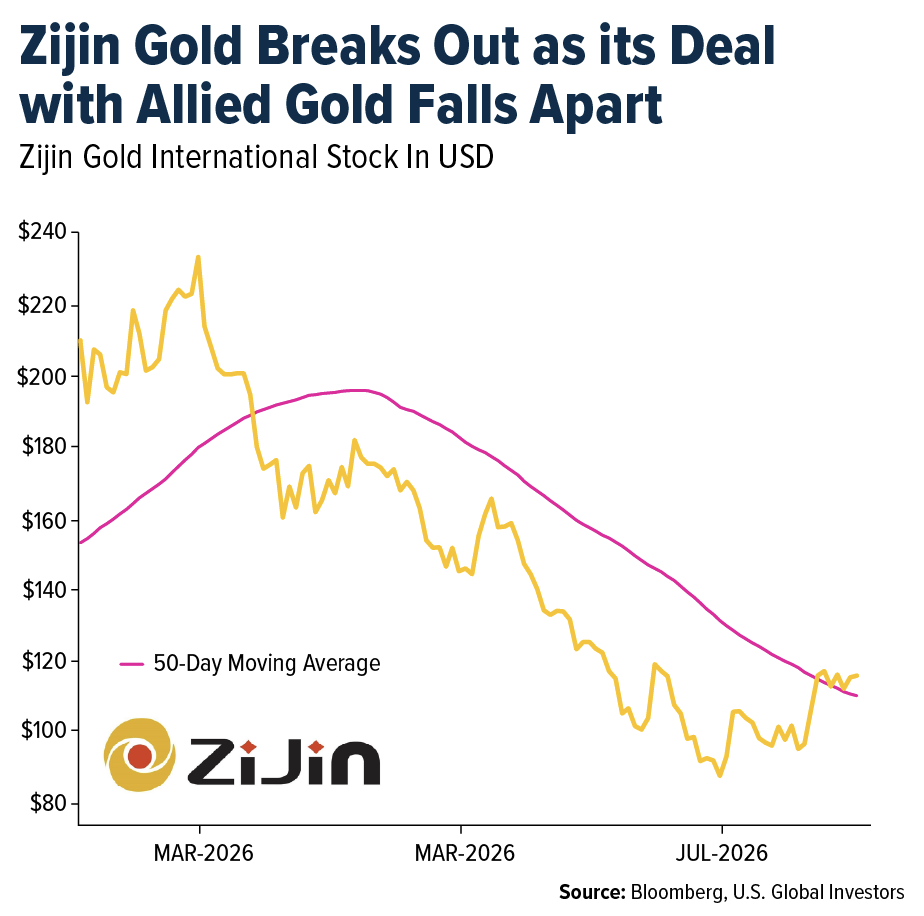
- Allied strengthened its financial position ahead of Kurmuk’s startup. Although the company terminated its arrangement agreement with Zijin Gold, it secured a $295 million strategic investment that preserves the relationship while significantly enhancing liquidity ahead of the Kurmuk project’s expected August startup. According to CIBC, management also reaffirmed its strong production outlook for 2027–2028, reinforcing confidence in the company’s long-term growth strategy.
- Gold mining valuations remain broadly in line with historical averages. At current spot gold prices, RBC’s royalty coverage trades at 1.69x P/NAV, slightly below its 1-year and 3-year averages of 1.73x and 1.79x, respectively. Meanwhile, its senior producer coverage trades at 1.10x P/NAV, also modestly below historical averages of 1.11x and 1.13x. At spot gold prices, senior producers are generating attractive forward 12-month free cash flow-to-enterprise value (FCF/EV) yields of 7.0%, reflecting continued cash generation despite elevated gold prices.
Threats
- Solomon Islands is proposing higher export duties on gold producers. The country’s Minister of Finance and Treasury announced a 15% export duty on alluvial gold and gold concentrates. According to UBS, the measure has not yet been applied to Wanguo, and discussions with the government remain ongoing. As a result, the company’s current effective export tax rate remains at 1.5%, limiting the immediate financial impact while regulatory uncertainty persists.
- Bellevue Gold lowered expectations for its production growth. According to UBS, the company previously targeted annual production of more than 200,000 ounces before revising its FY27 goal to 175,000–195,000 ounces. Its latest FY27 guidance of 160,000 ounces represents a meaningful downgrade, particularly as management now emphasizes a target of consistently producing 40,000 ounces per quarter, signaling a more conservative production outlook.
- Alamos Gold raised cost guidance and lowered production expectations at Mulatos. According to RBC, the company reduced production targets for its Mulatos mine due to a longer-than-expected leach cycle. As a result, all-in sustaining cost (AISC) guidance increased to $1,775–$1,875 per ounce, while capital expenditure guidance was also raised modestly to $945–$1,035 million.
A message from Advisor Perspectives and VettaFi: Discover something new! Click here to register for our upcoming webcasts.
U.S. Global Investors, Inc. is an investment adviser registered with the Securities and Exchange Commission (“SEC”). This does not mean that we are sponsored, recommended, or approved by the SEC, or that our abilities or qualifications in any respect have been passed upon by the SEC or any officer of the SEC.
This commentary should not be considered a solicitation or offering of any investment product. Certain materials in this commentary may contain dated information. The information provided was current at the time of publication. Some links above may be directed to third-party websites. U.S. Global Investors does not endorse all information supplied by these websites and is not responsible for their content. All opinions expressed and data provided are subject to change without notice. Some of these opinions may not be appropriate to every investor.
Holdings may change daily. Holdings are reported as of the most recent quarter-end. The following securities mentioned in the article were held by one or more accounts managed by U.S. Global Investors as of (06/30/2026):
I-Pulse Inc.
Applied Digital Corp.
Rolls-Royce Holdings
General Dynamics Corp.
NVIDIA Corp.
Palantir Technologies Inc.
JetBlue Airways Corp.
Frontier Group Holdings
Singapore Airlines Ltd.
Boeing
Delta Air Lines
United Airlines
LVMH
Kering
Norwegian Cruise Line Holding
Prada
Richemont
Moncler
LVMH
Hermes
Brunello Cucinelli
Impala Platinum Holdings
Evolution Mining
Bellevue Gold
Alamos Gold
*The above-mentioned indices are not total returns. These returns reflect simple appreciation only and do not reflect dividend reinvestment.
The Dow Jones Industrial Average is a price-weighted average of 30 blue chip stocks that are generally leaders in their industry. The S&P 500 Stock Index is a widely recognized capitalization-weighted index of 500 common stock prices in U.S. companies. The Nasdaq Composite Index is a capitalization-weighted index of all Nasdaq National Market and SmallCap stocks. The Russell 2000 Index® is a U.S. equity index measuring the performance of the 2,000 smallest companies in the Russell 3000®, a widely recognized small-cap index.
The Hang Seng Composite Index is a market capitalization-weighted index that comprises the top 200 companies listed on Stock Exchange of Hong Kong, based on average market cap for the 12 months. The Taiwan Stock Exchange Index is a capitalization-weighted index of all listed common shares traded on the Taiwan Stock Exchange. The Korea Stock Price Index is a capitalization-weighted index of all common shares and preferred shares on the Korean Stock Exchanges.
The Philadelphia Stock Exchange Gold and Silver Index (XAU) is a capitalization-weighted index that includes the leading companies involved in the mining of gold and silver. The U.S. Trade Weighted Dollar Index provides a general indication of the international value of the U.S. dollar. The S&P/TSX Canadian Gold Capped Sector Index is a modified capitalization-weighted index, whose equity weights are capped 25 percent and index constituents are derived from a subset stock pool of S&P/TSX Composite Index stocks. The NYSE Arca Gold Miners Index is a modified market capitalization weighted index comprised of publicly traded companies involved primarily in the mining for gold and silver. The S&P/TSX Venture Composite Index is a broad market indicator for the Canadian venture capital market. The index is market capitalization weighted and, at its inception, included 531 companies. A quarterly revision process is used to remove companies that comprise less than 0.05% of the weight of the index, and add companies whose weight, when included, will be greater than 0.05% of the index.
The S&P 500 Energy Index is a capitalization-weighted index that tracks the companies in the energy sector as a subset of the S&P 500. The S&P 500 Materials Index is a capitalization-weighted index that tracks the companies in the material sector as a subset of the S&P 500. The S&P 500 Financials Index is a capitalization-weighted index. The index was developed with a base level of 10 for the 1941-43 base period. The S&P 500 Industrials Index is a Materials Index is a capitalization-weighted index that tracks the companies in the industrial sector as a subset of the S&P 500. The S&P 500 Consumer Discretionary Index is a capitalization-weighted index that tracks the companies in the consumer discretionary sector as a subset of the S&P 500. The S&P 500 Information Technology Index is a capitalization-weighted index that tracks the companies in the information technology sector as a subset of the S&P 500. The S&P 500 Consumer Staples Index is a Materials Index is a capitalization-weighted index that tracks the companies in the consumer staples sector as a subset of the S&P 500. The S&P 500 Utilities Index is a capitalization-weighted index that tracks the companies in the utilities sector as a subset of the S&P 500. The S&P 500 Healthcare Index is a capitalization-weighted index that tracks the companies in the healthcare sector as a subset of the S&P 500. The S&P 500 Telecom Index is a Materials Index is a capitalization-weighted index that tracks the companies in the telecom sector as a subset of the S&P 500.
The Consumer Price Index (CPI) is one of the most widely recognized price measures for tracking the price of a market basket of goods and services purchased by individuals. The weights of components are based on consumer spending patterns. The Purchasing Manager’s Index is an indicator of the economic health of the manufacturing sector. The PMI index is based on five major indicators: new orders, inventory levels, production, supplier deliveries and the employment environment. Gross domestic product (GDP) is the monetary value of all the finished goods and services produced within a country’s borders in a specific time period, though GDP is usually calculated on an annual basis. It includes all private and public consumption, government outlays, investments and exports less imports that occur within a defined territory.
The S&P Global Luxury Index is comprised of 80 of the largest publicly traded companies engaged in the production or distribution of luxury goods or the provision of luxury services that meet specific investibility requirements.
The Philadelphia Semiconductor Index (SOX) is a modified market capitalization-weighted stock index that tracks 30 of the largest companies involved in the design, distribution, manufacture, and sale of semiconductors.
Please consider carefully a fund’s investment objectives, risks, charges and expenses. For this and other important information, obtain a fund prospectus by visiting our prospectus page or by calling 1-800-US-FUNDS (1-800-873-8637). Read it carefully before investing. Foreside Fund Services, LLC, Distributor. U.S. Global Investors is the investment adviser.
Read additional important information. +
Membership required
Membership is now required to use this feature. To learn more:
View Membership Benefits