The Incredible Shrinking Market: Three Decades of De-Equitization—And the First Signs of a Turn
Membership required
Membership is now required to use this feature. To learn more:
View Membership Benefits
There are 38% fewer companies listed on U.S. exchanges today than at the peak in the mid-1990s. The forces behind that decline—regulatory burden, the abundance of private capital, and the quiet disappearance of mid-sized public companies—are structural, not cyclical. But 2026 may represent the first meaningful inflection point in a generation for public capital markets. SpaceX’s historic IPO on June 12, the confidential S-1 filings of Anthropic and OpenAI, and a $4.3 trillion backlog of private market value all point in the same direction. For investors, families, and institutions that have spent decades navigating an increasingly concentrated public market, the implications could be profound. Whether this becomes a true re-equitization of the American market, or simply a brief opening of a window that quickly closes again, may prove to be the defining capital markets question of the next three years.
How We Got Here
In 1996, the United States had 8,823 companies listed across its major exchanges. Today, that number stands at 5,492. This marks a decline of nearly 3,400 companies, or 38%, over three decades during which the American economy grew dramatically and the country produced many influential businesses. The paradox is that many of those businesses never reached public investors at all. They were born, scaled, and in many cases acquired without ever offering investors a seat at the table. For affluent families and long-term investors, that shift has fundamentally altered where wealth creation occurs and who has access to it.
See more: Quarterly Review and Outlook Second Quarter 2026
The peak came at the height of the dot-com era, when cheap capital, retail investor enthusiasm, and a permissive regulatory environment made going public the natural endpoint of any ambitious company’s journey. What followed was not a cyclical slowdown, but a long, structural reversal.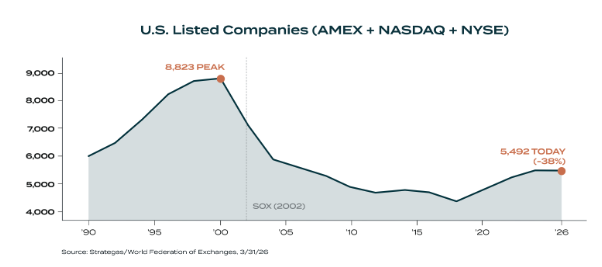
Four Forces That Hollowed Out The Public Market
Regulatory burden came first. The Sarbanes-Oxley Act of 2002, passed in the aftermath of Enron and WorldCom, imposed compliance costs that made public life genuinely expensive for smaller companies. The SEC’s quarterly reporting regime, proxy rules, and litigation exposure led mid-sized growth companies to increasingly favor staying private. What began as a governance response to corporate misconduct ultimately reshaped the economics of public ownership for an entire generation of emerging companies.
Private capital quickly filled the vacuum. Venture capital, growth equity, and ultimately private credit expanded dramatically to meet the financing needs of companies that no longer needed public markets. By 2025, global private markets—an industry that barely existed at institutional scale when the listing count peaked—managed an estimated $13 trillion in assets. Companies that in an earlier era would have raised their Series C on Nasdaq were now raising $1 billion rounds from sovereign wealth funds and staying private indefinitely.
Big tech consumed the pipeline. A generation of companies that might have listed independently were instead acquired by Google, Amazon, Apple, Meta, and Microsoft. The FTC permitted many of these transactions, and the result was a steady compression of the potential public company universe. Instagram, WhatsApp, YouTube, and dozens of others never traded publicly. The index grew more concentrated even as the company count fell. Public investors benefited from the acquirers’ growth but often lost direct access to the acquired businesses’ growth trajectories.
Short-termism made public life unappealing. The quarterly earnings treadmill, activist investor pressure, and the rise of algorithmic trading shortened corporate time horizons, making public markets actively hostile to companies building for the long term. For founders running capital-intensive, long-duration businesses, precisely the kind likely to generate transformational returns, the calculus increasingly favored private ownership. The result was a market structure that increasingly rewarded near-term performance over long-term value creation.
The Private Market That Grew to Fill the Gap
From Niche To $13 Trillion
The story of de-equitization cannot be told without understanding what replaced it. Private markets did not merely grow—they transformed. What was once a niche corner of institutional finance available only to endowments, foundations, and the largest pension funds has become a mainstream asset class, reaching into defined contribution plans, insurance portfolios, and, the accounts of individual investors. In effect, capital migrated away from public markets even as investor demand for growth and diversification remained unchanged.
Global private credit alone reached $3.5 trillion in assets under management by the end of 2025, up from roughly $1 trillion a decade earlier. Moody’s projects that the figure will grow toward $5 trillion by 2030. Private equity deal value grew 61% in 2025 versus the prior year. Retail capital flowing into alternative investment structures reached $204 billion in the U.S. in 2025 alone, more than double the 2023 level. The five largest listed private markets managers—Apollo, Ares, Blackstone, Carlyle, and KKR—now collectively manage approximately $1.5 trillion in perpetual capital, roughly 40% of their combined assets under management. What was once considered an alternative allocation has increasingly become a core component of the modern capital markets ecosystem.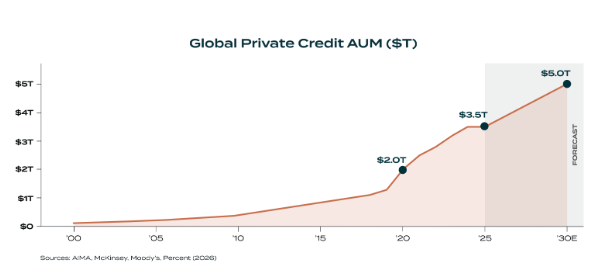
The Cost Of This Arrangement
The growth of private markets has not been without consequence for ordinary investors. When transformational companies like SpaceX, Anthropic, and Stripe remain private through their highest-growth years, the returns from that growth accrue exclusively to institutional and accredited investors. Public equity indexes—the primary savings vehicle for many Americans—have grown more concentrated in a smaller number of aging large-cap companies, even as dynamic growth has happened elsewhere. The result is a widening gap between where innovation occurs and where many investors can participate.
Jason Trennert of Strategas has described this dynamic as the “de-equitization” of U.S. markets, and the data supports his claim. In 2025 alone, more than 1,000 new ETFs were launched, but the universe of underlying stocks those ETFs could hold barely grew. More investment products chasing the same shrinking pool of securities has become one reason U.S. equity valuations have remained elevated even as economic conditions have grown more uncertain. It also means that a growing share of the market’s gains have been structural driven by the mechanics of capital flows into a fixed supply of equities—rather than fundamental.
For investors, particularly those managing substantial, multigenerational wealth, this raises an important strategic question: Are traditional public markets still providing the same breadth of opportunity they once did, or has the investment landscape fundamentally changed?
Meanwhile, limited partners in private funds have faced their own frustrations. With distributions running at just 6% of PE assets under management versus a historical average of 16%, the $4.3 trillion in private company value estimated to be waiting for an exit has created a kind of liquidity pressure cooker—enormous paper wealth that cannot easily be converted into cash, returned to investors, or made accessible to the public.
The Inflection Point—Or Is It?
SPACEX opens the window
On June 12, 2026, SpaceX began trading on the Nasdaq under the ticker SPCX, priced at $135 per share and raising $75 billion—the largest initial public offering in history. The stock opened at $150, rose as high as $176, and closed its first day at $161, a gain of 19.2% that lifted SpaceX’s market capitalization above $2 trillion and made it the sixth-largest publicly traded company in the United States. By any measure, the offering was a success.
The significance of SpaceX’s debut is not simply that it was large. It is that it passed what might be called the first real test of whether the public market can properly value a generation of companies that have spent years developing entirely outside it. SpaceX arrived as a business generating $18.7 billion in annual revenue, growing at 33% year-over-year, $6.6 billion in adjusted EBITDA, and a $41.3 billion accumulated deficit. It is simultaneously a profitable satellite internet company, a commercial launch monopoly, and an AI infrastructure business with ambitions extending to Mars. The public market priced it accordingly, suggesting investors were prepared to underwrite a business of this complexity and scale.
For investors, the more important takeaway may be what the offering revealed about the evolving relationship between public and private markets. As more transformational companies remain private for longer, their eventual public debut becomes not just a liquidity event but a test of whether public markets can still efficiently absorb and value businesses that have matured almost entirely outside the traditional public capital formation process.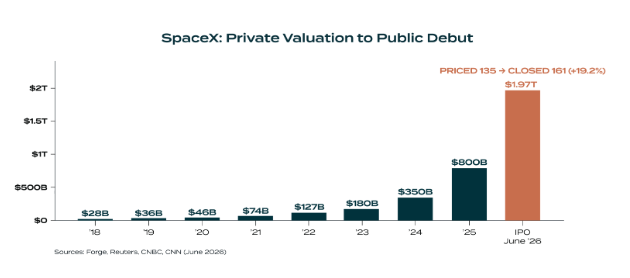
The Structural Pull Of Private Markets Endures
Why This May Not Be the Reversal It Appears
It would be a mistake to read SpaceX’s IPO as a signal that the forces behind de-equitization have been resolved. They have not. The economics of staying private remain compelling: private equity managers generate roughly four times the profit per dollar of assets under management as traditional asset managers. The August 2026 executive order opening America’s $12.5 trillion defined contribution market to alternative investments will accelerate the flow of retail capital into private funds, not out of them. The incentive structure that kept Databricks, Stripe, and hundreds of other companies private is not disappearing—it continues to strengthen.
There is also the question of what happens after the IPO. Figma’s experience is instructive: four staggered lockup expirations following its listing triggered meaningful price compression at each release. SpaceX’s 555.6 million shares sold represent a small fraction of total shares outstanding. As insiders and early institutional holders begin to sell in the months and quarters ahead, the pressure on SPCX’s stock price could be meaningful. A faltering SpaceX debut in the secondary market could cool enthusiasm for the queue behind it just as quickly as a strong first day fired it.
The Simultaneous Filing Problem
OpenAI and Anthropic are direct competitors. They are racing to the same institutional investor base within a 30-day window, and they will be publicly compared for the first time using actual disclosed financial data. That comparison may not prove favorable to either. OpenAI projects a net loss of approximately $14 billion in 2026 and does not expect to reach profitability until 2029 or 2030. Anthropic projects its first operating profit in Q2 2026 but has already raised $129 billion in cumulative funding. The greater question is not whether one of them successfully lists, but whether the public market, seeing both companies side by side for the first time, assigns valuations that meet private investors’ expectations. The outcome could influence how other late-stage private companies evaluate their own path to the public markets.
There is also a deeper structural issue. Roughly 60% of existing unicorns are still priced off 2021 and 2022 funding rounds and have not raised new capital since 2024. For those companies, a public listing would require accepting down-round valuations that many founders and early investors are economically, psychologically, and contractually resistant to. The $4.3 trillion in private market value that is theoretically available for re-equitization is not uniformly available—much of it is locked behind the gap between what private investors believe their holdings are worth and what public markets would actually pay. That disconnect may prove to be one of the defining constraints on re-equitization, reminding investors that reopening the IPO window is only one step; aligning private expectations with public market pricing is an entirely different challenge.
What To Watch
The test of whether this is a genuine inflection point or a temporary opening will be answered in the months that follow. Three developments warrant particularly close attention.
- First, how SpaceX trades after its lockup expiration: A sustained price above the IPO level would suggest that the public market is a viable long-term home for this generation of companies.
- Second, whether Anthropic or OpenAI’s debut pricing validates or compresses their private-market valuations: down-round IPO could send a chilling signal to every unicorn weighing its options.
- Third, whether the current IPO-friendly regulatory environment survives political and economic shifts that inevitably occur over a multi-year window.
Sequoia Sentinel Perspective
The U.S. public equity market has been quietly hollowing out for 30 years. The forces behind that hollowing—private capital abundance, regulatory burden, big-tech acquisition, and the short-termism of public markets—have not disappeared. What has changed is that the backlog of private-market value has grown large enough and LP pressure for liquidity has grown acute enough that a window has opened. SpaceX walked through it. Whether Anthropic, OpenAI, and the generation of companies behind them follow—and whether those listings prove durable—will determine whether 2026 is remembered as the beginning of a re-equitization or simply a brief interruption in a longer structural decline. Our view is that the truth lies somewhere between those poles: a partial, managed migration back toward public markets, compressed into the next two to three years by the weight of necessity rather than the pull of enthusiasm creating both opportunities and new considerations for long-term investors.
A message from Advisor Perspectives and VettaFi: Discover something new! Click here to register for our upcoming webcasts.
The views expressed represent the opinion of Sequoia Financial Group. The views are subject to change and are not intended as a forecast or guarantee of future results. This material is for informational purposes only. It does not constitute investment advice and is not intended as an endorsement of any specific investment. Stated information is derived from proprietary and nonproprietary sources that have not been independently verified for accuracy or completeness. While Sequoia believes the information to be accurate and reliable, we do not claim or have responsibility for its completeness, accuracy, or reliability. Statements of future expectations, estimates, projections, and other forward-looking statements are based on available information and Sequoia’s view as of the time of these statements. Accordingly, such statements are inherently speculative as they are based on assumptions that may involve known and unknown risks and uncertainties. Actual results, performance or events may differ materially from those expressed or implied in such statements. Investing in equity securities involves risks, including the potential loss of principal. While equities may offer the potential for greater long-term growth than most debt securities, they generally have higher volatility. Past performance is not an indication of future results. Investment advisory services offered through Sequoia Financial Advisors, LLC, an SEC Registered Investment Advisor. Registration as an investment advisor does not imply a certain level of skill or training.
This material is for informational purposes only and does not constitute investment advice or a recommendation to buy or sell any security. Information has been obtained from sources believed to be reliable; no representation is made as to accuracy or completeness. Past performance is not indicative of future results. This document does not constitute tax or legal advice. Investment advisory services offered through Sequoia Financial Advisors, LLC, an SEC Registered Investment Advisor. Registration does not imply a certain level of skill or training. ©2026 Sequoia Financial Group.
Membership required
Membership is now required to use this feature. To learn more:
View Membership Benefits