The Great Reimagination, Part 3: Investing in a Fractured Global Economy
Membership required
Membership is now required to use this feature. To learn more:
View Membership Benefits
In Part I of this series, I described what I call the Great Reimagination of the global order: a move from a rules-based world to a more power-based one, with long-standing alliances and trade patterns being rewritten in real time. In Part 2, I focused on markets: fifteen years of outsized U.S. equity returns powered by a small group of mega-caps, and why I think that pattern, along with the “the market always comes back” mindset, is coming to an end.
Now we turn to the global backdrop of the Great Reimagination: fractured globalization, the growing strain of government debt, and the dollar’s evolving role in the global financial system.
See more: A Shift In Stock Market Leadership
Key points:
- Globalization is splintering into regional and strategic blocs, and policy volatility is creating a “great hesitation” for businesses and investors.
- Rising debt and interest costs raise questions about the long-term path of the dollar and inflation.
- I’m responding with allocations to real assets and carefully chosen international exposures that reflect the new trade and currency landscape.
Fractured Globalization and the Great Hesitation
For many years, globalization felt like a one-way street. Supply chains stretched effortlessly across continents. Companies built “just-in-time” systems that assumed goods, data, and capital would flow smoothly around the world. Investors could buy a global index fund and feel reasonably confident that they were capturing the benefits of ever-closer integration.
That world is changing. The Great Reimagination involves not just the reordering of geopolitics and market leadership, but also the way the global real economy itself is wired.
One of the most visible changes is the return of tariffs and industrial policy. Trade disputes, once the domain of dense communiqués and specialized lawyers, now show up as front-page headlines and social-media fights. The United States has experimented with large, varying, and unpredictable tariffs on multiple trading partners, sometimes in ways that courts have later questioned. Other countries have responded with their own countermeasures. Rules around technology exports, sanctions, and investment are tightening.
Imagine you’re a business leader trying to decide whether to build a new factory or expand a supply chain. Each day, you wake up without knowing what tariffs or tax rates you’ll be dealing with, who will be making the decisions, or even which country you should be producing in. It is very hard to sign off on a ten‑year project in that environment. That is the “Great Hesitation” and almost by definition throws sand in the gears of global economic growth. Business leaders are effectively frozen while they wait to find out what the rules are going to be. Investors face a similar dilemma as they try to project revenues, earnings, and dividends into the future on a spreadsheet.
Debt, the Dollar, and Real Assets
At the same time, the fiscal picture has become more strained. The U.S. government now carries a debt load measured in the tens of trillions of dollars, and as interest rates have risen from their near-zero levels, the cost of servicing that debt has climbed sharply. We now run deficits of around two trillion dollars a year (in a non-recession economy!) and spend roughly a trillion dollars a year just to service the federal debt1, more than we spend on national defense and on the same order as health care (Medicare plus all the other programs). I walk past the U.S. debt clock near our office in New York, and whenever I go by I take a picture. I have years of those photos saved. It keeps ticking higher, and it is always a little alarming; you start to wonder how long it will be before they have to make the board bigger.
That doesn’t mean a default is imminent. It does mean the system is carrying more weight and we have less room for error. Any significant rise in rates, or any loss of foreign appetite for our bonds, makes the math harder.
This leads naturally to questions about the dollar. For decades, the dollar has been the world’s reserve currency. Oil is priced in dollars, global trade is largely invoiced in dollars, and central banks hold huge reserves of U.S. Treasuries. That status gives the United States tremendous advantages, which the former French president Valéry Giscard d’Estaing famously called “exorbitant privilege”: we can borrow more cheaply, we can impose financial sanctions more effectively, and we can run larger deficits for longer. Recent events have not dethroned the dollar – the dollar is in fact up over the last 10 and 20 years2 – but they have raised eyebrows. Some energy exporters openly discuss pricing in other currencies. Some large holders of U.S. debt remind Washington that they have options. At the margin, more countries are exploring alternatives, even if the dollar remains dominant for now.
If you add in the physical side of globalization – ports, pipelines, rare‑earth mines, and the cables that carry data across oceans – you start to see how much stress the system is under. New trade corridors are emerging as companies diversify away from single-country dependence. Mexico (population 133 million) has overtaken China (population 1.4 billion) as America’s largest trading partner3. Vietnam, India, and others are winning new manufacturing investment. Countries rich in key resources such as lithium, copper, and rare earths have found themselves at the center of strategic competition. All of this changes the map of where economic value is created and captured.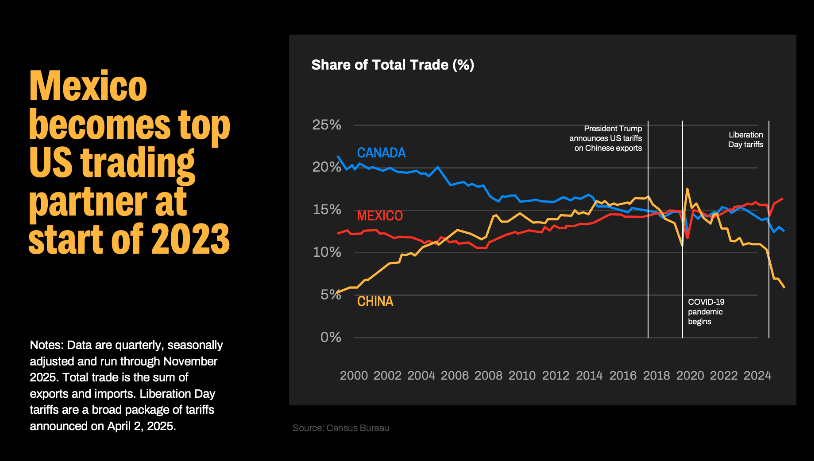
So how could an investor position himself or herself for these changes? First, the Great Reimagination strengthens the case for real assets. In a world where governments carry heavy debts, where central banks may at times err on the side of financial stability over low inflation, and where supply shocks are more frequent, owning claims on physical things becomes more valuable. That is one reason why investors might consider the role of commodities and gold within a diversified portfolio. Gold, in particular, tends to do well in periods when investors worry about currencies and real interest rates, and we’ve seen that tendency recently as gold prices have risen sharply after a long stretch when gold was a thankless holding. Commodities more broadly—especially energy—have also been important diversifiers and sources of return.
We’re not recommending owning commodities simply as a bet on chaos. We favor them because they play a specific role in portfolios: they can provide ballast when inflation surprises to the upside, when the dollar weakens, or when geopolitical events disrupt supply. Because most commodities are priced in U.S. dollars, a weaker dollar effectively puts them on sale for the rest of the world, which tends to support demand and prices at exactly the times when portfolios need that diversification. The years when those risks don’t materialize can feel frustrating, but as we saw when gold and commodities rallied strongly after long quiet periods, the payoff can come in lumpy bursts. They can feel like thankless holdings for years, and then, in a short period, you get what feels like a decade’s worth of return all at once.
Second, we approach international investing with a new lens. Rather than treating “international” as a monolith, or simply an alternative to investing in the United States, we ask: which countries are positioned to benefit from the rewiring of globalization, and which are more exposed? Mexico is a good example of the former. As U.S. companies look to bring production closer to home and reduce their reliance on single suppliers, Mexico’s proximity, labor force, and trade agreements may position it to benefit from these trends. It has already overtaken China as America’s largest trading partner3, which is a simple way to see how those shifts are showing up in the real world.
A similar opportunity has emerged in Canada, which combines political stability with important roles in energy, aerospace, and increasingly space-related industries. In Brazil, the combination of natural resources and a large domestic market creates interesting possibilities, and it is also a major exporter of key commodities like soybeans, which matter far beyond what we see on the dinner table. In addition, Brazil is geographically out of the path of most potential superpower conflicts, and as such has remained nonaligned. Investing in Brazil has become more important as food and fertilizer markets have come under strain. Provided we are careful about company‑specific and governance risks, the mix of countries described above can be a useful part of a diversified international allocation.
In Asia, alternative supply chains are emerging. Vietnam has already become a significant manufacturing hub. India is investing heavily in infrastructure and courting foreign capital as it seeks to move up the value chain. Even in regions often seen as risky, such as parts of the Middle East or Africa, there are specific companies and projects that stand to benefit from investment in energy, logistics, and telecommunications.
Third, currency exposure is an important and often overlooked aspect of investing. I am not predicting the end of the dollar’s dominance. But I also don’t build portfolios on the assumption that the dollar can strengthen forever, or that U.S. assets will always be the only safe harbor, or a safer harbor than other advanced countries. Owning non-U.S. equities and, where appropriate, non-U.S. bonds provides natural diversification across currencies. That way, if the dollar weakens over time—because of debt dynamics, policy choices, or a more multipolar currency system—our clients are not entirely exposed to that single outcome.
Resilient Businesses in a Reimagined World
Finally, investors should favor companies that can adapt to this fractured landscape. Desirable businesses tend to have flexible supply chains, multiple sourcing options, and the ability to shift production or logistics if rules or tariffs change. They serve essential needs—energy, food, healthcare, logistics, national security, communications—where demand is less discretionary. These companies are investing steadily in technology and efficiency so they can absorb cost shocks better than competitors. A manufacturer that can move some production from one country to another without blowing up its margins, or a logistics company that can reroute efficiently when a port closes, is worth more in this environment than a static, fragile competitor.
Taken together, these three pieces—the shift to a more power‑based global order, the end of magical (endlessly bullish) thinking in markets, and the fracturing of globalization and currency assumptions—are what I mean by the Great Reimagination. We do not control these forces. What investors can control is how they respond: by diversifying more thoughtfully, by respecting risk rather than denying it, and by seeking out resilient businesses and real assets that can thrive across a wide range of futures.
Our goal at Quent is to help our investors navigate this reimagined world not with fear, but with a disciplined, long‑term plan. Every day, entrepreneurs around the world wake up, grab an espresso, and get to work building products, services, and companies that did not exist before. They are not trying to lose money. They are trying to solve real problems and create value. Our job is to back the ones with the resilience and flexibility to thrive in this environment, to be honest about risk and concentration, and to stay disciplined when the path is less smooth than what many investors have gotten used to.
The future is not only worth living in, but worth backing with our dollars. It will not look like the last fifteen or 20 years, and that is why the Great Reimagination matters for investors.
Endnotes
1 Source: Bloomberg.
2 Source: Bloomberg.
3 Source: World Bank, current USD, nominal (2024).
A message from Advisor Perspectives and VettaFi: Discover something new! Click here to register for our upcoming webcasts
Disclosure
This material is for informational and educational purposes only and does not constitute an offer to sell or a solicitation of an offer to buy any security, investment product, or investment advisory service. The views expressed reflect Quent Capital’s opinions as of the date of publication and are subject to change without notice.
This material should not be construed as personalized investment advice or as a recommendation to buy, sell, hold, or avoid any security, sector, country, asset class, commodity, currency, index, strategy, or investment product. References to specific companies, securities, indexes, sectors, countries, asset classes, commodities, currencies, market segments, or investment themes are for illustrative purposes only and should not be interpreted as a recommendation or endorsement.
Past performance is not indicative of future results. Investing involves risk, including the possible loss of principal. There can be no assurance that any investment strategy, theme, allocation, methodology, or investment program discussed herein will be profitable or achieve its objectives.
Certain statements in this material are forward-looking and are based on current views, assumptions, estimates, and expectations. Actual results, performance, market conditions, geopolitical developments, interest rates, inflation, currency movements, policy decisions, or other events may differ materially from those expressed or implied. No representation is made that any forecast, estimate, projection, or opinion will be realized.
International investments involve additional risks, including currency fluctuations, political and economic instability, different accounting standards, less liquidity, and differing regulatory and market practices. Investments in smaller and mid-sized companies may involve greater volatility, lower liquidity, and higher risk than investments in larger, more established companies.
Investments in commodities, gold, real assets, infrastructure, and related companies may be affected by changes in supply and demand, interest rates, inflation, currency movements, geopolitical events, regulatory developments, environmental factors, and other market conditions. These investments may be volatile and may not perform as expected.
Sector, thematic, and concentration-related investments may be more volatile than broadly diversified investments and may be affected by developments specific to a particular sector, industry, country, theme, or group of issuers. Diversification does not ensure a profit or protect against loss.
Index references, including references to the S&P 500 or other market indexes, are provided for informational purposes only. Indexes are unmanaged, do not reflect the deduction of advisory fees, transaction costs, taxes, or other expenses, and cannot be invested in directly.
Market, economic, fiscal, geopolitical, currency, and performance data are based on sources Quent Capital believes to be reliable, but accuracy and completeness are not guaranteed. Quent Capital does not undertake to update any information contained herein.
Quent Capital, LLC is an SEC-registered investment adviser. Registration does not imply any level of skill or training. For additional information regarding Quent Capital’s services, fees, and conflicts of interest, please review Quent Capital’s Form ADV Part 2A and related disclosures available on the firm’s website.
Membership required
Membership is now required to use this feature. To learn more:
View Membership BenefitsSponsored Content
Upcoming Virtual Events View All