Liability-Driven Investing Midyear Outlook 2026: Well-Funded Corporate Plans
Membership required
Membership is now required to use this feature. To learn more:
View Membership Benefits
Pensions are as healthy as they’ve been for a long while. Maintaining tried and true investment strategies has led the way to current funding levels and may support pension stability for years to come.
The broken record still spins: Over half of corporate pension plans are now over 100% funded. Funding has continued to improve, with the Milliman 100 Pension Funding Index climbing further from 106.1% at the end of 2025 to 109.5% through June 2026.
See more: Q2 2026 Equity Markets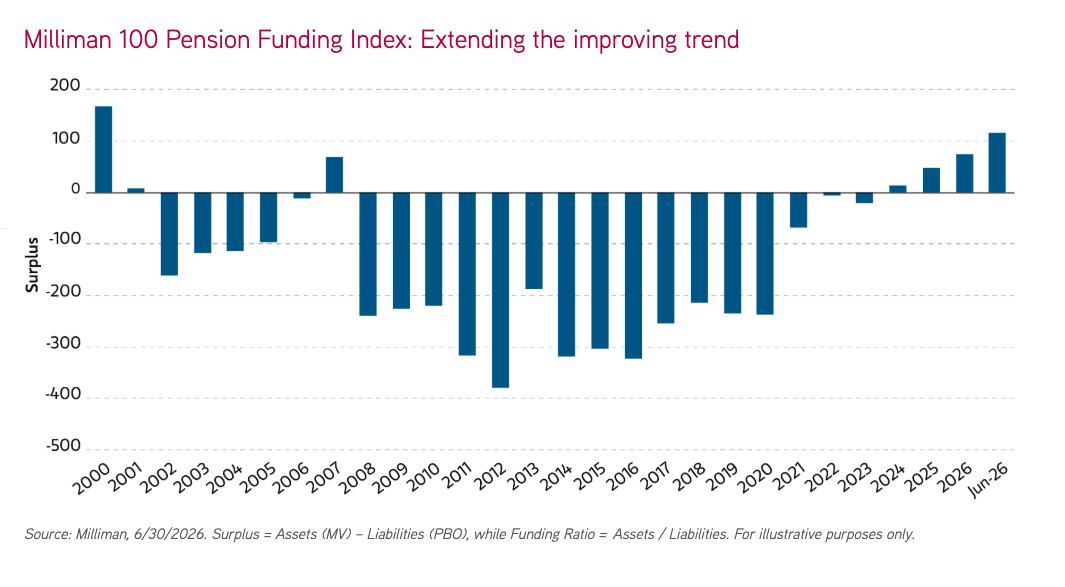
Pension investing environment
Equity market returns continue to drive funded ratios upward, with returns around 10% through the first half of 2026. In the meantime, liabilities have stayed around the same level. The yield curve has flattened with short yields rising. Credit spreads have remained relatively tight.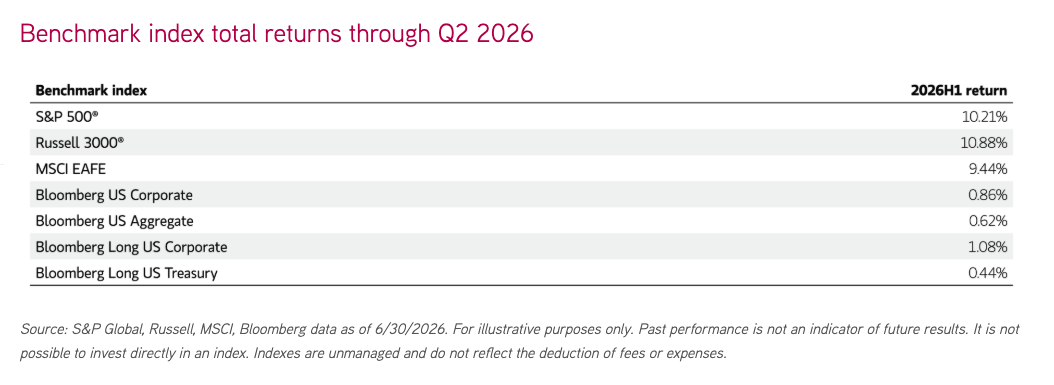
Pension risk transfer trends: Buy-outs versus buy-ins
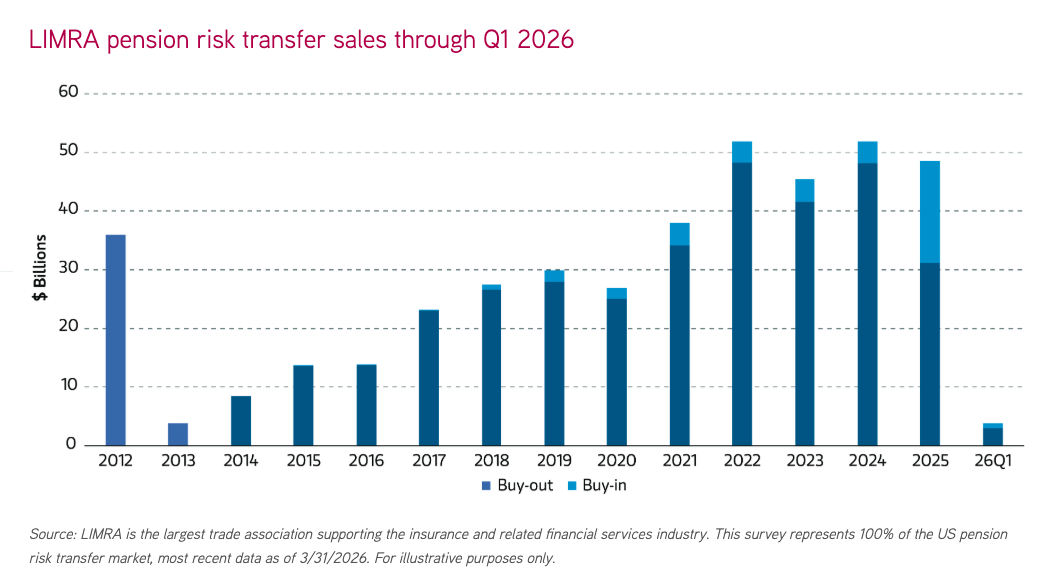
Pension risk transfers (PRT) are implemented by purchasing annuities for participants from an insurance company. With better funded ratios, we might expect to see greater interest in PRTs, which did pick up in Q4 2025, as we expected—pushing annual total transfers into the same ballpark as prior years. However, we’ve noted a difference in 2025 that may continue forward into the future.
Annuity purchases for a pension plan can be executed through a buy-out or a buy-in. Both cover future benefit payments for some or all plan participants. With a buy-out, the pension liabilities and assets leave the plan and are no longer plan obligations once transferred to an insurance company. With a buy-in, participants’ liabilities and assets remain in the plan and continue to be reflected in required contribution calculations and financial statements.
Buy-outs were lower for 2025 than they had been since 2020, with the gap closed by buy-ins around four or five times higher than we’ve seen in the past. For most plans, a buy-in is an intermediate step toward conversion to a buy-out at a later date. The plan sponsor is still on the hook to pay Pension Benefit Guaranty Corporation (PBGC) premiums each year for the participants who remain in the plan. Yet the buy-in gives the plan sponsor more flexibility and certainty in terms of annuity pricing while a time-consuming partial termination plays out. And the plan sponsor can defer settlement accounting that may require costs to be recognized sooner than originally planned.
Given the increase in buy-ins, we believe plan sponsors and investment managers need to have a clear understanding of the plan’s exposure to surplus volatility with the buy-in in place. From the plan’s perspective, the buy-in annuities exactly match the liability, including longevity risk. However, liability values in reporting and the buy-in assets backing them may appear to be unequal. Understanding the difference is key to managing the remaining assets to implement the intended total plan strategy.
Finally, the trend toward fewer PRTs is notable. While we’ve historically seen less PRT activity in first quarters than during the rest of the year, Q1 2026 combined buy-outs and buy-ins are the lowest of any first quarter since 2018.
Pension litigation related to PRTs, accounting benefits of a well-funded plan, existing strategies that stabilize funding levels and lack of urgency for the plan sponsor who may have other preoccupations—these are all factors driving the trend of slowing PRT activity.
Refine and enhance liability-driven investing strategies
Where this leaves pensions
Looking ahead, we find the usual lesson applies: It’s important to avoid making costly mistakes in a pension plan. Understanding the plan and investments—including the increasingly common case of a buy-in—remains key. For plan sponsors with well-funded plans, falling back into underfunding is the last thing they need.
Higher yields are creating opportunities for investors, as outlined in Parametric’s fixed income midyear outlook. Nevertheless, pension investors still face surplus risk related to yield changes that can result from policy under a new Fed regime, future developments in the Middle East or other uncertainties. Preserving funded status and managing downside risk should take precedence over return maximization at these levels of funding.
The bottom line
With funding ratios that have been stable and growing, pensions are as healthy as they’ve been for a long time. A well-funded, well-managed pension plan may provide benefits for a plan sponsor, who could get lulled into a false sense of security when everything has been going so well.
But let’s remember that risks still exist in pension plans if care isn’t taken. Markets are uncertain, with many potential reasons that the current environment could change. Surplus risk management is the primary goal for well-funded plans, so it’s important to maintain investment strategies that keep the risk exposures within the plans well-known and properly mitigated, helping to preserve pension stability going forward.
A message from Advisor Perspectives and VettaFi: Discover something new! Click here to register for our upcoming webcasts.
The views expressed in these posts are those of the authors and are current only through the date stated. These views are subject to change at any time based upon market or other conditions, and Parametric and its affiliates disclaim any responsibility to update such views. These views may not be relied upon as investment advice and, because investment decisions for Parametric are based on many factors, may not be relied upon as an indication of trading intent on behalf of any Parametric strategy. The discussion herein is general in nature and is provided for informational purposes only. There is no guarantee as to its accuracy or completeness. Past performance is no guarantee of future results. All investments are subject to the risk of loss. Prospective investors should consult with a tax or legal advisor before making any investment decision. Please refer to the Disclosure page on our website for important information about investments and risks.
Investment advisory services offered through Parametric Portfolio Associates LLC ("Parametric"), an investment advisor registered with the US Securities and Exchange Commission (CRD #114310). Parametric is also registered as a portfolio manager with the securities regulatory authorities in certain provinces of Canada (National Registration Database No. 42850) with regard to specific products and strategies. Parametric provides advisory services directly to institutional investors and indirectly to individual investors through financial intermediaries. The information on this website does not constitute an offer to sell, or a solicitation of an offer to purchase, securities in any jurisdiction to any person to whom it is not lawful to make such an offer. Investing entails risks, and there can be no assurance that Parametric (and its affiliates) will achieve profits or avoid incurring losses. All investments are subject to potential loss of principal. Parametric does not provide tax or legal advice. Prospective investors should consult with a tax or legal advisor before making any investment decision. Please refer to the disclosure page for important information about investments and risks.
S&P Dow Jones Indices are a product of S&P Dow Jones Indices LLC (“S&P DJI”) and have been licensed for use. S&P® indexes are registered trademarks of S&P DJI; Dow Jones® is a registered trademark of Dow Jones Trademark Holdings LLC (“Dow Jones”); S&P DJI, Dow Jones, and their respective affiliates do not sponsor, endorse, sell, or promote Parametric and its strategies, will not have any liability with respect thereto, and do not have any liability for any errors, omissions, or interruptions of the S&P Dow Jones Indices.©2026 Parametric Portfolio Associates LLC. All rights reserved. 800 Fifth Avenue, Suite 2800, Seattle, WA 98104
Membership required
Membership is now required to use this feature. To learn more:
View Membership Benefits