The first half of 2026 reinforced an important lesson for fixed income investors: Tax-loss harvesting opportunities don’t always arrive at year-end, often appearing during short periods of market dislocation when interest rates rise, new-issue supply increases or investor sentiment shifts.
This year, rate volatility, above-target inflation, geopolitical risk and uncertainty around the path of monetary policy have shaped the backdrop. The Federal Reserve’s leadership transition has added another variable for markets to digest—particularly as investors evaluate whether policy will remain patient and data dependent or move in a more hawkish direction if inflation pressures persist.
Parametric’s 2026 midyear fixed income outlook noted that this policy ambiguity, alongside elevated global bond yields and still-high inflation, has added another layer of uncertainty for investors. The silver lining is that higher yields may offer an attractive entry point for income-focused investors—especially for those seeking durable income and the ability to reinvest at more compelling levels. Periods of volatility may also create a practical opportunity: realizing losses while staying invested in the market.
How tax-loss harvesting works in fixed income
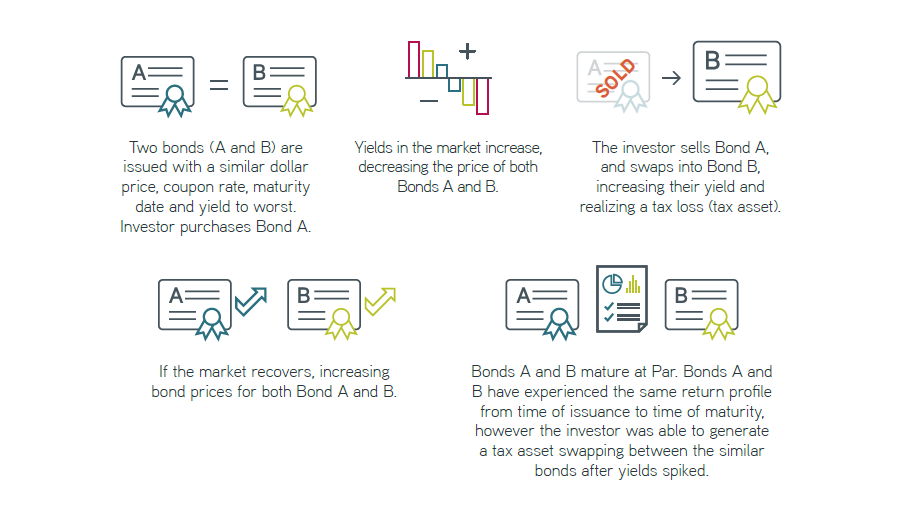
Tax-loss harvesting involves selling a security that has declined below its tax cost basis and using the realized loss to offset capital gains elsewhere in an investor’s portfolio. In fixed income, changes in interest rates and yield curves often drive the opportunity: When yields rise, bond prices fall, and that may create a harvestable loss even when the bond’s credit quality remains sound.

For illustrative purposes only. This represents how a portfolio management team could generally implements its investment process under normal market conditions. All investments are subject to risk, including risk of loss.
The key point is that the investor doesn’t need to exit the asset class. The proceeds could be reinvested into another bond with similar characteristics, helping preserve the duration, credit quality, income profile and overall positioning of the portfolio.
See more: Apple’s $600 Billion Rally Fueled by Traders Fleeing AI Selloff
First-half 2026 results
Through the first half of 2026, Parametric used periods of rate and market volatility to identify tax-loss harvesting opportunities across fixed income SMA portfolios.
Year to date through June 30, 2026, Parametric sold more than $2.8 billion of bonds at a loss. In aggregate, this realized $62 million in net losses—creating an estimated potential tax benefit of $20 million for Parametric Fixed Income SMA investors.1
These realized losses may be used to offset capital gains in the current tax year or carried forward to offset future gains, depending on the investor’s individual tax situation.
Why wash-sale discipline mattersTax-loss harvesting must be implemented carefully. Under the wash-sale rule, an investor generally can’t deduct a loss if they sell a security at a loss and buy the same or a substantially identical security within 30 days before or after the sale.
For fixed income portfolios, that means replacement security selection matters. The objective is to maintain comparable market exposure without purchasing a substantially identical bond. In practice, this may involve replacing the bond sold with another bond that has similar portfolio characteristics but differs in issuer, coupon, maturity, call structure or other relevant features.
Professional management can be particularly important here. Rather than simply generating a tax loss, the goal is creating a tax loss while maintaining the portfolio’s investment objectives and avoiding unnecessary risk, transaction costs or wash-sale issues.
How we implement tax-loss harvesting
A disciplined fixed income tax-loss harvesting process typically requires four capabilities:
- Portfolios need to be monitored continuously. Losses can appear and disappear quickly as yields move. Waiting until year-end may mean the opportunity has already passed.
- The manager must evaluate whether a trade makes economic sense, weighing the expected tax benefit against transaction costs, liquidity, portfolio impact and the quality of available replacement bonds.
- The replacement bond needs to be selected thoughtfully, with the implementation process seeking to maintain the investor’s desired exposure to duration, curve positioning, credit quality, sector, state preference and income.
- The trade must be executed efficiently. In fixed income markets, execution quality may have a direct impact on investor outcomes.
Technology and scale help make it possible
Technology is central to making tax-loss harvesting work across thousands of customized fixed income accounts. Parametric’s proprietary systems generate buy and sell orders and allocate trades across thousands of accounts each day, allowing traders to focus more on market conditions and execution quality and less on operational or allocation issues. That matters for tax-loss harvesting. A scalable technology platform can help identify eligible losses, evaluate replacement securities, monitor portfolio constraints and support timely execution.
But technology alone isn’t enough. Trading experience, liquidity insight and dealer relationships remain critical—particularly in municipal bonds where lot size, structure and market depth can vary meaningfully. For tax-aware investors, that combination of technology, scale and trading judgment may help turn volatility into after-tax value.
The bottom line
The first half of 2026 showed why tax-loss harvesting in fixed income should be an ongoing process, not only a year-end event. Rate volatility, heavy municipal supply and uncertainty around the Fed’s policy path have created opportunities for investors positioned to act.
Looking ahead, we are constructive on the opportunity for fixed income investors—especially given the attractive yields available now. While volatility may remain a defining feature of the market, higher yields could help support income generation, improve reinvestment opportunities and create potential entry points for long-term investors. For tax-aware investors, volatility may also offer opportunities to improve after-tax outcomes over time.
1 Source: Parametric, 06/30/2026. The information is provided for illustrative purposes only. Values are aggregated across all municipal, corporate and preferred strategies with managed, laddered or total return mandates. Only client positions with unverified cost basis were excluded from calculations. Loss calculation is based on the amortized book price minus the sell price, represents historical information and should not be construed as future results. Loss information illustrates the effect to a portfolio and is not representative of, and should not be construed as, performance. There is no assurance that tax loss harvesting will continue in the future. There is no guarantee that any specific account may engage in tax loss harvesting.
Parametric and Morgan Stanley do not provide legal, tax, or accounting advice or services. Clients should consult with their own tax or legal advisor prior to entering into any transaction or strategy described herein.
The views expressed in these posts are those of the authors and are current only through the date stated. These views are subject to change at any time based upon market or other conditions, and Parametric and its affiliates disclaim any responsibility to update such views. These views may not be relied upon as investment advice and, because investment decisions for Parametric are based on many factors, may not be relied upon as an indication of trading intent on behalf of any Parametric strategy. The discussion herein is general in nature and is provided for informational purposes only. There is no guarantee as to its accuracy or completeness. Past performance is no guarantee of future results. All investments are subject to the risk of loss. Prospective investors should consult with a tax or legal advisor before making any investment decision. Please refer to the Disclosure page on our website for important information about investments and risks.
07.08.2028 | RO 5730052
A message from Advisor Perspectives and VettaFi: Discover something new! Click here to register for our upcoming webcasts.
© Parametric
Read more commentaries by Parametric