Key Takeaways
- Wall Street analysts expect Q2 S&P 500® profit growth of 23.6%, which could mark the 7th consecutive quarter of double digit earnings growth.
- Banks kick things off on Tuesday, with the overall Financials sector expecting a 6.6% increase in EPS, as a massive resurgence in Wall Street dealmaking and higher asset values battle headwinds from compressed commercial lending margins and rising credit provisions.
- Corporate guidance will be top of mind for investors especially as geopolitical uncertainties remain.
Upward Revisions Fuel Big Expectations for Q2 Earnings
As the big banks prepare to kick off the Q2 2026 reporting cycle this week, the S&P 500 is positioned to demonstrate massive fundamental strength. Corporate profits are projected to log a staggering 23.6% year-over-year EPS growth rate, according to FactSet, marking the index's second consecutive quarter of 20%+ profit expansion and its seventh consecutive quarter of double-digit growth. Impressive earnings growth is anticipated to be supported by a robust 12.3% YoY increase in revenues. Leaders on both the top and bottom-line include Energy and Tech, while Health Care currently remains the only laggard with EPS expected to decline 9.0% from Q2 2025.1
What makes this earnings setup truly unique is the behavior of Wall Street analysts over the last 90 days. Because corporate guidance tends to be conservative, analysts historically cut estimates ahead of time. According to FactSet, over the last 5 years the sell-side has cut EPS estimates by an average of 2% in the quarter leading up to an earnings season. That number increases to 4% when you look at the 20-year average. By contrast, leading into Q2 2026 results we’ve seen analysts raise the bottom-up S&P 500 EPS estimate by 3.4% from where expectations stood on March 31. This builds directly on a spectacular Q1 performance that surged past 27% growth after starting the cycle at just 13%. It also represents the largest intra-quarter upward revision seen in five years, dating back to Q2 2021 when the global economy was aggressively unshackling itself from pandemic-era lockdowns.2
Early results from the likes of Oracle, Nike and Darden suggest companies are surpassing bottom-line targets through cost management strategies, focusing on cutting unnecessary overhead and running more efficiently in order to defend net margins.
See more: Midyear Outlook 2026: Key Takeaways for the Second Half
Big Banks on Deck
The Financials sector enters the Q2 2026 earnings season with measured expectations, projecting a modest 6.6% increase in EPS alongside an 9.5% expansion in revenue. This performance is heavily underpinned by a massive resurgence in Wall Street dealmaking, as global equity issuance cleared the $250 billion mark in the first half of 2026 driven by high-profile IPOs like SpaceX and Cerebras Systems.3 This revival positions pure-play investment engines like Goldman Sachs and Morgan Stanley to reap massive year-over-year gains in advisory and underwriting fees. Furthermore, expanding asset values through the first half of the year will allow wealth hubs like Morgan Stanley and JPMorgan Chase to report record recurring fee lines, while intense trading volumes driven by early-quarter commodity volatility will boost fixed-income trading revenues.
Conversely, traditional commercial lending operations face mounting macroeconomic headwinds. Because the Federal Reserve has held the federal funds rate steady at 3.50% - 3.75%, banks are experiencing net interest margin compression as consumers continue to shift cash to high-yield alternatives and loan demand flatlines due to high borrowing costs. Compounding this pressure, sticky inflation and record consumer credit card debt are forcing banks to step up their Provisions for Credit Losses. This proactive move will pull money out of current earnings to shield balance sheets against credit card delinquencies and commercial real estate restructurings, presenting a direct drag on profitability.

Source: Wall Street Horizon, Data as of July 9, 2026.
What to Look Out For in Q2 Results: Guidance, Dividends, Tariff Refunds
Forward looking guidance
While we’ll be curious to see what companies surpass their Q2 expectations, the real focus in any earnings season is forward looking guidance. This will be an especially critical focal point this reporting cycle following the end of the Iran ceasefire last week. During the Q1 2026 reporting season, a wide range of companies highlighted how escalating Middle East conflict was severely clouding their visibility, prompting several to delay, pull, or heavily qualify their forward-looking numbers. Ford explicitly noted that its upgraded guidance figures did not factor in the potential demand and macro impacts of a sustained conflict in the Middle East,4 while Honeywell warned investors of potential revenue delays due to shipping disruptions that could push Q1 revenue later into the year.5
This geopolitical friction has forced highly defensive posture changes across consumer-facing industries. Air Canada completely suspended its full-year 2026 financial guidance, pulling its prior outlook because of extreme jet fuel price volatility tied directly to the war.6 In a similar vein, Procter & Gamble acknowledged it was expecting roughly a $150M earnings hit from the conflict, but would not release official FY 2027 guidance until July.7 Even outside of direct energy impacts, Constellation Brands withdrew its long-term fiscal 2028 guidance entirely, pointing to dynamic operating environments and limited near-term visibility.8 In the coming weeks, Wall Street will be listening closely to see if corporate boards are finally ready to quantify these geopolitical wildcards or if guidance suspensions and delays will become the broader market norm.
Dividend suspensions?
Another highly defensive theme to monitor in upcoming company commentary is whether persistent macroeconomic pressures will force boards to cut or suspend dividends. The most jarring precedent came earlier this quarter from appliance giant Whirlpool, which made the drastic decision to suspend its dividend after 70-years, in order to preserve cash and accelerate debt paydown. Whirlpool's management explicitly blamed the war in Iran for escalating domestic cost-of-living concerns and plunging U.S. consumer sentiment to record lows, triggering a "recession-level industry decline" as Americans delayed big-ticket home replacements.9 With high energy prices continuing to eat into corporate margins and household budgets, Wall Street will be listening closely for signs of whether other capital-intensive or consumer-facing giants will follow suit and sacrifice their dividends to protect their balance sheets.
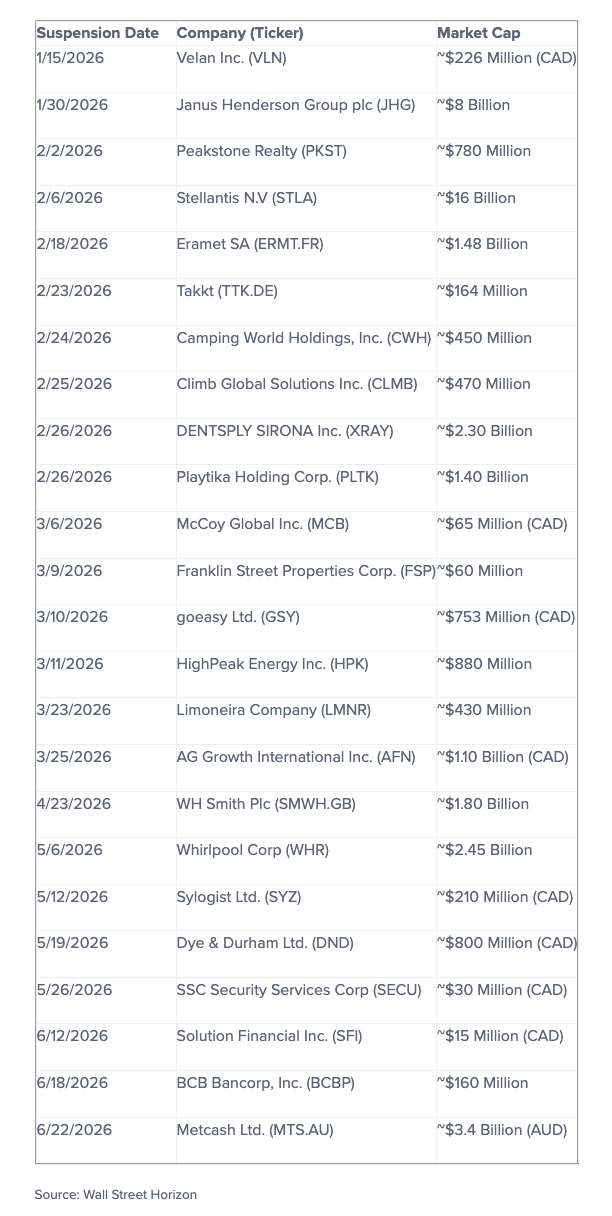
Below is a list of dividend suspensions year-to-date. The only other large cap to stop paying a dividend in 2026 is automaker Stellantis N.V., which counts Jeep, Fiat, Maserati and Dodge among its brands. The Stellantis suspension came on February 6, prior to the start of the Iran conflict, and was done to “help preserve the balance sheet.”10
Dividend suspensions from this year include:
Tariff refunds
Alongside geopolitical guidance and dividend adjustments, corporate commentary will also feature details on how management teams are deploying cash from recent tariff refunds. Companies are handling these rebates through highly distinct strategic lenses depending on their immediate operating needs. For instance, McCormick received $28 million this quarter, with another $3 million expected later this year, but management explicitly stated that the cash is being entirely eaten up to absorb rising logistics and freight costs tied to the Middle East conflict, which has driven baseline cost inflation up to 6%. Conversely, Nike stands as the largest corporate winner by booking a massive $986 million expected tariff recovery. The apparel giant is channeling that cash directly onto its balance sheet to offset previous duties, a move that successfully expanded its gross operating margin by 890 basis points.
Other major players are choosing to pass the windfalls directly down the value chain to protect their market share. Taking an entirely client-first approach, FedEx is returning roughly $800 million in clawed-back duties directly to the shippers who originally took on those charges. Meanwhile, on the retail front, BJ’s Wholesale Club reinvested its smaller $20 million refund directly into grocery price cuts. This tactical move successfully sparked half a point of deflation in its pricing, allowing the wholesaler to defend membership loyalty and actively fight off consumer churn.
Q2 2026 Earnings Wave
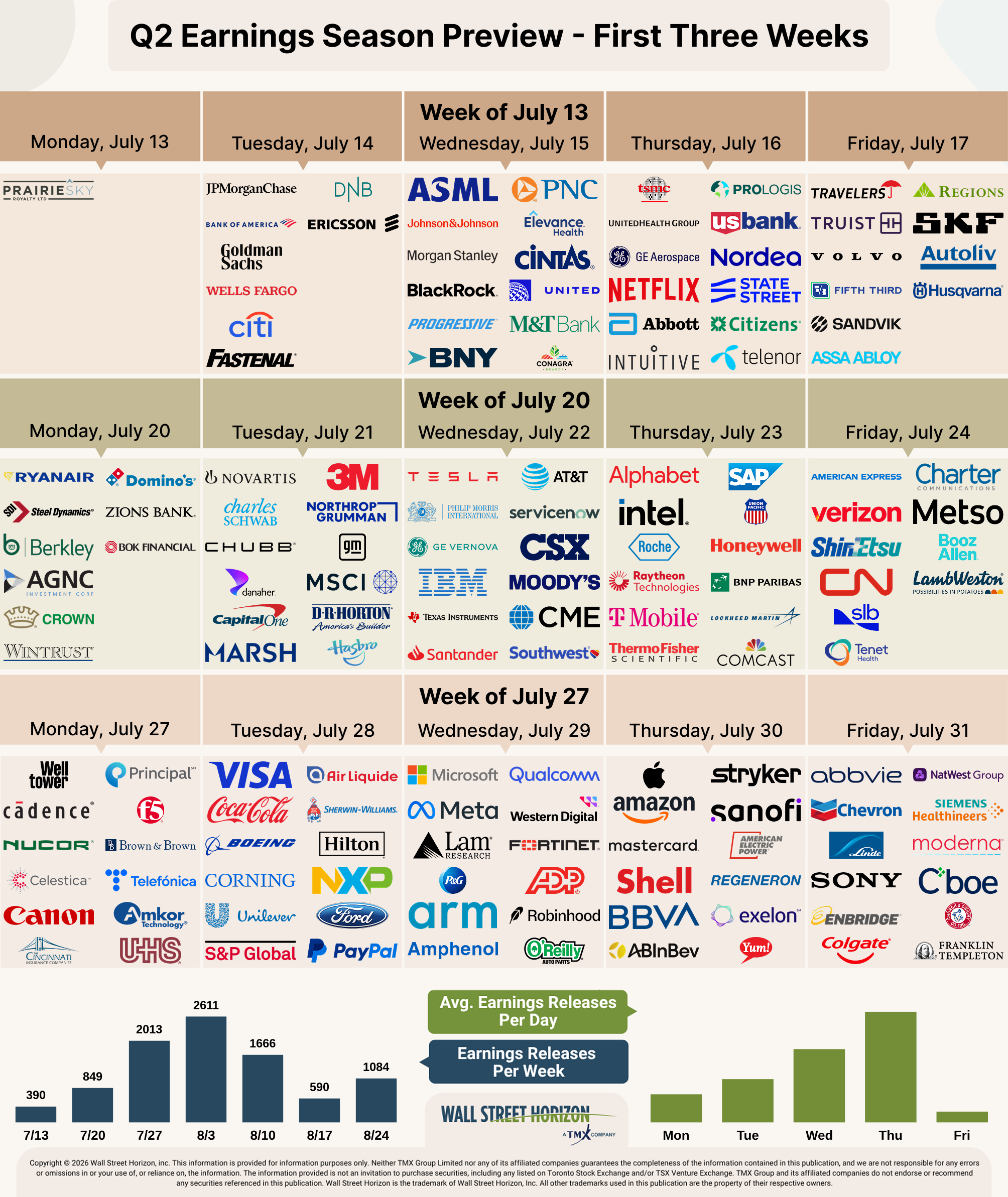
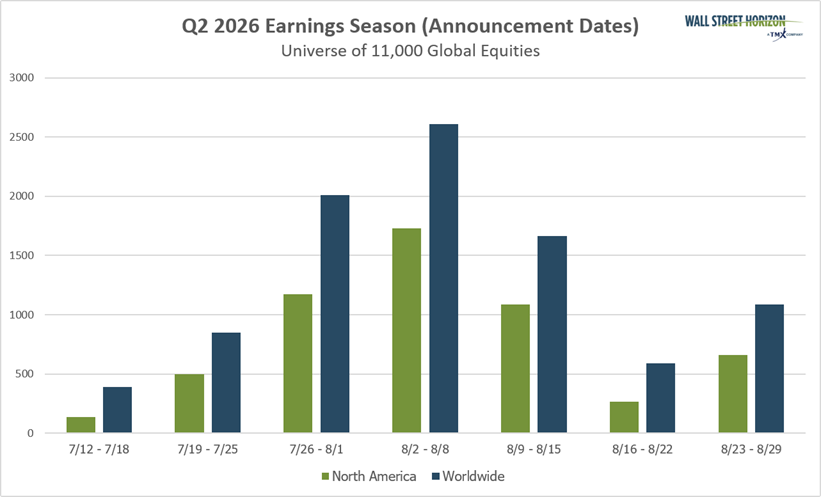
The peak weeks of the Q2 earnings season are expected to fall between July 27 - August 14, with each week expected to see over 2,000 reports. Currently, August 6 is predicted to be the most active day with 1,265 companies anticipated to report. Thus far, only 47% of companies have confirmed their earnings date (out of our universe of 11,000+ global names). The remaining dates are estimated based on historical reporting data.
Source: Wall Street Horizon
1 FactSet Earnings Insight, John Butters, July 10, 2026, https://advantage.factset.com
2 FactSet Earnings Insight, John Butters, July 10, 2026, https://advantage.factset.com
3 “SpaceX Pushes US Share Sales to Record $251 Billion at Midyear,” Bloomberg, Bailey Lipschultz and Anthony Hughes, June 29, 2026, https://www.bloomberg.com
4 Ford Reports First-Quarter 2026 Financial Results; Raises Full-Year Guidance, April 29, 2026, https://s205.q4cdn.com
5 “Honeywell warns of potential revenue delay due to Middle East shipping disruption,” Reuters, March 17, 2026, https://www.reuters.com
6 “Air Canada suspends 2026 forecast on Iran war uncertainty despite sturdy travel demand,” Reuters, Shivansh Tiwary and Allison Lampert, April 30, 2026, https://www.reuters.com
7 “P&G expects $150M earnings hit from Middle East conflict,” CFO Dive, Alexei Alexis, April 24, 2026, https://www.cfodive.com
8 “Constellation Brands, U.S. maker of Modelo and Corona, withdraws 2028 guidance due to uncertainty,” CNBC, Laya Neelakandan, April 8, 2026, https://www.cnbc.comngs.html
9 “For 70 Years, Whirlpool Paid a Dividend. Suddenly It Can’t Afford One.” Wall Street Journal, John Keilman, May 7, 2025, https://www.wsj.com
10 Stellantis Suspends Dividend Due To $26 Billion Restructuring Charge, Yahoo Finance, Baystreet, February 6, 2026, https://ca.finance.yahoo.com
11 “McCormick gets $28M tariff refund as Iran war raises costs,” Supply Chain Dive, Antone Gonsalves, July 2, 2026, https://finance.yahoo.com
12 Nike expects nearly $1B in IEEPA tariff refunds,” Supply Chain Dive, Kelly Stroh, July 8, 2026, https://finance.yahoo.com
13 “FedEx to Return $800 Million in Tariff Refunds,” Sourcing Journal, Glenn Taylor, June 2024, 2026, https://finance.yahoo.com
14 “BJ’s Wholesale Club uses tariff refunds to cut prices,” Supply Chain Dive, Antone Gonsalves, June 18, 2026, https://finance.yahoo.com
Copyright © 2026 Wall Street Horizon, Inc. All rights reserved. Do not copy, distribute, sell or modify this document without Wall Street Horizon's prior written consent. This information is provided for information purposes only. Neither TMX Group Limited nor any of its affiliated companies guarantees the completeness of the information contained in this publication, and we are not responsible for any errors or omissions in or your use of, or reliance on, the information. This publication is not intended to provide legal, accounting, tax, investment, financial or other advice and should not be relied upon for such advice. The information provided is not an invitation to purchase securities, including any listed on Toronto Stock Exchange and/or TSX Venture Exchange. TMX Group and its affiliated companies do not endorse or recommend any securities referenced in this publication. This publication shall not constitute an offer to sell or the solicitation of an offer to buy, nor may there be any sale of any securities in any state or jurisdiction in which such offer, solicitation or sale would be unlawful prior to registration or qualification under the securities laws of any such state or jurisdiction. TMX, the TMX design, TMX Group, Toronto Stock Exchange, TSX, and TSX Venture Exchange are the trademarks of TSX Inc. and are used under license. Wall Street Horizon is the trademark of Wall Street Horizon, Inc. All other trademarks used in this publication are the property of their respective owners.
A message from Advisor Perspectives and VettaFi: Discover something new! Click here to register for our upcoming webcasts.
© Wall Street Horizon
More Global Markets Topics >