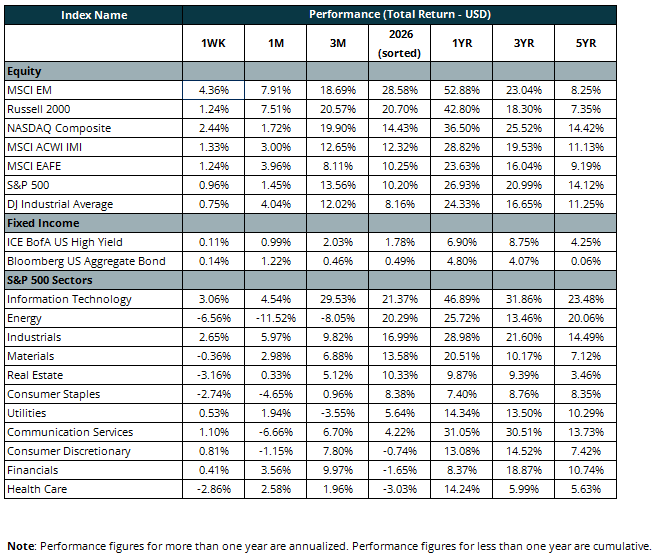
Equities rallied after President Trump announced an agreement with Iran to end their conflict and reopen the Strait of Hormuz. The S&P 500 and the NASDAQ finished the holiday-shortened week with solid gains, led by the technology sector. The AI demand narrative returned to center stage with another sharp advance in semiconductors. The Dow Jones Industrial Average gained only modestly, as energy, banks, and health care gave back earlier gains.
WTI crude fell for the sixth consecutive week as traders priced in renewed Iranian supply. The MOU allows Iran to restart exports immediately, with the US granting sanctions waivers. If sanctions were to be lifted entirely, analysts estimate Iran’s oil production could eventually exceed pre-war levels by roughly one million barrels per day. Reaching that output level could take two to three years, however. Full reopening of the Strait itself might take several weeks, as mine-clearing and restoring commercial shipping confidence are gradual processes.
Read more: Peace Prospects, Inflation Pressures, and SpaceX’s Historic IPO Drive Markets
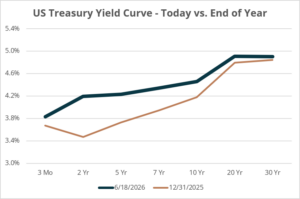
Last week marked a changing of the guard at the Fed, as Kevin Warsh chaired his first Federal Open Market Committee (FOMC) meeting. The FOMC, which sets the Fed funds rate target, delivered a hawkish surprise: nine of 18 officials penciled in at least one rate hike for 2026, the median dot for 2027 and 2028 moved higher, and the statement dropped forward guidance entirely. Markets repriced to reflect one to two rate hikes through year-end. Stocks sold off following Warsh’s press conference but recovered on Thursday as investors refocused on the peace deal and AI momentum. In fact, Wells Fargo raised its S&P 500 year-end target to 7,950, citing easing macro worries, the Iran deal, and rate hikes already reflected in prices.
Gold was a notable loser last week, down three per cent as investors rotated out of safe-haven assets and into risk. The Fed’s hawkish pivot removed one of gold’s key tailwinds. Gold tends to shine when inflation runs hot and erodes the value of paper assets. The yellow metal is down two per cent for the year and 22 per cent off its high reached back in January.
How quickly the Strait of Hormuz normalizes will drive energy prices and inflation expectations in the weeks ahead. Some uncertainty in oil markets will persist even as headline risk recedes. Fed watchers will scrutinize any upcoming communications for whether the June dot plot is a firm commitment or a forecast that could shift as energy-driven inflation pressures ease. The AI/semiconductor theme remains a powerful undercurrent. Continued AI momentum, alongside genuine Middle East de-escalation, sets up a constructive backdrop heading into the first full week of summer.

A message from Advisor Perspectives and VettaFi: Discover something new! Click here to register for our upcoming webcasts.
The views expressed represent the opinion of Sequoia Financial Group. The views are subject to change and are not intended as a forecast or guarantee of future results. This material is for informational purposes only. It does not constitute investment advice and is not intended as an endorsement of any specific investment. Stated information is derived from proprietary and nonproprietary sources that have not been independently verified for accuracy or completeness. While Sequoia believes the information to be accurate and reliable, we do not claim or have responsibility for its completeness, accuracy, or reliability. Statements of future expectations, estimates, projections, and other forward-looking statements are based on available information and Sequoia’s view as of the time of these statements. Accordingly, such statements are inherently speculative as they are based on assumptions that may involve known and unknown risks and uncertainties. Actual results, performance or events may differ materially from those expressed or implied in such statements. Investing in equity securities involves risks, including the potential loss of principal. While equities may offer the potential for greater long-term growth than most debt securities, they generally have higher volatility. Past performance is not an indication of future results. Investment advisory services offered through Sequoia Financial Advisors, LLC, an SEC Registered Investment Advisor. Registration as an investment advisor does not imply a certain level of skill or training.
© Sequoia Financial Group
Read more commentaries by Sequoia Financial Group