US growth stocks underperformed in early 2026 amid AI disruption fears and an unresolved conflict in the Middle East. But these stresses could create favorable conditions for selective, diversified investors to unlock long-term growth potential in a rotating market. Equity market dynamics have been shifting rapidly this year. First, a sell-off in software stocks over AI concerns and the underperformance of the Magnificent Seven mega-caps prompted a rotation toward value equities and defensive sectors. Then, equities fell sharply in March on the Iran war and oil price shock, and rebounded in April amid a fragile ceasefire. US growth stocks lagged value stocks in the first quarter, but reasserted leadership through mid-May on strong earnings and continued AI related capital spending.
Many investors in active growth strategies have experienced volatile performance in these markets. Yet, despite the bumpy ride, we think there are three good reasons to maintain active exposure to growth stocks.
1. Market concentration creates both risk and opportunity. The large-cap growth market is in the grip of a historic concentration cycle that has buoyed passive portfolios while making it extremely difficult for diversified active managers to outperform. The 10 largest holdings in the Russell 1000 Growth Index now account for more than 60% of the benchmark, versus 42% at the peak of the dot-com era in 1999. Back then, the top stocks spanned the aerospace, retail and technology industries. By contrast, concentration today is overwhelmingly tech-centric and closely tied to the AI narrative.
That distinction matters. We think concentration is a key risk for passive investors today not just because of the index weights themselves—but because of the narrow set of earnings, sentiment and capital-spending expectations driving them.
Of course, nobody can predict when a reversal might materialize. But we think some degree of broadening is inevitable as competition rises and AI-driven disruption reshapes profit pools across industries. That doesn’t mean we expect a broad equity sell-off; equities rose from 2001 to 2007 when markets broadened after the dot-com bubble burst. In fact, AI reinforces our optimism. If the technology delivers on its promise and adoption spreads, productivity gains and cost savings will filter through to a much broader set of companies—much as the internet eventually did. If AI disappoints or simply fails to meet today’s ambitious timeline embedded in prices, the market’s current winners could lag, paving the way to relative outperformance elsewhere.
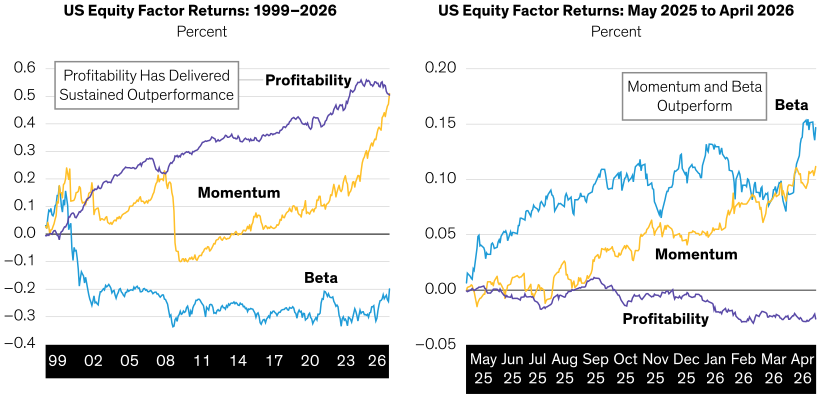
2. Profitable-growth companies offer resilience. Quality businesses, backed by strong profitability, are a time-tested recipe for growth investing success. That’s why the profitability equity factor has outperformed market-driven factors such as momentum and beta for a quarter century (Display).
Over the last year, however, that pattern has changed and high-profitability stocks have underperformed momentum and beta-oriented names. In our view, these trends are transitory and profitable growth stocks should ultimately regain their prominence as market leaders.
Our research suggests that companies like these—particularly those with high return on assets (ROA)—tend to deliver superior economic performance, which we expect to translate into higher investment returns when the profitability factor rebounds. We believe that portfolios focused on companies at the intersection of profitability and reinvestment opportunity can unlock the power of compounding returns.
3. Pockets of economic weakness could support structural growth winners. It sounds counterintuitive, but when macroeconomic growth weakens, select growth stocks can do well. That’s because when growth becomes scarce, investors prize businesses that enjoy non-cyclical growth drivers backed by competitive advantages and pricing power.
Today, investors are grappling with macroeconomic uncertainty. Rising oil prices are threatening to fuel inflation and could lead to stagflation, the dreaded combination of high inflation and an economic slowdown. The outlook for interest rates is unclear, but longer-duration bonds have been selling off globally.
If inflation curbs economic growth, we think sectors that enjoy structural growth drivers could return to favor. These include consumer staples, a defensive sector that tends to perform well in tougher economies but includes companies with solid growth potential.
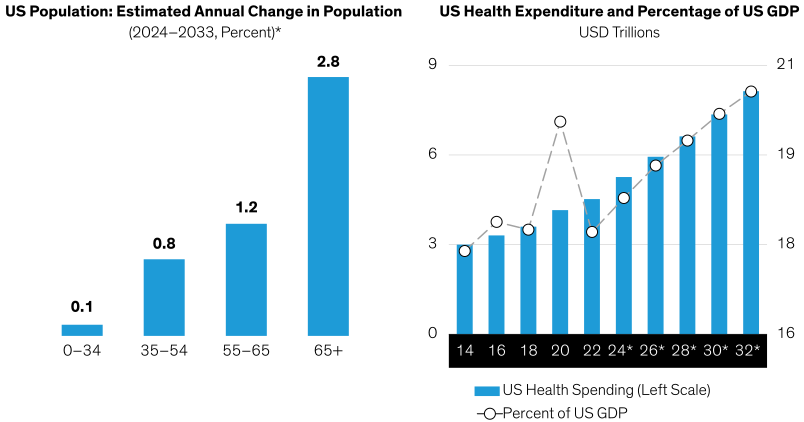
Healthcare is another example. Valuations across the sector are compressed even though the sector enjoys structural demand growth and long-term pricing power driven by demographic change as the US population ages (Display). Older people tend to spend more on medical services, which is why health expenditure is projected to steadily rise in the coming years—regardless of how the macroeconomic cycle plays out. The sector also benefits from innovation as well as high potential from AI adoption that we believe should ultimately reward shares of companies with quality businesses.
Narrowing momentum, particularly around beneficiaries of AI capex spending, has tested the tolerance of investors who prioritize diversified, profitable-growth exposure. Yet it’s important to remember that owning businesses with durable compounding potential has historically been a solid strategy for investors with long time horizons.
We believe that staying disciplined and following fundamental research in the pursuit of profitability can position portfolios for the opportunities that often emerge after dislocation. Patience is hardest in punishing markets—but it’s often the prerequisite for capturing the long-term payoff potential of quality growth stocks.
The views expressed herein do not constitute research, investment advice or trade recommendations, do not necessarily represent the views of all AB portfolio-management teams and are subject to change over time.
MSCI makes no express or implied warranties or representations, and shall have no liability whatsoever with respect to any MSCI data contained herein. The MSCI data may not be further redistributed or used as a basis for other indices or any securities or financial products. This report is not approved, reviewed or produced by MSCI.
A message from Advisor Perspectives and VettaFi: Discover something new! Click here to register for our upcoming webcasts.