The market has shifted quickly from concerns about artificial intelligence (AI) disruption to rising geopolitical risks tied to the conflict in Iran. Headlines continue to drive market movements as investors wait for greater clarity on the timing of a U.S. exit strategy. For now, oil remains the primary market driver, with developments around the reopening of the Strait of Hormuz acting as either an accelerator or a brake on risk appetite. In our view, easing Iran tensions and the restoration of global oil supply will be essential catalysts for equity markets to advance.
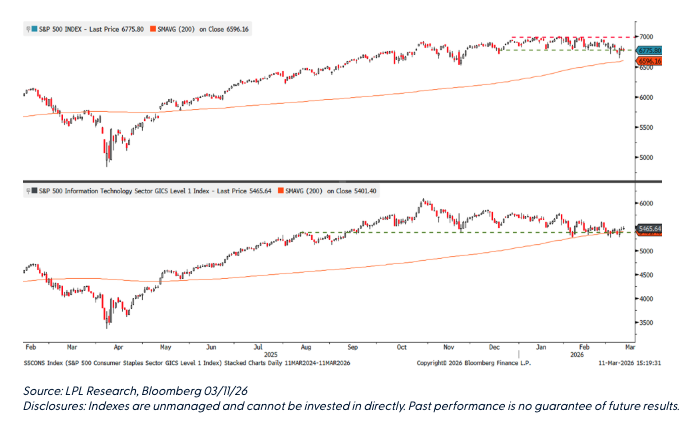
Despite the building uncertainty, equity markets are holding up relatively well. As of March 10, the S&P 500 was trading about 3% below its record high. Earlier this week, bulls made a strong showing by reversing a sizable intraday decline and pushed the index back above support near 6,775, which represents the lower end of a multi-month trading range. That level is being tested again today, and it will be important for buyers to defend it. The technology sector has also shown renewed signs of resilience and successfully withstood another retest of its closely watched 200-day moving average (dma).
Bulls Face Another Big Test

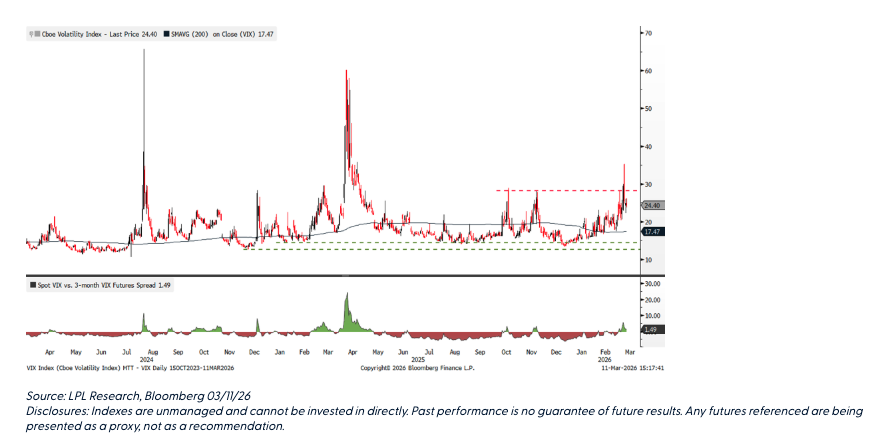
Peak Fear?
Signs are beginning to appear that investor fear may be peaking. The CBOE Volatility Index (VIX) climbed as high as 35.30 on Monday morning as demand for downside protection spiked. Historically, intraday VIX readings above 30 have often coincided with market inflection points and have been followed by above‑average S&P 500 returns over the subsequent 12 months. Although the fear gauge remains elevated, it has retreated back below support near 29, with the VIX futures curve also becoming less inverted and moving closer to its typical upward‑sloping structure.
The Fear Gauge Remains Elevated, but Has Backed Off the Initial Highs
Oil in the Driver’s Seat
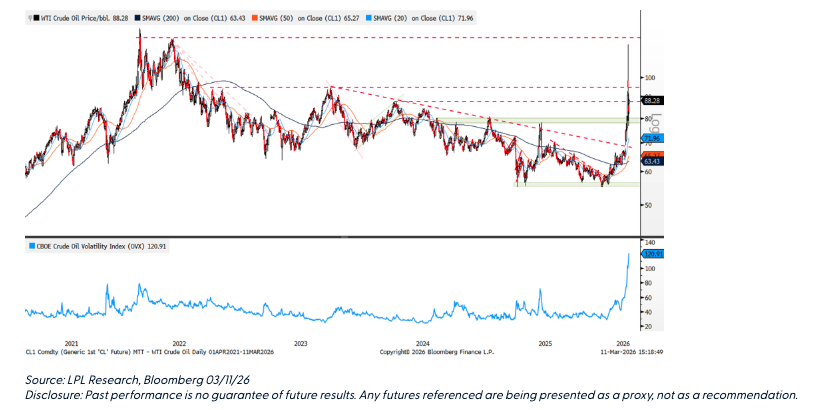
Oil markets continue to offer real‑time insight into expectations for how the conflict with Iran may unfold. West Texas Intermediate (WTI) crude spiked to nearly $120 per barrel when futures opened on March 8, following reports that Israel had struck Iranian oil facilities and several Middle Eastern producers announced production cuts tied to the effective shutdown of the Strait of Hormuz. Prices have since pulled back as investors reassess how much additional risk premium can reasonably be priced in, particularly given President Trump’s stated goal of ending the war within weeks rather than months and his commitment to keeping the Strait open to tanker traffic.
From a technical standpoint, WTI is retesting resistance near $88 after breaking below its 2024 high of $95. Additional support sits in the $78 to $80 range, and a move below this area would be viewed as a constructive signal for both a potentially better‑than‑feared resolution with Iran and for broader market sentiment. Although crude has eased from Sunday night’s highs, implied volatility remains elevated. The CBOE Crude Oil Volatility Index (OVX), often described as the oil market’s version of the VIX, has surged to 121, its highest level since the start of the COVID‑19 pandemic. The divergence between the pullback in oil prices and persistently high implied volatility underscores the significant uncertainty surrounding the duration and intensity of the conflict and suggests the oil market is likely to remain extremely choppy, with further upside risk if geopolitical tensions escalate.
Oil Prices Fade, But Remain Uncomfortably High
History as a Guide
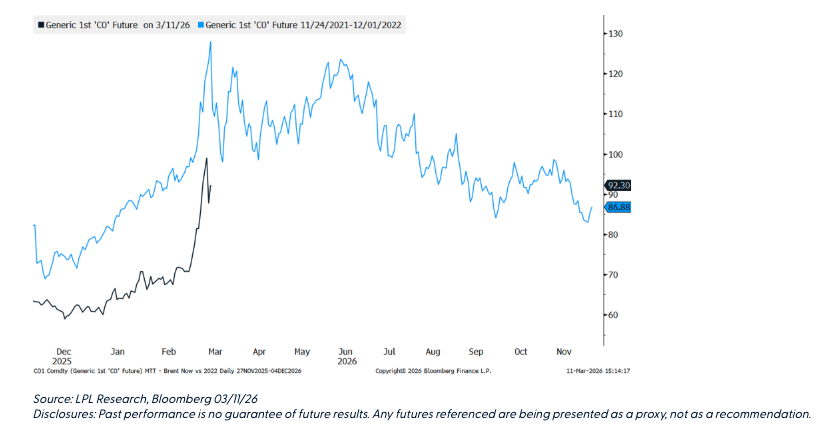
While the latest moves in the oil market have been surprising, they are not unprecedented. Brent crude, the global oil benchmark, is tracing a pattern that closely resembles its price behavior around the time of Russia’s invasion of Ukraine.
In late 2021, Russia began amassing military assets along the Ukrainian border, prompting President Joe Biden to warn that the United States and its allies would respond with strong economic measures in the event of further escalation. Despite these warnings, Russia continued to build its troop presence and conduct military exercises into early 2022 before officially invading Ukraine on February 24, 2022.
Although the motivations and timelines differ, the recent escalation in the Middle East has followed a similar path of rising geopolitical tension. The buildup has included increased U.S. military presence, pressure on Iran to reach a nuclear agreement, and the ultimate U.S.–Israeli strike on Tehran.
Within this backdrop, Brent crude has behaved in a familiar way. In early 2022, the threat of conflict pushed oil prices from roughly $65 in early December to a closing high of $128 as the war unfolded, before easing as supply concerns moderated. The historical pattern also shows that oil does not immediately relinquish its war‑related risk premium, with Brent remaining highly volatile for months after the Ukraine invasion before eventually moving lower.
A similar dynamic is unfolding today. Escalating tensions with Iran pushed Brent from about $60 in early December to nearly $120 on March 9. Prices have since retreated as reports of some tanker traffic moving through the Strait of Hormuz emerged (reportedly nearly 12 million barrels originating from Iran since the war began) and President Trump suggested the conflict could be nearing a resolution. The administration also warned of severe retaliation should Iran attempt to block the Strait. In addition, the International Energy Agency recently proposed an unprecedented release of strategic oil reserves to help counter elevated prices, echoing its response during the Ukraine conflict.
While the 2022 comparison may indicate that peak prices for the current geopolitical conflict may already be behind us, it is important to recognize that the Strait of Hormuz introduces a fundamentally different level of supply risk in the case of Iran.
Brent Crude Comparison to Russia’s Invasion of Ukraine
Conclusion
Markets have shifted their focus from AI-related concerns to the war in Iran. Oil remains the key driver of investor sentiment, with the reopening of the Strait of Hormuz determining risk appetite. Despite a high degree of uncertainty over what happens next, equity markets have held up relatively well, with the S&P 500 trading only modestly below its recent record high.
Volatility has spiked, but early signs suggest fear may be peaking. Oil markets are expected to remain highly volatile as investors assess the likelihood of a prolonged supply disruption. Current price patterns closely mirror the behavior seen during the Russia–Ukraine conflict in 2022, though the Strait of Hormuz presents a more acute supply risk.
A message from Advisor Perspectives and VettaFi: Discover something new! Click here to register for our upcoming webcasts.
Important Disclosures
This material is for general information only and is not intended to provide specific advice or recommendations for any individual. There is no assurance that the views or strategies discussed are suitable for all investors. To determine which investment(s) may be appropriate for you, please consult your financial professional prior to investing.
Investing involves risks including possible loss of principal. No investment strategy or risk management technique can guarantee return or eliminate risk.
Indexes are unmanaged and cannot be invested into directly. Index performance is not indicative of the performance of any investment and does not reflect fees, expenses, or sales charges. All performance referenced is historical and is no guarantee of future results.
This material was prepared by LPL Financial, LLC. All information is believed to be from reliable sources; however LPL Financial makes no representation as to its completeness or accuracy.
Unless otherwise stated LPL Financial and the third party persons and firms mentioned are not affiliates of each other and make no representation with respect to each other. Any company names noted herein are for educational purposes only and not an indication of trading intent or a solicitation of their products or services.
Asset Class Disclosures –
International investing involves special risks such as currency fluctuation and political instability and may not be suitable for all investors. These risks are often heightened for investments in emerging markets.
Bonds are subject to market and interest rate risk if sold prior to maturity.
Municipal bonds are subject and market and interest rate risk and potentially capital gains tax if sold prior to maturity. Interest income may be subject to the alternative minimum tax. Municipal bonds are federally tax-free but other state and local taxes may apply.
Preferred stock dividends are paid at the discretion of the issuing company. Preferred stocks are subject to interest rate and credit risk. They may be subject to a call features.
Alternative investments may not be suitable for all investors and involve special risks such as leveraging the investment, potential adverse market forces, regulatory changes and potentially illiquidity. The strategies employed in the management of alternative investments may accelerate the velocity of potential losses.
Mortgage backed securities are subject to credit, default, prepayment, extension, market and interest rate risk.
High yield/junk bonds (grade BB or below) are below investment grade securities, and are subject to higher interest rate, credit, and liquidity risks than those graded BBB and above. They generally should be part of a diversified portfolio for sophisticated investors.
Precious metal investing involves greater fluctuation and potential for losses.
The fast price swings of commodities will result in significant volatility in an investor's holdings.
This research material has been prepared by LPL Financial LLC.
Not Insured by FDIC/NCUA or Any Other Government Agency | Not Bank/Credit Union Deposits or Obligations | Not Bank/Credit Union Guaranteed | May Lose Value
Read more commentaries by LPL Financial