Since the U.S.-China trade war first broke out in 2017, Chinese companies have faced rising tariffs and trade barriers around the world. Even after the modest détente in October between President Trump and President Xi, the average tariff on Chinese exports to the U.S. is still more than 47%.1 Given the ongoing trade investigations by the U.S. government and volatility in relations between the two countries, tariffs could rise even higher. China’s trade challenges are not limited to the U.S. The European Union, Canada, Japan, Brazil, and other major markets have also increased tariffs and imposed additional restrictions on Chinese goods, though not to the same extent as the U.S.
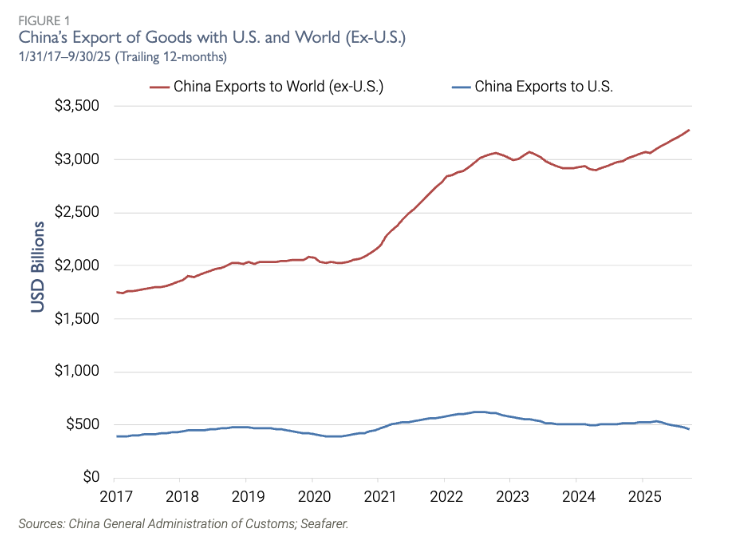
The surprising fact is that despite these trade headwinds, Chinese exports have continued to grow. Since the start of the trade war in 2017, China’s exports have expanded dramatically. As shown in Figure 1, total exports have risen by 58%, reaching a staggering $3.58 trillion per year. China has accomplished this by roughly maintaining export levels to the U.S. while sharply increasing exports to other global markets.

Despite the intense trade conflict between China and the U.S. this year – which shut down trade in many goods during April and May – China’s total exports are still up 6% year to date.2 While some of this increase may reflect frontloading orders to get ahead of new tariffs, Chinese exports are still performing much better than many analysts expected given the severity of the trade conflict.
What are Companies Doing?
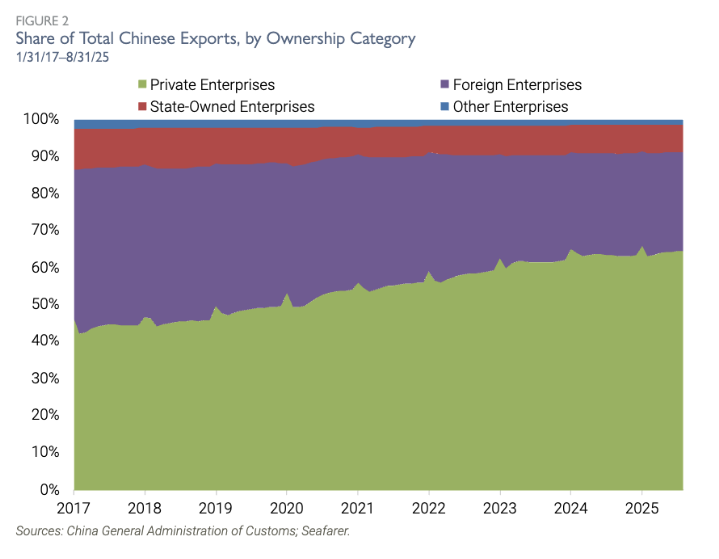
How should we understand the fact that Chinese companies have so far managed to sustain export growth despite rising tariffs and other barriers? First, it’s important to remember that Chinese exports are produced primarily by private domestic firms and foreign companies operating in China, which tend to be the most profit-oriented and efficient firms in China. While other parts of the Chinese economy are weighed down by inefficient state-owned enterprises, trade is where competitive forces in China are at their sharpest. As shown in Figure 2, Chinese private firms have further increased their share of total exports since the start of the trade war. In contrast, state-owned firms remain relatively minor players in China’s overall exports.
Second, Chinese companies are highly motivated to maintain and expand their overseas revenues. Many industries in China are struggling with low profitability and race-to-the-bottom competition. In some sectors, conditions have become so difficult that overseas markets are among the few remaining sources of growth. In this context, Chinese companies have proactively adopted a variety of strategies to maintain their international competitiveness:
Export Market Diversification: Some companies have shifted their focus to markets with lower tariffs and fewer political or regulatory barriers for Chinese firms. In recent years, Chinese exporters have experienced faster growth in Asia and Latin America than in the U.S. and Europe.3 Huawei is perhaps the most striking example of this approach. Having been largely banned from selling equipment in the U.S. and many European countries, the company has had no choice but to turn its focus to Asia, Latin America, and the Middle East.
Relocating Production: In other cases, Chinese companies are moving production to third countries such as Vietnam, India, and Mexico to take advantage of the lower U.S. tariffs those markets face. In line with this trend, the stock of Chinese foreign direct investment (FDI) into Vietnam has more than doubled over the past five years.4 Chinese companies like power tool and outdoor equipment maker Chervon Group have explicitly stated their expansions in Vietnam are a reaction to U.S. tariffs.5 It is important to note that this approach depends on these countries facing significantly lower tariffs from the U.S. and Europe than China, and on production within these countries being sufficiently localized to meet rules of origin requirements.
Price Adjustments: Where possible, certain Chinese companies have been able to pass tariff costs on to their customers. This is more feasible when a company holds a particularly strong competitive position and customers have limited alternatives. For example, Chinese drone and electronics maker DJI sharply increased prices on several of its products sold in the U.S. shortly after the tariffs went into effect.6 When higher prices cannot be passed on due to competitive pressures, some Chinese companies have agreed to price cuts to preserve volumes at the expense of margins.
Focusing on Higher-Margin Products: Another response has been for Chinese companies to concentrate on exporting higher-margin products to the U.S. By moving up the value chain toward more profitable goods, these firms have greater room to absorb tariff costs. Chinese home appliance maker Midea has leaned into its higher margin products and more premium brands as a method to offset the impact of tariffs.7
Cost-Cutting to Offset Tariff Impact: A final strategy is cutting costs to remain competitive. Chinese firms are working to drive down domestic production costs to offset the impact of tariffs. This can be done by utilizing technology to reduce labor costs, such as through the use of industrial robots, or through measures such as squeezing upstream suppliers for lower costs. BYD, China’s leading EV and hybrid manufacturer, is notorious for its relentless efforts to drive costs lower by pressuring suppliers to cut their prices and accept extended repayment terms.8
How’s it Going so Far?
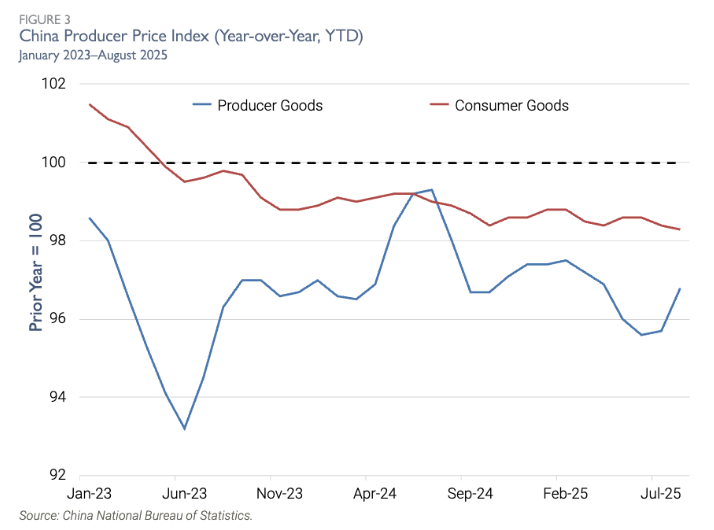
There is some evidence that the strategies outlined above are showing some signs of success, at least in the short run. Figure 3 shows the producer price index for goods used in production and for consumer goods. This index measures the prices that manufacturers receive for their goods at the “factory gate.” Producer prices in China have been falling for almost the entire period since the country reopened after the pandemic. The reasons behind these falling prices are complex, stemming from excess investment in productive capacity and involuted industries. This suggests that Chinese companies are driving prices even lower in response to competitive pressures at home and tariffs abroad.
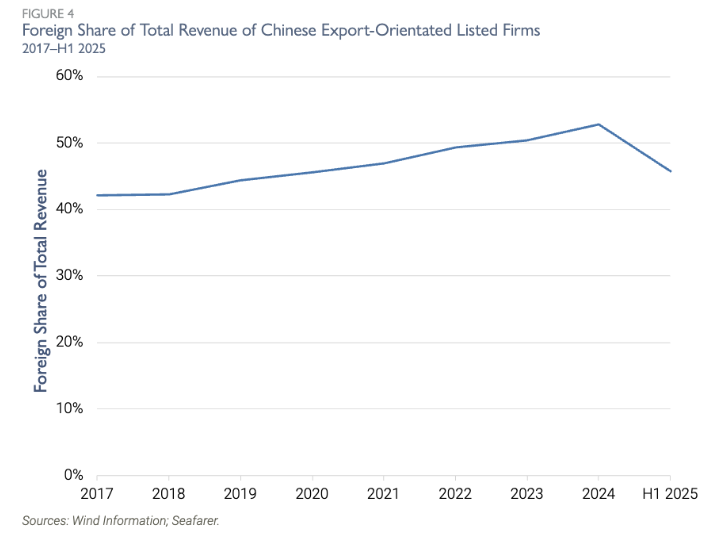
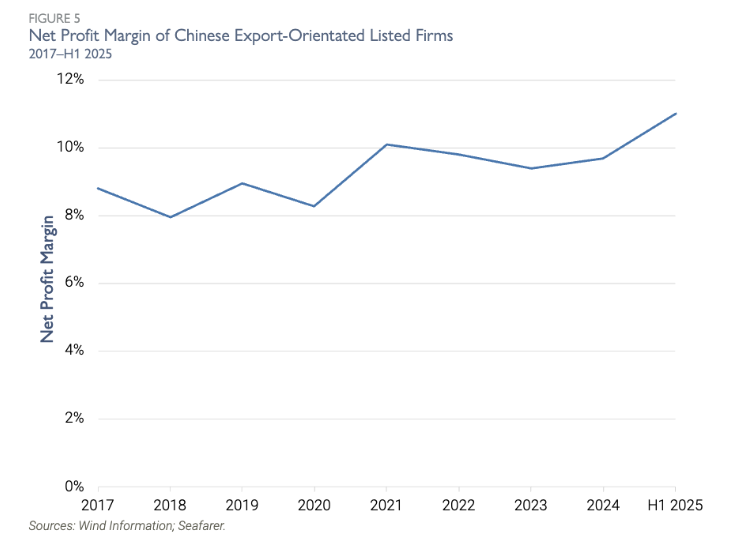
Another indicator of success is that the overseas income and profit margins of export-focused firms have proven more resilient than expected. Wind Information tracks an index of 129 listed Chinese firms across a variety of industries that have large overseas businesses.9 Figure 4 shows that the foreign income share of total revenue for this group of firms has generally increased since the start of the trade war in 2017, although the first half of this year shows a downturn.
Figure 5 shows that the net profit margin for this group of firms has actually edged upward since 2017, even amid the headwinds of this year.
The data so far show that for this group of Chinese export-focused firms, the trade conflict has not led to a collapse in their foreign revenue or profit margins.
How Long Can it Last?
At what point do tariffs and other trade barriers become insurmountable? There is undoubtedly a “tariff tipping point” beyond which even the most competitive Chinese firms cannot overcome. This tipping point has already been reached for several categories of Chinese exports to the U.S. Even before the trade war, Obama-era tariffs on Chinese solar panels caused exports to the U.S. to collapse from over 50% to just above 10% of total solar imports.10 Further solar tariffs pushed Chinese exports down to essentially nothing. The U.S. government has also implemented a preemptive “tipping point” tariff for electric vehicles. The Biden administration’s 100% tariff on Chinese EVs has effectively blocked any exports from China in that sector.11 Raising the barriers even further, the U.S. government has also threatened to take steps to block Chinese EV companies exporting to the U.S. from third countries.12
Confronted with growing trade barriers across the world, Beijing is focused on two strategies to respond to this challenge. First, the Chinese government is pursuing a comprehensive strategy to lower domestic manufacturing costs, helping Chinese exporters remain competitive. Policymakers have prioritized reducing energy expenses through energy market reforms and a massive expansion of clean energy capacity.13 Heavy investment in the country’s infrastructure has cut logistics costs, while local governments have established vast industrial parks that provide manufacturers with inexpensive land.14 Beijing has deployed a range of funding mechanisms, including government investment funds, central bank relending facilities, and policy bank loans, to lower the cost of capital for manufacturers. The securities regulator has loosened listing requirements for high-tech manufacturing startups, allowing them to go public without strict profitability criteria.15 Over the past several years, the government has also reduced taxes, fees, and employer social insurance contributions, along with offering incentives to upgrade industrial equipment. Collectively, these measures represent a significant and sustained effort by Beijing to drive down the overall cost of production.
None of these measures will make much difference if the world shuts its doors to Chinese exports. Therefore, Beijing’s second strategy is to use its economic and geopolitical influence to punish and pressure countries that impose trade restrictions on China. For example, when Sweden moved to restrict Huawei and ZTE equipment from its 5G networks, the Swedish company Ericsson soon saw its sales in China plummet.16 In response to proposed E.U. tariffs on Chinese EVs, Beijing threatened to impose high tariffs on European car imports into China.17 Pressure from China was so strong that German auto firms, perhaps those with the most to lose from Chinese EV imports, began lobbying against the EV tariffs out of fear that Beijing would harm their business operations in China.18 When the tariffs were implemented, China responded by targeting European countries that had supported the tariffs with punitive measures on their exports, including pork and brandy, and by launching an investigation into European dairy exports.19 During the U.S.-China trade war, China has used its position as a major source of demand for certain products, such as soybeans, as a point of negotiating leverage. U.S. companies with business in China, such as Qualcomm and Illumina, have also found themselves subject to investigations and market bans.20
The largest escalation of this tactic has been Beijing’s new effort to wield its control over key resources, notably rare earths, as a source of economic leverage. In response to continued trade conflict with the U.S., Beijing announced a major extraterritorial expansion of export controls in October 2025 on goods using Chinese rare earths.21 Because rare earths are a critical input for many high-tech products, this gives Beijing significant influence over global production. The Chinese government is sending a clear message that it will use its own sources of leverage to counter what it views as growing foreign trade protectionism.
Beijing can use its economic influence to keep foreign export markets open, but there are limitations to this strategy. One of the main limitations is that China’s unbalanced trading relationships with much of the world have led more countries to view their economic relationship with China in zero-sum terms. In 2023, an astounding 150 countries ran a goods trade deficit with China.22 In the face of ever-growing Chinese exports, many countries see additional trade barriers as the only way to protect their domestic industries from being wiped out. Therefore, the extent to which Beijing can continue to keep global markets open to Chinese companies amid increasing foreign economic backlash remains highly uncertain.
Nicholas Borst is Vice President and Director of China Research at Seafarer Capital Partners, LLC.
The views and information discussed in this commentary are as of the date of publication, are subject to change, and may not reflect Seafarer Capital Partners’ current views. The views expressed represent an assessment of market conditions at a specific point in time, are opinions only, and should not be relied upon as investment advice regarding a particular investment or markets in general. Such information does not constitute a recommendation to buy or sell specific securities or investment vehicles. The subject matter contained herein has been derived from several sources believed to be reliable and accurate at the time of compilation. Seafarer does not accept any liability for losses either direct or consequential caused by the use of this information.
As of September 30, 2025 Seafarer’s client accounts did not own shares in the securities referenced in this commentary.
1 Swanson, Ana, and Alexandra Stevenson. “Will Trump’s Tariff Deal Tilt the Playing Field Back Toward China?” (https://www.nytimes.com/2025/11/02/business/economy/trump-tariff-deal-china.html) The New York Times, November 2, 2025.
2 Source: CEIC Data. Data as of October 21, 2025.
3 Source: CEIC Data. Data as of October 21, 2025.
4 Source: CEIC Data. Data as of October 21, 2025.
5 “Announcement of Annual Results for the Year Ended December 31, 2024” (http://ir.chervongroup.com/projectimg/250326QO0EA3NV.pdf) Chervon Holdings Limited, March 26, 2025.
6 Hollister, Sean. “DJI’s Back-to-back Osmo Pocket 3 Price Hikes Take It From $519 to $799 in Two Months” (https://www.theverge.com/tech/659791/dji-osmo-pocket-3-price-hike-tariffs) The Verge, May 1, 2025.
7 “Midea Bets on Innovation, Global Expansion as Trade Headwinds Rise” (https://www.caixinglobal.com/2025-04-21/chinese-appliance-giant-tops-56-billion-annual-revenue-as-it-leans-into-obm-strategy-b2b-growth-and-ai-powered-transformation-amid-rising-geopolitical-risks-102311502.html) Caixin Global, April 21, 2025.
8 Fu, Claire, and Daisuke Wakabayashi. “Chinese Automakers Tell Suppliers to Cut Costs as Price War Deepens” (https://www.nytimes.com/2024/11/27/business/byd-china-electric-vehicles.html) The New York Times, November 27, 2024.
9 See the Wind Export-Oriented Enterprises Concept Index (an index of listed Chinese firms across a variety of industries that have large overseas businesses. Index code: 8841070.WI. It is not possible to invest directly in an index.).
10 Robinson, Quill, and Ryan Featherston. “Assessing the United States’ Solar Power Play” (https://www.csis.org/analysis/assessing-united-states-solar-power-play) Center for Strategic and International Studies, July 1, 2024.
11 Cordes, Nancy, and Kathryn Watson. “Biden Announces New Tariffs on Chinese EVs, Semiconductors, Solar Cells and More” (https://www.cbsnews.com/news/biden-to-announce-new-100-tariffs-on-chinese-evs/) CBS News, May 14, 2024.
12 Boak, Josh. “U.S. Suggests Possibility of Penalties if Production of Chinese Electric Vehicles Moves to Mexico” (https://apnews.com/article/biden-tariffs-ev-china-mexico-tai-809b0e27339d38dcd3834d2cbb14e1d1) AP News, May 14, 2024.
13 “China’s Power Prices Nosedive in Relief to Tariff-hit Factories” (https://www.straitstimes.com/business/economy/chinas-power-prices-nosedive-in-relief-to-tariff-hit-factories) The Straits Times, June 5, 2025.
14 Jing, Wang, and Denise Jia. “China’s Cities Offer Rent-Free Industrial Parks in Battle to Lure Startups” (https://www.caixinglobal.com/2025-08-21/chinas-cities-offer-rent-free-industrial-parks-in-battle-to-lure-startups-102353797.html) Caixin Global, August 21, 2025.
15 Cheung, Rachel. “Chinese Companies Are Looking to List Again: Profits Not Required” (https://www.thewirechina.com/2025/10/19/chinese-companies-are-looking-to-list-again-profits-not-required-china-ipos/) The Wire China, October 19, 2025.
16 Woo, Stu. “Ericsson Warns China Backlash Threatens Its Market Share” (https://www.wsj.com/business/telecom/ericsson-warns-china-backlash-threatens-its-market-share-11626440735) The Wall Street Journal, July 16, 2021.
17 “Chinese Automakers Seek Retaliatory Tariffs on EU Cars, State Media Reports” (https://www.reuters.com/business/autos-transportation/china-automakers-urge-beijing-raise-tariffs-large-gasoline-vehicles-imported-eu-2024-06-19/) Reuters, June 19, 2024.
18 “German Car Industry Urges EU to Drop Tariffs on China-made Cars” (https://www.reuters.com/business/autos-transportation/german-car-industry-urges-eu-drop-tariffs-china-made-cars-2024-07-03/) Reuters, July 3, 2024.
19 Trompiz, Gus. “China’s Retaliatory Tariffs to Squeeze EU Pork Producers” (https://www.reuters.com/world/china/chinas-retaliatory-tariffs-squeeze-eu-pork-producers-2025-09-10/) Reuters, September 10, 2025.
20 Kharpal, Arjun. “China Opens Antitrust Probe Into the U.S. Chip Giant Qualcomm” (https://www.cnbc.com/2025/10/10/qualcomm-shares-today-after-china-opens-antitrust-probe.html) CNBC, October 10, 2025.
21 Baskaran, Gracelin. “China’s New Rare Earth and Magnet Restrictions Threaten U.S. Defense Supply Chains” (https://www.csis.org/analysis/chinas-new-rare-earth-and-magnet-restrictions-threaten-us-defense-supply-chains) Center for Strategic and International Studies, October 9, 2025.
22 Matthes, Jürgen. “China’s Trade Surplus – Implications for the World and for Europe” (https://www.intereconomics.eu/contents/year/2024/number/2/article/china-s-trade-surplus-implications-for-the-world-and-for-europe.html) Intereconomics, Volume 59, 2024.
A message from Advisor Perspectives and VettaFi: Stay ahead of market changes with our daily updates on key market and economic indicators. Visit the AP Charts and Analysis site for our expert insights.
© Seafarer Capital Partners
Read more commentaries by Seafarer Capital Partners