Key Points:
- Roughly 20% of October layoff announcements were attributed to artificial intelligence (AI) alone. Overall, cost-cutting drove 33% of all layoff announcements.
- Interestingly, businesses are not reporting weaker economic conditions or slower sales as major reasons to announce layoffs.
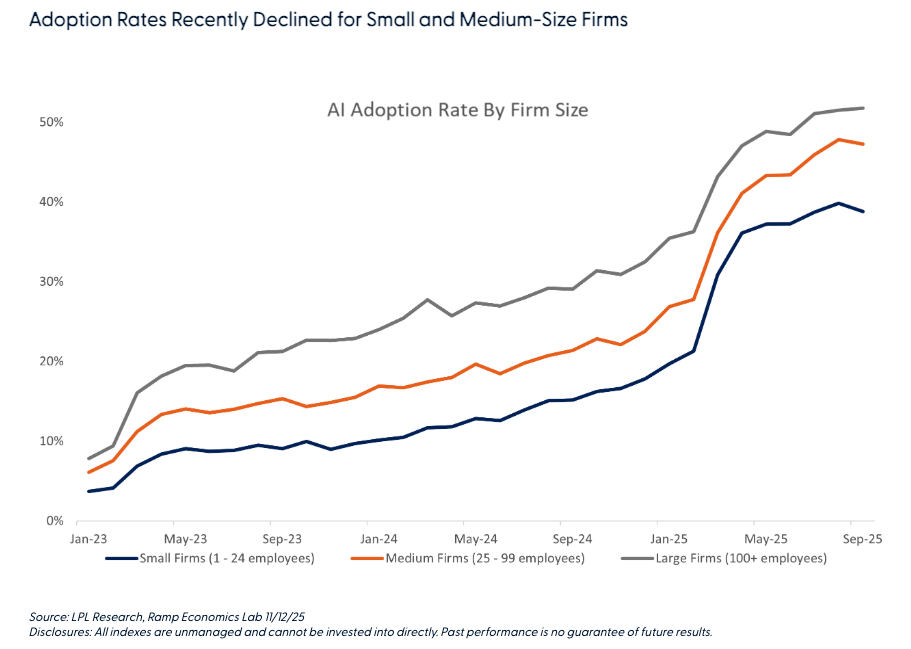
- Small and medium businesses have a lot more upside to AI adoption rates in the years to come.
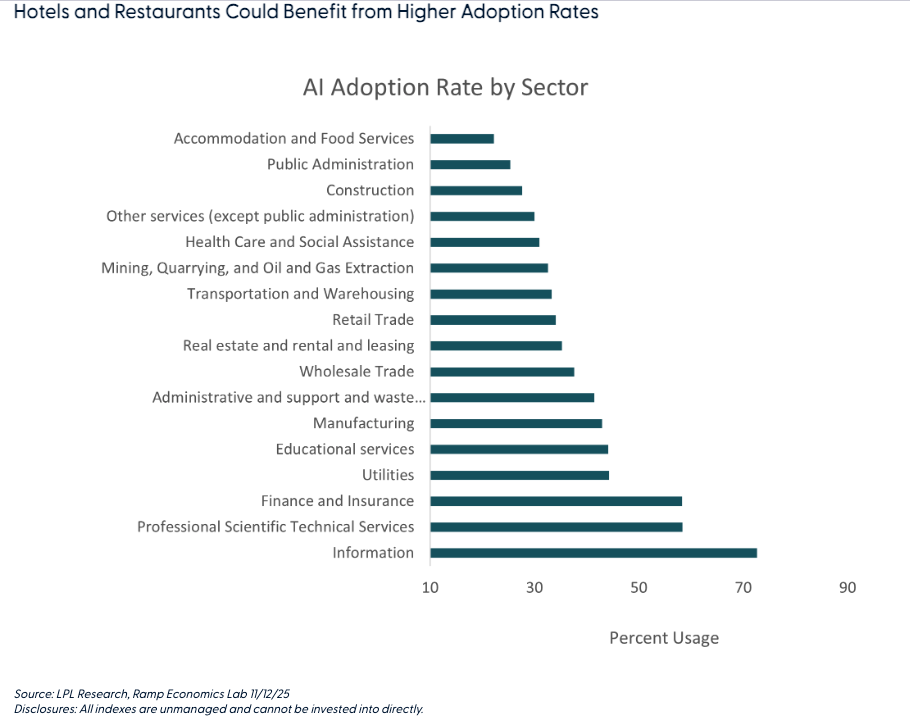
- Within sectors, healthcare and retail trade have surprisingly low adoption rates. Information and technical services are at the top.
Cutting Labor Costs by Increasing AI Adoption
As global labor arbitrage becomes less viable and access to cheap labor in emerging markets continues to narrow, businesses are increasingly turning to AI as a domestic solution for cost control and productivity gains. The recent spike in layoff announcements illustrates the pressure on businesses to curb costs, and it seems like businesses plan to increase AI adoption rates as they decrease headcount.
AI tools now offer companies the ability to automate routine tasks, streamline operations, and reduce reliance on large payrolls — without offshoring. From customer service bots to intelligent document processing and predictive analytics, AI is becoming the new workforce multiplier. In this environment, the competitive edge no longer comes from finding cheaper labor abroad, but from deploying smarter algorithms at home.
Tracking AI Adoption with Real Spend Data
The Ramp AI Index offers a new lens into how American businesses are adopting artificial intelligence, using actual spending data rather than just survey responses. Drawing from over 40,000 companies and billions in corporate transactions processed through Ramp’s card and bill pay platform, the index provides a real-time, data-driven view of AI adoption across industries.
Unlike surveys that rely on self-reported usage, the Ramp AI Index identifies AI adoption through verified transactions. When a business pays for an AI product or service — detected via merchant names and line-item details on receipts and bills — it’s counted as an adopter. This method captures actual engagement with AI tools, offering a more accurate and timelier picture of how firms are integrating these technologies into their operations.
Limitations and the Rise of Free AI Tools
While the Ramp AI Index provides a robust measure of paid AI adoption, it likely underestimates total usage. Many businesses experiment with free AI tools or allow employees to use personal accounts for work-related tasks, which don’t show up in transaction data. Still, the index represents a major step forward in understanding how AI is reshaping the business landscape — offering policymakers, investors, and analysts a clearer view of where and how AI is gaining traction.

In recent months, small and medium-sized firms have slowed the pace of AI adoption, but probably not for long. In the months before the government shutdown, the corporate sector was developing the economic outlook. It’s possible the temporary concerns about growth and inflation put a damper on adoption rates, but as the tailwinds to growth reemerge, we should expect renewed interest in protecting margins, preparing for expansion, and managing headcount through greater AI adoption.
It’s not surprising that the information and technical services sectors have high adoption rates, but the drop in adoption rates across sectors suggests some upside usage for several sectors.
Conclusion
There’s a growing number of AI products and services available, and as the ecosystem matures, these tools are becoming better aligned with the needs of businesses — delivering real, measurable value. Not only are the offerings improving in quality, but they’re also earning stronger customer loyalty, reflected in higher retention rates. At the same time, AI spending is increasingly being viewed as a core business expense. The question “What’s your AI strategy?” is no longer just a buzzword, it’s a serious expectation from investors, executives, and advisors who now see long-term investment in AI as essential to scaling operations and staying competitive.
A message from Advisor Perspectives and VettaFi: Interested in learning more about how bond ETFs can help diversify your portfolio? Click here to read more.
Important Disclosures
This material is for general information only and is not intended to provide specific advice or recommendations for any individual. There is no assurance that the views or strategies discussed are suitable for all investors. To determine which investment(s) may be appropriate for you, please consult your financial professional prior to investing.
Investing involves risks including possible loss of principal. No investment strategy or risk management technique can guarantee return or eliminate risk.
Indexes are unmanaged and cannot be invested into directly. Index performance is not indicative of the performance of any investment and does not reflect fees, expenses, or sales charges. All performance referenced is historical and is no guarantee of future results.
This material was prepared by LPL Financial, LLC. All information is believed to be from reliable sources; however LPL Financial makes no representation as to its completeness or accuracy.
Unless otherwise stated LPL Financial and the third party persons and firms mentioned are not affiliates of each other and make no representation with respect to each other. Any company names noted herein are for educational purposes only and not an indication of trading intent or a solicitation of their products or services.
Asset Class Disclosures –
International investing involves special risks such as currency fluctuation and political instability and may not be suitable for all investors. These risks are often heightened for investments in emerging markets.
Bonds are subject to market and interest rate risk if sold prior to maturity.
Municipal bonds are subject and market and interest rate risk and potentially capital gains tax if sold prior to maturity. Interest income may be subject to the alternative minimum tax. Municipal bonds are federally tax-free but other state and local taxes may apply.
Preferred stock dividends are paid at the discretion of the issuing company. Preferred stocks are subject to interest rate and credit risk. They may be subject to a call features.
Alternative investments may not be suitable for all investors and involve special risks such as leveraging the investment, potential adverse market forces, regulatory changes and potentially illiquidity. The strategies employed in the management of alternative investments may accelerate the velocity of potential losses.
Mortgage backed securities are subject to credit, default, prepayment, extension, market and interest rate risk.
High yield/junk bonds (grade BB or below) are below investment grade securities, and are subject to higher interest rate, credit, and liquidity risks than those graded BBB and above. They generally should be part of a diversified portfolio for sophisticated investors.
Precious metal investing involves greater fluctuation and potential for losses.
The fast price swings of commodities will result in significant volatility in an investor's holdings.
This research material has been prepared by LPL Financial LLC.
Not Insured by FDIC/NCUA or Any Other Government Agency | Not Bank/Credit Union Deposits or Obligations | Not Bank/Credit Union Guaranteed | May Lose Value
For Public Use – Tracking: #824382
Read more commentaries by LPL Financial