Here is a Solution That Uses Two Classical Money Management Approaches to Solve the Problem
Bitcoin’s Returns in Context
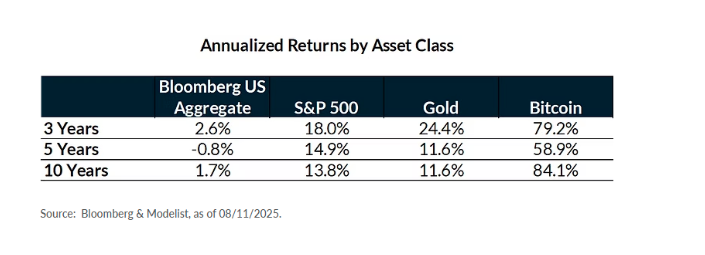
Over nearly every meaningful time frame, Bitcoin has dramatically outperformed traditional asset classes. In the last 3 years, it has returned an astonishing 79.2% annualized, compared to 18% for the S&P 500, 24.4% for gold, and just 2.6% for the Bloomberg U.S. Aggregate Bond Index. Extending the horizon to 5 years, Bitcoin has delivered 58.9% annualized versus roughly 14.9% for equities and 11–12% for gold, while bonds were slightly negative. Over the last decade, Bitcoin’s 84.1% annualized return dwarfs all major asset classes, underscoring both its powerful growth potential and the importance of managing its volatility.

Bitcoin’s Volatility
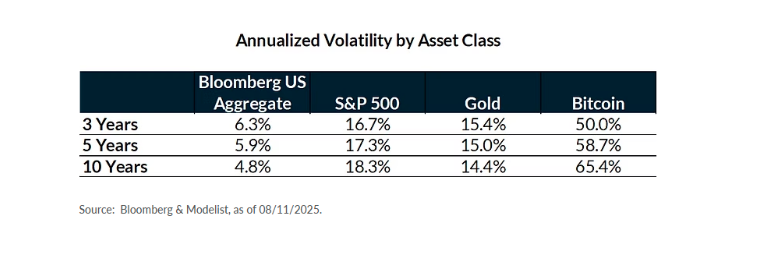
Bitcoin’s potential for outsized returns has captivated investors for over a decade—but so has its rollercoaster ride. Annualized volatility for Bitcoin has historically been in the 50–65% range, compared to about 16–18% for U.S. stocks, 5–6.5% for bonds, and 15% for gold. In other words, Bitcoin’s price swings can be three to four times more violent than equities and up to ten times more volatile than a core bond portfolio.
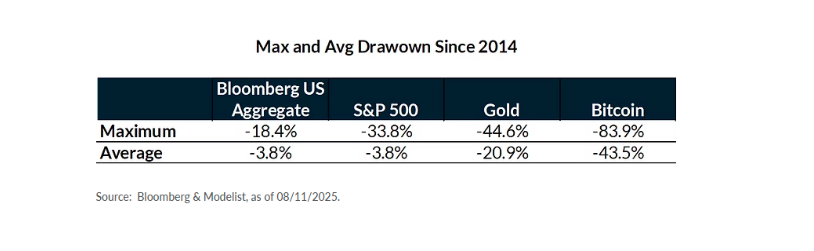
This volatility naturally leads to deeper drawdowns. Since inception, Bitcoin’s maximum peak-to-trough loss has been more than 80%—multiple times—while the S&P 500’s worst drawdown in modern history was about -55% during the 2008 financial crisis. Gold’s largest drawdown since 1970 sits near -45%, and U.S. bonds have never experienced more than about -15% in real terms. On average, Bitcoin’s drawdowns from recent highs are more severe and more frequent than traditional asset classes.
And yet, despite these gut-wrenching declines, Bitcoin has delivered exceptional long-term returns. Like equities, it has a positive expected return profile over the long run, and like gold, it is often viewed as a hedge against inflation or a devaluation of the U.S. dollar, and has no underlying cash flows. This dual identity—both a “risk-on” growth asset and a “hard-money” alternative store of value—makes it unique.
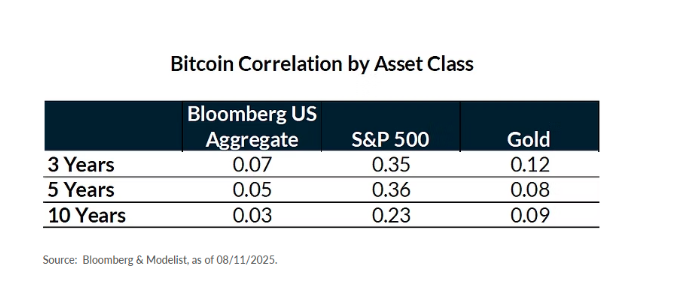
Bitcoin’s third defining trait is its relatively low correlation with other major asset classes. Over the last decade, Bitcoin’s correlation to stocks has generally been below 0.4, and to bonds and gold near zero. This means Bitcoin can potentially act as a portfolio diversifier, smoothing returns if managed properly. But its extreme volatility means it cannot simply be “plugged in” to a portfolio in the same way one would add bonds or gold without risk management.
Managing Bitcoin’s Volatility: Vol Targeting
The biggest challenge for investors isn’t Bitcoin’s long-term value proposition—it’s surviving its wild swings without being forced out at the worst times. For many portfolios, especially those built around a traditional 60/40 stock-bond mix, simply holding Bitcoin at its full natural volatility is too risky.
One approach to making Bitcoin more portfolio-friendly is volatility targeting—adjusting the position size to aim for a volatility level closer to that of equities (around 15–20% annualized) or even bonds (5–7%) depending on risk tolerance.
For example:
- If Bitcoin’s current volatility is 70% annualized, and an investor wants to match equity-like risk at 17% volatility, they would hold roughly 17 ÷ 70 = 24% of the “full” position size.
- If aiming for bond-like volatility at 7%, the allocation would shrink to about 7 ÷ 70 = 10% of the full size.
This scaling process keeps the risk contribution of Bitcoin in line with other portfolio components, preventing it from overwhelming the total portfolio risk budget. Vol targeting also has the psychological benefit of making Bitcoin’s inevitable drawdowns feel less catastrophic—turning an 80% loss in Bitcoin into something like a 20% hit on the position.
The downside of vol targeting is that it mutes the upside during big bull runs, but for many investors, this trade-off is worth it. The goal is not to chase Bitcoin’s full return potential in isolation, but to integrate it in a way that improves the overall portfolio’s risk-adjusted return.
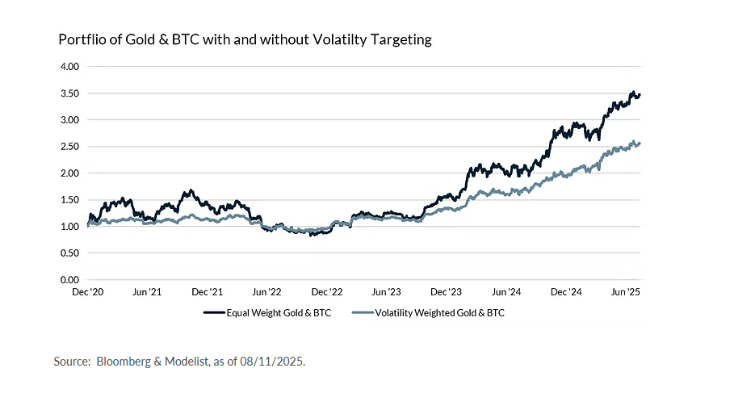
As an example, consider a portfolio that has an Alternatives allocation where it holds Gold and Bitcoin. One path would be to simply put equal % in both, and rebalance to equal weights, while the second option would be to downsize BTC so it had the same volatility as Gold and then put an equal vol allocation in each asset. These two portfolios are shown below since 2020. In the long run, the equal weight portfolio would come out ahead, but the vol target portfolio is a more pleasant ride. In 2022, with the first portfolio you lose 45% vs. 26% for the vol target portfolio. Your average loss over 5 years on any given day is around 11.6% in the equal weight vs. 5.7% for the vol target. In the end, your risk- adjusted returns are about 23% better when you vol target.
Timing Bitcoin with Momentum Strategies
Independent of volatility targeting, another challenge remains: timing. Bitcoin has experienced multi-year bear markets, where holding through the pain offered little reward until the next cycle.
This is where momentum investing techniques—rooted in decades of academic research—can help. Momentum strategies in equities and commodities have consistently shown that assets with strong trailing returns tend to outperform those with weak trailing returns in the near term.
Applied to Bitcoin, a simple rule is to stay invested when medium-term price momentum is positive and to step aside when it turns negative. For instance:
- Measure Bitcoin’s total return over the last 3, 6, or 12 months.
- If returns are positive, remain long.
- If returns turn negative, reduce or eliminate exposure until momentum recovers.
This approach won’t catch every bottom or sell at every top—momentum works by avoiding prolonged downturns, not short-term noise—but historically, it has helped sidestep Bitcoin’s deepest bear markets, while still participating in its strongest uptrends.
This systematic investing method shifts Bitcoin from a speculative gamble to a managed, rules-based allocation—making it easier to hold for the long run while avoiding the worst of its drawdowns.
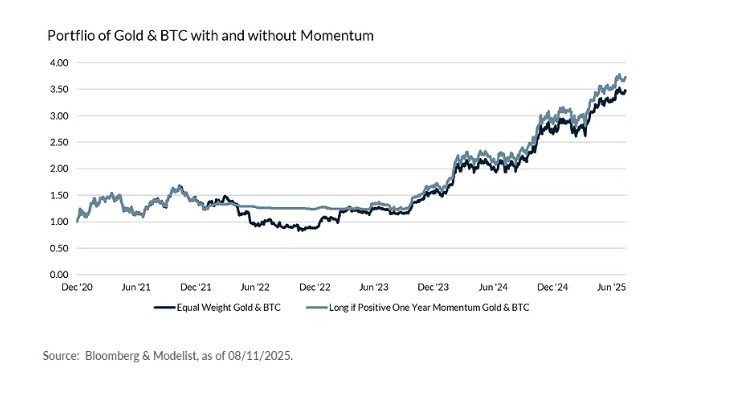
Using a slightly different example, we took the equal-weight portfolio and added a rule which says if Gold or BTC is up over the last year we hold the full allocation to that asset, otherwise we have no position. Now your max drawdown moves from 45% equal weight to 29%. In this case, there is not any loss of upside, but you have considerably reduced the downside, which means you or clients are more likely to stay invested and not panic or sell when a sell-off starts. Put another way, you have a more asymmetric payout with upside but with a method to contain the downside.
Final Thoughts
Bitcoin is no longer a fringe asset—it’s a maturing (though still volatile) market with unique characteristics: high potential returns, inflation-hedge qualities, and low correlations to other asset classes. But without a thoughtful approach, its volatility can overwhelm even seasoned investors.
The best way to invest in Bitcoin isn’t about trying to predict the next moonshot or crash. It’s about integrating it into a portfolio with purpose: scaling it to a risk level you can live with if you wish to integrate it with more traditional assets classes, or perhaps using momentum-based timing to stay invested during healthy market environments while sidestepping prolonged downturns in the context of a portfolio that contains a dedicated risky asset section.
When approached with discipline, Bitcoin can serve as both a growth booster and a diversifier—two traits that, over time, can improve a portfolio’s resilience and return potential.
Originally published at Modelist
For more news, information, and strategy, visit the ETF Strategist Content Hub.
Originally published on ETF Trends
Make the most of these insights using Modelist. We create customized investment models for the fiduciary financial advisor. Get in touch with us at [email protected] for a personal consultation.
Modelist Inc. is a registered investment adviser. Information presented is for educational purposes only and does not intend to make an offer or solicitation for the sale or purchase of any specific securities, investments, or investment strategies. All investments involve risk, including the risk of loss. Cryptocurrencies are highly volatile, speculative, and may not be suitable for all investors.
Performance figures presented are for informational purposes only and may not reflect the deduction of fees, expenses, or taxes. Past performance is not indicative of future results.
References to performance of other asset classes (e.g., equities, bonds, gold) are based on publicly available index data. Indexes are unmanaged, cannot be invested in directly, and are shown for comparison purposes only.
Any portfolio results, strategies, or case studies shown are based on historical backtesting or simulations and do not represent actual trading results. Backtested performance has inherent limitations, is designed with the benefit of hindsight, and does not guarantee future results.
Be sure to first consult with a qualified financial adviser and/or tax professional before implementing any strategy discussed herein.For additional information about Modelist Inc., please refer to our Form ADV Part 2.
© Modelist
More Fiduciary Rules Topics >