How the ACE framework nudges investors forward
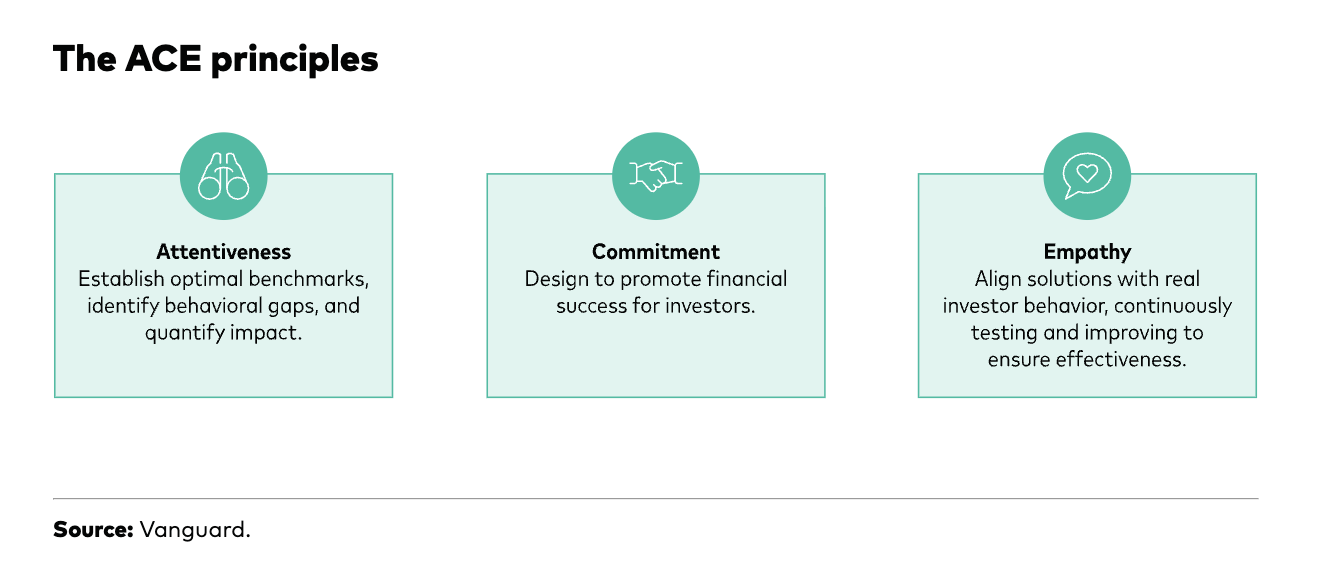
We believe that better investor decisions start with principled design. That’s why we developed the ACE framework—attentiveness, commitment, and empathy—to guide how we build digital experiences that help investors overcome behavioral barriers and stay on track for long-term success.
A nudge, or subtle prompt, can guide investors to make better decisions without limiting choice. The ACE framework blends intuitive design with behavioral science, creating digital experiences that gently steer investors toward stronger financial outcomes.
Just as important, the ACE framework helps us avoid design practices that can harm investors, even if unintentionally. Some digital platforms use techniques that make it easy to take actions that aren’t in investors’ best interests, or that add unnecessary obstacles for investors in managing their money. By following ACE, we set clear boundaries to prevent these kinds of confusing, frustrating, or even potentially manipulative designs. Instead, our focus is on empowering investors and supporting their financial well-being.

Attentiveness means understanding how investor behavior diverges from optimal benchmarks. We define ideal behaviors—such as consistent saving or diversification—and use models to benchmark them. Then we identify where investors fall short, such as having low engagement rates or poor asset allocation. We quantify how those gaps may affect outcomes using our proprietary frameworks (such as the Vanguard Life-Cycle Model or the Vanguard Asset Allocation Model) that guide personalized investment strategies and portfolio optimization across an investor’s lifetime. This proactive method leads to informed, targeted interventions and strengthens design practice.
Commitment is about designing digital experiences that actively support investor success while also ensuring a seamless experience. We prioritize features that promote long-term financial wellness and embed goal-oriented nudges. We measure success not by clicks or daily engagement, but by whether investors are on track to reach their goals, stay diversified, minimize costs, and maintain discipline. Unlike designs that focus on short‑term activity metrics, ours has a scorecard that is centered on investor outcomes and progress.
Empathy ensures that our experiences reflect how investors really think and behave. Beyond clear language and progressive disclosure of information, we simplify choices, use helpful defaults, break decisions into manageable steps, and provide timely prompts and guidance. These strategies help investors take action confidently, no matter their financial background. Continuous testing and refinement help us meet investors where they are, supporting better decisions and long-term financial well-being. Designs that overlook empathy risk disadvantaging investors by assuming they always make perfect decisions and pay full attention. This can lead to experiences that don’t match real investor behavior, resulting in less optimal financial outcomes.
“We implement behavioral designs to empower investors to make better-informed decisions,” said Xiao Xu, Ph.D., Vanguard investment strategy analyst and lead author of Principles for Behavioral Design: Nudging for Better Investor Outcomes. “By embedding ACE into our platforms, we’re not just making investing easier. We’re helping more people achieve better financial outcomes.”
Smart design helps investors stay on track
The financial industry often overwhelms investors with complex choices, dense jargon, and unclear trade-offs—conditions that amplify issues such as present bias, inertia, and low financial literacy. Thoughtful design can counter these challenges and empower better decisions.
Present bias causes investors to focus on short-term rewards rather than long-term gains. We counter this by offering tools that let investors commit to future goals, using reminders and visuals to highlight long-term benefits, and framing choices in ways that encourage thinking ahead.
Inertia and the tendency to delay decisions can be especially damaging. That’s why we use smart defaults, automation, and timely nudges to help investors take action with less hassle.
Low financial literacy is another barrier. We offer education through tooltips, videos, and FAQs; simplify complex steps; and use visuals to make things easier to understand.
When there’s too much information or there are too many choices, it’s easy for investors to tune out or make decisions they later regret. We make things simpler by using clear language, putting the most important messages up front, clustering options in a meaningful way, and sharing details only when they’re needed.
By designing simpler experiences that support better choices, we help investors overcome barriers and move confidently toward their financial goals.
Behavioral insights guide smarter investor choices
To help investors make better decisions, Vanguard applies the ACE framework in designing digital experiences. We use optimal behavioral benchmarks to guide product development, align features with long-term success, and refine designs based on real user behavior.
Vanguard’s behavioral research teams use attentiveness to identify where investors may fall short, such as when they save inconsistently or leave assets in cash for years rather than investing the assets in the market. The teams design targeted nudges to close these gaps. Reminders and automated investing options have helped clients contribute billions of dollars more to IRAs and move billions out of cash and into diversified portfolios. By addressing behavioral gaps caused by inertia and limited attention, these interventions have delivered measurable improvements in retirement readiness and long-term outcomes.
Commitment and empathy further strengthen these results. Vanguard’s digital experiences embed prompts for features such as the MinTax cost basis method, which guides investors toward smarter, tax-efficient trades without disrupting the trading experience. Empathetic design also simplifies complex choices and addresses misconceptions, making it easier for investors to take action. Together, these principles ensure that every design decision supports real investor progress and financial well-being.
“Behavioral design creates meaningful support,” Xu said. “By applying the ACE framework, digital platforms can help investors make better decisions, improve outcomes, and build trust.”
The goal is not just usability, but lasting impact. By putting behavioral insights into action, we help investors build confidence, make smarter choices, and move closer to their financial goals.
Note: All investing is subject to risk.
A message from Advisor Perspectives and VettaFi: Did you know that we provide daily updates when key market and economic indicators change? Visit the AP Charts and Analysis site to get our expert insights.
© Vanguard
Read more commentaries by Vanguard