Is It a Good Time to Consider Japanese Stocks?
Membership required
Membership is now required to use this feature. To learn more:
View Membership BenefitsInvestors have ample reason to consider Japanese stocks—primarily the combination of earnings growth, reforms to improve corporate governance and capital management, and attractive valuations. Additionally, volatility stemming from changes in the government, Bank of Japan activities, and tariffs may create potential opportunities for stock investors.
Exiting 30 years of deflation
In the years following the COVID-19 pandemic, inflation increased worldwide, including in Japan, where that shift from long-term deflation has had significant implications. During a deflationary mindset, consumers postpone purchases in hopes of lower prices in the future, which tends to slow demand and economic growth. An inflationary mindset has the opposite effect.
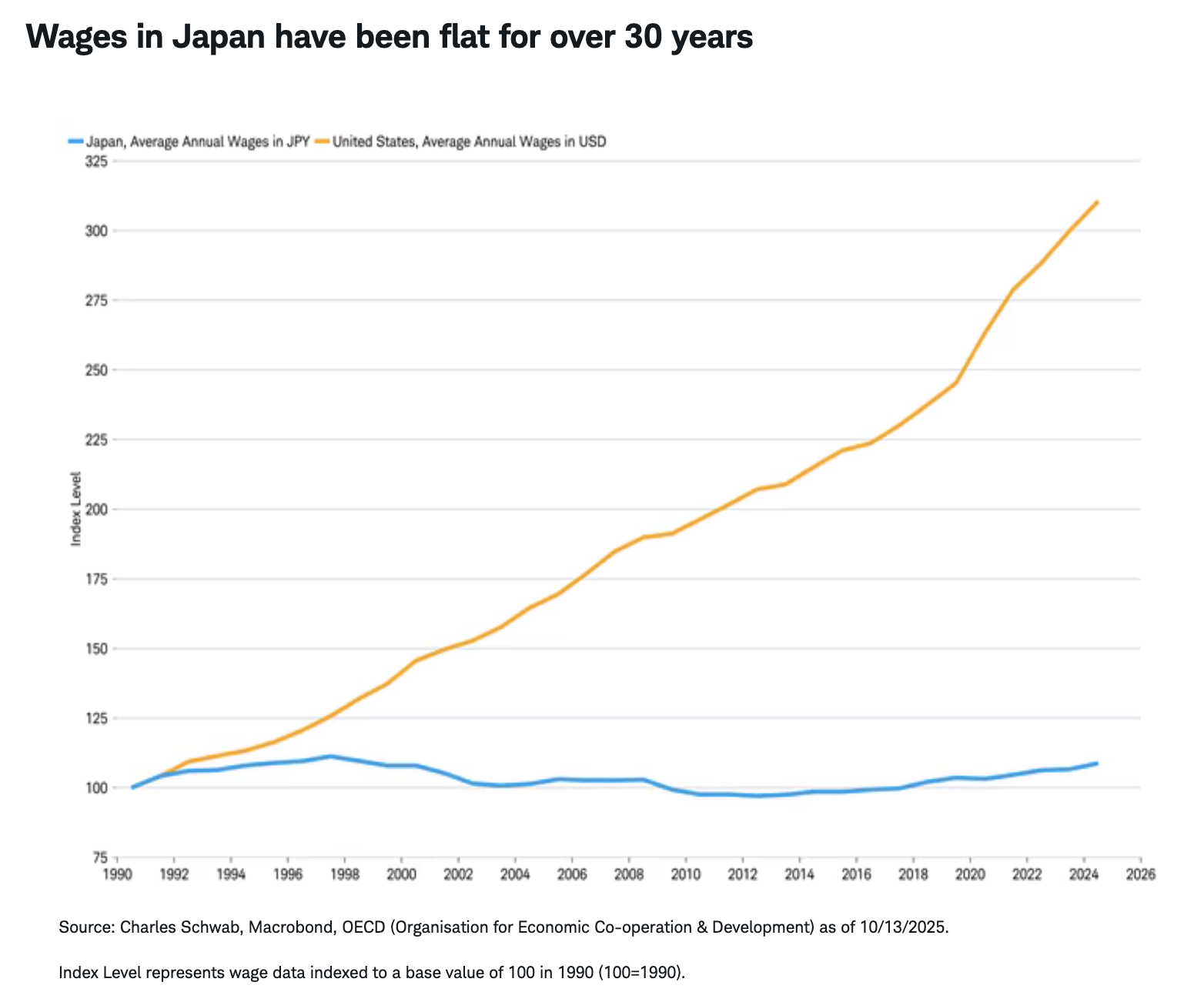
Wage growth is key to breaking the cycle of deflation. When wages rise faster than inflation, consumers tend to have greater purchasing power and spend more, which helps to increase corporate revenues, enabling the expansion of business investment and hiring. The chart below shows the stark difference in wage growth over time between Japan and the U.S. Japanese wages remained stagnant for decades; only recently have they started to rise as labor unions have demanded higher pay in response to inflation.
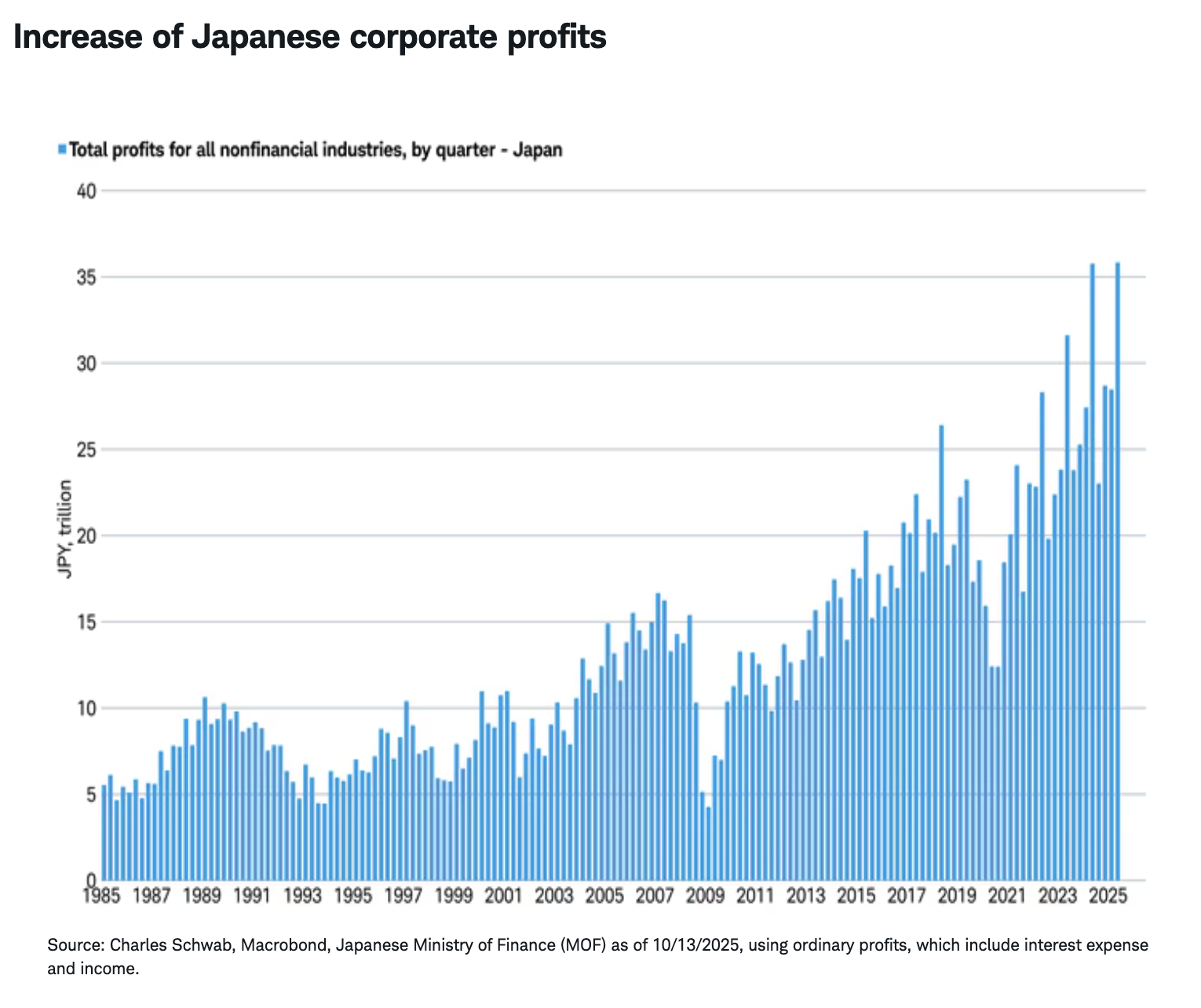
Nonfinancial corporate profits are growing
The shift to inflation has allowed Japanese companies to raise prices and grow revenues. Profit margins are also increasing, supported by a combination of: a weak yen, which has made Japanese exports more attractive; the relocation of companies' offshore operations to lower-cost areas; and the divestiture of low-margin businesses in response to shareholder-friendly reforms.
Shareholder-friendly reforms
Reforms instituted in 2023 by the Tokyo Stock Exchange (TSE) created a structural change in attitude toward shareholders and initiated a cycle that is increasing the value of companies.
For many years, Japanese companies posted low returns on their capital, often sitting on hordes of cash. Companies spent years paying down debt accumulated during the excesses of the 1980s, and the resulting reduction in interest expense, as well as lack of investment, allowed cash balances to grow. High levels of cross-shareholdings—where firms have large stakes in each other—allowed companies to become insulated and resist the influence of outside shareholders.
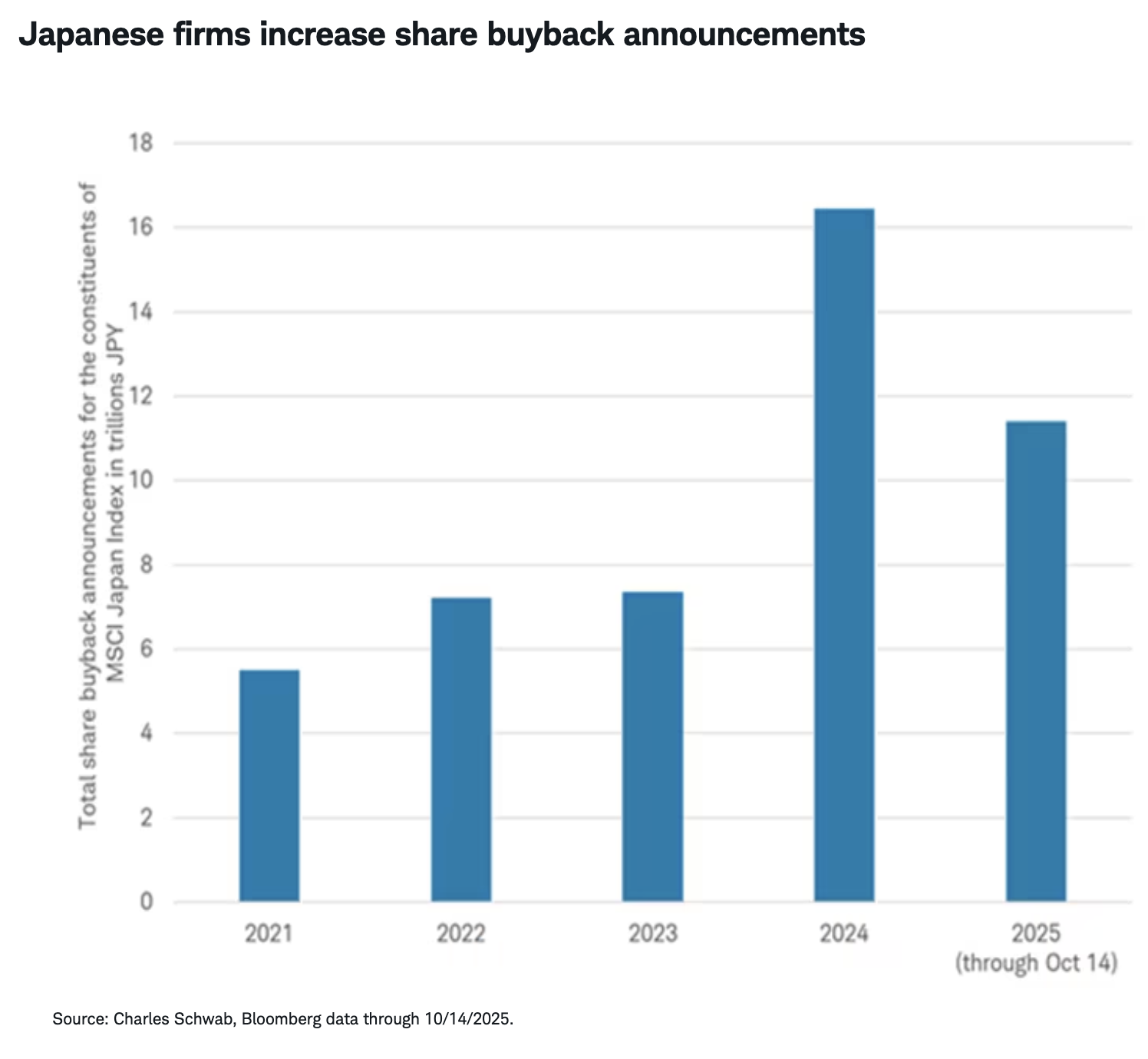
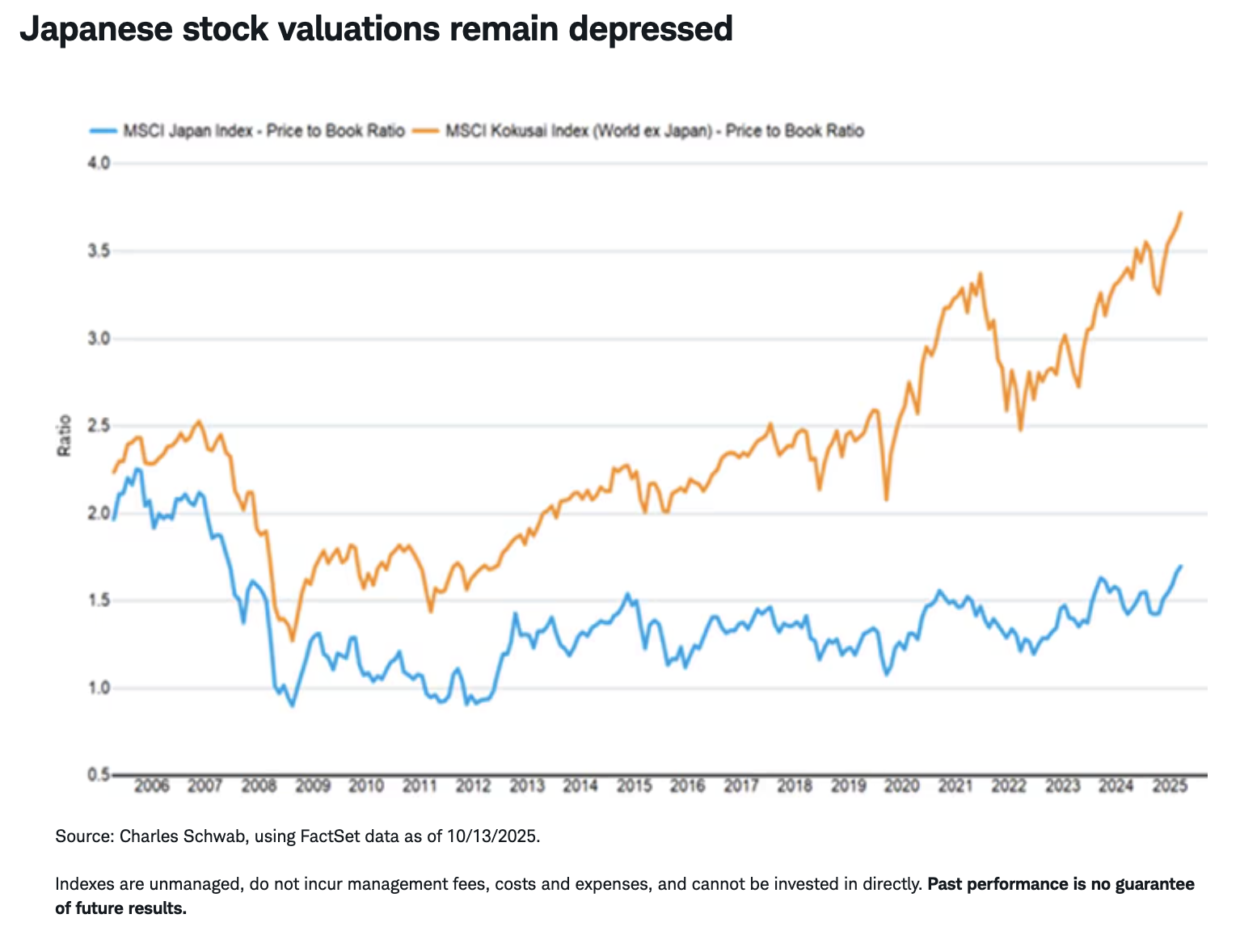
In March 2023, the TSE's "Action to Implement Management that is Conscious of Cost of Capital and Stock Price" sparked reforms to improve the low returns of Japan's listed companies. Specifically, the so-called action required companies listed in the Prime and Standard sections of the exchange to increase their price-to-book (P/B) ratio (the metric that measures a company's market value relative to its book value) above 1.0. A price-to-book ratio below 1.0 typically is a sign that investors are valuing the company at less than its book value or the company needs to improve profitability. Prior to 2023, the book value—the value of a company's assets minus its liabilities—on the balance sheets of Japanese firms had ballooned, pushing the P/B ratio for many listings below 1.0. Companies can increase their P/B ratio by reducing the denominator, lowering the book value of the company by distributing cash via stock buybacks or dividends. In 2024 and 2025 (year to date) there was a significant uptick in the size of announced stock buybacks, as seen in the chart below. The value of share buybacks in Japan exceeded the value of new share issuance in 2023 and 2024, according to investment-research firm Nomura.
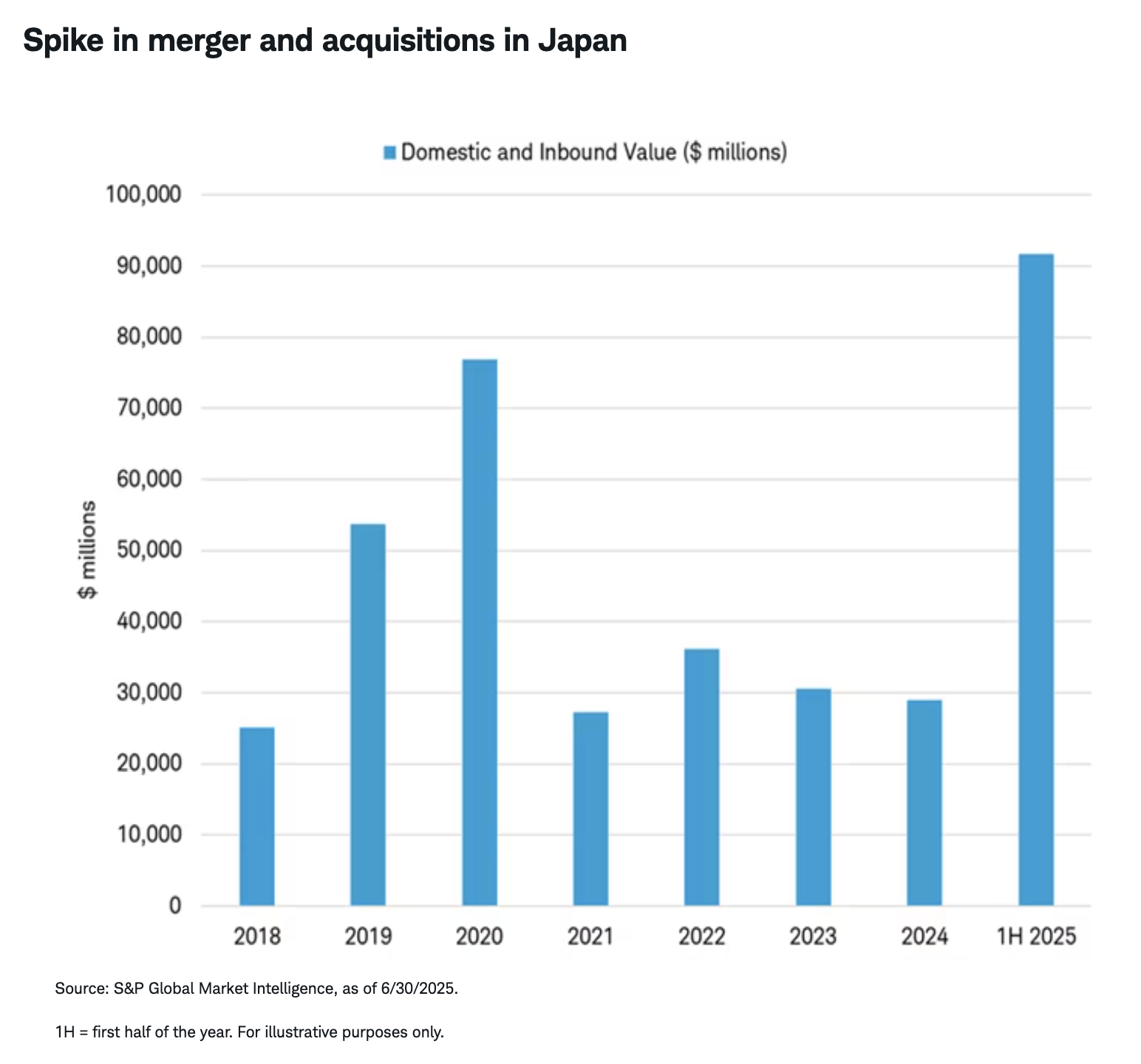
Corporate governance reform has also been catalyzed by government actions to increase transparency and reduce cross-shareholdings. The market-oriented and governance reforms have enabled activists to push management teams into value-creating activities like returning cash to shareholders, divesting underperforming divisions and assets that are not core to the business, as well as acquisitions to consolidate industries or pursue new growth markets. Mergers and acquisition (M&A) activity has spiked in the first half of 2025.
The TSE continues to enhance shareholder-friendly reforms. In April 2025, the TSE proposed stricter listing criteria starting in 2030 for companies on the Growth section of the exchange. Although valuations for Japanese stocks have increased because of these reforms, they remain low relative to the rest of the world, suggesting there may be room for further expansion.
Potential risks and areas to watch
The recent change in leadership of Japan's government creates some uncertainties over fiscal spending. Japan's government debt-to-GDP ratio is currently over 200%; any additional increase in the fiscal deficit may prompt investors to demand higher yields on longer-term Japanese government bonds (JGBs). Volatility in the JGB market has historically tended to spill over into the currency and Japanese stock markets. Specifically, Japanese banks, which make up almost 10% of the MSCI Japan Index, could be exposed to losses on their holdings of JGBs.
The Bank of Japan (BOJ) meets at the end of October and may decide to delay an interest rate hike, giving the central bankers time to assess the fiscal spending outlook under the new government. This decision may weaken the yen. Japanese stocks tend to have a negative correlation with Japan's currency, so a weaker yen may boost stock prices in the local currency. However, delaying hikes and allowing the yen to weaken could increase import inflation and intensify the need to hike rates in the future. A shift back to hiking rates could then strengthen the yen and weaken stocks.
With the potential for near-term volatility in the yen, investors may want to hedge currency when investing in Japanese stocks—but at the risk of limiting potential returns longer term. Hedging currency would mean keeping investments in yen rather than in U.S. dollars by using financial instruments to manage risks of exchange rate fluctuations, including exchange traded funds (ETFs) that provide this service as part of the investment. Keep in mind that hedging and protective strategies generally involve added costs, do not assure a profit, or guarantee against loss. Additionally, before considering any fund, you should consult the fund's prospectus to understand its investment objectives, risks, charges, and expenses. That said, the yen is historically weak and could appreciate longer term; U.S. investors who are unhedged would see greater benefit if the yen appreciates relative to the U.S. dollar.
The increase in U.S. tariff rates in 2025 could hinder exports to the U.S. or the ability for Japanese companies to utilize lower-cost manufacturing in countries such as Vietnam, reducing corporate profits. Additionally, profit margins would be impacted if wage growth exceeds the ability for companies to raise prices and if companies are unable to find ways to improve labor productivity to offset higher wages.
What this means for investors
We believe any near-term volatility related to changes in Japan’s government and Bank of Japan policy could create potential opportunities. With deflation in the rearview mirror, Japanese stocks could continue to post solid returns longer term due to the combination of earnings growth, corporate reforms to improve governance and capital management, as well as attractive valuations.
Heather O'Leary, Senior Global Investment Research Analyst, contributed to this report.
A message from Advisor Perspectives and VettaFi: Looking for a way to gain exposure to the evolving digital asset landscape? Learn about CoinShares ETFs.
This material is intended for general informational and educational purposes only. This should not be considered an individualized recommendation or personalized investment advice. The securities, investment products and investment strategies mentioned are not suitable for everyone. Each investor needs to review an investment strategy for his or her own particular situation before making any investment decisions.
All expressions of opinion are subject to change without notice in reaction to shifting market, economic, or political conditions. Data contained herein from third party providers is obtained from what are considered reliable sources. However, its accuracy, completeness or reliability cannot be guaranteed.
All corporate names and market data shown are for illustrative purposes only and are not a recommendation, offer to sell, or a solicitation of an offer to buy any security.
Investing involves risk, including loss of principal.
Past performance is no guarantee of future results.
Currency trading is speculative, very volatile and not suitable for all investors.
International investments involve additional risks, which include differences in financial accounting standards, currency fluctuations, geopolitical risk, foreign taxes and regulations, and the potential for illiquid markets. Investing in emerging markets may accentuate this risk.
Forecasts contained herein are for illustrative purposes only, may be based upon proprietary research and are developed through analysis of historical public data.
Fixed income securities are subject to increased loss of principal during periods of rising interest rates. Fixed income investments are subject to various other risks including changes in credit quality, market valuations, liquidity, prepayments, early redemption, corporate events, tax ramifications, and other factors.
The policy analysis provided by the Charles Schwab & Co., Inc., does not constitute and should not be interpreted as an endorsement of any political party.
Schwab does not recommend the use of technical analysis as a sole means of investment research.
Indexes are unmanaged, do not incur management fees, costs, and expenses and cannot be invested in directly.
The MSCI Japan Index is designed to measure the performance of the large- and mid-cap segments of the Japanese market. The index covers approximately 85% of the free float-adjusted market capitalization in Japan.
The MSCI Kokusai Index (also known as the MSCI World ex Japan Index) captures large- and mid-cap representation across Developed Markets countries (excluding Japan). The index covers approximately 85% of the free float-adjusted market capitalization in each country.
The Schwab Center for Financial Research is a division of Charles Schwab & Co., Inc
Membership required
Membership is now required to use this feature. To learn more:
View Membership BenefitsSponsored Content
Upcoming Virtual Events View All











