Artificial intelligence is poised to revolutionize healthcare. Its headline-grabbing potential in drug discovery is still years from materializing. However, its impact is already tangible in diagnostics and treatment selection. Leading this immediate charge is Tempus AI, a company focused on structuring the complex data needed to make personalized patient care a reality.
The inspiration for Tempus came after its founder’s wife was diagnosed with breast cancer. Her diagnosis exposed him to the healthcare system’s frustrating one-size-fits-all approach. This drove Eric Lefkofsky to create a company dedicated to personalizing treatment through data in 2015. That founding mission continues to guide Tempus’s strategy, which has accelerated dramatically since its IPO in June 2024.
The best way to describe Tempus is as a healthcare technology company building a comprehensive operating system for precision medicine. It integrates multimodal data from its own diagnostic services, including genomics, digital pathology, and hereditary screening, to provide immediate clinical insights for patient care. This vast, real-world dataset then fuels a powerful research platform that offers everything from licensed data to trial acceleration software for the pharmaceutical industry.
The Tempus Playbook: Building a Moat
Since going public in June 2024, Tempus has executed a multi-faceted strategy centered on creating a durable, competitive moat through targeted acquisitions and internal R&D initiatives. These moves are designed to accelerate the growth of an already strong business. Tempus generated $314.6 million in revenue in the second quarter of 2025, up 89.6% year over year. Furthermore, the FactSet analyst consensus for FY 2025 sales has been revised upwards by 36.2% over the last 365 days, with a 28.5% upward revision for FY 2026. Reflecting this momentum, the company’s stock has gained ~60% since being added to the ROBO Global Healthcare Technology and Innovation Index (HTEC) and the ROBO Global Artificial Intelligence Index (THNQ) in Q3 2024.

Source: VettaFi, based on Tempus investor communications.
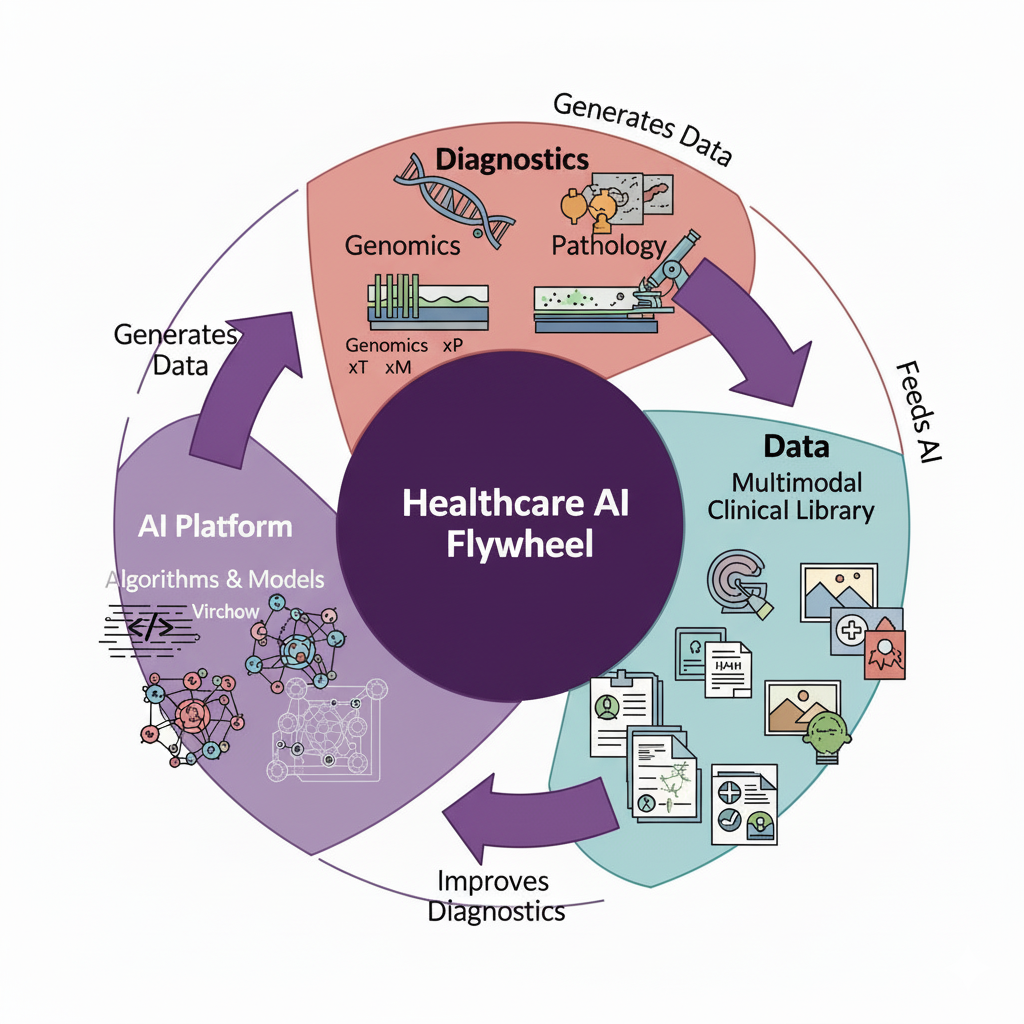
The $600 million acquisition of Ambry Genetics (November 2024) was a strategically significant move, instantly positioning Tempus as a leader in hereditary cancer screening. Crucially, it also provided a mature, revenue-generating business that accelerates the entire company’s path to profitability. Likewise, acquiring AI-pathology pioneer Paige (August 2025) was a key step to bolster its capabilities in digital imaging. Meanwhile, the Deep 6 AI (March 2025) purchase fortified its clinical trial capabilities. Together, these moves create a virtuous cycle: More diagnostics lead to more data, which in turn improves the AI.
High-value partnerships complement this strategy. The $200 million deal with AstraZeneca (April 2025) is particularly noteworthy, transforming Tempus’s vast data library from an internal asset into a high-margin, scalable product. This agreement validates their data’s immense value and establishes a powerful new revenue stream.
Beyond expanding the business, these moves serve a more critical purpose: reinforcing the company’s data advantage. Each acquisition provides a new, dedicated pipeline of structured clinical data. That data is used to refine Tempus’s AI models, directly improving their accuracy. This constant enhancement of its AI is what solidifies the company’s competitive edge.
What’s Next: Unlocking Trillion-Dollar Markets
For Tempus, the strategic pieces are in place. The next chapter is about monetization, with key catalysts on the horizon.
Source: Tempus management, Morgan Stanley Global Healthcare Conference (Sept. 2025).
Tapping the $60B Oncology Market
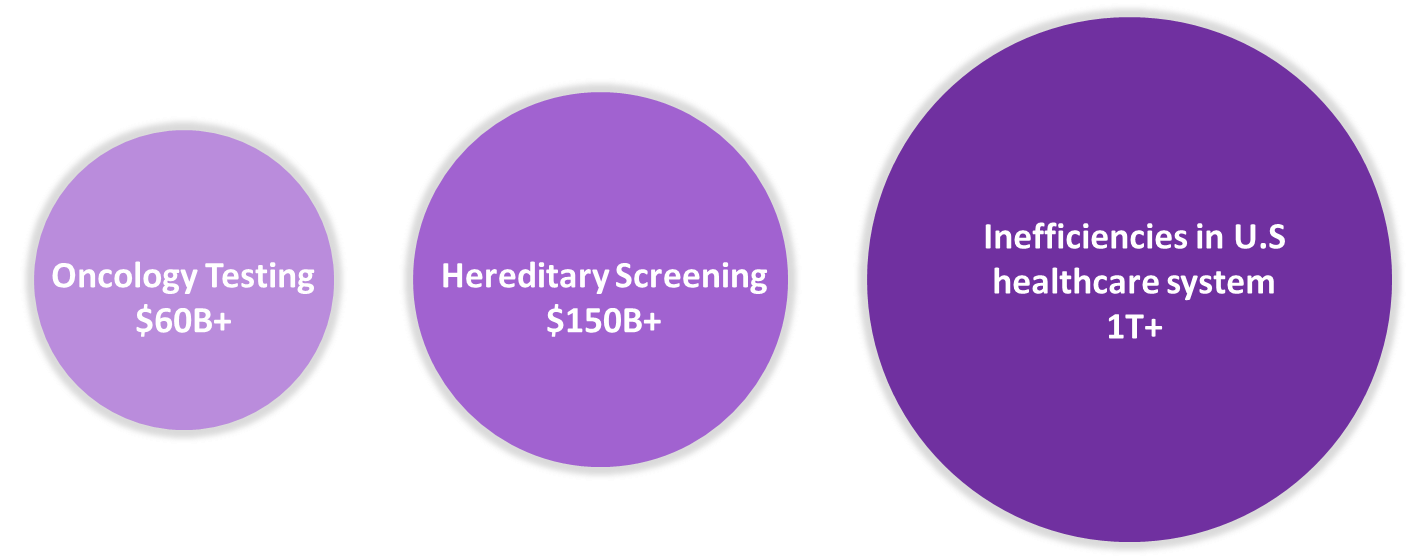
The company’s Minimal Residual Disease (MRD) tests are a key near-term catalyst. Tempus is currently limiting test performed pending reimbursement approval, which it anticipates securing by the end of 2025. Right now major insurance companies and government programs like Medicare don’t cover the cost of these tests for patients. This would position MRD as a significant growth driver in 2026 within the $60 billion oncology testing market.
Expanding Into Hereditary Screening
The acquisition of Ambry unlocks the vast hereditary screening market, an opportunity management believes could be 10 to 20 times larger than cancer sequencing in patient volume. This expansion targets a market estimated to be worth over $150 billion.
The Trillion-Dollar Prize: AI Reimbursement
The ultimate goal is securing broad reimbursement for its AI algorithms. CEO Eric Lefkofsky notes that AI has the potential to address “$1 trillion or $2 trillion” of inefficiency in the U.S. healthcare system. To unlock this value, companies must clear two major hurdles: regulatory approval and payer reimbursement.
Tempus is now showing significant progress on both fronts. On the regulatory side, the company recently received FDA (U.S. Food and Drug Administration) 510(k) clearance for its Tempus Pixel cardiac imaging platform, an AI-powered tool that enhances cardiac MR image analysis. This follows a promising precedent on the reimbursement side, where CMS (Centers for Medicare & Medicaid Services) is already reimbursing one of the company’s other cardiac algorithms at ~$128 per test.
Successfully navigating both the regulatory and reimbursement landscapes is critical. Scaling this two-pronged model of gaining approvals and securing payment would transform the business entirely.
Outlook
Tempus has demonstrated impressive operational discipline, significantly narrowing its losses and setting a clear course for profitability. Others talk about the future potential of AI. Meanwhile, Tempus is actively monetizing AI today, by turning data into revenue and diagnostics into a defensible business. The challenge ahead is one of execution. Its long-term success now hinges on navigating the complex reimbursement landscape and proving that its AI-driven insights are not just innovative, but indispensable.
Looking for regular updates? Subscribe here for weekly insights on robotics, AI, and healthcare technology, delivered straight to your inbox.
For more news, information, and analysis, visit the Disruptive Technology Content Hub.
THNQ is the underlying index for the ROBO Global Artificial Intelligence ETF (THNQ) and the L&G Artificial Intelligence UCITS ETF (AIAI.LN).
HTEC is the underlying index for the Robo Global Healthcare Technology & Innovation ETF (HTEC) and the L&G Healthcare Technology & Innovation UCITS ETF (DOCT.LN).
vettafi.com is owned by VettaFi LLC (“VettaFi”). VettaFi is the index provider for THNQ ETF, AIAI.LN, HTEC ETF and DOCT.LN, for which it receives an index licensing fee. However, THNQ ETF, AIAI.LN, HTEC ETF and DOCT.LN are not issued, sponsored, endorsed, or sold by VettaFi. VettaFi and its affiliates have no obligation or liability in connection with the issuance, administration, marketing, or trading of THNQ ETF, AIAI.LN, HTEC ETF and DOCT.LN.
A message from Advisor Perspectives and VettaFi: Discover something new! Click here to register for our upcoming webcasts.
More Robo Advisors Topics >