Impacting the federal workforce more than the deficit
DOGE was one of over 100 executive orders signed by President Trump early in his second term. As in his first term, some of these directives have been met with legal challenges. After courts questioned their legal authority, initial efforts by DOGE to repeal federal grants were reversed and fired employees reinstated.
Following DOGE recommendations, the Senate recently passed legislation rescinding $9 billion in spending appropriated to public broadcasting and foreign aid. Yet independent estimates of cumulative savings fall severely short of the $190 billion claimed on the DOGE website—let alone the $1 trillion to $2 trillion in savings initially pitched to the American public.
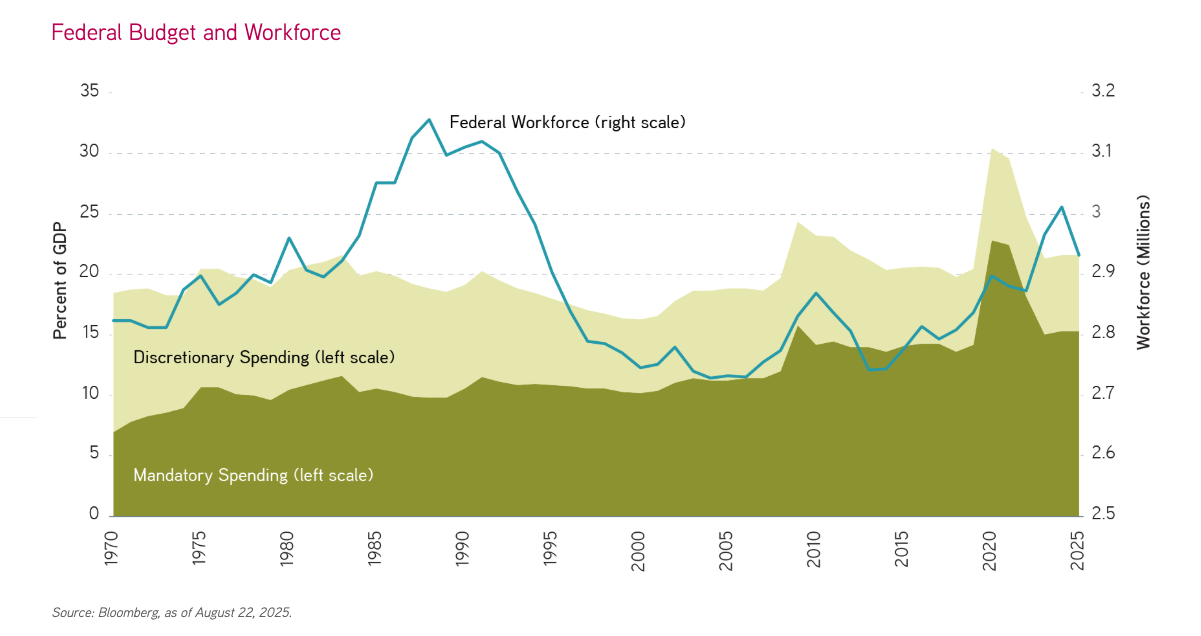
Courts will ultimately decide the degree of executive authority over federal agencies, but DOGE has already had a clear impact on the federal workforce. Announced federal jobs cuts spiked to an all-time high in March, while monthly job separations for federal workers recently hit the highest level in three years, according to JOLTS data. Initial cuts have focused on probationary workers, though 154,000—over 6% of the federal workforce excluding the postal service—have accepted deferred resignation packages. Reducing the federal workforce by 10% could save approximately $30 billion annually, assuming average wages and benefits.
Bear in mind that the allocation of government spending differs from, say, a software company. Wages and benefits account for less than 10% of the federal budget. When Peter Fischer, Treasury undersecretary during President George W. Bush’s administration, commented that the “US government is an insurance company with an army,” he had it just about right.
Mandatory spending is written into law, not subject to the annual appropriations process, yet comprises over 60% of federal spending—mainly for benefit programs like Social Security, Medicare and Medicaid. By contrast, non-defense discretionary spending was less than $1 trillion of the $6.75 trillion budget in 2024.1
Federal Budget and Workforce

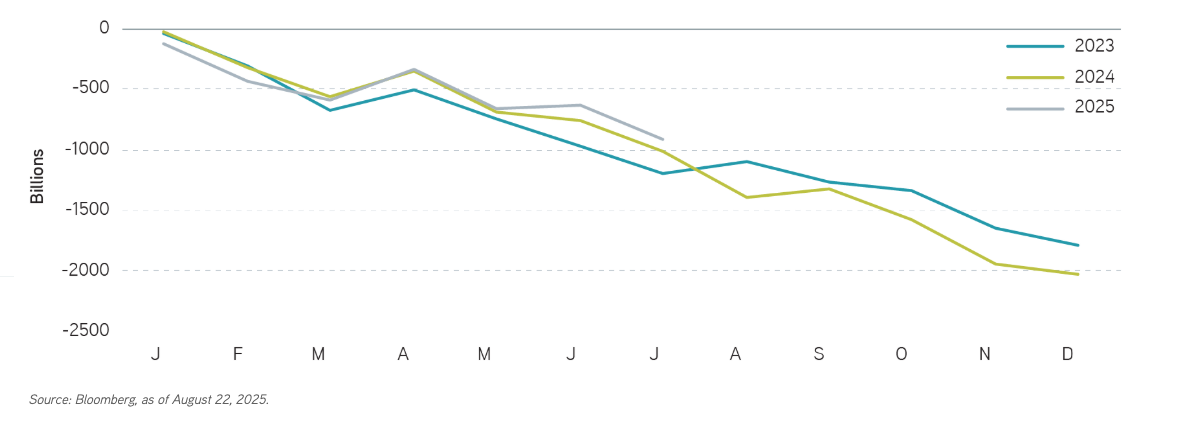
Previous administrations have also cut the federal workforce. For example, President Clinton oversaw a reduction of 400,000 federal jobs, offering $25,000 buyouts as part of a government-shrinking initiative. At the end of the Cold War, the Department of Defense (DOD) shed thousands of jobs. Now under DOGE, cuts have impacted thousands of federal employees, but with little discernible impact to monthly budget data or the US economy outside the Washington, DC beltway.
Cumulative Budget Deficit over the Last Three Years
Finding the low-hanging fruit
Politicians and the public have often groused about government excesses, applying the term broadly for different sets of spending, which we would distinguish from one another. There is waste, as in fraudulent payments during the COVID pandemic, there is legitimate spending that could be done more efficiently, and there is spending that may not align with certain political views, such as foreign aid. For the first two categories of waste and inefficiency, the annual “High-Risk List” from the Government Accountability Office (GAO) is a deep dive into areas for improvement.2
Fraudulent payments have declined from their COVID-era peak but remain staggeringly high. Over the last seven years, improper payments have exceeded $150 billion annually, costing the government an estimated $2.8 trillion since 2003. In 2024, the majority of this waste came from Medicare, Medicaid and the Earned Income Tax Credit (EITC).
To improve efficiency, the GAO has identified a total of 38 areas. The most critical are enhancing tax collection, reducing costs for high value procurements, rightsizing federal real estate holdings and upgrading technology.
In 2024, the IRS estimated a $696 billion tax gap for 2022—that is, the difference between taxes owed and taxes paid. Improving collections may help reduce that value over time, but DOGE attempts to cut the IRS workforce could be counterproductive. After all, the IRS includes some of the most cost-effective employees on government payrolls.
Historically, the government has struggled to manage costs in its $750 billion procurement portfolio, such as equipment and systems for defense and space programs. The GAO has singled out the DOD since 1990. Applying leading practices could yield billions in annual savings and reduce delays. Real estate holdings could be trimmed, too. Maintaining the government’s underutilized real estate portfolio costs over $10 billion annually, and deferred maintenance totaled $370 billion in 2024.
DOGE was created with a purpose to “implement the President’s DOGE Agenda, by modernizing Federal technology and software.”3 As highlighted by the GAO, the federal government spends over $100 billion annually on IT, with the majority spent on maintaining aging systems. AI offers great potential to improve legacy systems and reduce fraud in government payments. Combined, these efforts could have a significant impact on the budget, and cumulatively Congress has implemented over $750 billion in savings, writing recommendations from the GAO into legislation.
The bottom line
We are fortunate to have leaders from the private sector willing to apply their talents to such an important issue as federal spending. Challenges aside, allocating government dollars more optimally has the potential to strengthen our economy and our country. We believe efforts would be better spent targeting payment fraud, legacy systems and the government procurement process—not the workforce. In other words, no chainsaw is necessary.
1 Congressional Budget Office. The Budget and Economic Outlook: 2025 to 2035, January 2025.
2 Government Accountability Office. High-Risk Series: Heightened Attention Could Save Billions More and Improve Government Efficiency and Effectiveness, February 25, 2025.
3 The White House. Establishing and Implementing the President’s “Department of Government Efficiency,” January 20, 2025.
The views expressed in these posts are those of the authors and are current only through the date stated. These views are subject to change at any time based upon market or other conditions, and Parametric and its affiliates disclaim any responsibility to update such views. These views may not be relied upon as investment advice and, because investment decisions for Parametric are based on many factors, may not be relied upon as an indication of trading intent on behalf of any Parametric strategy. The discussion herein is general in nature and is provided for informational purposes only. There is no guarantee as to its accuracy or completeness. Past performance is no guarantee of future results. All investments are subject to the risk of loss. Prospective investors should consult with a tax or legal advisor before making any investment decision. Please refer to the Disclosure page on our website for important information about investments and risks.
A message from Advisor Perspectives and VettaFi: To learn more about this and other topics, check out some of our webcasts.
© Parametric
Read more commentaries by Parametric