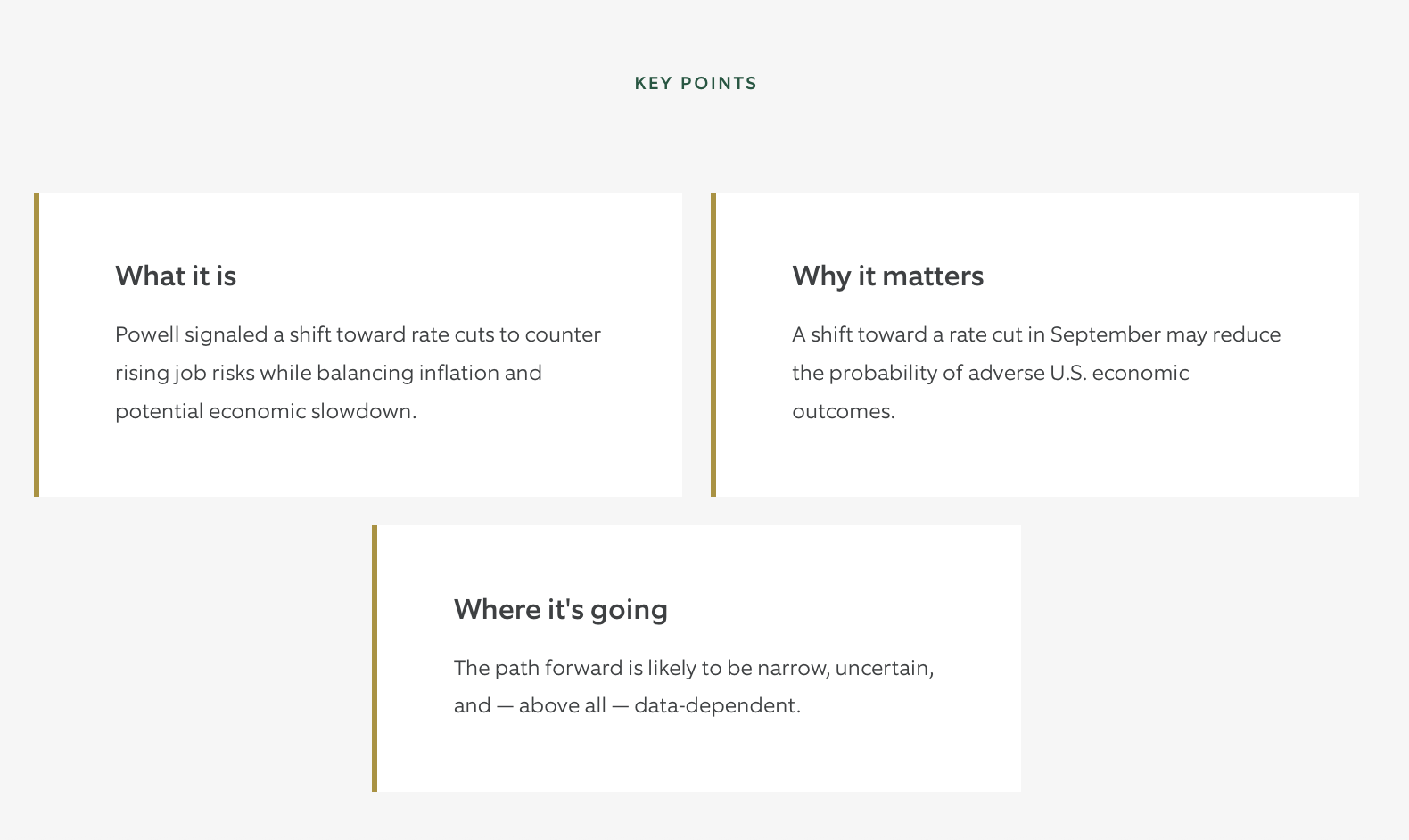
Federal Reserve Chair Jerome Powell’s remarks at the Jackson Hole symposium on Friday delivered a subtle but unmistakable shift in tone on the near-term direction of U.S. monetary policy. He acknowledged that the July employment report showed a slowing in job growth that was “much larger than assessed just a month ago” and that downside risks to employment “are rising”. More tellingly, while also acknowledging that risks to inflation remain “tilted to the upside”, he noted that “the baseline outlook and the shifting balance of risks may warrant adjusting our policy stance”.
Markets, always hyper-attuned to the faintest shifts in the wind, have swiftly recalibrated. A 25-basis-point rate cut at the September Federal Open Market Committee (FOMC) meeting is now our base case, and the pricing is explicit: futures markets have embedded this expectation with conviction. The FOMC’s restrictive policy stance, long justified by sticky inflation, is now being challenged by the prospect of rising unemployment.
Importantly, Powell’s pivot should also be viewed as a strategic move to mitigate the tail-risk of a hard landing. By shifting toward an easing stance, the Fed is not only addressing emerging employment threats but also lowering the probability of more adverse outcomes for U.S. economic activity — providing a backstop that reassures financial markets.
Recent economic data only reinforces the plausibility of this scenario. Over the past several weeks, the hard and soft indicators alike have painted a picture consistent with the oft-cited “soft landing”. Growth is cooling but not collapsing, demand is slowing in a controlled fashion, and inflation has retreated from the multi-decade highs that so alarmed policymakers last year. If ever there was a window to transition toward a more balanced monetary stance, it is opening now.
Of course, the Fed’s next moves will be shaped not only by its own evolving assessments of the outlook and attendant risks, which will in turn be informed by the inflation and economic activity data to arrive before the September meeting. Should the data surprise to the upside — strong hiring, resilient wage growth, or a re-acceleration in inflation — the Fed may opt for what the market has already begun to coin a “hawkish cut,” or even not cut at all in September. Regarding the former, it is entirely plausible that the Fed cuts rates while signaling that the easing cycle will be shallow — a mere recalibration, rather than a wholesale shift toward accommodation.
The ramifications for long-dated interest rates could be profound. A hawkish cut, far from fueling a rally in Treasurys, could spark concerns that policy will remain restrictive for longer, pushing up yields at the long-end of the curve. In turn, this could paradoxically tighten overall financial conditions even as the Fed attempts to loosen them — an outcome that would frustrate the central bank’s aims and potentially amplify the very downside risks to employment Powell is now acknowledging.
It’s crucial to note that the Fed’s pivot does not stand in isolation. Across the globe, central banks from Europe to Asia have embarked on their own campaigns of rate cuts, collectively contributing to more accommodative financial conditions around the globe. This synchronized easing amplifies the broader impact, offering tailwinds to both global growth and risk assets. The Fed, then, is very much a participant in a worldwide shift — a recognition that the challenge of reigniting economic vitality transcends any single economy’s borders.
With the Fed’s shift aligning ever closer to the global easing trend, narrowing interest rate differentials — particularly in the context of still above-average inflation — are poised to exert additional downward pressure on the U.S. dollar. This environment sets a favorable stage for non-U.S.-dollar risk assets to continue outperforming.
As we look ahead to the September meeting, the message is clear: The Fed’s balancing act has become more challenging as policymakers are facing rising downside risks to employment while still seeing upside risks to inflation. Market participants would do well to resist the temptation to interpret every move as a harbinger of full-blown easing. The path forward is likely to be narrow, uncertain, and — above all — data-dependent.
A message from Advisor Perspectives and VettaFi: To learn more about this and other topics, check out some of our webcasts.
IMPORTANT INFORMATION
Northern Trust Asset Management (NTAM) is composed of Northern Trust Investments, Inc., Northern Trust Global Investments Limited, Northern Trust Fund Managers (Ireland) Limited, Northern Trust Global Investments Japan, K.K., NT Global Advisors, Inc., 50 South Capital Advisors, LLC, Northern Trust Asset Management Australia Pty Ltd, and investment personnel of The Northern Trust Company of Hong Kong Limited and The Northern Trust Company.
Issued in the United Kingdom by Northern Trust Global Investments Limited, issued in the European Economic Association (“EEA”) by Northern Trust Fund Managers (Ireland) Limited, issued in Australia by Northern Trust Asset Management (Australia) Limited (ACN 648 476 019) which holds an Australian Financial Services Licence (License Number: 529895) and is regulated by the Australian Securities and Investments Commission (ASIC), and issued in Hong Kong by The Northern Trust Company of Hong Kong Limited which is regulated by the Hong Kong Securities and Futures Commission.
For Asia-Pacific (APAC) and Europe, Middle East and Africa (EMEA) markets, this information is directed to institutional, professional and wholesale clients or investors only and should not be relied upon by retail clients or investors. This information may not be edited, altered, revised, paraphrased, or otherwise modified without the prior written permission of NTAM. The information is not intended for distribution or use by any person in any jurisdiction where such distribution would be contrary to local law or regulation. NTAM may have positions in and may effect transactions in the markets, contracts and related investments different than described in this information. This information is obtained from sources believed to be reliable, its accuracy and completeness are not guaranteed, and is subject to change. Information does not constitute a recommendation of any investment strategy, is not intended as investment advice and does not take into account all the circumstances of each investor.
This report is provided for informational purposes only and is not intended to be, and should not be construed as, an offer, solicitation or recommendation with respect to any transaction and should not be treated as legal advice, investment advice or tax advice. Recipients should not rely upon this information as a substitute for obtaining specific legal or tax advice from their own professional legal or tax advisors. References to specific securities and their issuers are for illustrative purposes only and are not intended and should not be interpreted as recommendations to purchase or sell such securities. Indices and trademarks are the property of their respective owners. Information is subject to change based on market or other conditions.
All securities investing and trading activities risk the loss of capital. Each portfolio is subject to substantial risks including market risks, strategy risks, advisor risk, and risks with respect to its investment in other structures. There can be no assurance that any portfolio investment objectives will be achieved, or that any investment will achieve profits or avoid incurring substantial losses. No investment strategy or risk management technique can guarantee returns or eliminate risk in any market environment. Risk controls and models do not promise any level of performance or guarantee against loss of principal. Any discussion of risk management is intended to describe NTAM’s efforts to monitor and manage risk but does not imply low risk.
Past performance is not a guarantee of future results. Performance returns and the principal value of an investment will fluctuate. Performance returns contained herein are subject to revision by NTAM. Comparative indices shown are provided as an indication of the performance of a particular segment of the capital markets and/or alternative strategies in general. Index performance returns do not reflect any management fees, transaction costs or expenses. It is not possible to invest directly in any index. Net performance returns are reduced by investment management fees and other expenses relating to the management of the account. Gross performance returns contained herein include reinvestment of dividends and other earnings, transaction costs, and all fees and expenses other than investment management fees, unless indicated otherwise. For U.S. NTI prospects or clients, please refer to Part 2a of the Form ADV or consult an NTI representative for additional information on fees.
Forward-looking statements and assumptions are NTAM’s current estimates or expectations of future events or future results based upon proprietary research and should not be construed as an estimate or promise of results that a portfolio may achieve. Actual results could differ materially from the results indicated by this information.
Not FDIC insured | May lose value | No bank guarantee
© Northern Trust
Read more commentaries by Northern Trust