International stocks have outperformed U.S. stocks so far this year—the MSCI EAFE Index is up 25.2% through August 22nd while the S&P 500 is up 10.9%—due in part to changes in Europe that are bolstering confidence, as well as weakness in the U.S. dollar. How should investors think about the impact of currency exposure on returns in international stocks?
The fall in the dollar boosts international returns
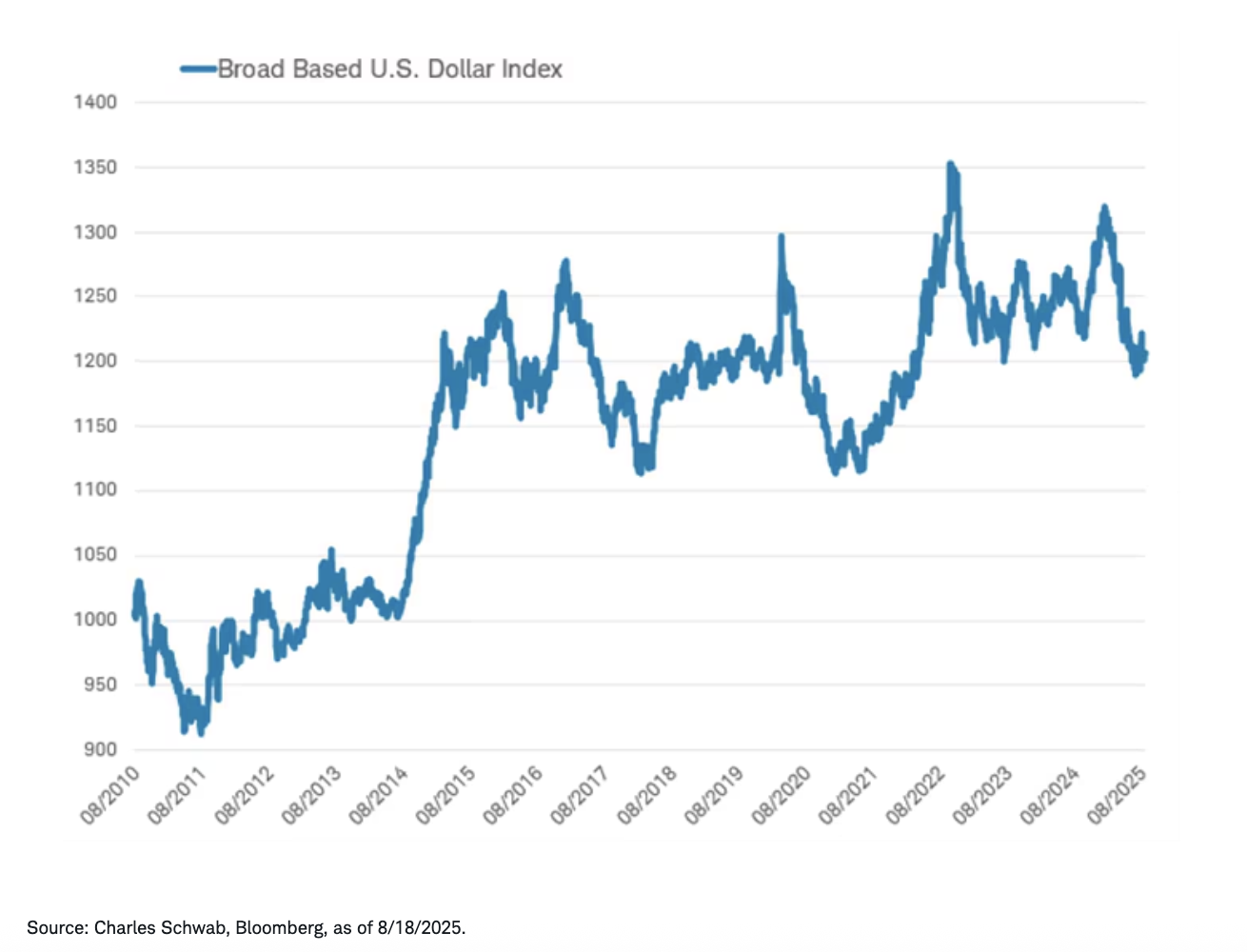
U.S. policy volatility and the prospect of slower U.S. economic growth resulted in a decline in the value of the U.S. dollar since the beginning of this year. Interest rates on government debt in the U.S. remain elevated relative to other countries; there is scope for this differential to continue to narrow, resulting in further weakness in the U.S. dollar. There is potential for narrowing should the Federal Reserve restart rate cuts while the European Central Bank appears to be at or near the end of its rate-cutting cycle, and as countries like Germany accelerate fiscal spending, reducing the gap between German and U.S. government bond yields.
The dollar has weakened but remains elevated

Chart shows the performance of the Bloomberg Dollar Spot Index, which tracks the performance of a basket of developed and emerging-market currencies against the U.S. dollar. Currencies are speculative, very volatile and not suitable for all investors. Indexes are unmanaged, do not incur management fees, costs and expenses, and cannot be invested in directly. Past performance is no guarantee of future results.
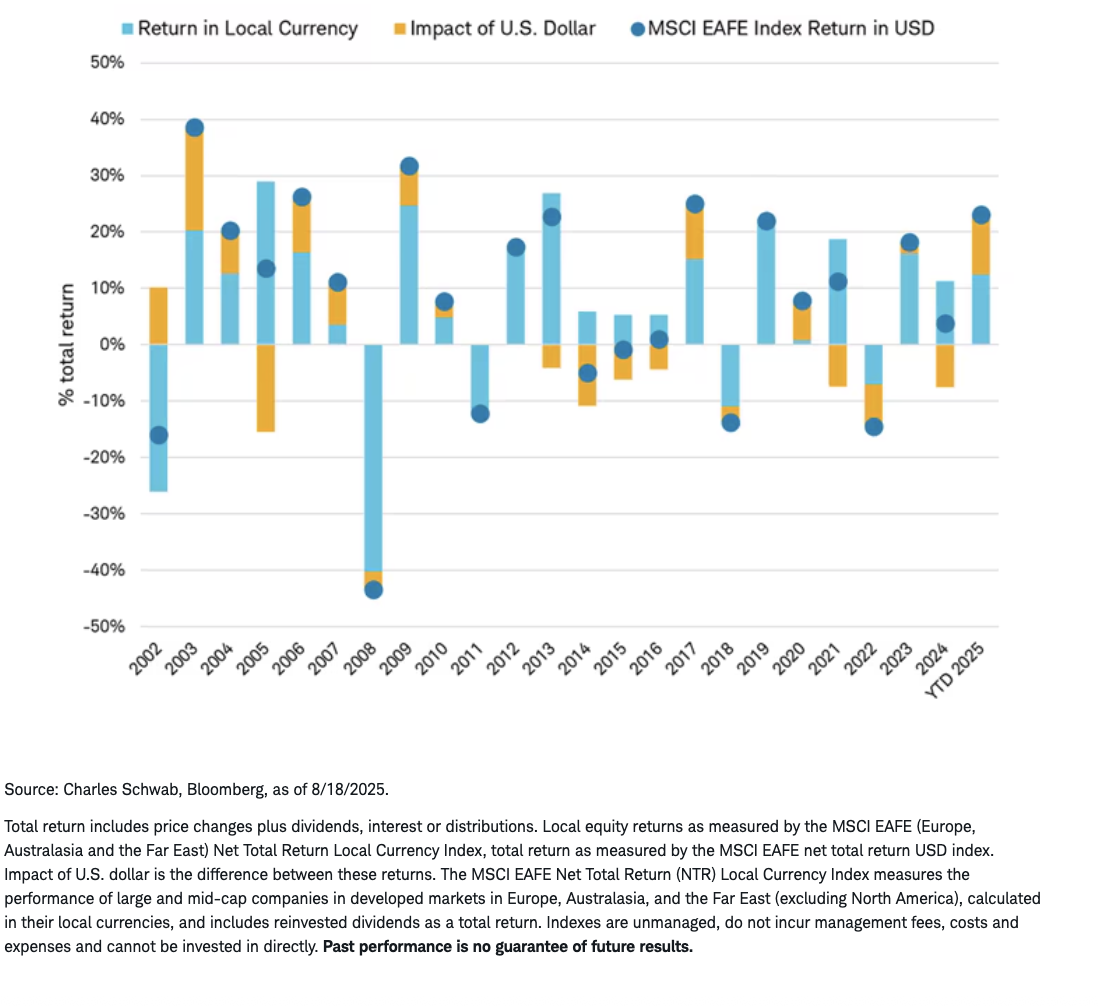
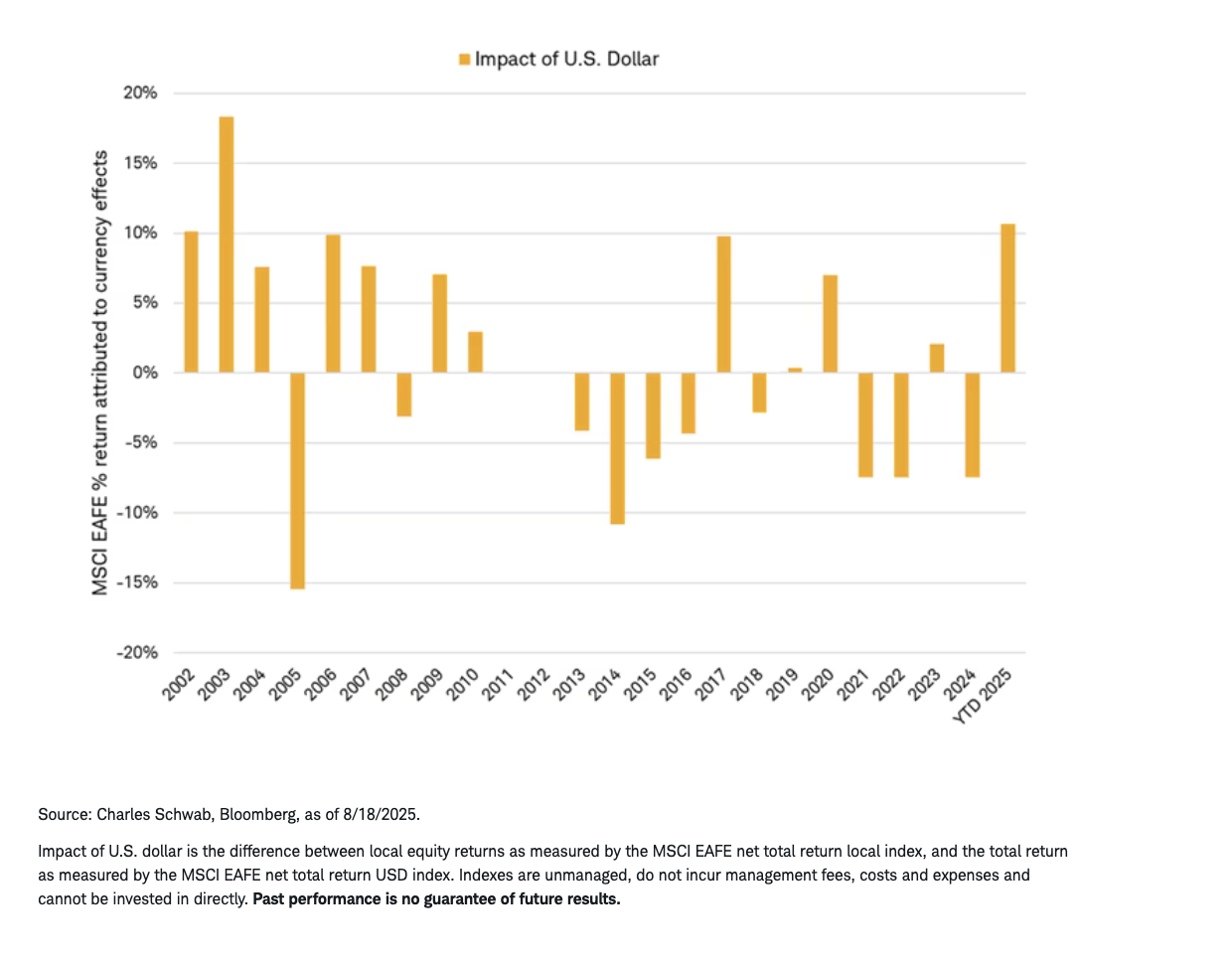
The mirror of a decline in the dollar is a stronger foreign currency. The effect of a stronger euro relative to the U.S. dollar means returns earned overseas in euros exchange into more dollars, which boosts returns for U.S. investors. However, the currency impact of the dollar has not always boosted international stock returns as it has this year, as you can see in the chart below.
Currency impact has added and subtracted from returns
From 2013 to 2024, currency exposure subtracted from international stock returns for eight of the 12 years; the dollar gained in value most of those calendar years. Prior to that dollar bull cycle, a weak dollar for the most part of 2002 to 2011 resulted in currency adding to international stock returns measured in U.S. dollars for seven of the nine calendar years.
Currency impact
Currency impact on earnings
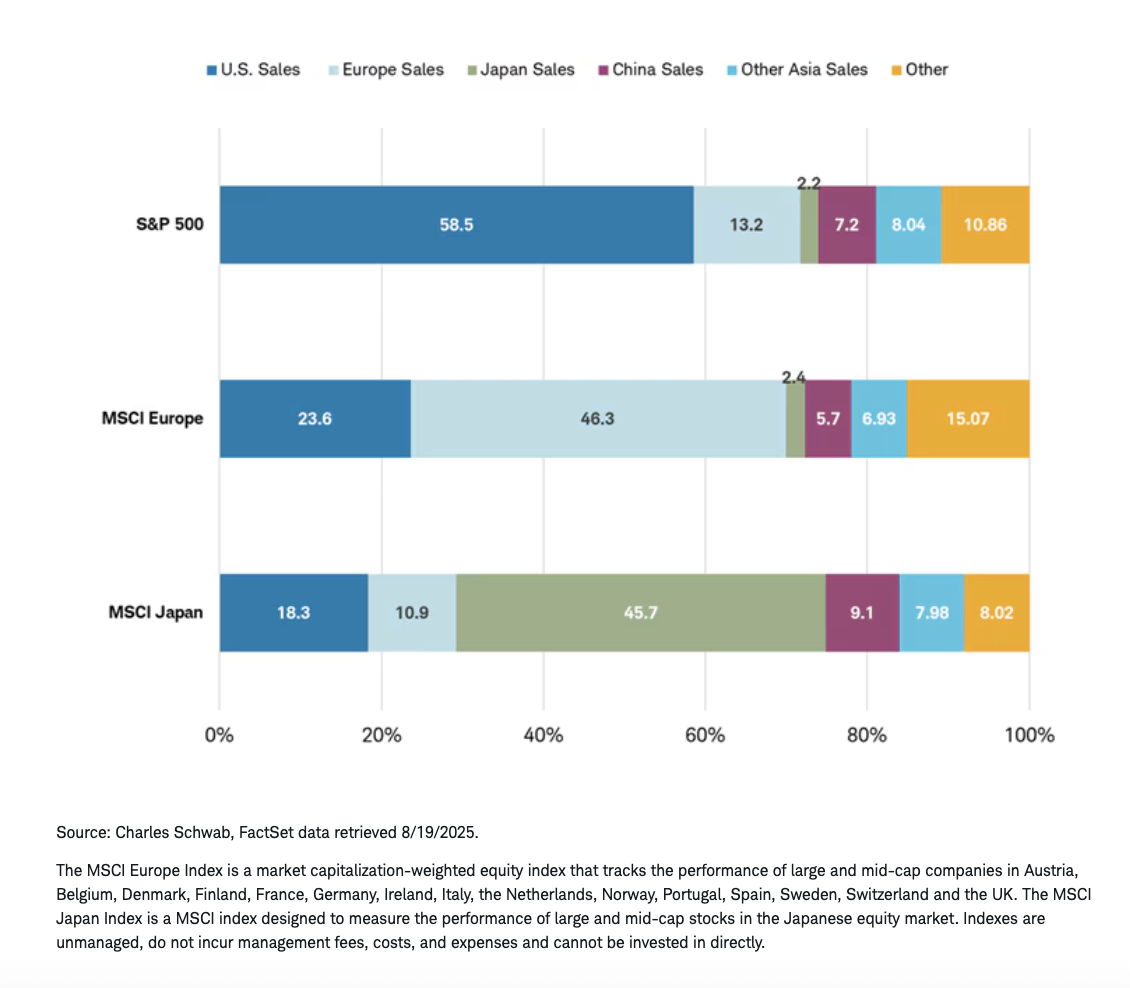
The impact of currency is not isolated to the geographic location where the stock trades. There is also an impact on sales and earnings of companies which do business outside of their domestic economy. A weaker dollar has the potential to reduce earnings for foreign companies that have a high percentage of sales and earnings generated in the U.S., as well as U.S. companies that have a large percentage of foreign sales and earnings. The size of these impacts could vary depending on the expense base of operations, as well as any currency hedging done by the company. This factor may be amplified for investors who invest in individual companies compared with those who utilize diversified funds where the impact is spread across many companies, sectors, and countries.
Geographic exposure by index
To hedge or not to hedge currency?
Part of the diversification benefit from investing internationally is currency exposure. By having exposure to multiple currencies, investors may be able to ride out the fluctuations in currency over the long term. However, currency fluctuations in the short term have tended to add volatility to investment returns. Investors may wonder if it makes sense to use exchange-traded funds (ETFs) that hedge currency exposure for them. This would be a tactical decision and requires the ability to predict the timing and trend of currency moves, which can be difficult due to the wide range of factors that can affect relative values.
Investment implications
During times of U.S. dollar weakness, U.S. investors have benefitted from keeping international stock investments unhedged to earn the extra return received from currency translation. If the dollar continues to weaken, investors may consider not hedging currency exposure. However, international stock returns for U.S. investors could be impacted negatively if the dollar pivots back to a strengthening cycle, during which investors may want to consider hedging currency. Investors in individual international stocks may want to also consider the currency exposure of those companies' operations, as a high percentage of sales and earnings coming from the U.S. could be undercut by a weaker dollar.
Investment and Insurance Products Are: Not FDIC Insured • Not Insured by Any Federal Government Agency • Not a Deposit or Other Obligation of, or Guaranteed by, the Bank or any of its Affiliates • Subject to Investment Risks, Including Possible Loss of Principal Amount Invested
The Charles Schwab Corporation provides a full range of brokerage, banking and financial advisory services through its operating subsidiaries. Its broker-dealer subsidiary, Charles Schwab & Co. Inc. (Member SIPC), and its affiliates offer investment services and products. Its banking subsidiary, Charles Schwab Bank, SSB (member FDIC and an Equal Housing Lender), provides deposit and lending services and products.
This site is designed for U.S. residents. Non-U.S. residents are subject to country-specific restrictions. Learn more about our services for non-U.S. residents, Charles Schwab Hong Kong clients, Charles Schwab U.K. clients.
© 2025 Charles Schwab & Co., Inc. All rights reserved. Member SIPC. Unauthorized access is prohibited. Usage will be monitored.
© Charles Schwab
Read more commentaries by Charles Schwab