Market volatility can feel like an emotional yo-yo: sudden drops, sharp rebounds, and the unsettling feeling of not knowing what’s next. Feeling anxious, unsettled, or even tempted to take swift action to protect your investments is natural. But often, the best move is the one you don’t make.
This is where behavioral finance comes into play. Behavioral finance studies the psychological and emotional forces that drive financial decisions, especially during uncertain times.
Understanding Behavioral Finance
Behavioral finance focuses on the intersection of psychology and investing. As a subfield of behavioral economics, it proposes that psychological influences and biases affect investors’ financial behaviors. Behavioral finance reveals that people are not always rational when it comes to money. Natural human emotions and instincts, like fear, can sometimes lead to decisions that conflict with long-term financial goals.
Some common tendencies that may affect investors include:
-
Loss Aversion: Investors often feel the pain of losses more intensely than the pleasure of gains, leading to decisions like selling during market downturns to avoid further losses.
-
Recency Bias: Recent market events tend to feel more significant and predictive of future performances than they actually are, causing investors to overweight what just happened.
-
Herd Mentality: When uncertainty is high, there’s a natural tendency to look to what others are doing for guidance, even when it contradicts sound investment principles.
These instincts are hardwired and powerful, but they do not have to drive your decision-making.
Keeping Calm
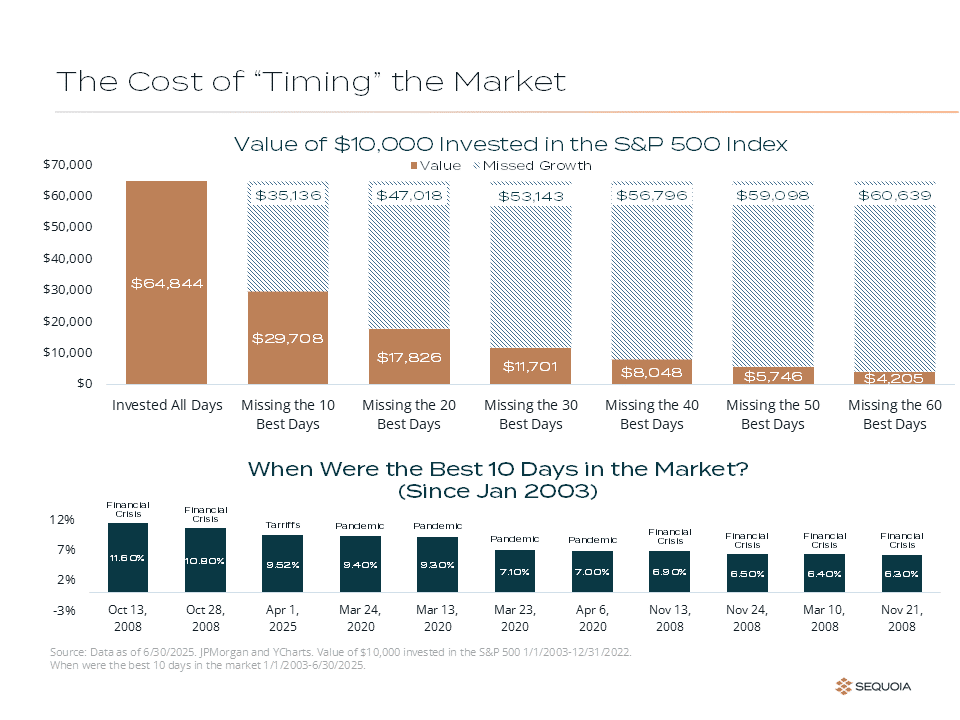
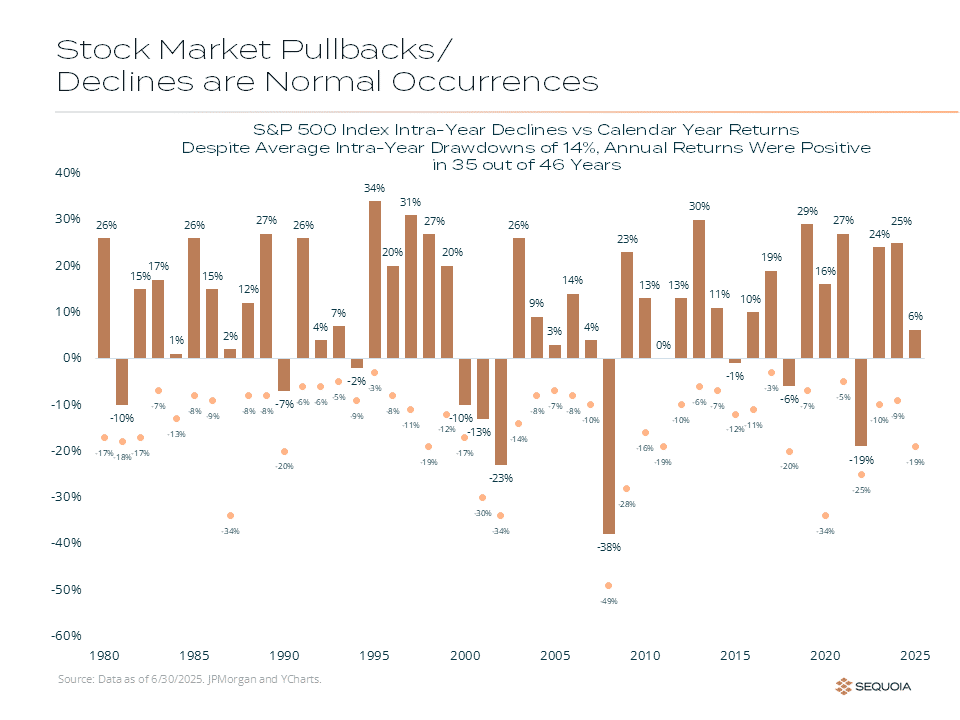
History has shown that markets recover. Staying invested and avoiding reactionary behaviors yields better results over the long term. Even though investment returns may decline during downturns, staying the course allows the investments to recover when the market rebounds, continuing to compound and grow.
The charts below demonstrate the value of staying invested in the market. While intra-year drops in the S&P 500 are quite common, annual returns have been positive 34 of the last 45 years.

During periods of volatility, it’s important to remember that your financial plan and its investment strategy are BUILT FOR YOU for the long term, with periods of volatility in mind. Today’s 24-hour news cycle can add stress and challenge your investment discipline. Try to tune out the noise to avoid making emotional decisions based on a headline of the moment.
Carrying On
Gratefully, you don’t have to weather uncertainty alone. Addressing anxiety and reaffirming financial goals are among the objectives we always seek to address in serving you. Additionally, as a fiduciary, the Sequoia team commits to always acting in your best interests. We’re honored to walk alongside you in your investment journey and understand that volatility is a human experience that carries many emotions unique to each individual. Our disciplined, diversified, research-based investment approach is designed to mitigate risk, capture global market returns, reduce fees, and drive toward tax efficiency to support the success of your wealth management plan.
This material is for informational purposes only and is not intended to serve as a substitute for personalized investment advice or as a recommendation or solicitation of any particular security, strategy or investment product. Diversification cannot assure profit or guarantee against loss. There is no guarantee that any investment will achieve its objectives, generate positive returns, or avoid losses. Sequoia Financial Advisors, LLC makes no representations or warranties with respect to the accuracy, reliability, or utility of information obtained from third-parties. Certain assumptions may have been made by these sources in compiling such information, and changes to assumptions may have material impact on the information presented in these materials. The tax and estate planning information offered by the advisor is general in nature. It is provided for informational purposes only and should not be construed as legal or tax advice. Always consult an attorney or tax professional regarding your specific legal or tax situation. Clients requesting tax return or estate preparation services are referred to a commonly-held affiliate, Sequoia Tax Services or a third party and not Sequoia Financial Group. Investment advisory services offered by Sequoia Financial Advisors, LLC, an SEC Registered Investment Advisor. Registration as an investment advisor does not imply a certain level of skill or training.
A message from Advisor Perspectives and VettaFi: To learn more about this and other topics, check out some of our webcasts.
© Sequoia Financial Group
More Fiduciary Rules Topics >