A Return to the 19th Century
Membership required
Membership is now required to use this feature. To learn more:
View Membership Benefits2nd Quarter, 2025
Barriers to open trade are rising across the world at a pace unseen in decades, a cascade of protectionism that harks back to the isolationist fervor that swept the globe in the 1930s and worsened the Great Depression.
Economists and historians say the flurry of recent moves suggest the world could be heading toward the largest, broadest surge in protectionist activity since the U.S. Smoot-Hawley Tariff Act of 1930 touched off a global retreat behind tariff walls that lasted until after World War II.
~ The Wall Street Journal, March 25, 2025
Investors have slashed holdings of US equities by the most on record, according to Bank of America Corp.’s latest survey, underscoring the massive rotation that’s underway in global markets.
While high valuations and tepid economic growth have made investors jittery about the US, European markets are riding a wave of newfound optimism with Germany getting ready to unlock billions in defense and infrastructure spending.
~ Bloomberg, March 18, 2025
Investors active today can be forgiven if the events of the past few months have been a bewildering experience. The sudden reintroduction of high tariffs on imported goods has brought policy tools back to life that have not been used since before World War II, more than ninety years ago. Yet even then, tariffs were fading as a preferred policy tool. The legacy of the Smoot-Harley Tariff Act of 1930 is forever stained by the Great Depression it helped deepen, and that traumatic experience marked the end of broad-based tariffs.
In order to return to a time when tariffs were viewed more favorably, more along the lines of how they appeared to be viewed by the new administration, we have to venture all the way back to the 19th century.
***
In the early 1800s, tariffs, or customs duties as they were then commonly known, were the primary source of revenue for the fledgling Federal Government. And while there were some notable departures during times of crisis, customs duties remained a primary source of revenue for the Federal Government throughout the 19th century.
When the constitution was adopted and the Treasury Department was first organized by Alexander Hamilton in the 1790s, duties on goods imported from abroad accounted for over 90% of the revenue of the Federal Government. The debate over powers of taxation had been a central issue during the Constitutional Convention, and the idea of direct taxation of citizens by the Federal Government remained a divisive issue.
During the Revolutionary War, efforts to raise funds from the states had failed, and the Continental Congress had resorted to printing Continental currency to pay the Continental Army. The printing of paper currency to cover government expenses in lieu of directly taxing citizens had been a common practice throughout the colonies in the early 1700s, and the restriction of the practice by Parliament in 1751 and 1764 had festered into a major grievance prior to the revolution. As with Continentals, most colonial paper currency issues in the 18th century ended up nearly worthless. Even so, the practice remained more popular than direct taxation.
By the Constitutional Convention in 1787, however, a century’s worth of traumatic experience with depreciating paper currencies was enough for the delegates to enshrine gold and silver coin as the basis for legal tender in Article I of the Constitution and the subsequent Coinage Act of 1792. Direct taxation remained such a divisive issue at the time that taxing imports with customs duties, which were paid by importers at ports of entry, proved to be the only politically palatable source of revenue for the Federal Government.
Thus, when the Treasury Department first began operating, revenue from such import duties represented the government’s entire operating budget.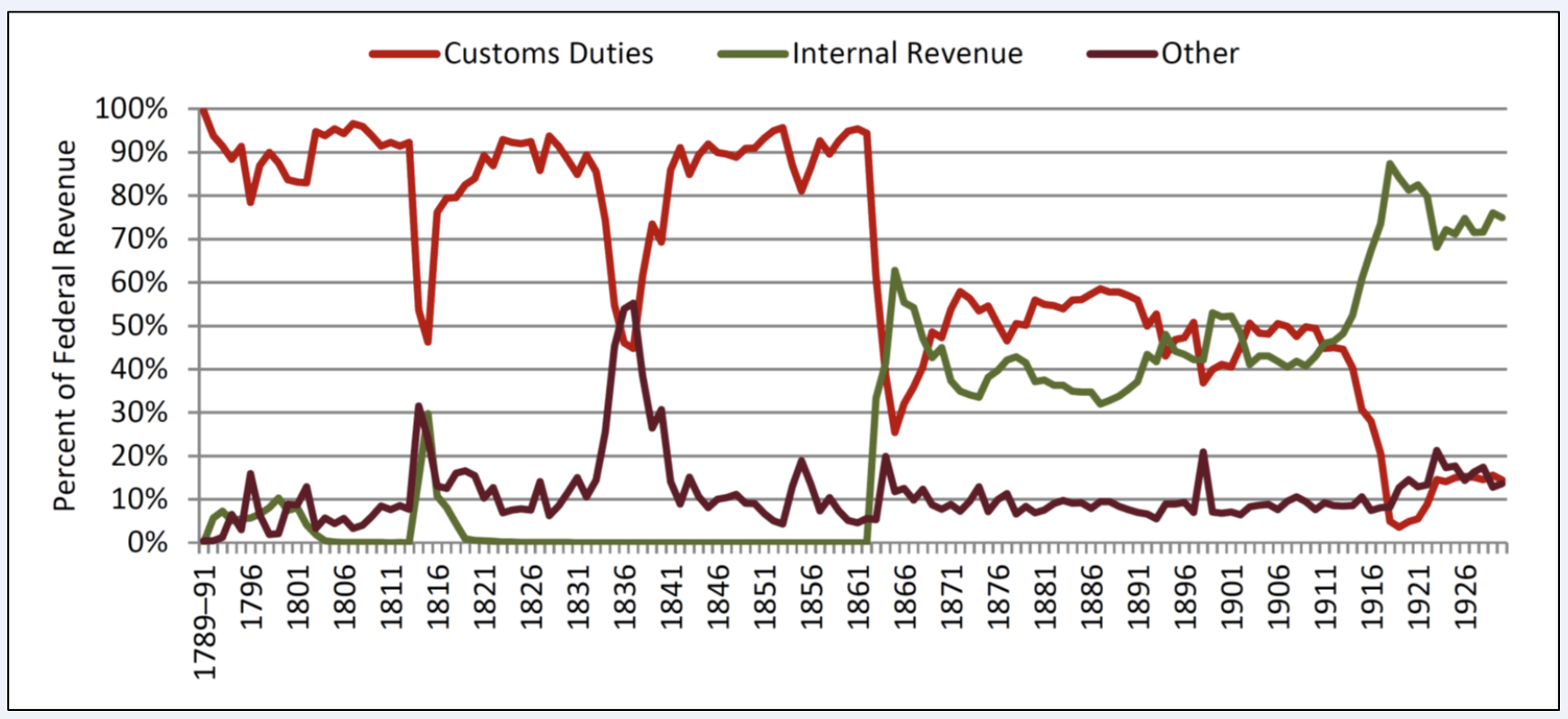
In the early 1800s, thinking about tariffs began to evolve. In addition to being the primary source of revenue for the Federal Government, the notion of using tariffs as a tool for achieving specific political and economic goals gained wider acceptance.
After the War of 1812, a consensus emerged in Congress that the U.S. was too reliant on Europe for manufactured goods. An early product of that consensus was the Tariff Act of 1816, which imposed a blanket 25% tariff on all imports. The burgeoning Protectionist movement wanted to reduce the country’s economic dependance on Europe, especially Britain, and the aim of the Act was to raise prices of imported raw materials and manufactured goods high enough to favor the rapid development of domestic sources of supply.
Thus, the Tariff Act of 1816 marked an important moment in the evolution of tariffs from a source of government revenue in lieu of direct taxation, to both a source of government revenue and a way to target domestic economic development.
In the following decades, a series of additional Tariff Acts in 1824, 1828, 1832, and 1842 raised and lowered tariff rates as protectionist and free-trade sentiments ebbed and flooded. The political jockeying between industrial interests in the northeast, agricultural interests in the south, and agricultural and mining interests in western states during these years was fierce. Each Act singled out specific goods to encourage domestic supply: cotton, wool, textiles, copper, iron, anthracite coal, carpet, hosiery, worsteds, and many more targeted. And amidst the political fray, periodic financial crises and economic depressions occasioned prohibitively high import tariffs, in an effort to raise revenue while protecting fledgling, but temporarily foundering, domestic industries.
The use of import tariffs as a revenue source and a precision tool to promote economic development continued through the rest of the 19th century. However, the crisis of the Civil War witnessed the introduction of new internal sources of revenue, including income taxes and taxes on liquor and tobacco. While income taxes were repealed after the war, the other internal taxes were maintained, and tariffs no longer represented the vast majority of government revenue as they had before the war.
Yet even while tariffs eventually became accepted by the public as part of the fabric of the economy, in the late 19th century tariffs began to be recognized among economists as a system of artificially high prices that were effectively a form of corporate welfare. Moreover, the tariffs represented a regressive tax on U.S. citizens. As the Gilded Age produced vast industrial fortunes in protected industries, a growing movement in the 1890s sought to shift the tax burden to less regressive sources.
The legislative pivot in taxation began with the passage of the 16th Amendment of the Constitution in 1913, which authorized the direct taxation of incomes. The coincident movement away from tariffs began with the Underwood-Simmons Tariff Act, which lowered import tariffs that same year.
While there were notable exceptions, such as the Smoot-Hawley Tariff Act at the beginning of the Great Depression, the trend toward free trade and increasingly sourcing federal government revenue from direct taxes on incomes continued for over a century.
Thus, as much as the 19th century was defined by protectionism and import duties, the 20th century came to be defined by free-trade and globalization as tariffs were phased out in favor of income taxes. By the turn of the millennium, average tariff rates had dropped from over 25% to near zero.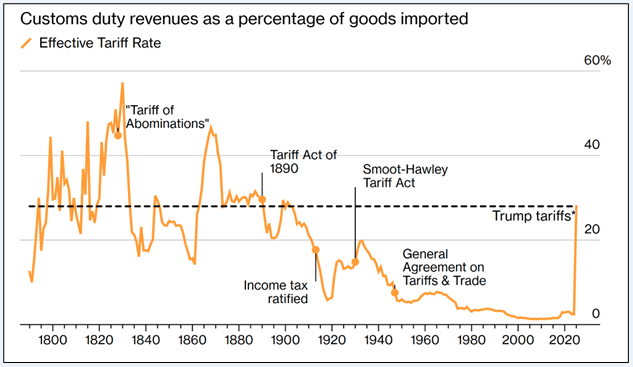
Yet with the tariffs being enacted this year, marked in the graphic above by an abrupt shift back to effective tariff rates last seen in the 19th century, we could be witnessing the last curtain call of the globalization era.
In this broader context, it is unfortunate that contemporary conversations about tariffs usually begin and end with the Smoot-Hawley Tariff Act. In many ways, the Smoot-Hawley Act represented the final gasp of a protectionist era that was drawing to a close in 1930. It also occurred at the onset of the Great Depression. Although the beggar-thy-neighbor trade war spawned by the Smoot-Hawley Tariff Act undoubtably worsened the downturn that had begun the previous year, the transition from recession to depression in the early 1930s was primarily driven by monetary factors, i.e. the Federal Reserve’s first Great Mistake. Monetary deflation was primary, tariffs were secondary.
As monetary conditions today are very different than they were in the early 1930s when the Smoot-Hawley Tariff Act was passed, and quite unrecognizable from the hard money standard of the late 19th century, from which Free Silver populism emerged, the response of the financial markets and the economy to the return of high tariff rates can be expected to be different as well.
Not surprisingly, the scale and abruptness of the new tariff regime resulted in immediate downward revisions for economic growth in the year ahead. These downward revisions could be seen in the real-time forecasts for real Gross Domestic Product growth in the first quarter, shown in the chart below on the left. The sudden drop seen in mid-February occurred after the tariffs were announced. The odds of a recession this year also increased substantially after the scale of the tariffs were known.
While the downward swings in forecasts of U.S. economic growth and the volatility in the stock market during the first quarter was dramatic, the pivots in surveys of inflation expectations could prove more consequential for investors in the years ahead. As can be seen in the chart below on the right, long-term inflation expectations are now increasing dramatically.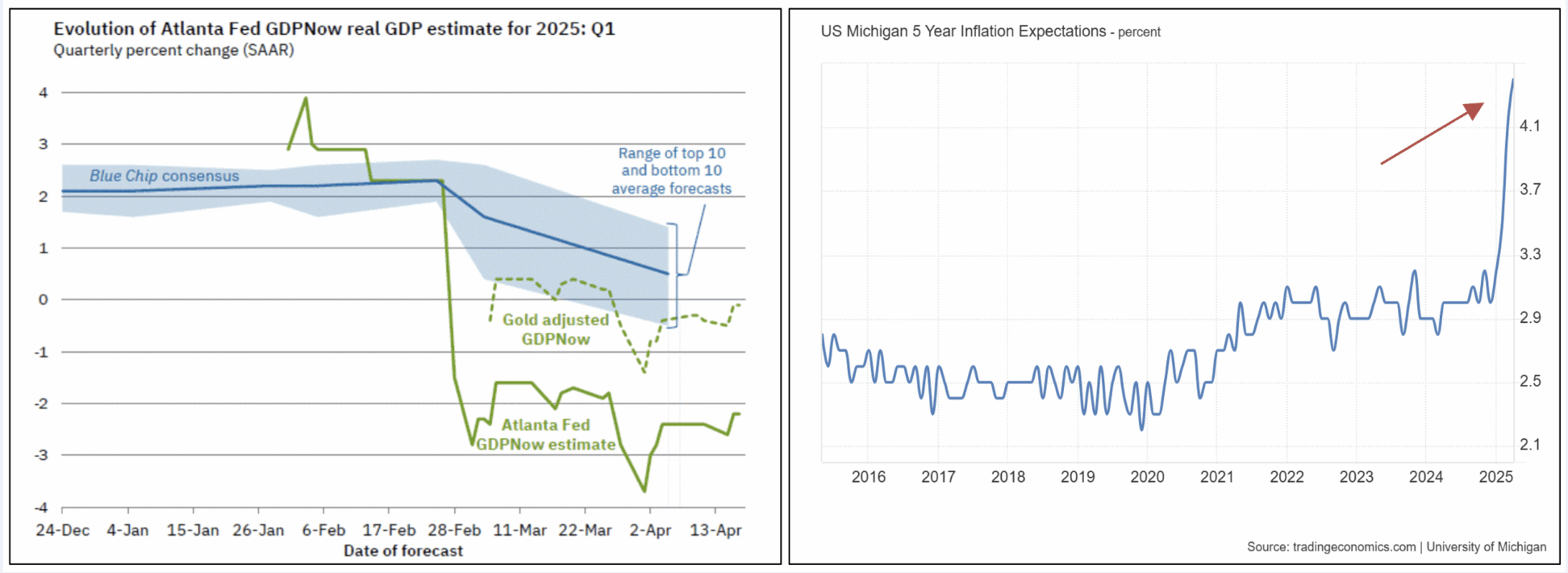
One of the lessons citizens of 19th century America learned was that while tariffs protected the interests of domestic producers of wool, cotton, textiles, metals, and every raw material and manufactured good which was targeted for protection, they also increased the prices consumers paid for both imported and domestically produced goods above what they would be otherwise.
Although a century has passed since widespread tariffs have been used, it seems – by the rapid increase in surveys of inflation expectations this year – that the cultural memory of the impact of tariffs on prices has not entirely faded. This cultural memory will likely have a significant impact on how the Federal Reserve responds to any conflict between the employment and stable prices parts of its dual mandate that emerges in the months and years ahead.
***
While we will see in the course of time how the Federal Reserve handles the conflicts presented by a slowing economy coupled with rising rates of inflation, it was abundantly clear that financial markets have already reached some initial conclusions.
The first quarter witnessed a significant financial outflow from the dollar and dollar-denominated financial assets, and a correspondingly large inflow into European and Asian markets. During this outflow, the U.S. dollar fell significantly against nearly every other major trading partner. The Euro, the British Pound, the Japanese Yen, the Canadian Dollar and others rose after the tariffs were announced. Equity markets denominated in those currencies rose significantly as well.
This initial reaction comes at a moment of vulnerability for the dollar, and a moment of value for equity outside the U.S, which is a topic we have discussed thoroughly over the past few years. The U.S. dollar rose throughout the 2010s (chart below, on the left) as capital flowed into the U.S., and this left other currencies, and their respective equity markets, significantly undervalued relative to U.S. markets (chart below, on the right). The degree of this undervaluation is such that even though markets such as Germany’s DAX rose more than 20% relative to the S&P 500 in the first quarter, the decline in the dollar and the recent outperformance of global equities barely registers in a long-term view of relative performance (green circles).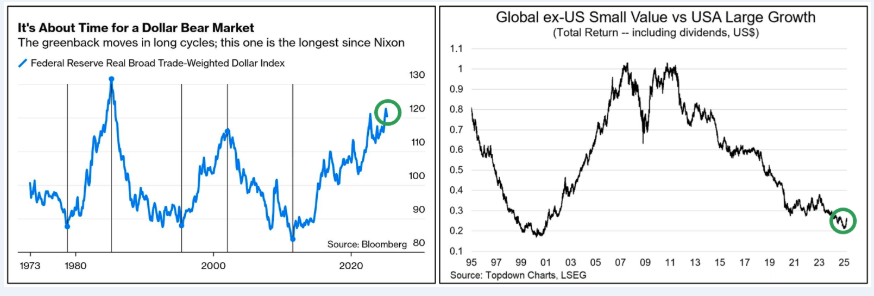
From a relative value viewpoint, the gains enjoyed by markets outside the U.S. in the first quarter have the potential to be just the beginning of a much larger cycle in the years ahead. As you can see in the charts above, these market cycles, once they establish some momentum, tend to last for a number of years.
One of the immediate reactions to the sudden return of tariffs has been a flight of capital toward domestic sources of supply all around the globe, and this was certainly in evidence in the first quarter. In Europe, the European Union passed a defense bill that represented the first significant departure from its staunch fiscal restraint during the post-Cold war era, in an effort to further develop its own defense industry. In Canada, the U.S.’s largest trading partner, a similar movement to distance itself from a dependance on U.S. imports and defense technology appears to be underway. And in Asia, it was notable that China, Japan, and South Korea held the first discussions in years during March and April to negotiate a trilateral free-trade agreement.
These developments, if carried forward and cemented, highlight a risk that while the imposition of tariffs could result in the onshoring of manufacturing in the U.S., it could also result in an offshoring of capital as global trade fragments and countries seek to secure their domestic and regional supplies of critical goods and raw materials. Such a departure of capital out of the U.S. dollar has been the overriding theme so far this year.
***
The issues surrounding tariffs will likely be a topic of much discussion in the quarters ahead, and we will certainly review the details of these new policies as the dust settles. The economic and financial impact of a pivot back toward 19th century tariff policies has likely only just begun.
In the meantime, the immediate impact of the policy changes over the past quarter has proven to be a welcome tailwind to many of the sectors and markets we are focused on, and we remain committed to maintaining investments and allocations which represent a compelling long-term value. As a recession now appears to be more likely than not in the year ahead, the policy dilemma between supporting growth and restraining tariff-induced price increases on top of already elevated inflation will likely pose a particularly difficult problem for the Federal Reserve. The rise of gold to another record over the past quarter could be a harbinger of that looming conflict.
***
The content of this article is provided as general information and is for educational purposes only. It is not intended to provide investment or other advice. This material is not to be construed as a recommendation or solicitation to buy or sell any security, financial product, instrument or to participate in any particular trading strategy. Not all securities, products or services described are available in all countries, and nothing herein constitutes an offer or solicitation of any securities, products or services in any jurisdiction where their offer or sale is not qualified or exempt from registration or otherwise legally permissible.
Although the material herein is based upon information considered reliable and up-to-date, Sitka Pacific Capital Management, LLC does not assure that this material is accurate, current, or complete, and it should not be relied upon as such. Content in this article may not be copied, reproduced, republished, or posted, in whole or in part, without prior written consent — which is usually gladly given, as long as its use includes clear and proper attribution. Contact us for more information.
© Sitka Pacific Capital Management, LLC
A message from Advisor Perspectives and VettaFi: To learn more about this and other topics, check out some of our webcasts.
Membership required
Membership is now required to use this feature. To learn more:
View Membership BenefitsSponsored Content
Upcoming Virtual Events View All












