Oh, how “great minds” can differ.
Actually, on at least one aspect of the Federal Open Market Committee’s (FOMC) seemingly inevitable move to hike interest rates, there is considerable agreement: The first 0.25%, or 0.50%, or even 0.75% move(s) in the federal funds rate will not make a material difference to US and global economies.
However, the debate continues to rage on the impact of beginning a new interest rate upward trend over the next several years, even though the Fed maintains it will be “measured and gradual.” (The historical norm for the effective Fed funds rate is around 4%.)
While we may all be getting tired of the “will they or won’t they” run-up to each Open Market Committee meeting, it is a pretty significant debate that has created passionate arguments on both sides. And that is not surprising: Never in modern US economic history has the Fed maintained a zero-interest-policy (ZIRP) stance for so long. And, the very first rate hike, minimal as it might be, would represent the first increase in the federal funds rate since 2006.
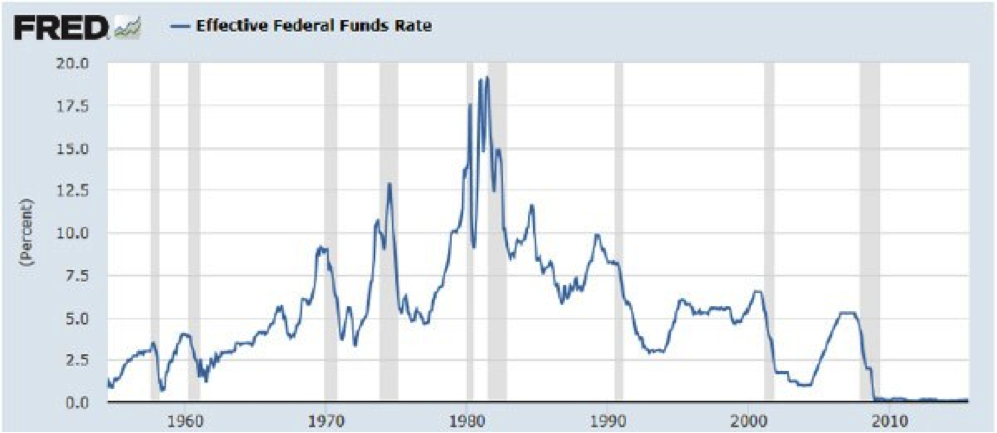
Source: St. Louis Fed, Board of Governors of the Federal Reserve System (U.S.)
On the one hand, it has been argued that the Great Recession of 2007-09 was a system-threatening and once-in-a- lifetime event, requiring drastic and sustained interest rate action on the part of the Fed. Also, as has been noted repeatedly, the US economy has had one of the weakest post-recession rebounds since World War II, despite the progress on the official unemployment rate.
But isn’t enough finally enough as it pertains to ZIRP? Isn’t the US economy resilient enough to handle some
normalization of rates at this time?
Not according to several outspoken figures.
IMF head Christine Lagarde has repeatedly said the Fed should not move on rates any earlier than 2016, believing the risks far outweigh any potential benefits, especially in the context of further Dollar appreciation. The IMF said early in September, “There are still too many risks to global growth. Advanced economies should continue to pursue ‘growth supportive policies’.”
Former US treasury secretary Lawrence Summers, professor and past president of Harvard University, said in an op-ed piece in late August, “Raising rates in the near future would be a serious error that would threaten all three of the Fed’s major objectives: price stability, full employment and financial stability.”
Ray Dalio, founder of giant investment firm Bridgewater Associates, voiced a consistently held opinion again in an interview with Bloomberg last Wednesday: “There is no good reason for a hike at this time. There are too many asymmetrical risks around the globe, especially in the debt and credit cycles. If anything, most central banks around the world should be lowering rates to overcome deflationary pressures.”
There are numerous equally impressive advocates for a “long overdue” rate increase in the investment world, academia, and think tanks. Perhaps some of the most persistent can be found on the FOMC itself, voting and non- voting members alike. Three members came out following last Thursday’s “no-decision” by the Fed, with varying points of view and the belief that a hike should likely still come at October’s meeting.
Federal Reserve Bank of St. Louis president James Bullard noted that the FOMC wants unemployment at its long- run level and inflation at the target rate of 2%, saying, “The Committee is about as close to meeting these objectives as it has ever been in the past 50 years. Even during normalization, the Fed’s highly accommodative policy will be
putting upward pressure on inflation, encouraging continued improvement in labor markets, and providing the best contribution to global growth that we can provide.”
So where does that leave Fed Chair Janet Yellen in the face of strong arguments on both sides?
The markets pronounced downward reaction this past Friday to September’s “stay put” announcement made the situation just a little bit muddier, with markets presumably saying they did not welcome further rate policy uncertainty. San Francisco Fed president John Williams, a long-time policy centrist, seemed mindful of global market reactions to any rate hike decision or non-decision. He said on Friday, “It was a close call in my mind, in part reflecting the conflicting signals we’re getting.” Williams acknowledged that there is a risk that US policy moves could profoundly affect markets abroad, in turn negatively detracting from the US recovery.
It seems only that two things are certain: 1) the October and December meetings of the FOMC will be “live,” meaning that there will have been no preordained decisions beforehand and 2) The Fed will continue to keep a close eye on both domestic and global market volatility and economic data, seeing emerging market volatility as a renewed threat to financial stability and global growth.
The following exhibit shows how selected nations’ economies have performed during the 2011-14 period, compared to pre-recession levels of 2002-08. Unfortunately for countries such as Russia, Brazil, and China, GDP performance for 2015 is predicted to fall short of even the 2011-14 average shown below, with Russia and Brazil lapsing into negative territory and many doubting China’s growth will be much more than 6%.
Selected nations’ year over year GDP rate of increase:
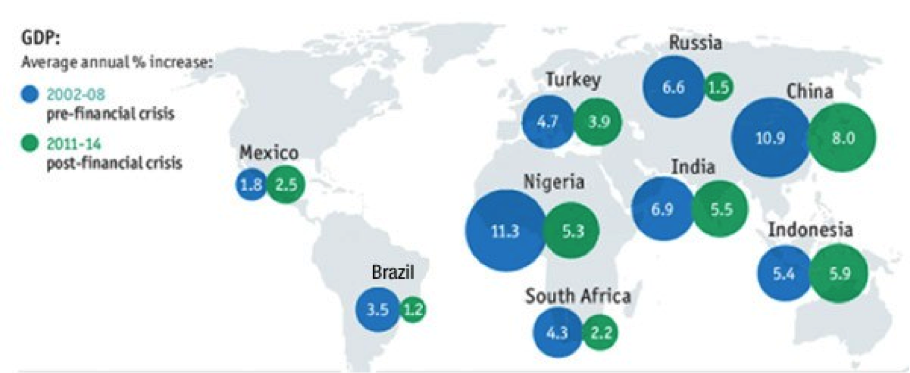
Sources: economist.com, IMF
Perhaps the most relevant comment coming out of all of the recent back and forth was found in Mr. Williams’ remarks, as he paraphrased noted physicist Niels Bohr, “It is difficult to make predictions, especially about the future.”
It is fair to say that the strategists at Flexible Plan Investments would generally agree with this statement. That is why FPI adopts a systematic, risk-managed, and quantitative approach to portfolio construction and implementation—evaluating trends, market direction, and the relative performance of asset classes as they happen in real time, not based on what “should be.”
So we will just have to wait and see how much that quarter point really does matter—knowing FPI’s strategically diversified portfolios are well prepared for whatever the investment environment may bring.
Have a great week.
http://www.flexibleplan.com/market-hotline/disclosures